
Camping set missing piece control works when the buyer defines one approved component baseline, gives every piece a visible counting position, and records exceptions before the set is closed. Do not rely on total piece count alone. Count by component family, place setting, shared module and storage position, then reconcile the packed set against the approved bill of components.
Camping set missing piece control starts with a baseline
A count cannot be audited until the program defines what belongs in one saleable set. The baseline should separate individual place-setting pieces from shared items, optional modules and packaging parts. A four-person set might contain four plates, four bowls and four cups, but only one cutlery roll, one divided container and one carry case.
The baseline is a procurement record, not a marketing number. “Twenty pieces” can describe several different configurations, so the buyer should approve the component name, quantity, revision and packing position. This is the foundation of camping set missing piece control. If the configuration changes, issue a new revision rather than editing an old card without traceability.
| Component family | Approved quantity | Count method | Exception rule |
|---|---|---|---|
| Individual plates, bowls and cups | One per user unless the specification states otherwise | Count by type and by place setting | A substituted size or shape is not an acceptable count match |
| Fork, spoon and knife groups | One complete group per user | Count utensils before closing the roll or cassette | Do not accept a correct total made from the wrong utensil mix |
| Shared serving or food modules | As listed in the approved component matrix | Count each module and its matching lid separately | An unmatched lid is an incomplete component |
| Carry case and removable inserts | One approved assembly | Confirm shell, insert, dividers and retention parts | A missing divider can make the set incomplete even if tableware count is correct |
| Optional add-ons | Only for the relevant sales configuration | Use a separate option line | Never mix optional pieces into the core-set count |

Use two counts, not one
The first count is the configuration count: does the set contain the correct types and quantities? The second is the pack-position count: is every approved piece in its assigned location? These checks find different errors. A loose spoon may satisfy the total count while still indicating that the cutlery cassette was not packed correctly.
For modular programs, add a third check for interfaces. A container and lid may both be present but belong to different revisions. Compatibility should therefore be confirmed against the approved sample and drawing, not inferred from appearance. For related design controls, see the published guide on which camping-set parts should be modular.
A practical missing-piece audit card
| Audit line | Expected evidence | Record at pack-back | Buyer decision |
|---|---|---|---|
| Set identity | Approved configuration name and revision | Revision used for this count | Accept only the released configuration |
| Component families | Quantity by plate, bowl, cup, utensil and shared item | Actual count by family | Investigate every variance; do not net shortages against extras |
| Matched parts | Container/lid and insert/case pairings | Pair confirmed or exception raised | Hold mismatched revisions for review |
| Condition boundary | Clean, dry and suitable for repack under the approved workflow | Condition exception, if any | Separate condition failure from quantity failure |
| Closure check | Case closes without forcing or loose movement | Closure and retention confirmed | Reject a count that only fits by changing the pack sequence |
| Sign-off | Named role and time of review | Reviewer and exception reference | Release, rework or hold |
Make missing positions visible
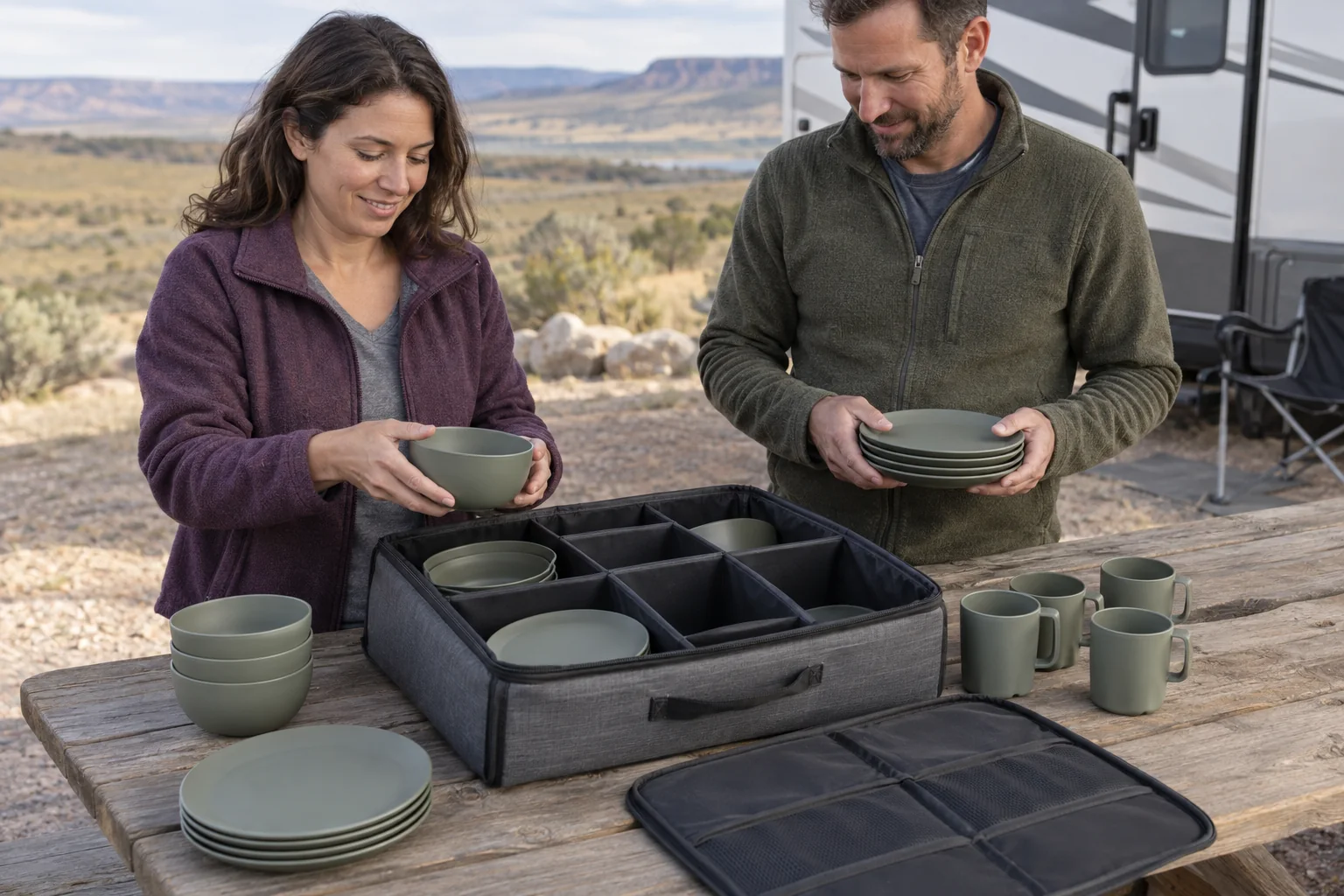
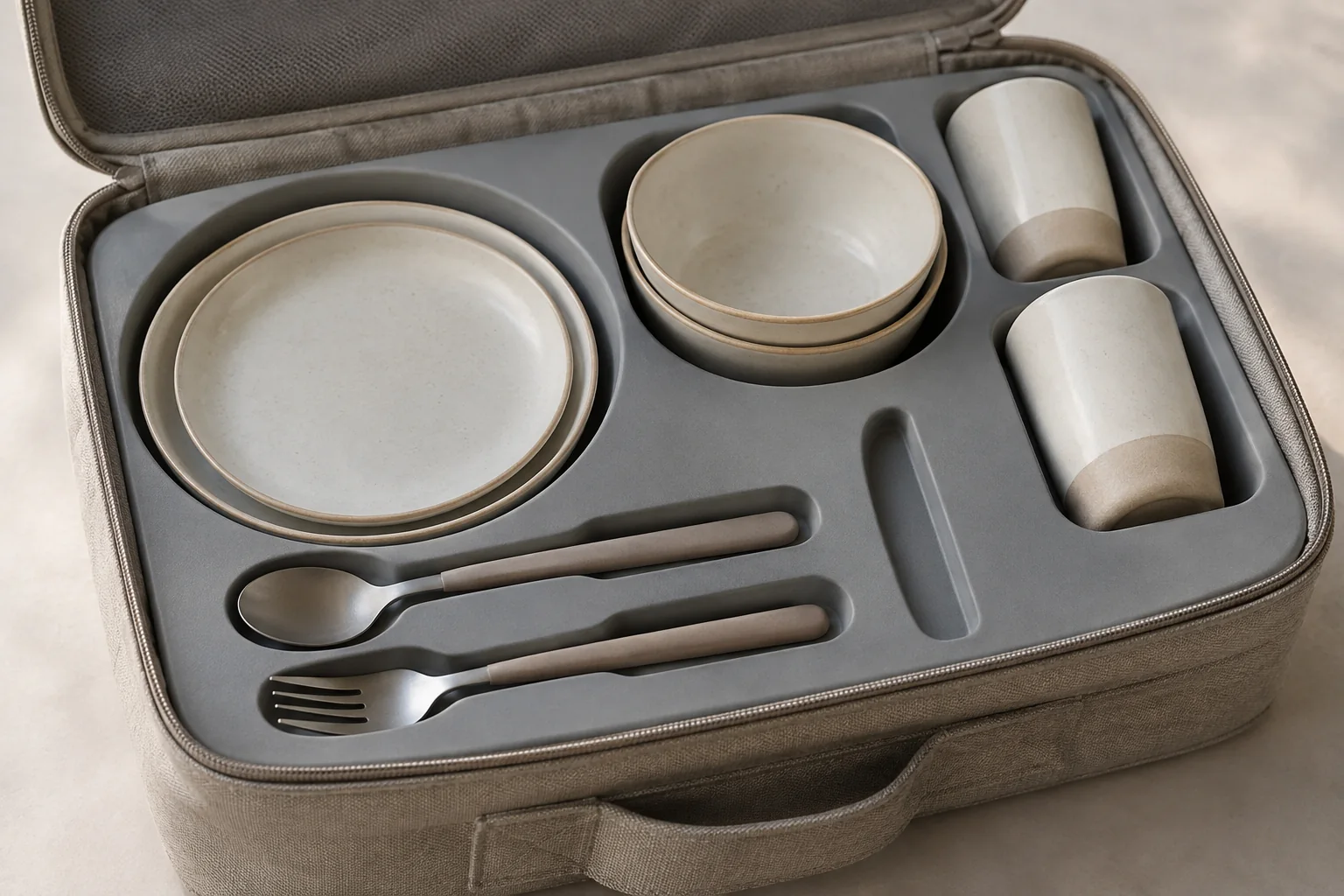
A visible empty position is faster to detect than a missing line in a long checklist. Molded trays, removable dividers, retained pockets or a simple packing diagram can give each component a defined home. Camping set missing piece control should remain understandable without relying on decorative labels that wear off or become ambiguous across languages.
However, dedicated cavities can reduce configuration flexibility. Buyers should decide whether the program values fast visual control or shared packaging across several set sizes. A flexible divider system may support more configurations, while a molded insert may make shortages easier to see. The correct choice depends on the channel’s return, replenishment and inspection workflow.
Count at the right control points
Counting only at final packing is too late for many failures. Use a baseline review when the set is approved, an assembly count when components are brought together, a pack-position count before closure and a return count after a field-use or sample-review cycle. The same component names should be used at every stage so camping set missing piece control remains consistent.
After outdoor use, quantity control should not override hygiene boundaries. Pieces that are wet, soiled or damaged need a separate disposition rather than being returned to the clean compartment merely to complete the count. The companion workflow on separating clean and used outdoor dinnerware explains that boundary.
For field programs, the USDA FSIS camping food-safety guidance and the CDC food-safety prevention guidance provide useful hygiene context. They do not define a product-specific count plan; the buyer still needs a written configuration and handling procedure.
Separate quantity failures from specification failures
A set can have the correct number of pieces and still be wrong. Common examples include a bowl from the wrong revision, a cup in an unapproved color, a lid that does not match its container or a divider installed in the wrong position. Effective camping set missing piece control therefore includes both quantity and identity fields.
Food-contact suitability also cannot be proven by counting. Market-specific declarations, test reports and conditions of use must be reviewed for the actual material and SKU. The FDA food-type and condition-of-use framework illustrates why a generic material name is not enough evidence for every application.
Choose the control level by channel
Retail sets usually need a simple, repeatable pack audit that protects shelf presentation and reduces incomplete returns. Rental, event and institutional programs often need faster turn-around counts, clearer user responsibility and a way to quarantine wet or damaged pieces. E-commerce programs should also consider the cost of replacement shipments when one low-value component is missing. In each channel, camping set missing piece control should match the actual release and return workflow.
A visual packing card may be enough for a stable configuration. A highly modular program may need a revision-controlled matrix and a barcode or system record managed outside the product page. This article does not prescribe a tracking technology; it defines the information that any tracking method must preserve.
B2B Buyer Checklist
| Check | Question | Why It Matters |
|---|---|---|
| Approved baseline | Does the document list every core, shared and optional component by revision? | Prevents total piece count from hiding the wrong mix. |
| Visible positions | Can a reviewer identify an empty position without unpacking every layer? | Reduces count time and supports rapid exception detection. |
| Matched interfaces | Are lids, containers, inserts and cases checked as compatible pairs? | Presence alone does not prove fit. |
| Condition separation | Can wet, used or damaged pieces be held apart from clean inventory? | A complete count must not compromise handling controls. |
| Revision control | Does a configuration change trigger a new audit-card revision? | Stops obsolete quantities from remaining in circulation. |
| Exception ownership | Who decides replacement, rework, hold or release? | Turns a count difference into a controlled buyer action. |
Frequently asked procurement questions
1. Is a total piece count enough?
No. Record quantity by component family and confirm the correct mix, revision and pack position.
2. Should lids count as separate pieces?
For audit purposes, yes, when a lid can be omitted or mismatched. The sales piece count can follow the approved commercial convention, but the operational audit should still verify the pair.
3. Are molded inserts always better?
No. They make empty positions visible but can reduce flexibility across configurations. Compare the control benefit with tooling, volume and revision implications before approval.
4. How should optional modules be handled?
Keep them on separate option lines and identify which commercial configuration includes them. Do not inflate the core baseline with add-ons.
5. What happens when a piece is present but damaged?
Record it as a condition exception, remove it from releasable inventory and follow the approved replacement or hold process.
6. When should the audit card be revised?
Revise it whenever component quantity, geometry, revision, packing position or option logic changes.
Request a component-count review
Send the intended user count, component matrix, shared modules, option logic, case drawing and pack-back workflow. Naike Dinner can use that brief to discuss camping set missing piece control, an existing-product combination or a project-specific sample and specification review without assuming unverified compatibility.
Request a specification review Review the pack-out instruction guide
For a written quotation, include the target market, material scope, artwork, packaging, intended use and evidence requirements through the Naike Dinner inquiry page.