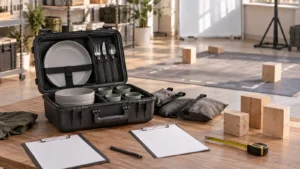
Direct answer: A camping tableware RFQ checklist becomes quotable when it identifies the controlled component list, quantities, material and use conditions, decoration, packaging, destination, commercial basis, evidence needs and approval path. Unknowns may remain, but each must be labelled, assigned to an owner and separated from the supplier inputs needed for a comparable quotation.
Use this camping tableware RFQ checklist as a buyer-side control tool. It does not promise a material, certification, price, MOQ, lead time, production method or product performance. Use project drawings, approved samples and destination-market advice to replace every open field.
RFQ release path
- Name the saleable set and intended user count.
- Freeze the component revision and quantity basis.
- Describe food use, cleaning and target market.
- Attach decoration and packaging requirements.
- State quotation terms, destination and exclusions.
- List evidence, sample and approval deliverables.
1. Start with one controlled camping tableware RFQ identity
Give the request a project code, revision, issue date and quotation deadline. State whether it covers one reference configuration or permitted alternatives. A supplier cannot normalize a request when the email subject, BOM, drawing and packaging brief describe different versions.
Link the request to a controlled component structure. The camping dinnerware BOM revision guide explains how to keep dinnerware, case and packaging changes under one release. If multiple suppliers will be compared, use the normalized quotation table to preserve identical scope.

2. Copy this complete camping tableware RFQ checklist
| RFQ field group | Buyer must provide | Acceptable open status | Quotation impact |
|---|---|---|---|
| Project control | Project code, revision, issue date, deadline and contact owner | None before release | Prevents mixed revisions and lost clarifications |
| Set definition | User count, component names, quantities and saleable unit | Optional components clearly marked | Defines the commercial denominator |
| Geometry | Drawings, target dimensions, fit interfaces or physical samples | Values marked “supplier proposal requested” | Separates priced scope from development scope |
| Material / finish | Requested material family, color, finish and food-use conditions | Alternatives allowed with declaration | Changes evidence, sampling and cost basis |
| Decoration | Logo artwork, location, colors, process constraints and approval method | Artwork pending with placeholder dimensions | Avoids hiding decoration setup or sampling |
| Carry system | Case type, loading direction, closure, handle and packed envelope | Compatibility to be confirmed by project sample and drawing. | Controls fit, assembly and pack-out questions |
| Packaging | Unit pack, inserts, labels, manuals, carton marks and channel needs | Packaging concept requested as a separate option | Prevents a bare-product quote being compared with retail-ready scope |
| Quantity basis | Quote quantity, forecast range, sample quantity and replacement mix | Scenario quantities listed separately | Allows comparable breaks without invented MOQ |
| Destination / terms | Country, named place, requested Incoterm rule and currency | Two named commercial scenarios | Exposes included and excluded logistics |
| Evidence | Target market, food-contact use, documents, tests and approval records required | Buyer requests an evidence-gap response | Prevents blanket compliance wording |
| Timing | Target sample review and launch windows | Supplier returns a project schedule after scope review | Keeps the request from becoming an unsupported lead-time promise |
3. The BOM must describe counts, not only product names
In the camping tableware RFQ checklist, the BOM is the commercial denominator: every quoted scenario must point to the same controlled component count.
“Four-person camping set” is not a sufficient line item. State whether one saleable set contains four plates, four bowls, four cups, four knives, four forks and four spoons, or another configuration. Keep the lunch box, storage case, instructions and protective packaging on separate lines. Mark buyer-supplied and supplier-proposed components explicitly.
Replacement pieces also need their own quantities and purpose. Saleable spares, service spares and production overage have different commercial treatment. The camping dinnerware landed-cost model shows why combining them with base-set units hides the later decision.
4. Use-condition fields turn vague material requests into reviewable inputs

| Input | Buyer question | Evidence boundary |
|---|---|---|
| Food type | What food or beverage may contact each component? | Do not generalize one component’s evidence to the full set |
| Temperature / duration | What contact conditions are intended? | Do not infer microwave, oven or cookware use |
| Cleaning | Hand wash, dishwasher review or another defined method? | Cleaning claims require project evidence |
| Target market | Where will the finished set be supplied? | Evidence scope follows the finished article and destination |
| Decoration | Where are inks, labels or coatings relative to food contact? | Review the finished decorated component |
The US FDA food-contact notification inventory and the European Commission food-contact materials overview are primary starting points for defining questions; neither page certifies an unspecified camping tableware set.
5. Packaging must be a quotable workstream
The camping tableware RFQ checklist should keep the carry system, retail presentation and transport packaging as separate review fields.
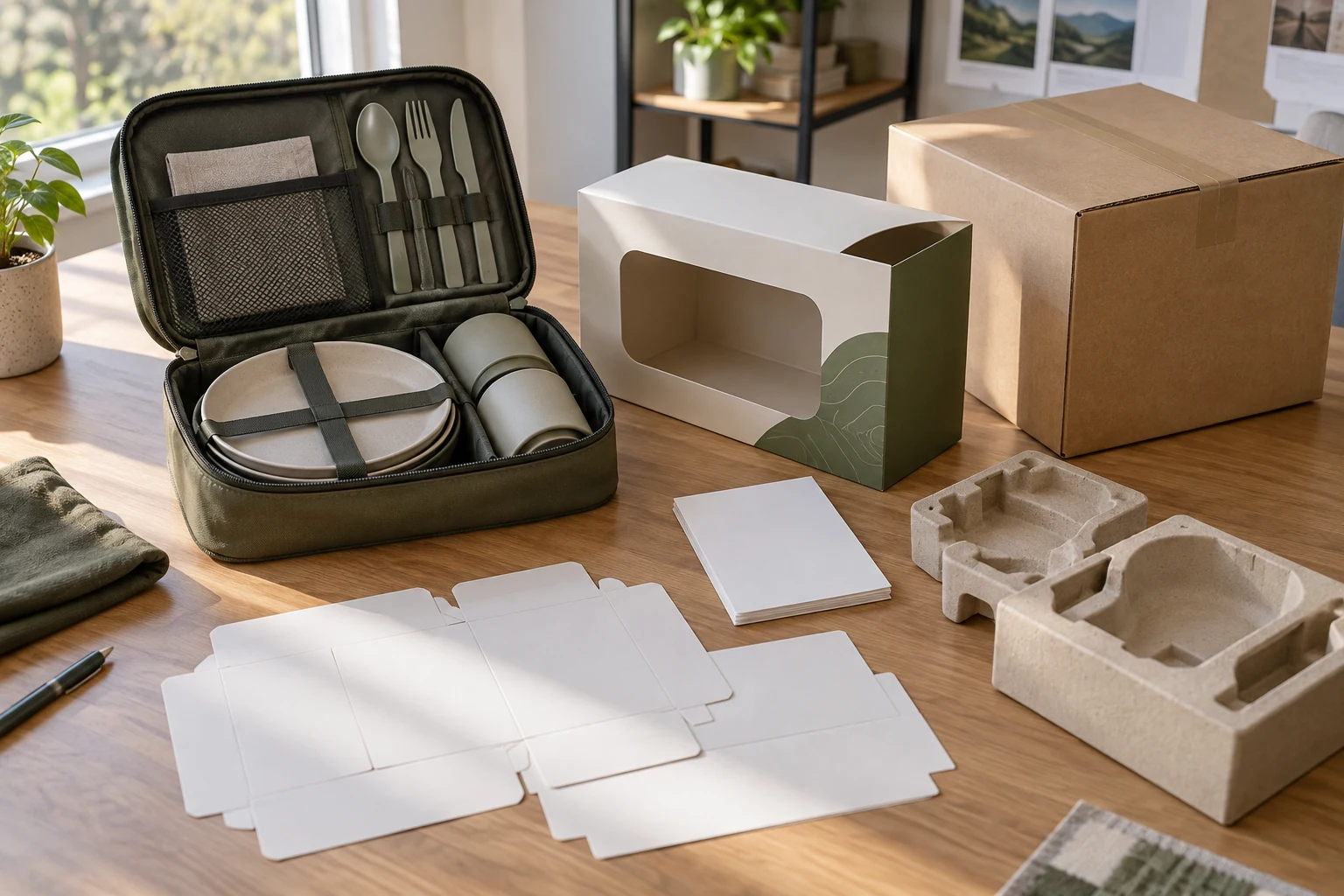
List the carry case separately from the retail or transport pack. Include the intended loading sequence, protective contact points, unit presentation, label/artwork responsibility, instruction language, master-carton marks and destination handling needs. If the packaging design is not frozen, request a separate development option instead of asking the supplier to absorb an undefined scope.
6. Commercial terms need a named place and exclusion list
Write the requested Incoterm rule with its named place and edition, then ask the supplier to state inclusions and exclusions. The ICC Incoterms rules allocate delivery responsibilities, costs and risks; they do not define product specification, tariff classification or regulatory evidence. The World Customs Organization Harmonized System overview explains the classification framework, but the responsible party must review the finished shipment and destination rules.
7. Quote-return matrix
| Supplier must return | Required format | Buyer acceptance test |
|---|---|---|
| Line-item quotation | Base set, optional components, decoration, case, packaging and development separated | Every cost maps to the same RFQ revision |
| Assumptions / exclusions | One explicit list | No silent material, component or packaging substitution |
| Open-question log | Question, owner, due date and price/schedule effect | Blocking items visible before comparison |
| Evidence matrix | Document/test, finished component, market, status and gap | No blanket certificate claim |
| Sample plan | Sample type, controlled revision, review items and approval owner | Sample purpose is not confused with production release |
| Schedule basis | Dependencies and buyer approvals, not only one date | Timing remains conditional on defined inputs |
8. Quotability gate and approval record
Release the camping tableware RFQ checklist only after the owner can distinguish fixed inputs, permitted alternatives and unanswered questions.
| Gate | Pass condition | If not passed |
|---|---|---|
| Scope identity | One project code and revision across all files | Return for document alignment |
| Component count | Saleable unit and each component quantity stated | Ask buyer to freeze BOM basis |
| Interfaces | Drawings, samples or proposal responsibility identified | Price development separately |
| Use and market | Food use, cleaning and destination stated | Evidence scope remains open |
| Commercial basis | Quantity, currency, Incoterm and named place stated | Quote only defined scenarios |
| Packaging | Carry, unit and transport packaging distinguished | Return separate assumptions/options |
| Approval path | Owners and acceptance records assigned | Do not treat sample feedback as release |
Buyer checklist
| Send | Require back | Approve |
|---|---|---|
| Controlled RFQ, BOM, drawings, artwork and packaging brief | Line-item quote, assumptions, exclusions and alternatives | Common revision and saleable-unit definition |
| Use conditions, market, evidence needs and named destination | Evidence-gap matrix and open-question log | Material/evidence scope and responsible owners |
| Quantity scenarios, sample purpose and timing window | Conditional sample plan and schedule dependencies | Quote comparison record and next action |
FAQ
Must every RFQ field be final before quotation?
No. A supplier can price defined scenarios when unknowns are labelled and the proposal responsibility is clear. Hidden or contradictory unknowns make comparison unreliable.
Can the buyer request material alternatives?
Yes. State the intended use, market and decision criteria, then require each alternative to declare its component, finish, evidence scope and price impact.
Should MOQ and lead time be inserted into the RFQ template?
No invented values should be inserted. Ask the supplier to return project-specific quantity and timing terms after reviewing the controlled scope.
Is a product photo enough to quote a carry case?
Usually not. Component envelopes, loading sequence, retention interfaces, closure, packed size and compatibility need drawings or sample review.
What makes two quotes comparable?
A shared camping tableware RFQ checklist: the same revision, component count, material/evidence assumptions, decoration, packaging, quantity, currency and commercial boundary.
Request an RFQ completeness review
Send the camping tableware RFQ checklist, controlled BOM, drawings or component samples, use conditions, destination, decoration and packaging brief. Naike can mark missing product inputs and return a structured clarification list before quotation.
Request an RFQ review · Send BOM and drawings · Discuss packaging scope
Reviewed . Evidence scope: RFQ completeness and cited primary guidance; all commercial and technical values remain project-specific.