Direct answer: Calculate camping dinnerware landed cost from buyer-entered quantities and verified shipment data. Keep base sets, saleable replacement parts, free service spares, freight, insurance, duty, brokerage and destination charges on separate lines. Allocate shared charges with one declared basis, then divide by saleable units—not by every physical piece in the shipment.
This model is a decision worksheet, not a quotation and not customs advice. It states no Naike price, MOQ, duty rate, freight rate, lead time or product capability. Replace every blank with project evidence from the supplier, forwarder, broker and destination authority.
Decision path
- Freeze the saleable unit and shipment scenario.
- Separate replacement inventory from base sets.
- Enter verified origin-to-destination charges.
- Choose and document each allocation basis.
- Calculate unit, channel and replenishment views.
- Release assumptions with an owner and evidence date.
1. Define the denominator before calculating landed cost
The denominator should match the commercial decision. For a retail launch it may be the number of complete saleable sets. For service planning it may be the number of replacement bowls or cutlery packs. Do not divide the total shipment cost by a combined count of sets and spare pieces: that hides how much capital and logistics cost belong to replacement inventory.
Start from the approved BOM and quote boundary. Use the camping set cost breakdown worksheet to expose the product scope, the normalized quotation table to align supplier offers, and the BOM revision guide to keep quantities tied to one release.
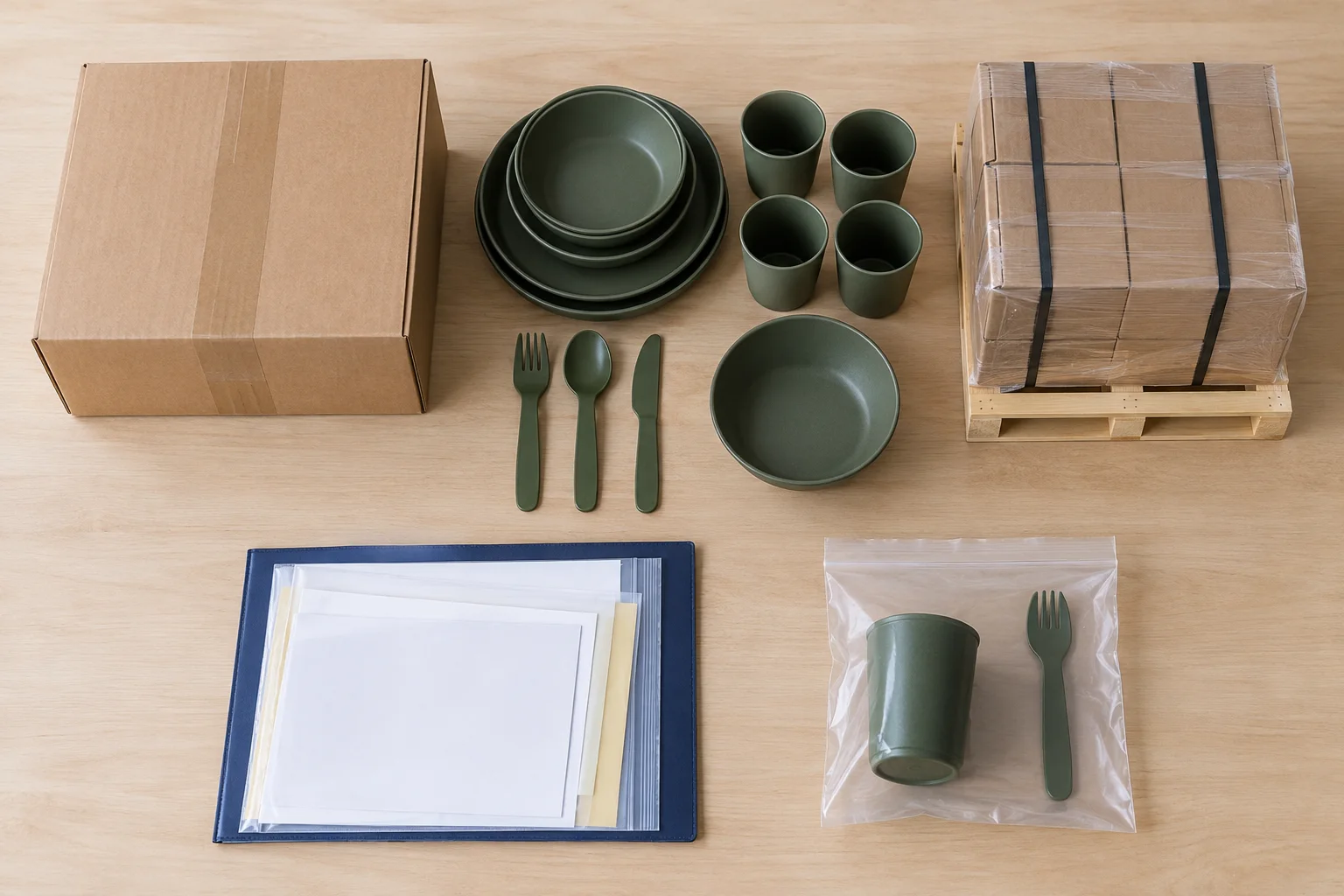
2. Copy this camping dinnerware landed cost model
The camping dinnerware landed cost model below keeps the supplier value, evidence source and allocation method together so a buyer can audit every entered number.
| Line | Buyer input | Evidence / source | Allocation treatment |
|---|---|---|---|
| Base sets | Quantity × verified unit value | Approved quotation and BOM revision | Direct to saleable sets |
| Saleable replacement parts | Part quantity × verified unit value | Replacement-parts quotation | Direct to replacement inventory |
| Free service spares | Quantity and customs value treatment | Commercial invoice and broker instruction | Separate pool; never assume zero customs value |
| Export pack / origin charges | Verified supplier or forwarder values | Quote, booking or invoice | Direct or shared by declared basis |
| Main freight and insurance | Verified shipment amount | Forwarder quote or invoice | Allocate by chargeable weight, volume or another recorded basis |
| Duty and import taxes | Destination-specific verified values | Broker calculation and official tariff source | Follow legal calculation; do not use a generic percentage |
| Brokerage / port / terminal | Verified destination charges | Broker, carrier or terminal document | Shipment-level shared cost |
| Inland delivery / receiving | Verified destination movement and handling | Carrier quote, warehouse record | Allocate by pallets, cartons, weight or units as documented |
| Contingency | Buyer-approved scenario value | Finance assumption record | Show separately; never present as supplier price |
3. Use the camping dinnerware landed cost formula without hiding spare parts
Shipment landed cost = entered product values + entered origin charges + freight + insurance + destination-assessed duty/tax + brokerage/terminal + inland delivery + receiving + approved contingency.
Base-set landed cost = direct base-set value + allocated shared logistics assigned to base sets ÷ number of saleable base sets.
Replacement-part landed cost = direct replacement value + allocated shared logistics assigned to that replacement pool ÷ saleable replacement units.
Keep the allocation driver beside the camping dinnerware landed cost result. Weight may be suitable for one charge, occupied volume for another, and declared value for an insurance allocation. A single allocation rule across every charge is convenient but may distort the result.
4. Replacement parts need three separate statuses
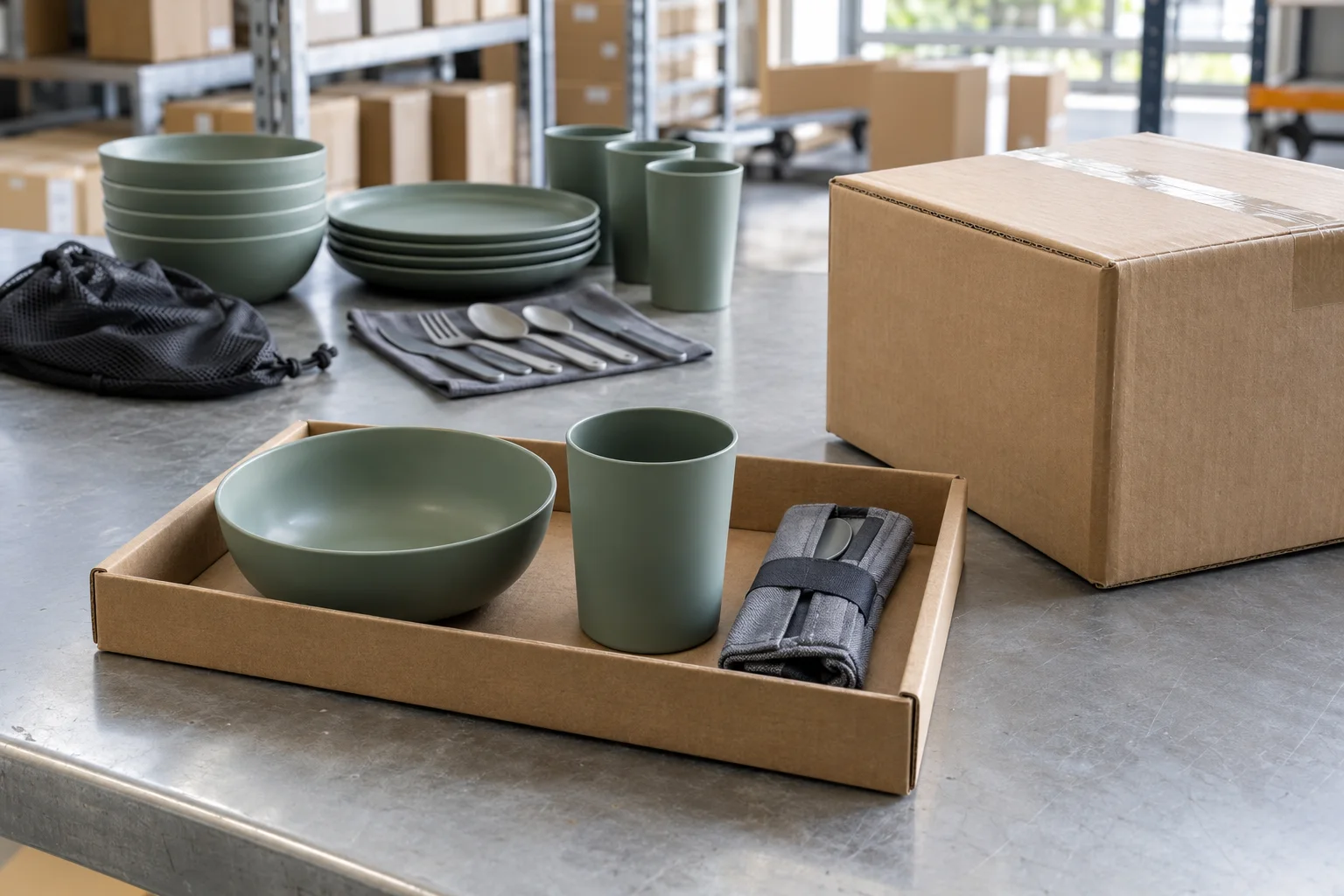
| Status | Buyer decision | Cost treatment | Risk if hidden |
|---|---|---|---|
| Saleable replacement | Will be stocked and sold separately | Own SKU-level landed cost | Margin appears better than it is |
| Warranty / service spare | Held for no-charge replacement | Service reserve or program cost | After-sales expense disappears |
| Production overage | Unreleased until inspection and ownership are confirmed | Open item, not automatically free stock | Inventory and customs records diverge |
Also record whether replacement pieces share the final-set material, color, finish, decoration and evidence scope. Compatibility to be confirmed by project sample and drawing.
5. Camping dinnerware landed cost scenario table
| Scenario input | Base case | High case | Approval note |
|---|---|---|---|
| Saleable set quantity | Buyer enters | Buyer enters | Same BOM and pack revision |
| Replacement mix and quantity | Buyer enters | Buyer enters | Separate saleable and service pools |
| Chargeable weight / volume | Forwarder enters | Forwarder enters | Use approved pack-out data |
| Freight and destination charges | Verified quote | Stress assumption | Record validity date and exclusions |
| Classification / duty basis | Broker-reviewed | Alternate reviewed | Record authority and rationale |
| Damage / service reserve | Finance enters | Finance enters | Not a product-performance claim |
6. Evidence boundaries for freight, value and classification
The ICC Incoterms rules identify delivery, cost and risk responsibilities; they do not determine tariff classification or the product BOM. The World Customs Organization Harmonized System overview explains the classification framework. The WTO customs valuation overview explains the international valuation framework. Apply destination-country rules with the responsible broker or authority.
For volume inputs, use the final approved pack-out rather than an early design estimate. The camping tableware pack-volume worksheet separates component volume from actual packed-carton measurements.
7. Camping dinnerware landed cost approval record
| Approval question | Pass condition | Owner / evidence |
|---|---|---|
| Are set and replacement quantities separate? | Separate lines and inventory purpose | Purchasing / PO and BOM |
| Is the commercial boundary explicit? | Incoterm, named place and exclusions recorded | Purchasing / supplier quote |
| Are pack measurements final? | Approved carton count, dimensions and weight | Packaging / pack-out record |
| Are classification and value reviewed? | Destination-specific rationale retained | Broker / classification file |
| Are allocation drivers visible? | Each shared charge has a named driver | Finance / model revision |
| Can receiving reproduce the result? | Invoice, freight and receiving variances reconciled | Logistics / close-out sheet |
Buyer checklist
| Send / collect | Calculate | Approve |
|---|---|---|
| BOM, set quantity, replacement mix, pack-out and destination | Direct values and shared shipment charges in separate pools | Denominator and allocation driver for every result |
| Supplier quote, forwarder quote, broker review and authority links | Base, high and replenishment scenarios | Evidence date, validity, exclusions and owner |
| Receiving invoice, final freight and quantity variance | Actual-versus-model variance after arrival | Updated cost for the next purchasing decision |
FAQ
Should free service spares have zero landed cost?
No automatic assumption is safe. Record commercial value, customs treatment, logistics allocation and internal service use separately, then follow destination-specific requirements.
Can duty be estimated with one internet rate?
No. Classification, origin, valuation, destination and current measures can change the result. Use an official source and responsible broker review for the shipment.
Should freight be allocated by unit count?
Only when that driver is reasonable and documented. Weight, volume, pallet position or value may better represent a particular shared charge.
When should the model be updated?
At quotation comparison, booking, pre-shipment pack approval and receiving close-out. Keep planned and actual values as separate revisions.
Request a landed-cost input review
Send the controlled BOM, set and replacement quantities, case and packaging scope, approved pack-out, destination and commercial basis. Naike can identify missing product inputs while freight, classification, duty and tax decisions remain with the buyer’s responsible logistics and customs parties.
Request an input review · Send the BOM and spare mix · Discuss pack-out scope
Reviewed . Evidence scope: buyer decision model and cited primary guidance; every commercial value remains project-specific.