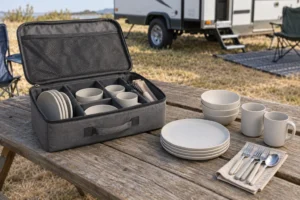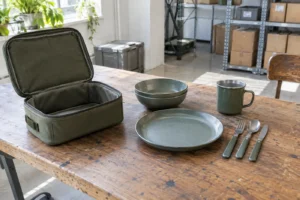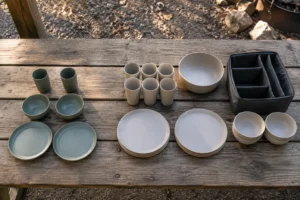
Choose PP when low unit weight, colour flexibility and quieter handling are central to the program. Choose stainless steel when buyers prioritize a rigid feel, metallic presentation and resistance to ordinary edge deformation. Neither material wins every requirement. Compare finished components under the same food, cleaning, packing and channel conditions before approving a camping dinnerware system.
Compare complete systems, not material labels
A PP vs stainless steel camping dinnerware comparison becomes useful only when the component roles match. A thin polymer cup and a large double-wall steel cup are not equivalent products, just as a shallow PP plate and a deep steel dish solve different meal problems. Freeze user count, component count, target capacities, food types and pack envelope before comparing samples.
Material is one input to performance. Polymer grade, wall profile, ribs, rim geometry, moulding control and pigments affect a PP item. Steel grade, sheet thickness, forming sequence, edge treatment, joining, surface finish and passivation decisions affect a stainless item. Procurement should approve defined finished parts rather than relying on a generic material reputation.
This article is neutral buyer guidance, not a statement that every illustrated construction is a current Naike Dinner product. Product availability, specifications, evidence and manufacturing feasibility require project confirmation. Plates, bowls and cups are dinnerware; their presence beside a campsite does not make them cookware or prove burner, stove, campfire or direct-flame suitability.
First create a component-parity sheet
List each plate, bowl and cup by user role. Add lunch boxes, cutlery and shared pieces only if both proposed systems include them. Record target usable capacity, maximum outer envelope, nesting order, colour and surface expectation, intended food temperatures, washing method, age group and target markets.
The parity sheet should show whether a requirement is fixed, a target or still open. If steel samples use a rolled rim while PP samples use a broad grip rim, record that difference rather than treating it as a material result. Geometry can influence grip, apparent capacity, stacking height and cleaning access as much as the base material.
Use the published camping dinnerware component matrix to reconcile the proposed set with packaging and marketing copy. A comparison based on equal component roles prevents a buyer from approving a lighter set simply because it contains fewer pieces.
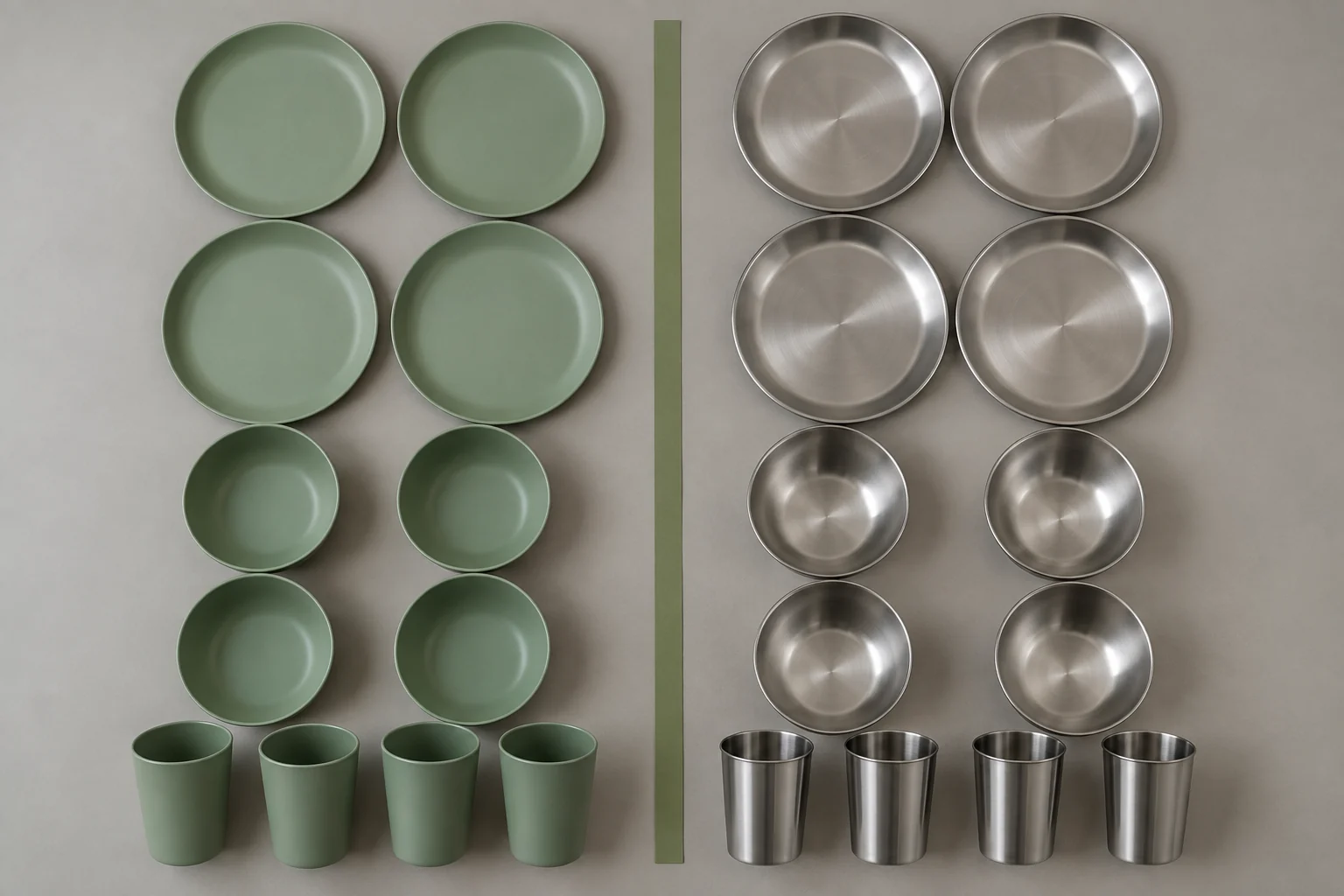
PP vs stainless steel camping dinnerware: seven buyer checks
| Check | PP system tendency | Stainless system tendency | Approval evidence |
|---|---|---|---|
| Weight budget | Often supports lighter configurations, depending on geometry | Mass depends on sheet thickness, forming and component count | Verified weight for each approved component and packed set |
| Nesting envelope | Ribs and draft can create spacing between nested parts | Thin formed walls may nest closely, but rims and handles govern pitch | Loaded stack height and extraction trial |
| Handling sound | Usually quieter during contact | Metal-to-metal contact can produce noticeable rattle | Complete-set handling trial in final carrier |
| Visible damage | May show scratches, stress marks or distortion under unsuitable conditions | May show dents, scratches or finish changes | Agreed inspection after handling and cleaning |
| Colour and finish | Colour may be integrated through a specified formulation | Appearance depends on polish, brushing, coating or other finish | Controlled colour/finish sample and approved boundary |
| Cleaning design | Ribs, texture and deep corners require attention | Rolled edges, seams and recesses require attention | Project cleaning method and dry-state inspection |
| Evidence scope | Grade, additives, colour and intended use must match evidence | Steel grade, finish, coatings and any joined parts must match evidence | Configuration-specific declaration and test-file review |
This matrix describes issues to examine, not guaranteed outcomes. A well-designed PP component may outperform a poorly designed metal part on pack fit, while a carefully formed steel item may resist service damage better than an under-specified polymer part. Replace adjectives with drawings, sample observations and measurable acceptance points.
Weight: build a budget by component
Buyers often assume PP is light and steel is heavy, but the relevant output is total packed mass. Record the verified weight of every plate, bowl, cup, lunch box, utensil, retainer and carrier. Then identify where weight contributes useful stiffness, protection or presentation and where it adds no buyer value.
A camping set designed for vehicle use may tolerate a higher dinnerware mass if it improves the intended experience. A trail-oriented set may assign a strict allowance to each component. Avoid publishing a weight advantage until both configurations contain equivalent roles and have been measured using approved samples.
Weight also changes user handling and carton economics. A heavier set can affect carry comfort and packed-carton limits, while a very light component may move or rattle if retention is poor. The buyer should connect the component budget to the pack-volume worksheet and the final shipping configuration.
Nesting: measure pitch, extraction and contact
Nesting efficiency is not simply wall thickness. PP parts normally need mould-release geometry and may use feet, ribs or locating features. Steel parts can have thin walls, yet rolled rims or formed bases may establish a larger gap. Measure the height of one item and a loaded stack, then calculate the added height per nested piece.
Observe whether users can separate components when wet or cold. Closely nested pieces may trap water or create suction. Excessive gap wastes space and allows movement. The method in nesting versus stacking helps teams record orientation, contact points and extraction sequence.
Inspect decorative surfaces after repeated sample nesting. Polymer texture can mask some marks but may create friction; polished or coated metal can reveal contact lines. Do not generalize from a pristine display sample. Test the actual finish and the maximum intended stack.
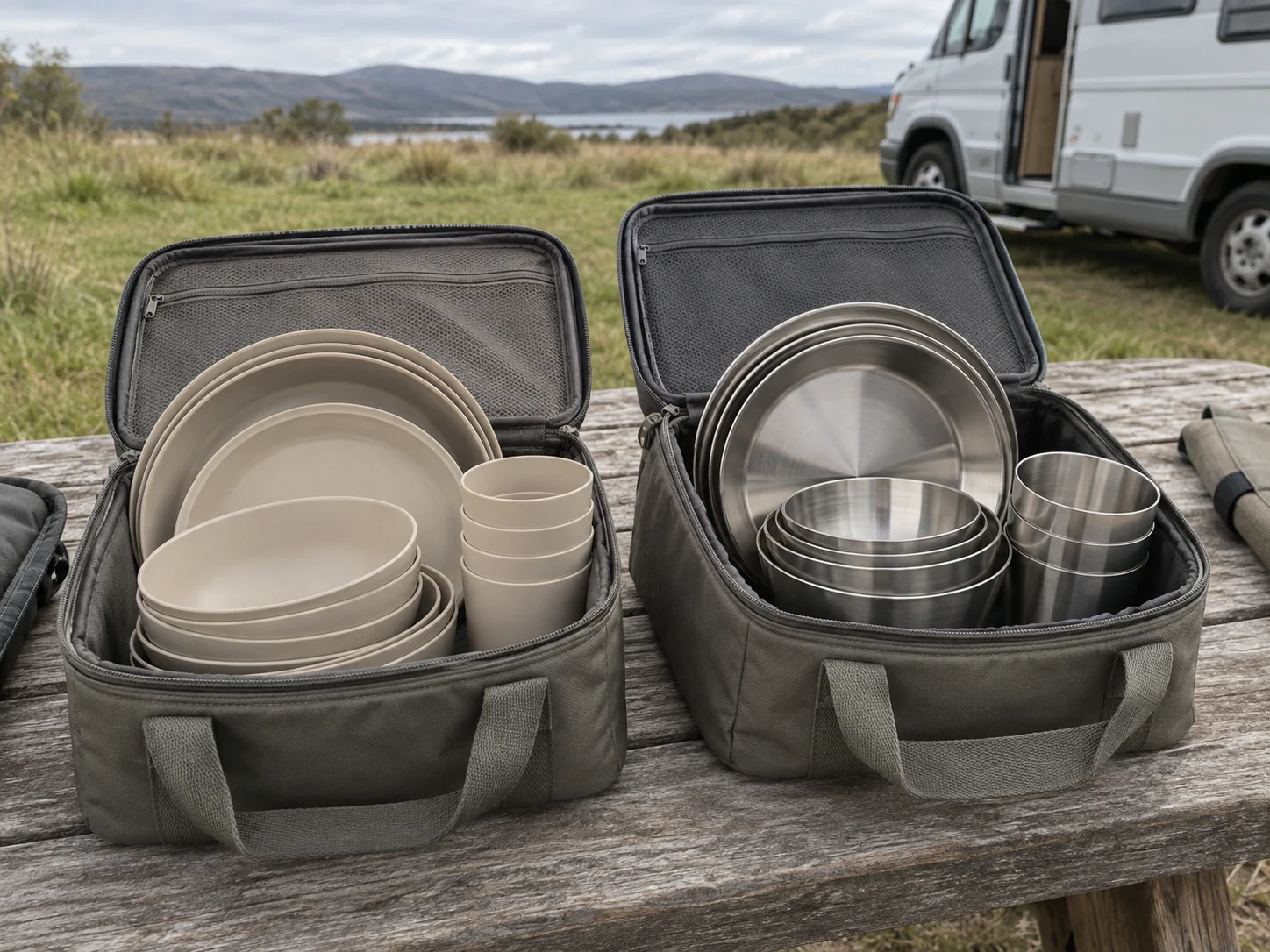
Rattle and surface contact
Steel components can create more audible contact when packed without separators. PP components are generally quieter, but they can still move against latches, cutlery or lunch boxes. A material substitution does not remove the need for retention design.
Map every likely contact pair in the packed set. Mark plate-to-plate, bowl-to-bowl, cup-to-case, utensil-to-dinnerware and carrier-to-component contacts. Then apply the nested dinnerware rattle checklist under the intended loading and handling sequence.
Ask what failure matters commercially. Noise may reduce perceived quality in retail demonstration; abrasion may create returns; movement may damage a latch; and tight separators may slow cleaning. Approve a balanced retention system instead of treating silence as the only target.
Heat, food and misuse boundaries
Intended food temperature must be specified for the finished item. A resin name does not prove suitability for every hot-food condition, and the metallic appearance of steel does not prove cookware performance. Require suppliers to state intended use and applicable limitations for the exact material, construction and market.
Do not place either dinnerware system on a burner or fire unless product-specific evidence explicitly supports that use. Thin dinnerware, polymer components, coatings, handles and joined parts may be inappropriate for direct heat. Marketing scenes and generated images are not performance evidence.
For acidic, oily or long-contact foods, define food type and contact time in the compliance brief. Evidence should match the final colour, additives, coatings, decorations and use conditions. Unsupported phrases such as “food safe for everything” should be rejected.
Cleaning and drying workflow
PP and stainless components can both fail a cleaning review because of geometry. Examine underside feet, rolled edges, textured zones, deep corners, seams and any assembled parts. Confirm whether the proposed cleaning method reaches those areas and whether water drains before the set is closed.
The FDA Food Code is model guidance rather than a product certificate, but its sanitation framework helps buyers define cleanable use. The European Commission food-contact materials legislation overview helps European programs scope responsibility, while Food Standards Australia New Zealand packaging guidance provides useful context for Australian food-contact projects.
None of these sources approves the illustrated products. Request material and test evidence connected to the exact finished configuration. If dishwasher suitability is required, agree the cycle, detergent, loading, number of repetitions and evaluation criteria before claims are written.

Appearance, colour and merchandising
PP can support coordinated colour families when resin, pigment, texture and process are controlled. Stainless steel offers a recognisable metallic presentation and may use brushing, polishing or project-specific surface treatments. Each route needs a visual approval standard under representative lighting.
Colour can help identify user groups or set tiers, but too many colours multiply approval and replacement complexity. Metal finish variations can also become visible when components come from different runs. Establish acceptable appearance boundaries using signed samples rather than screens or verbal descriptions.
For mixed retail programs, consider how the material communicates value beside the carry system and packaging. Do not imply sustainability, superior hygiene or premium performance solely from appearance. Claims require defined evidence and appropriate market review.
Damage modes and replacement planning
A PP item may scratch, warp, whiten at stress points or change surface appearance if design or use conditions are unsuitable. A stainless item may dent, scratch, deform at an edge or show finish variation. These are possible inspection categories, not predictions for every product.
Run handling trials with the final component geometry and carrier. Record the loaded orientation, drop or transport scope if one is agreed, cleaning conditions and examination method. Separate cosmetic observations from failures that affect fit, closure, hygiene or safe use.
Replacement strategy can influence the material decision. If a component is likely to be lost, the buyer may need stable colour and geometry across replenishment. If a steel finish changes, replacements may look different beside older pieces. Define identification and revision rules before launch.
Channel scenarios
Backpacking and weight-sensitive bundles
PP may be attractive when the complete mass budget is strict, but geometry and carrier weight still matter. Compare an equivalent loaded set and remove redundant pieces before changing material. Verify temperature and use limitations in the customer instructions.
Vehicle camping and family retail
Both materials can work. Buyers may value quieter colourful PP or the presentation of steel. Review nesting, cleaning, grip and replacement pieces with representative family users rather than choosing from a mood board.
Rental and guided programs
Inventory visibility, repeated washing and replacement control can outweigh initial appearance. Evaluate count marks, finish durability, stack behaviour and the time staff need to inspect a returned set. The chosen system should support a documented turnaround workflow.
Promotional and branded programs
Decoration must follow the surface and evidence scope. Request artwork location, colour standard, adhesion or durability method where relevant, and packaging protection. A logo change can affect compliance scope and should be controlled like any other specification revision.
Quotation normalization
Send the same component-parity sheet to every supplier. Require quotations to identify material specification, component count, finish, decoration, packaging, evidence, sample assumptions and exclusions. Do not compare a bare steel set with a fully packed PP program as if the numbers describe the same deliverable.
Ask suppliers to flag deviations line by line. A different plate diameter, cup capacity, wall profile or carry case can explain much of a weight or cost difference. Resolve those deviations before commercial selection so the final offer remains connected to the approved sample.
MOQ, price and lead time depend on the project and must not be invented. They can be discussed after component geometry, colour count, decoration, packaging and evidence needs are sufficiently defined for a written quotation.
B2B Buyer Checklist
| Check | Question | Why It Matters |
|---|---|---|
| Parity | Do both proposals contain identical user roles and quantities? | Prevents false weight, volume and price comparisons. |
| Material scope | Are grade, colour, additives, finish and joined parts identified? | Connects claims and evidence to the final item. |
| Pack-out | Are loaded envelope, nesting pitch and extraction verified? | Controls carrier and carton fit. |
| Contact | Which surfaces touch or rattle during transport? | Identifies noise and abrasion risks. |
| Cleaning | Does the agreed method reach and dry every feature? | Prevents unsupported cleaning claims. |
| Use limits | Are food, temperature and direct-heat boundaries written? | Reduces misuse and overclaim risk. |
| Evidence | Do declarations and tests match the final market configuration? | Supports defensible buyer approval. |
Build the approval record
Keep a dated component matrix, drawings, approved samples, measured weights, loaded dimensions, nesting photographs, cleaning observations, artwork files and evidence index. Link every document to a revision. If material, colour, finish or geometry changes, identify which checks must repeat.
Record decisions as pass, fail or open with an owner and next action. Avoid converting a limited sample observation into a universal claim. The record should show what was tested, under which conditions and how the result affects the purchasing decision.
At final approval, reconcile website copy, packaging, quotation and bill of materials. A material comparison is complete only when the selected configuration and its limitations are communicated consistently.
Design a controlled sample test sequence
Begin with identification. Photograph each component, assign a sample code and reconcile it with the material description and drawing. Do not proceed when an offered colour, finish or construction differs from the quotation, because later observations would describe the wrong configuration.
Next verify component parity and measured mass. Load both sets according to the same user matrix, place them in equivalent carriers and record the maximum closed envelope. Open and repack each system using the intended sequence, observing access, unstable stacks, trapped parts and any need to force closures.
Then perform the agreed handling and cleaning exercises. Note contact noise, displaced pieces, visible marks, water retention and changes in fit. Conditions and acceptance criteria must be defined before the trial. A demonstration chosen after seeing the sample can unintentionally favour one material.
Finish with a user and channel review. Retail teams may examine presentation and pack explanation; rental teams may time count checks and turnaround; technical teams may reconcile evidence. Consolidate observations into one decision record rather than letting separate departments approve incompatible versions.
Use a requirement-to-evidence map
Create one row for every proposed claim or critical requirement. Examples include target food-contact use, cleaning method, colour boundary, component weight, stack height, closure fit and absence of sharp accessible edges. Assign each row to a drawing, declaration, test report, measured result or observed sample check.
The map prevents a laboratory report from being used to support a feature it did not evaluate. It also shows where a supplier statement is still needed and where buyer validation remains open. Evidence should identify the tested material, colour, construction and use conditions closely enough to match the final product.
For PP, confirm that resin grade, additives and pigmentation are within the reviewed scope. For stainless, confirm grade, surface treatment, coatings and any joining or accessory materials. When a set mixes materials, maintain separate evidence lines and then reconcile them at complete-set level.
Do not fill gaps with broad marketing language. Mark them open, request the missing source and delay the affected claim. This approach protects both supplier and buyer from promising more than the approved configuration demonstrates.
Review production and inspection implications
A polymer program may depend on mould condition, processing control, colour consistency and removal of moulding defects. A formed steel program may depend on sheet input, forming consistency, edge finishing, surface condition and control of dents or scratches. These are process-review topics, not claims that Naike Dinner performs every process described.
Translate visible risks into inspection language. A PP plate may be checked for incomplete fill, obvious deformation, contamination, stress appearance and fit; a steel plate may be checked for edge condition, dents, deep scratches, contamination and fit. The actual sampling plan and acceptance standard must be agreed for the project.
Inspection should also verify the correct mix of components, colours and finishes. Multi-component sets can pass individual item inspection and still fail because a bowl colour, cup count or stack order is wrong. Include the complete packed configuration in final inspection.
If production changes after approval, require notification and a risk-based revalidation decision. Substituting resin grade, pigment, sheet, finish or packaging can affect evidence, appearance and performance. The golden sample should never be treated as permission for uncontrolled equivalents.
Model commercial risk before choosing
List the plausible cost of each failure: overweight packs, damaged finishes, noisy presentation, warped pieces, dented rims, difficult cleaning, mixed colours, missing evidence or misleading customer instructions. Score impact and likelihood using the buyer’s channel experience rather than generic assumptions.
Then identify which material-system design reduces the highest risks and which risks need controls regardless of material. For example, dividers may reduce steel contact, while better ribs may improve PP stiffness. A carry case, packing sequence or user instruction may be more effective than changing the plate material.
Consider replacement and revision costs. A colour-dependent PP range may require careful batch management; a distinctive metal finish may require matching boundaries. If replacements must remain available over several seasons, specify identification, compatibility and acceptable appearance variation.
The decision should end with a reasoned statement: selected configuration, target channel, verified benefits, unresolved limitations and required evidence. That statement is more useful than declaring PP or stainless “best,” because it remains auditable when the assortment evolves.
Sequential buyer FAQs
1. Is PP always lighter than stainless steel?
Not automatically for the complete set. Compare equivalent component counts and verified sample weights, including retainers, lunch boxes and carriers.
2. Does stainless steel always nest more tightly?
No. Rim, base, wall angle and handles determine nesting pitch. Measure the maximum approved stack and extraction behaviour.
3. Which material is quieter in a carry case?
PP is commonly quieter during contact, but either system can rattle when retention is poor. Test the complete loaded case.
4. Can both materials be used for hot food?
Only within the intended-use statement and evidence for the exact finished item. Material names alone are insufficient.
5. Is stainless dinnerware cookware?
No. A stainless plate or bowl should not be presented as burner or fire suitable without specific verified evidence for that construction.
6. Can one set mix PP and steel?
A mixed configuration can be reviewed when each material solves a defined role. Compatibility, contact, evidence and pack fit must be confirmed by project sample and drawing.
7. What should a buyer send for sampling?
Send user count, component matrix, target capacities and envelope, preferred materials and finishes, foods, cleaning method, markets, artwork, packaging and required evidence.
Request a material-system sample review
To compare PP vs stainless steel camping dinnerware for a real program, provide the same component and use brief for both alternatives. Request an equivalent sample and specification review covering weights, nesting, contact, cleaning, appearance and evidence.
If you already have drawings or samples, identify the decisions that remain open and the market claims you intend to make. Send the project file for a written comparison; material availability, MOQ, pricing and schedule will be confirmed only for the reviewed scope.