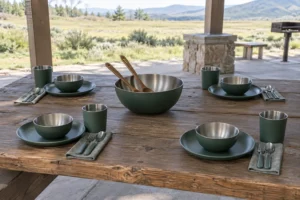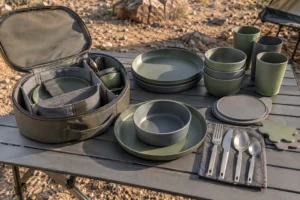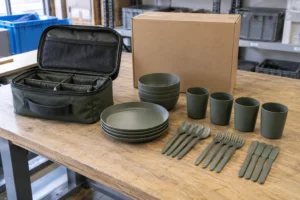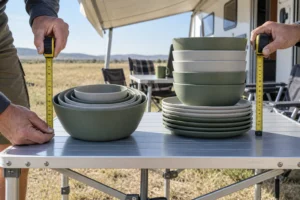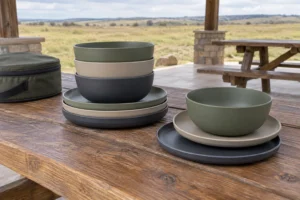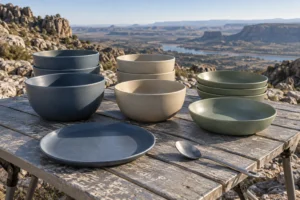
Yes—stainless steel plates for camping can be an excellent reusable choice when durability, easy cleaning and long service life matter more than minimum pack weight. Their actual suitability depends on verified alloy identity, finished-edge quality, plate geometry, corrosion resistance and the intended trip. A material label alone does not prove food-contact compliance or field performance.
Why Stainless Steel Plates for Camping Often Work Well
A camping plate is repeatedly packed, stacked, dropped, washed and exposed to moisture. Stainless steel is attractive because a correctly selected and finished article can tolerate this operational cycle without the brittle fracture associated with some rigid alternatives. It also avoids coatings that may become the primary wear surface, although a buyer must still verify whether any decoration, colored layer or bonded accessory is present.
The useful question is not whether all stainless steel is “good.” The question is whether a specific plate remains safe, usable and commercially consistent under a defined scenario. A shallow plate for a family car-camping set has different weight, nesting and rim priorities from a plate intended for backpacking, scout camps, rental fleets or emergency kits.
The material also does not turn a plate into cookware. A stainless dinner plate is designed to hold or serve food; it should not be placed on a stove, burner or campfire unless the supplier provides product-specific evidence that the finished article was designed for that use. This article treats plates as dinnerware, not as frying pans, pots or direct-flame vessels.
Evidence Buyers Should Use Instead of Marketing Claims
For Europe, the European Commission’s food-contact materials overview identifies tableware and metal among the articles and materials covered by the EU framework. It is useful for establishing the regulatory boundary, but a general policy page is not a certificate for a particular camping plate. The finished product, intended food types and foreseeable conditions still need project-specific evaluation.
For the United States, the FDA Food Code 2022 is a model code rather than a universal product approval. Its equipment and utensil provisions describe useful performance principles: food-contact materials should be safe, durable, corrosion-resistant, nonabsorbent, sufficiently robust for repeated warewashing and finished with smooth, cleanable surfaces. Buyers can translate those principles into inspection questions without claiming that the Food Code itself approves a SKU.
Material identity should also be separated from finished-product performance. Regulation (EC) No 1935/2004 sets general safety, inertness and traceability principles for food-contact materials, while ASTM G48-25 describes laboratory methods for comparing pitting and crevice-corrosion resistance under specified ferric-chloride conditions. Neither source automatically establishes that a formed, polished and decorated plate is suitable for every food or campsite.
This distinction protects buyers from two common errors. First, an alloy designation on a quotation is not the same as a traceable material record linked to the production lot. Second, a raw-material standard or aggressive corrosion test does not replace finished-article food-contact evaluation, rim inspection, cleaning validation or field-use sampling.
Quick Decision Table: Where Stainless Plates Fit
| Buyer criterion | Likely stainless-steel outcome | What must be verified |
|---|---|---|
| Repeated reuse | Strong candidate when the plate resists distortion and surface damage | Finished thickness, geometry, rim stiffness and cycle-based sample checks |
| Pack weight | Usually less attractive than the lightest material options | Actual grams per plate and complete-set weight, not adjectives such as “lightweight” |
| Cleaning | Smooth nonabsorbent surfaces can be practical | Finish roughness by inspection, crevices, rim seams, decoration and approved cleaning method |
| Corrosion exposure | Can perform well, but stainless does not mean corrosion-proof | Alloy identity, surface condition, salt/chloride scenario and product-specific evidence |
| Drop handling | Low risk of brittle fracture, but dents and rim deformation remain possible | Drop orientation, filled/unfilled condition, deformation criteria and sharp-edge inspection |
| Hot food | Suitable only within verified food-temperature conditions | Plate temperature, user contact, rim comfort and heat transfer during service |
| Direct flame | Not assumed for dinnerware | Exclude burners and campfires unless a separately designed product has verified instructions |
| Brand customization | Possible through several processes, each with its own evidence needs | Decoration method, location, wear, food-contact boundary and production consistency |
The table is a screening tool, not a universal ranking. A heavy-duty plate for a rental fleet may be successful precisely because it is not optimized for ultralight travel. Conversely, a backpacking brand may reject the same article because every gram and cubic centimeter affects the complete cook-and-eat system.
Scenario 1: Family and Car Camping
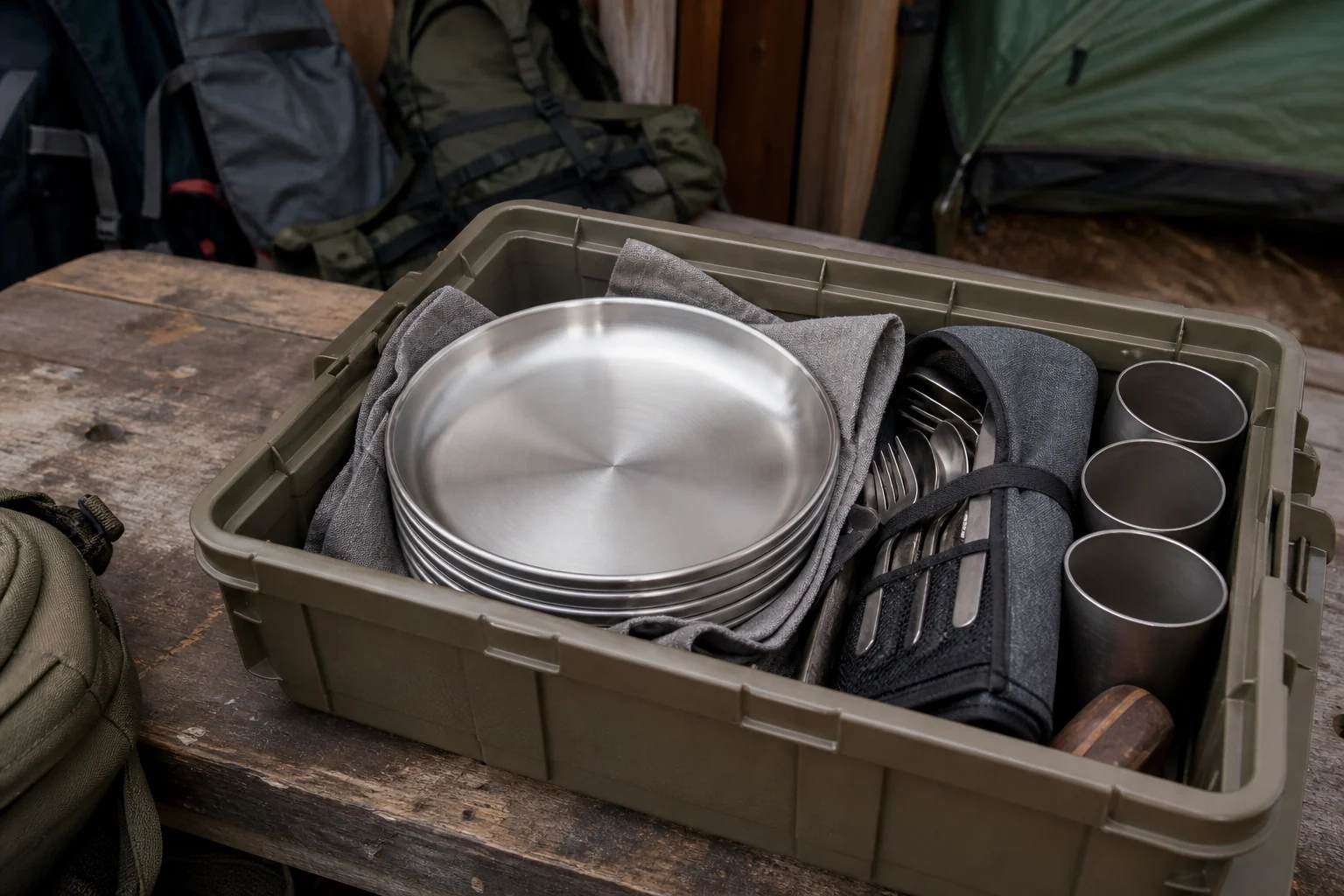
Stainless steel is often well aligned with family and car camping because the transport system absorbs some weight penalty. Plates can travel in a lidded bin, nest with bowls and cups, and tolerate frequent handling by different users. The buyer should still control rim comfort, plate depth and stack stability so a technically durable item is also pleasant to use.
For mixed meals, a shallow plate with enough wall height can reduce spills at an uneven picnic table. Very flat profiles pack efficiently but may perform poorly with sauces, beans or food served to children. The right geometry therefore depends on the menu and user group, not only on the metal.
Retailers should evaluate the plate as part of a set. Cup handles, bowl diameters, cutlery rolls and storage pouches can determine whether the finished system packs cleanly. Buyers comparing broader material options can use the site’s guide to the best material for camping dinnerware to frame these trade-offs before requesting a quotation.
Scenario 2: Backpacking and Weight-Sensitive Kits
Backpacking changes the decision. A stainless plate may be durable and familiar, yet its mass can be difficult to justify if a bowl, pot lid or food container already performs the eating function. Buyers should compare complete-system mass rather than placing an isolated plate on a scale and declaring it light or heavy.
The useful calculation is mass per eating place multiplied by the intended party size. Add the pouch, separators and utensils, then compare the volume of the nested stack. A few grams saved from one component can be lost through a bulky rim or a storage sleeve that does not fit the rest of the kit.
Where titanium is also under consideration, the existing titanium versus stainless steel camping tableware comparison explains the broader material decision. That article is buyer education; it does not establish that Naike Dinner manufactures either metal category.
Scenario 3: Camps, Rentals and Shared Equipment
Scout camps, outdoor schools, glamping operators and rental fleets place a premium on countability, cleaning and replacement control. Stainless plates can be practical because operators can visually inspect dents, residue and surface damage. However, high reuse also exposes weak rims, poor nesting and inconsistent finishes faster than occasional household use.
A fleet buyer should define retirement criteria before ordering. Examples include a rim that can snag a cleaning cloth, deformation that prevents stable stacking, deep scoring that cannot be cleaned predictably, or corrosion that appears after the approved wash-and-dry routine. These are buyer-defined acceptance rules, not claims about a product that has not yet been tested.
Inventory control may require an identification method, but decoration must be specified carefully. Marking location, depth, contrast and wear should not create an uncleanable recess or be represented as food-contact compliant without supporting evidence. A production-intent sample should carry the actual proposed mark, not a temporary substitute.
Rim Design Matters More Than Many Quotations Show
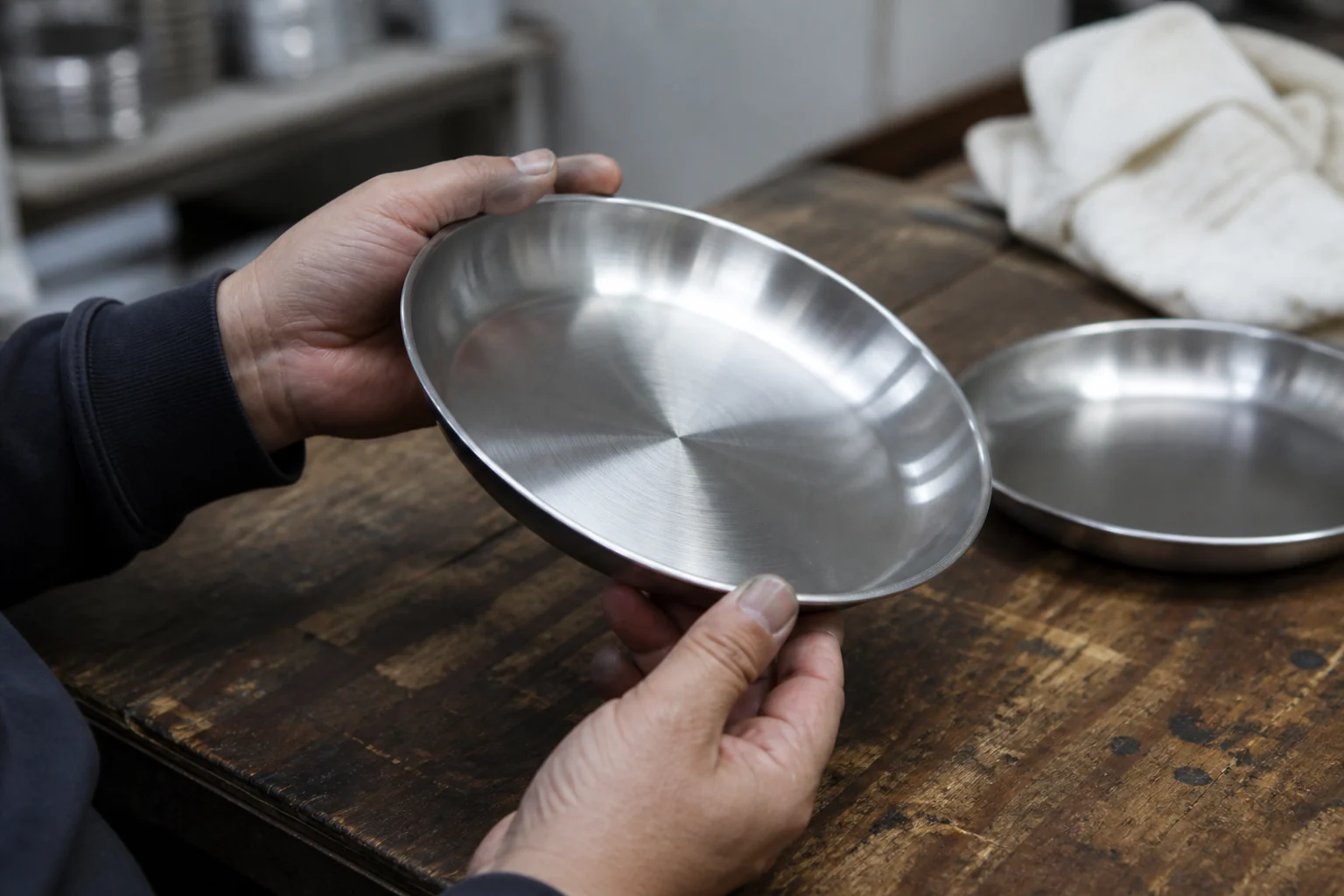
The rim is where the user grips the plate, where impact energy may concentrate and where forming details can create a difficult-to-clean seam. A rolled rim can feel comfortable and add stiffness, but buyers should examine whether the roll is closed consistently and whether moisture or food can remain in any accessible gap. A simple edge may be easier to inspect, yet it still needs safe finishing and adequate stiffness.
Photographs are not enough for this decision. Ask for production-intent samples from more than one cavity, tool position or production interval where relevant, then inspect the full circumference under normal light and by touch with an appropriate safe method. Do not run bare fingers aggressively along an unknown edge; use a controlled inspection procedure and record any snagging, burrs or distortion.
Plate geometry also affects rigidity. Beads, transitions and wall angles can increase stiffness without relying only on mass, while abrupt shapes may trap residue or reduce nesting efficiency. The supplier should provide a dimensional drawing, but the buyer must confirm that the drawing version matches the sample and later the approved production.
Weight, Thickness and the Risk of False Precision
Buyers often request a single thickness value, yet formed articles can vary by location. The base, wall, rim and formed features may not retain identical dimensions after manufacturing. A quotation should therefore state the measurement locations, tolerance method and finished mass rather than presenting one number as a complete performance guarantee.
Mass is easier for incoming inspection, but it is still a proxy. Two plates with similar mass can distribute material differently and behave differently under load or impact. A useful sample review combines mass, dimensions, stack height, rim inspection, stability on a flat surface and defined handling tests.
Avoid specifying the thinnest possible article merely to reach a marketing weight. An unstable base, easily bent rim or excessive flex can reduce perceived quality and shorten service life. The target should be the lightest configuration that passes the buyer’s defined use conditions with an appropriate consistency margin.
Heat: Safe Food Service Is Not the Same as Comfortable Handling
Metal transfers heat readily compared with many polymer or fiber-composite surfaces. A plate may remain structurally intact while becoming uncomfortable at the rim or underside when filled with very hot food. Buyers should therefore evaluate user-contact temperature and handling behavior, not only whether the article visibly deforms.
Test conditions should reproduce serving, not an artificial headline. Define the food or simulant temperature, fill volume, contact time, ambient condition and how users are expected to hold the plate. Include children or gloved use only when those scenarios genuinely belong in the product brief and risk review.
Never place the plate directly on a burner to “prove” heat resistance. That changes dinnerware into an unverified cooking application and can create hot spots, distortion, discoloration or injury. If the assortment needs cookware, source and evaluate it as a separate product category with its own design instructions and evidence file.
Corrosion Resistance Has Conditions and Limits
Stainless steel relies on material composition and surface condition for corrosion resistance, but the word “stainless” should never be read as “cannot corrode.” Chlorides, food residues, damaged surfaces, dissimilar-metal contact and prolonged wet storage can change the exposure. The buyer must define foreseeable conditions and request evidence that is relevant to those conditions.
ASTM G48 is useful for comparing resistance to pitting and crevice-corrosion initiation in specified oxidizing chloride environments. Its own scope is controlled and laboratory based, so a result should not be converted into an unsupported promise that a plate will never stain at a coastal campsite. Evidence must be interpreted within the method, specimen, finish and acceptance criteria used.
Grade shorthand also needs discipline. A quotation that says “304” or “316” without a linked material record, production-lot traceability and finished-article evaluation is incomplete. The purchasing team should ask how identity is controlled, how substitutions are prevented and how incoming material records connect to the finished batch.
Cleaning and Drying in Real Campsite Conditions
A smooth stainless surface can be straightforward to wash, but plate design can undermine that advantage. Rolled seams, embossed marks, deep scratches and tight decorative recesses can retain soil. Cleaning instructions should be based on the finished design and intended detergent, not borrowed from a generic statement about stainless steel.
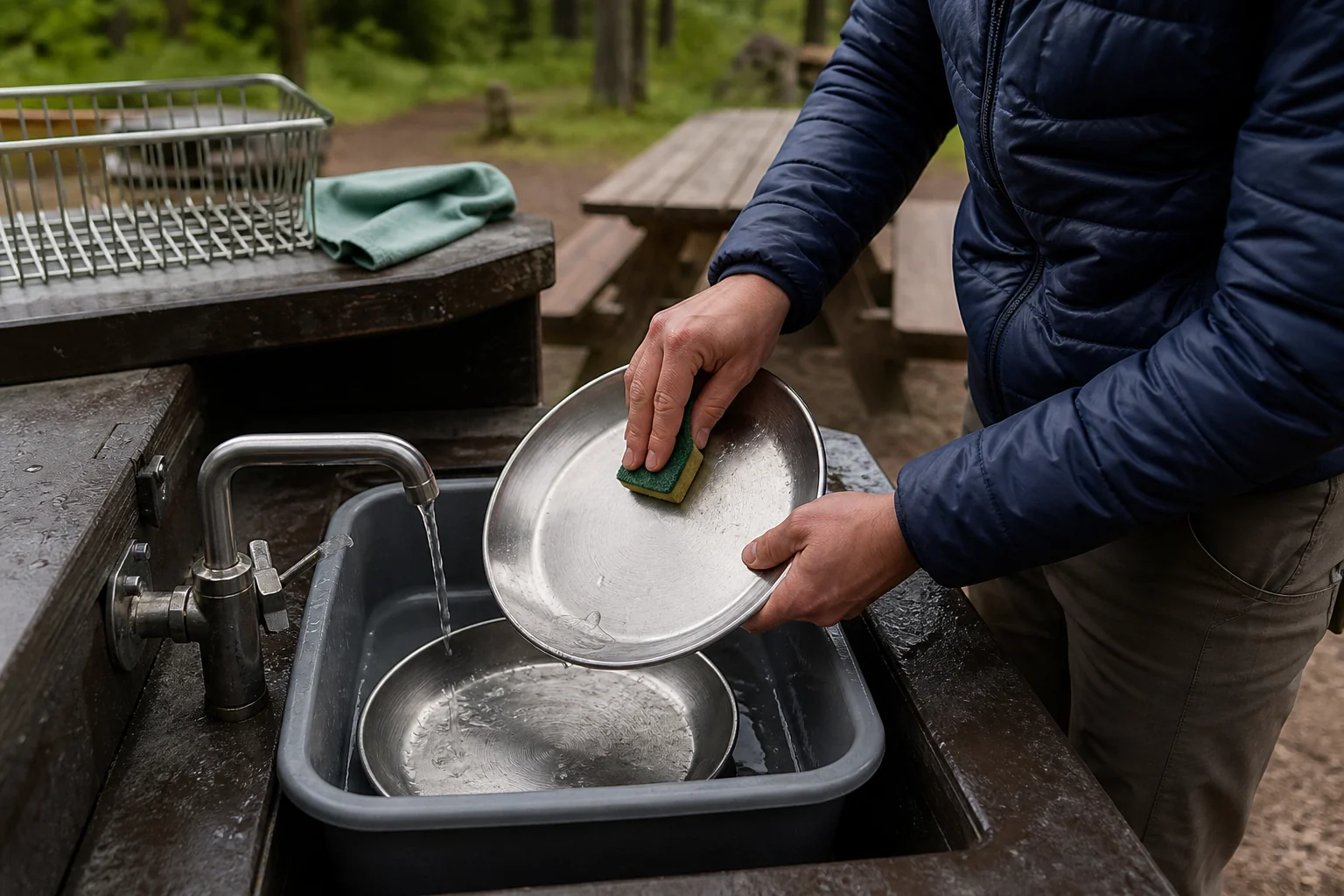
Field cleaning also includes water management and drying. Residue should be removed at a designated wash point, following local campsite rules, and the plate should be dried before enclosed storage when practical. Packing wet plates tightly with food residue creates a different exposure from normal indoor washing and should be included in a realistic use review.
Do not use aggressive abrasives merely to make an inspection sample look new. A buyer should verify which cleaning tools are allowed, whether the finish changes visibly and whether the approved process leaves the surface smooth and cleanable. If a dishwasher claim is planned, it requires defined cycle conditions and product-specific validation.
Limitations and Risks Buyers Must Put in the Brief
The first limitation is weight. Stainless steel may not suit an ultralight range even when it performs well in durability checks. The second is heat transfer: hot food can make user-contact areas uncomfortable. The third is deformation, because a plate can dent or warp without breaking.
Corrosion and staining are additional risks when alloy identity, finish or care is poorly controlled. Surface scratches may be acceptable cosmetic evidence of use, but deep damage can change cleanability and appearance. Buyers should distinguish cosmetic tolerance from a safety or functional rejection rule.
Noise and rattle can affect perceived quality in nested kits. Bare metal plates moving inside a vehicle or backpack may be irritating and can create visible rubbing marks. Cloth separators or a fitted pouch can help, but packaging adds cost, volume, cleaning questions and another component that must match the order quantity.
Finally, a stainless plate is not automatically the best choice for every user. Brands serving children, institutional buyers, premium ultralight hikers or customers seeking a quieter table setting may select another material or a mixed-material system. The right decision follows the scenario and evidence, not a universal material hierarchy.
Procurement Advice: Specify the Finished Plate
Begin with intended users, trip type, meal profile, cleaning method, target markets and expected reuse. Then define plate diameter, usable food area, wall height, rim style, finished mass, stack height and allowable dimensional variation. These inputs allow a supplier to quote a real configuration rather than a vague “stainless camping plate.”
Request an evidence map that separates raw-material identity, food-contact evaluation, corrosion or durability tests, dimensional inspection and packaging checks. Each document should identify the article, material, finish, test conditions and version it covers. If the tested sample differs from the proposed SKU, the supplier should explain the gap rather than implying equivalence.
Use production-intent samples for handling, meal, washing, drying and storage trials. Compare multiple pieces rather than treating one ideal sample as evidence of consistency. The site’s camping tableware manufacturer checklist provides a broader supplier-screening framework for identity, traceability and control records.
Material-neutral specification review
Send Naike Dinner your target users, markets, component list and use conditions. We can review the brief against verified capabilities and clearly separate general stainless-steel buyer education from any product that is actually available for quotation.
Request a specification reviewStainless Plate Procurement Checklist
| Check | Question | Why It Matters |
|---|---|---|
| Product boundary | Is this article dinnerware only, with direct flame explicitly excluded? | Prevents an unsupported cookware use from entering marketing or instructions. |
| Alloy identity | Which traceable material record links the declared alloy to the production lot? | A grade name in a quotation is not evidence of batch identity. |
| Food-contact scope | Which target market, foods, temperatures and contact times does the evidence cover? | Evidence applies only within its documented scope. |
| Finished geometry | Are diameter, wall height, rim profile, base stability and stack height defined? | Geometry determines usability, rigidity, cleaning and pack volume. |
| Rim inspection | How are burrs, open seams, snagging and deformation checked? | The rim is a frequent user-contact and impact area. |
| Surface finish | Is the approved finish linked to cleanability, appearance and corrosion evidence? | Finish condition can materially change performance. |
| Mass control | What is the finished mass range and how is it sampled? | Controls set weight and may reveal manufacturing inconsistency. |
| Use validation | Do samples pass the buyer’s meal, wash, dry, stack and transport sequence? | Real scenarios expose problems that isolated tests can miss. |
| Decoration | Is the actual logo method and location included in the evidence review? | Decoration can affect wear and the food-contact boundary. |
| Traceability | Can the finished article be linked to material, inspection and shipment records? | Supports investigation and corrective action. |
A Practical Sample Approval Sequence
First, confirm document identity before touching the sample: drawing version, material declaration, finish description and proposed decoration. Second, measure and weigh multiple pieces using an agreed method. Third, inspect rims, bases, surfaces and stack behavior under consistent lighting.
Fourth, conduct the intended meal and handling sequence. Include hot-food handling only within a safe, defined protocol, and do not add direct flame. Fifth, wash and dry the articles using the proposed consumer instructions, then examine them for residue, staining, distortion, sharp changes and nesting problems.
Sixth, repeat relevant steps rather than relying on a single cycle. Record observations in buyer-controlled language and distinguish critical, functional and cosmetic criteria. Seventh, seal an approved reference sample only after every agreed component—including pouch, separator and decoration—is present.
This process does not create a universal pass result. It creates a project-specific basis for comparing quotation assumptions, samples and later production. Buyers can ask Naike Dinner for a documented project review without assuming that an unverified metal product is part of the company’s current range.
Stainless Camping Plate FAQ: Follow-Up Questions
1. Are stainless steel camping plates too heavy for backpacking?
They can be heavier than alternatives chosen specifically for minimum mass, but the decision should use measured finished-set weight. Compare the complete eating system, party size and nesting volume. A durable plate may make sense for car camping while being unnecessary in an ultralight kit.
2. Does “stainless” mean the plate cannot rust or stain?
No. Corrosion behavior depends on composition, surface condition and exposure, including chlorides and wet storage. Request traceable material identity and evidence relevant to the intended conditions, then verify care instructions on production-intent samples.
3. Is a 304 or 316 label enough for purchasing?
No. A grade label must be supported by a material record linked to the production lot and controls that prevent substitution. It also does not replace finished-article food-contact, edge, cleaning and use-condition evaluation.
4. Can a stainless camping plate go directly on a stove or fire?
Do not assume so. A dinner plate is not cookware, even when both are made from metal. Direct-flame use requires a separately designed product, validated instructions and product-specific evidence.
5. Are stainless plates suitable for children at camp?
That depends on rim comfort, mass, stability, heat transfer and supervision. Buyers should evaluate the exact plate with the intended age group and meal temperatures, while following destination-market product-safety requirements.
6. What is the most important sample check?
There is no single check. Rim safety, base stability, finished mass, food-contact evidence, corrosion scope, cleaning and stacking interact. A controlled sequence using multiple production-intent samples gives a more reliable decision than one drop or one dishwasher cycle.
7. Should the buyer request a corrosion test?
Request evidence only after defining the exposure and decision it must support. A laboratory method such as ASTM G48 has a specific scope and should not be treated as a universal campsite guarantee. The supplier and test laboratory should identify the specimen, finish, conditions and acceptance criteria.
8. Does Naike Dinner manufacture stainless steel camping plates?
This article does not make that claim. Naike Dinner’s live site currently verifies reusable wheat-straw composite tableware content, while stainless steel is presented here as material-neutral buyer education. Product availability, materials and processes must be confirmed for each inquiry.
Request a camping plate specification and evidence review
Share your target market, trip scenario, plate dimensions, mass target, rim preference, meal temperature, cleaning method, decoration and packaging plan. Naike Dinner will separate verified project capability from general material guidance and identify the samples or records needed before a responsible quotation.
Request a documented quotation reviewCompare camping dinnerware materials