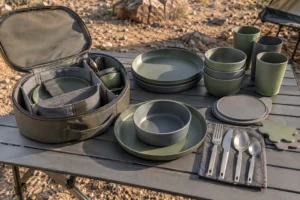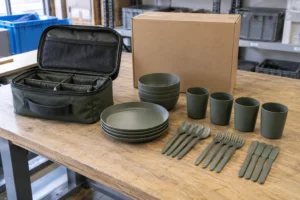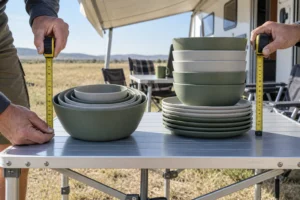
Camping dinnerware is truly stackable only when a controlled quantity aligns, remains stable, separates without sticking, drains after washing and fits the complete retained pack-out. A low pile in a product photo is not proof. Buyers need drawings, a contact map, incremental-height data and repeated handling checks using final materials, colors, decorations and component revisions.
Stackable camping dinnerware design needs an acceptance definition
“Stackable” is often used as a visual adjective, but procurement needs it to describe repeatable behavior. The buyer should define which components stack, in what order, at what quantity, under which orientation and for which stage of use. Without those boundaries, a supplier can show two aligned samples while the saleable set of four or six behaves differently.
A useful definition covers more than reduced height. The stack should have a predictable footprint, controlled vertical rise, acceptable lateral movement, accessible separation points and no damaging contact between food-contact or decorated surfaces. It should also survive the normal wash, dry, repack and carry sequence without relying on unlisted filler.
This is dinnerware engineering, not cookware performance. A plate or bowl that stacks efficiently must not be placed on a burner, stove, campfire or direct flame unless product-specific verified evidence expressly permits that use. Stackability cannot be used to infer heat resistance, food-contact compliance, dishwasher suitability or impact performance.
First distinguish stacking from nesting
Stacking describes repeated items resting in a controlled vertical arrangement. Nesting describes one item entering the volume of another. A bowl can do both: its rim and foot may create a stable repeated stack while its tapered wall allows partial nesting. Buyers should state which result they are evaluating instead of treating the words as interchangeable.
Pure stacking usually depends on defined contact ledges or feet and produces a regular incremental height. Deeper nesting may reduce the incremental height, but it can increase surface contact, suction, wedging or abrasion risk. Neither is automatically better; the approved geometry must balance packed envelope, release, hygiene and manufacturing variation.
A mixed camping set adds a third condition: coordinated stacking. Plates, bowls, lids and cups may form separate columns or one mixed sequence. The buyer must decide whether each column is independently retained, whether one component acts as a cap, and whether unloading one item forces unrelated pieces to be removed.
Eight stackability acceptance checks
| Check | Buyer question | Evidence to approve | Failure signal |
|---|---|---|---|
| 1. Stack identity | Which exact part numbers, revisions, colors and quantities belong in the stack? | Controlled BOM and stack-order drawing | Samples or images use unlisted substitutes |
| 2. Contact map | Where should each piece touch the one below? | Section drawing and marked interface review | Food-contact faces or decoration carry unintended load |
| 3. Incremental rise | How much height does each added piece contribute? | First-piece and repeated-rise measurements using one convention | Later pieces rise unevenly or exceed the case zone |
| 4. Alignment | Does the controlled stack remain centered and vertical? | Top, side and complete-quantity observation | Progressive lean, rotating offset or rim mismatch |
| 5. Release | Can intended users separate one piece without tools? | Repeated dry, damp and post-wash handling check | Wedging, suction, abrupt release or fingernail-only access |
| 6. Stability | Does the stack remain acceptably stable during loading and table use? | Declared surface, orientation and handling observation | Rocking, sliding or tipping under normal touch |
| 7. Drainage and cleaning | Can washed pieces drain and dry without trapped water? | Wash-drain-dry-repack review | Water remains in feet, ledges or nested gaps |
| 8. Retained pack-out | Does the full stack fit and remain controlled with every included component? | Closed-case sample, packing instruction and transit plan | Bulging closure, rattle, abrasion or omitted parts |
These are buyer acceptance directions, not universal pass values. Each program should define quantities, surfaces, handling cycles and observations that match its users and channel. If a dimension, tolerance or outcome has not been confirmed, record it as “To be confirmed for the project” rather than converting a concept into an unsupported claim.

Build the stack architecture from the component matrix
Do not design a plate stack in isolation and add bowls later. Start from the approved user and meal allocation: individual plates, individual bowls, cups, shared serving pieces, containers, lids, cutlery and the carry system. The guide to camping dinnerware set components provides a practical way to assign a role to every piece before its packed position is fixed.
For each component, identify whether it forms a repeated stack, nests inside another family, caps a column, fills a controlled void or remains in a separate retained zone. Then draw the complete packing sequence. A component that has no stable position should trigger a design decision, not be hidden by foam or loose tissue in the sample.
Quantity matters. A profile that behaves acceptably as a pair can accumulate offset over four or six pieces. Review the exact saleable quantity and any replacement-piece scenario. If retailers will offer different user counts, each configuration needs a controlled packed drawing and its own closure review.
Measure first-piece height and incremental rise separately
The first piece establishes the base height. Every additional identical piece contributes an incremental rise determined by wall angle, rim ledge, foot geometry and intended contact. Buyers should not estimate total stack height by multiplying overall piece height by quantity, because partial overlap changes the relationship.
Use one reference plane and one measurement convention across bidders. Record the first-piece height, the total height at each controlled quantity and the incremental rise between successive quantities. If the rise changes after later pieces are added, investigate interference, deformation, tolerance accumulation or incorrect contact.
A simple worksheet can list quantity in one column and measured stack height in the next. The difference between adjacent rows is the observed rise. The buyer can then compare that sequence with the allocated case zone and closure clearance without inventing a theoretical performance value.
Coordinate the result with the published camping plate and bowl size-system worksheet. Outside diameter, opening, usable base, foot and rim are related inputs. Optimizing only the stack height can reduce eating area, weaken finger access or create an unstable contact point.
Map intended contacts and prohibited contacts
A section drawing should show where one piece is designed to rest on the next. Intended contacts may occur at a foot ring, underside shoulder, rim ledge or controlled spacer. Prohibited contacts should also be marked, especially decorated surfaces, sharp edges, sealing lands or areas that could trap food or water.
Broad face-to-face contact can appear stable but increase friction, abrasion or suction. A very narrow point contact may release easily yet concentrate load or wobble. The buyer should ask why the chosen interface exists and what evidence will confirm it in the final material and process.
For mixed stacks, create a contact map for every transition: plate to plate, bowl to bowl, bowl to plate, lid to container and stack to case. When two components are supplied by different tools or production sources, identify who controls the shared interface and which drawing revision governs acceptance.
Decoration is part of the contact map. Printed, coated or textured areas should not be placed in repeated rubbing contact unless the buyer has defined the risk and evidence. A clean undecorated sample cannot approve a decorated production configuration.
Release is as important as compactness
A deep nest can save apparent volume while making pieces difficult to separate. Wedging occurs when walls or rims interfere. Suction can occur when close surfaces and moisture restrict air entry. A stack may also release suddenly, creating spills or drops, even when it looks compact on a shelf.
Specify a practical separation method. Users should be able to grasp a defined rim, tab, scallop or offset without tools and without unloading the entire case. Observe dry components, damp components after washing and pieces at the expected use temperature only under safe project conditions.
Do not approve a design based solely on a technician who knows the trick. Include representative users and state the intended action. If the product targets families, rental fleets or guided groups, the release method must remain understandable when pieces are returned in mixed orientations.
Alignment and wobble reveal tolerance problems
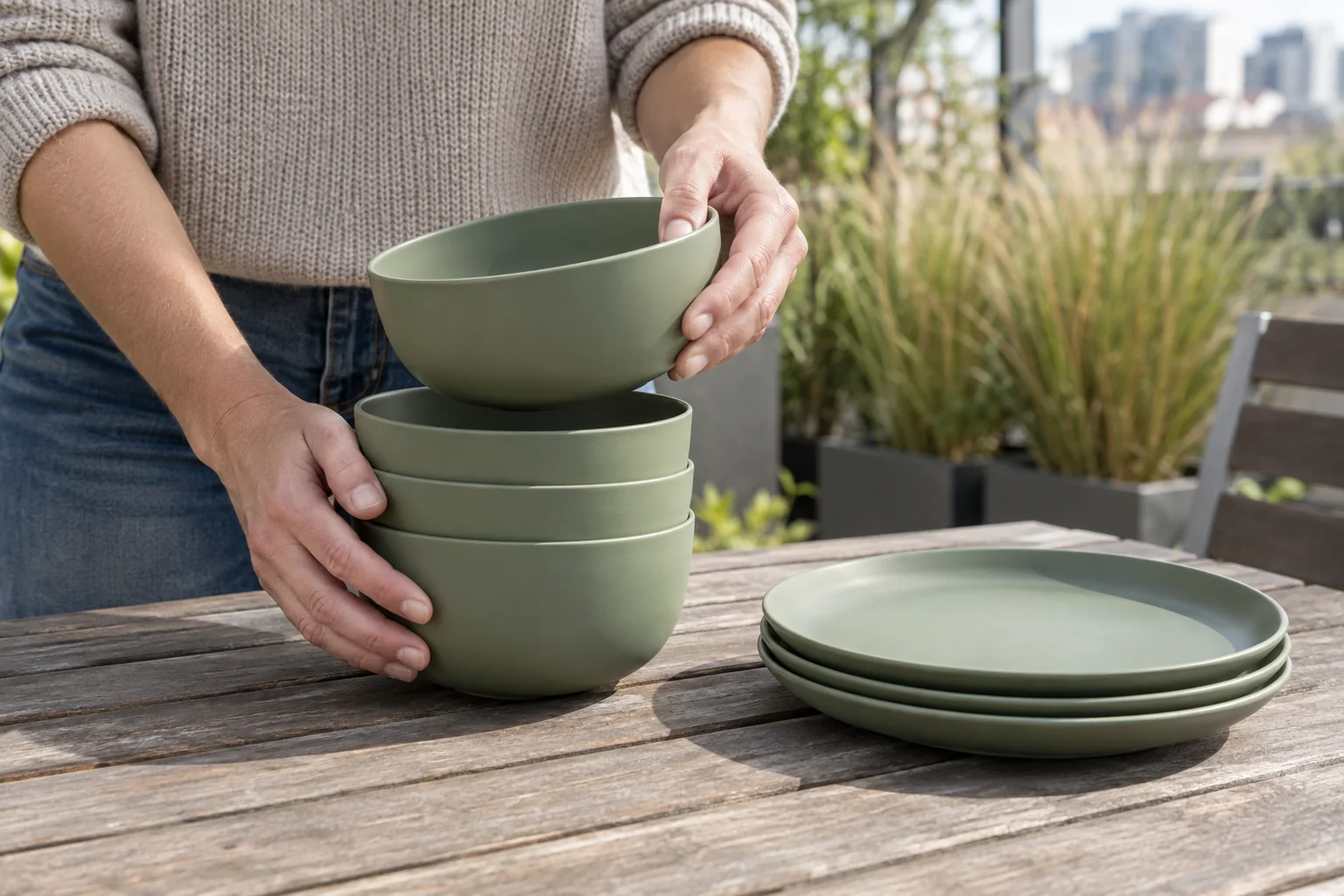
A stack should remain centered enough for its declared use and case. Progressive lean can come from uneven feet, inconsistent rim height, asymmetric warpage or contacts that rotate from piece to piece. Check the complete controlled quantity from several sides and rotate individual pieces to see whether the lean follows a part or the stack order.
Wobble is not just a table-use issue. It can create concentrated rubbing during transport and use closure pressure to hold the stack in place. A case should retain a stable stack; it should not compensate for unresolved geometry by compressing pieces together.
Document the surface used for observation. A visibly uneven picnic table is useful for scenario review but not a substitute for a controlled reference surface. Buyers can use both: one to compare components consistently and another to understand real-world handling.
Do not confuse packed stability with table stability
A bowl can sit stably within a packed stack yet rock when used alone because its foot and base relationship differ from the stacking contact. Likewise, a broad plate may be stable on a table but slide within the case. Approve the individual-use condition and packed condition separately.
The recent comparison of deep and shallow camping bowls explains why wall height alone does not determine stability. Base footprint, load position, material stiffness and surface condition matter. Stackability adds another interface but does not replace those factors.
When cups or lunch boxes cap a dinnerware column, confirm that the upper item cannot migrate into a damaging position. A loose top component can turn a stable vertical stack into a rattle source. Use defined dividers or retention features rather than relying on the closed lid to press everything downward.
Mixed-component order must be intentional
Some programs stack identical parts in separate columns because counting and replacement are simple. Others create place-setting modules, such as plate-bowl-cup groups, to speed distribution. The buyer should choose the order that supports use and return, not merely the lowest rendering height.
Separate columns make it easier to count a family of pieces and evaluate one interface repeatedly. Place-setting modules can give each user a compact bundle but introduce more transition contacts. A mixed sequence may also require users to unload cups before reaching plates.
Create a pack-order diagram with numbered actions, but keep the numbers in documentation rather than embedding unverified counts in concept imagery. During sample review, ask a person unfamiliar with the design to unpack, distribute, collect and repack the set. Record mistakes that reveal unclear architecture.
Stackability must survive washing, draining and drying
Feet, ledges and close nested gaps can retain water. A stack that is compact while dry may trap moisture when pieces are immediately reassembled. The buyer should define whether components must air-dry separately, can drain while loosely stacked or need a particular orientation.
Review external feet and underside recesses as carefully as food-contact interiors. Water hidden under a foot can transfer to the next piece or into the carry case. If drainage features are proposed, confirm that they do not create difficult-to-clean crevices or weaken the intended contact.
Dishwasher claims remain separate. The guide to camping dinnerware dishwasher claim validation explains why final components, colors, decorations and cycles require matching evidence. A post-wash release check can support stackability acceptance without proving dishwasher safety.
Material and manufacturing variation change the interface
Wall stiffness, shrinkage, warpage, surface texture and edge finishing can affect stack behavior. A geometry that releases in one material or color may behave differently after formulation, processing or decoration changes. Buyers should treat the stack interface as a controlled system, not a dimension copied between unrelated products.
Ask for drawing tolerances only after the functional contacts are understood. A tight tolerance is not automatically better, and an unsupported tolerance can raise cost without controlling the real failure. Link each important dimension to a failure mode such as lean, wedge, rattle, closure interference or loss of finger access.
Compatibility to be confirmed by project sample and drawing. If components come from existing product families, review actual retained samples rather than assuming that nominal diameters match. If new geometry is considered, tooling feasibility, ownership, maintenance, revision rights and commercial terms require separate written agreement.
Retained pack-out is the commercial acceptance point
A stack is not complete until it fits with cups, cutlery, containers, shared pieces, dividers and the intended carry system. Measure and observe the closed sales unit, not a dinnerware column on an empty table. Verify that closures operate without force and that no component is omitted to achieve the photographed result.
Retention should prevent damaging movement without making components difficult to remove. Soft dividers, molded trays, elastic features or component geometry may be used, but each option has its own cleaning, replacement and revision consequences. The final BOM must identify every retained part.
Rattle is a diagnostic signal rather than a universal failure by itself. Repeated impacts may indicate voids, uncontrolled interfaces or missing retention. Define the handling condition and observation before setting an acceptance statement; do not claim transit performance without an appropriate packaged-product plan.
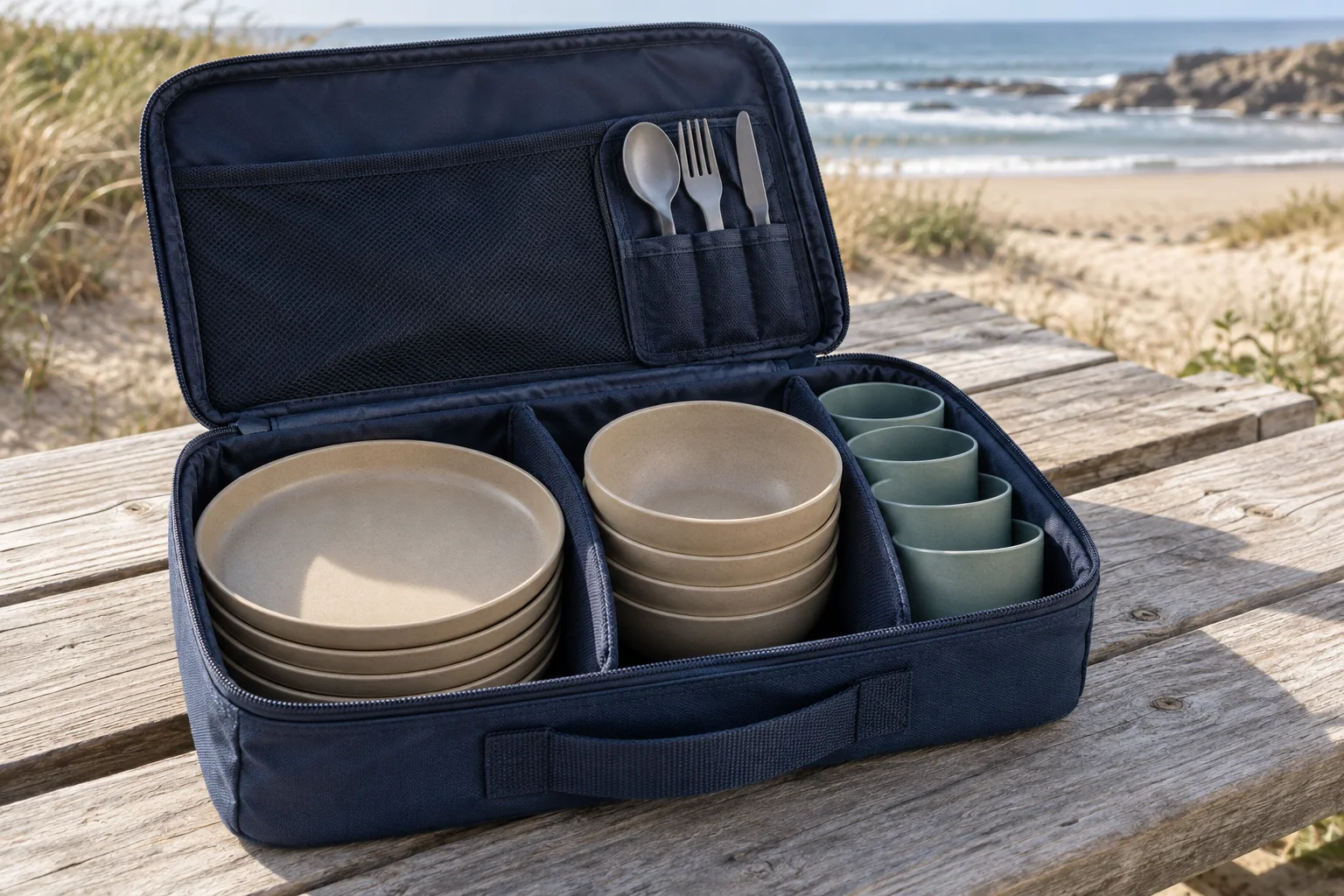
Apply the criteria to real B2B scenarios
Family car-camping retail set
Fast distribution and simple repacking may matter more than the smallest possible nested height. Separate plate and bowl stacks can make user counts visible, while cups and cutlery remain in dedicated zones. Use the family component-allocation table to prevent unnecessary shared pieces from complicating the stack.
RV and caravan program
Cabinet width, shelf height and drying space may constrain the architecture. A stable low stack can be preferable to a tall narrow column, even if both fit the same case. Review access inside the real storage zone and confirm that users do not need to lift unrelated items.
Rental fleet or guided group
Counting, loss detection and replacement can dominate the decision. Identical component columns and color-grouped place settings support different operating models. Select one and document the return sequence so mixed orientations do not create jamming or concealed missing pieces.
E-commerce bundle
A compact stack can reduce the product envelope, but transit packaging still needs controlled protection. Do not remove dividers or change the case merely to improve the product photo. The approved shipment configuration, artwork list and customer instructions must match the tested sales unit.
Limitations, misuse boundaries and commercial risks
No generic stackability check proves durability, drop resistance, food-contact compliance, heat resistance, stain resistance or dishwasher performance. Those claims need their own scoped methods and matching final-product evidence. This acceptance framework helps buyers define what to inspect; it does not certify any material or product.
Concept images cannot establish part count, dimensions, tolerance, availability or performance. They may help teams discuss interface logic, but controlled drawings, BOMs, approved samples and evidence files govern the project. Props and settings shown near dinnerware are not automatically included.
Commercial risk appears when the stack changes after packaging and artwork are approved. A small rim revision can alter incremental rise, case closure, carton dimensions and image accuracy. Use formal change control and repeat the affected checks before accepting a substitution.
Keep compliance evidence separate but configuration-specific
Stack geometry does not establish food-contact conformity. For EU-bound projects, buyers can start the evidence scope with Regulation (EC) No 1935/2004 and, where applicable to plastic components, Commission Regulation (EU) No 10/2011. United States programs should reconcile the final substances and intended uses with the FDA framework for food-contact substances.
These sources do not approve the pictured concepts. Evidence must match the final materials, colors, decorations, food types, contact duration and temperature conditions. If a stack mixes different materials or decorated surfaces, the evidence index should identify each final food-contact component rather than treating the set as one generic material.
Procurement workflow from brief to approval
- Freeze users, meals, component roles and controlled quantities.
- Define separate identical stacks, nested families and mixed transitions.
- Request component sections, contact maps and pack-order drawings.
- Measure first-piece height and incremental rise using one convention.
- Observe alignment, wobble and release in dry, damp and post-wash conditions.
- Review drainage, drying, full-case retention and closure clearance.
- Reconcile BOM, drawing revisions, approved samples, packaging and evidence scope.
- Repeat affected checks after any material, geometry, decoration or component change.
The output should be a signed stackability acceptance record, not a marketing adjective. Keep photographs connected to sample IDs and drawing revisions. Record observations and unresolved items separately so a conditional result is not mistaken for full approval.
B2B Buyer Checklist
| Check | Question | Why It Matters |
|---|---|---|
| Controlled stack | Which exact revisions and quantities are being approved? | Prevents a two-piece demonstration from representing a different saleable set |
| Contact surfaces | Where should pieces touch, and which surfaces must not touch? | Controls stability, abrasion, decoration and hygiene risk |
| Rise data | Are first-piece height and each incremental rise recorded? | Connects geometry to case and carton clearance |
| Release method | Can representative users separate pieces dry and damp? | Reveals wedging, suction and poor finger access |
| Alignment | Does lean follow a specific part, orientation or order? | Helps isolate warpage and tolerance accumulation |
| Drainage | Where can water remain after washing? | Prevents moisture being trapped in the stack or case |
| Pack retention | Does the complete listed set close and remain controlled? | Stops omitted parts and excessive closure pressure from hiding defects |
| Revision control | Which checks repeat after a geometry, material or decoration change? | Keeps approval evidence aligned with the shipped configuration |
Sequential buyer FAQs
1. Is a lower stack always better?
No. Lower incremental height can increase surface contact, suction, wedging or abrasion. Approve the smallest envelope that still provides reliable release, stability, cleaning access and intended eating geometry.
2. How many pieces should be tested?
Use the exact controlled quantity in each saleable configuration, plus any replacement or service condition the program requires. Do not infer a complete-set result from only two samples.
3. Can plates and bowls share one stack?
They can if the transition interfaces, unloading order and retention are deliberately defined. Compatibility to be confirmed by project sample and drawing.
4. What causes stacked bowls to stick?
Possible causes include wall interference, close wet surfaces, inadequate air entry, deformation or uncontrolled tolerances. Diagnose the actual interface before changing material or adding force.
5. Does a stackability result apply to every color?
Not automatically. Formulation, processing, surface finish and decoration can affect geometry and friction. Review the final production-representative variants included in the program.
6. Should the carry case compress the stack?
The case may retain components, but it should not be used to force an unstable or oversized stack into alignment. Define safe closure clearance and intended retention separately.
7. Does stackability prove transit performance?
No. It informs the pack architecture. Packaged-product handling and transit claims require a separate scope, configuration and method.
8. What should suppliers receive before quoting?
Send the component matrix, quantities, section drawings if available, stack order, case zone, materials, markets, artwork, packaging channel, acceptance checks and evidence requirements.
Request a stackability specification review
For a useful review, provide the target users and meals, full component list, quantities, existing drawings or samples, preferred stack order, case and carton constraints, materials, colors, artwork, destination markets, washing expectations and required evidence. Mark every unknown dimension or result as “To be confirmed for the project.”
Send the stack architecture and sample-review brief for a component, interface and evidence check. If you are still choosing components, use the project inquiry form to attach the meal matrix and proposed BOM before requesting drawings, samples or a documented quotation.