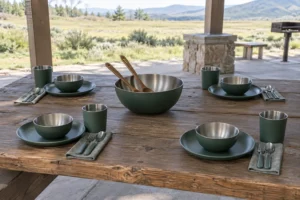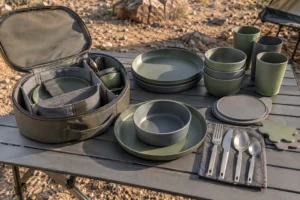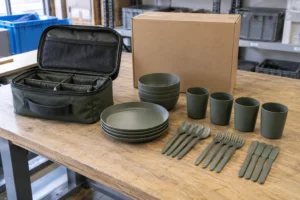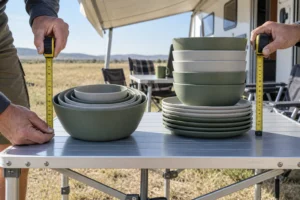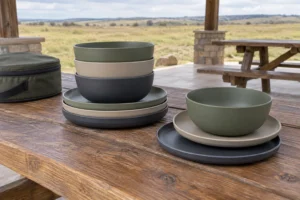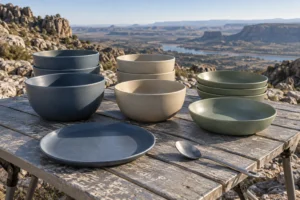
Deep vs shallow camping bowls should be decided by meal task, not appearance. Deep profiles better contain liquids and loose foods, while shallow profiles expose more usable eating area and often improve cutting, cooling and table access. A coherent outdoor set may need both, but each profile must earn its place through a meal matrix, packed-stack review and final-sample approval.
Start with the buyer decision, not a generic bowl label
“Deep” and “shallow” are relative descriptions. They do not tell a buyer the opening, usable base, wall angle, fill line, rim geometry or packed height. Two suppliers can use the same adjective for visibly different profiles, so the purchase brief needs measurable geometry and a declared meal function.
The practical decision is whether one profile can perform the planned tasks without creating problems in eating, carrying, cleaning or packing. If it cannot, define two controlled bowl roles. If it can, document the compromise and remove the redundant item from the set.
This comparison is about dinnerware. A bowl shown with hot food is not automatically cookware and must not be placed on a burner, stove or open flame unless product-specific evidence expressly permits that use. Intended food temperature, contact duration and user handling should be stated separately from direct-heating claims.
Convert the menu into a bowl-profile requirement
Begin with representative meals from the target channel. Soup, noodles, cereal, stew, rice dishes, grain salads, shared side dishes and snacks place different demands on the vessel. The buyer should list the food, portion direction, eating utensil, carrying distance and whether the bowl is individual or shared.
Do not use a marketing photo as the menu specification. A bowl that looks generous when empty may provide little accessible food area after the walls slope inward. Conversely, a wide shallow bowl can present a meal well but expose liquid to movement and wind.
The output should be a meal-to-profile matrix that accompanies the component list. This gives industrial designers, suppliers, packaging teams and compliance reviewers one shared explanation for why the profile exists. It also prevents an accessory from surviving only because it appeared in an early rendering.
Bowl-profile decision table
| Decision factor | Deep profile direction | Shallow profile direction | Buyer approval evidence |
|---|---|---|---|
| Primary meal tasks | Soups, noodles, cereal, loose or liquid-rich foods | Rice dishes, salads, pasta, shared sides and foods needing broad access | Representative meal trial and declared food list |
| Liquid containment | Higher wall and more vertical distance to rim can help during careful carrying | Lower wall provides less margin when moved or tilted | Loaded carry observation using the final fill direction |
| Utensil access | May constrain spoon angle or cutting when opening is narrow | Usually provides broader fork, spoon and knife approach | User trial with intended utensils and portions |
| Cooling and presentation | Smaller exposed surface may retain heat longer; no performance claim without a method | Broader exposed surface can change cooling and presentation | Project-specific observation under declared conditions |
| Stability | Depends on base footprint, wall angle, load and center of mass | Often permits a wider base, but profile alone does not prove stability | Final sample on representative outdoor tables |
| Cleaning and drying | Deep corners and narrow openings can reduce access | Broad interior may be easier to reach but occupies more drying area | Wash, rinse, drain and repack review |
| Nesting and packed height | Can create efficient diameter use but higher first-piece height | Can add less individual depth but a wider packed envelope | Section drawing and complete controlled pack-out |
| Shared serving | Useful where containment and passing are prioritized | Useful where visibility and access by several users matter | Table-layout and passing scenario |
The table is a decision aid, not a performance claim. Each project must set its own geometry, test conditions and acceptance statements. Unknown dimensions and outcomes should remain “To be confirmed for the project” until the buyer approves drawings and representative samples.
Compare opening, usable base and wall angle together
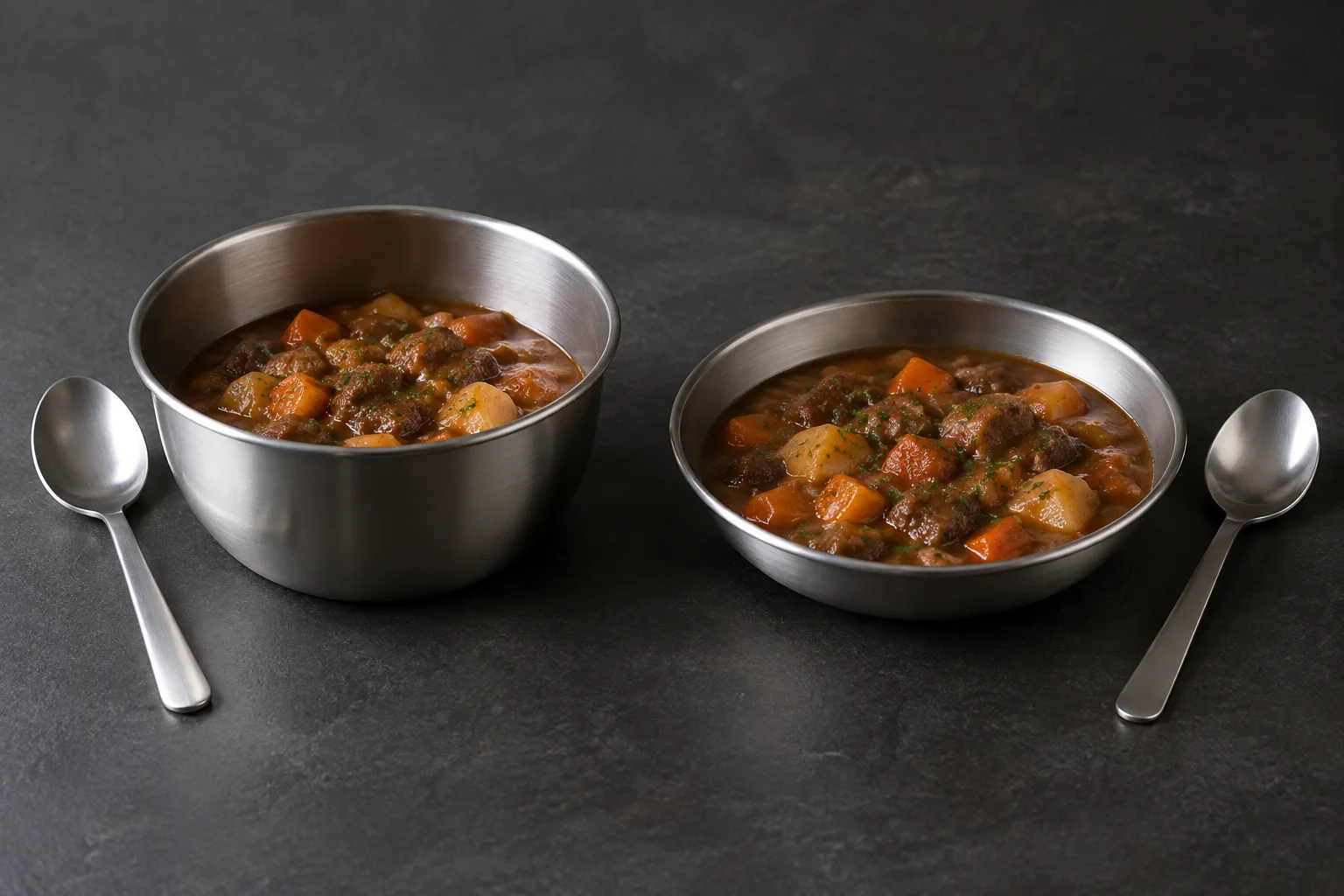
Outside diameter is only one boundary. The opening diameter affects access, the usable base supports food and the wall angle controls how quickly the interior narrows. A thick or rolled rim can also reduce usable opening even when the outside dimension stays unchanged.
Request a section drawing through the centerline. Mark outside envelope, inside opening, usable base, overall depth, rim height, foot geometry and the intended reference plane. If the bowl is oval or irregular, define both major and minor directions and state where each dimension is taken.
For comparison, ask every bidder to use the same measurement convention. Otherwise a supplier may quote opening diameter while another reports the maximum outside rim. The numbers may look comparable but describe different surfaces, creating errors in component fit and case design.
Deep profiles: where they add value
A deep bowl can provide vertical containment for soup, noodles and loose foods. The higher wall gives a user more distance between a normal fill level and the rim. That can be valuable when food is carried from a camp kitchen to a table, but it does not establish spill-proof performance.
Depth can also support compact diameter where table area is limited. A smaller opening may fit beside cups and shared dishes more easily. However, reducing opening too far can make it difficult to use a spoon, mix ingredients or retrieve food from the lower corner.
Deep bowls should be reviewed with the longest and widest intended utensils. Observe the approach angle, wrist position and whether the utensil handle contacts the rim. For noodles, check that users can lift and manage the food without the rim blocking the path.
A deep profile may suit individual liquid meals or a shared serving role, but those uses are not identical. A shared bowl needs table access from more than one direction and may be passed when loaded. Keep the intended allocation visible in the BOM and use instructions.

Shallow profiles: where broad access matters
A shallow bowl creates a broad eating surface while retaining more edge containment than a flat plate. It can serve rice dishes, pasta, salads and shared sides where users need to see, cut, mix or scoop across the vessel. This hybrid role can sometimes replace one plate, but only after representative meal trials.
Low walls usually allow utensils to approach from a wider range of angles. This can improve access at a crowded picnic table and may help users who prefer not to lift the bowl. Yet a broad opening can occupy more case width and expose liquids to movement.
Shallow profiles may also improve visual portion separation without molded compartments. A buyer should not infer a fixed capacity from that appearance. Actual capacity depends on interior geometry and the agreed fill reference, which should be recorded with the final drawing.
For shared food, review how several users reach the bowl and whether serving utensils remain inside without sliding. For personal meals, assess whether the low edge supports the planned food or increases spill risk during carrying. Different channels can reasonably reach different decisions.
Stability is a system property, not a depth claim
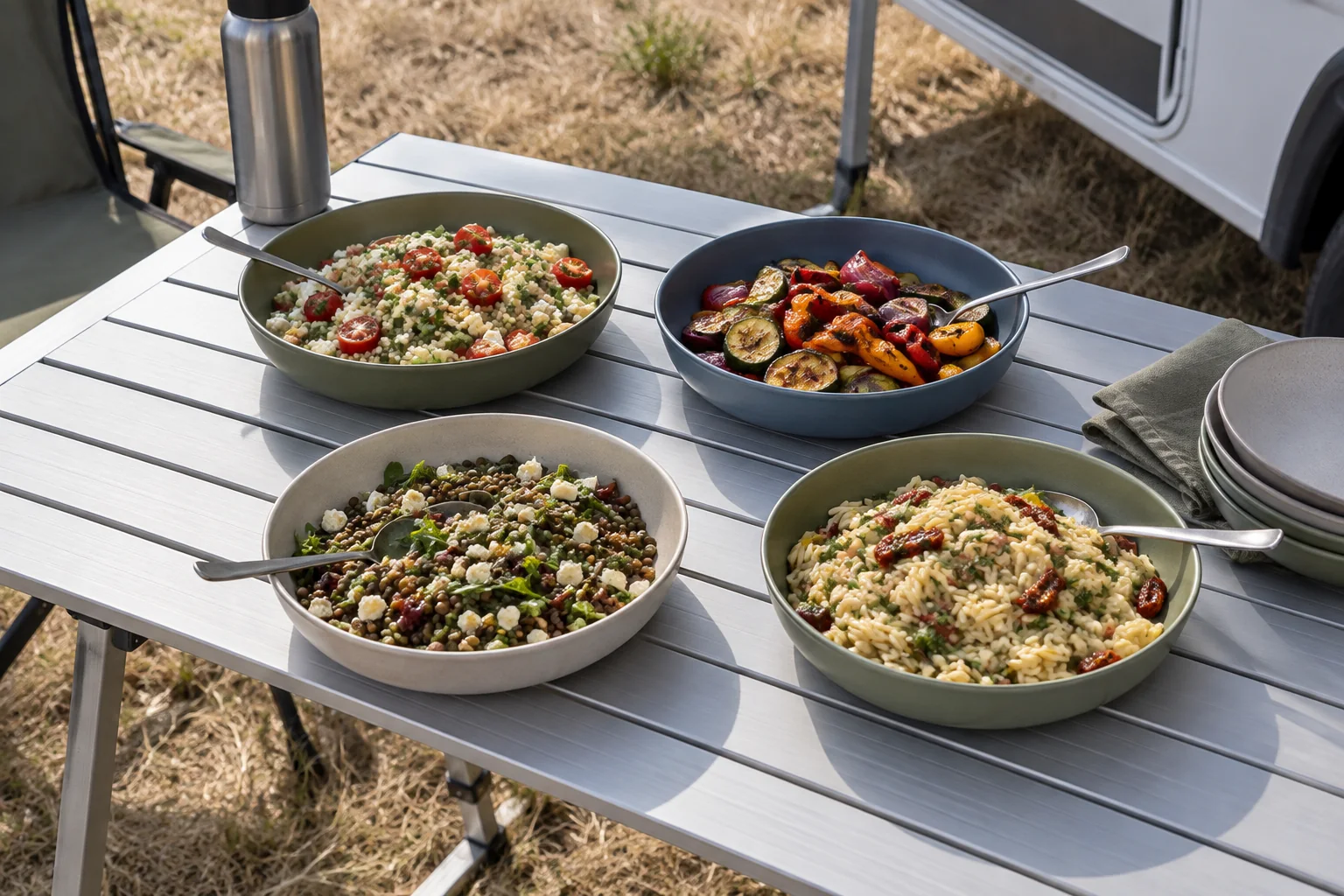
Deep bowls are not automatically unstable, and shallow bowls are not automatically stable. Base footprint, foot geometry, material stiffness, total mass, food position and surface condition all affect behavior. A tall wall combined with a narrow base can raise the center of mass, but the final sample must show the actual result.
Evaluate on representative tables: slatted campground surfaces, compact RV counters and stable outdoor trays. Record the surface, load, user action and observation. Avoid vague approval language such as “stable outdoors,” which cannot be audited later.
If the program targets children, guided groups or rental fleets, define the supervision and handling context. Colorful appearance does not establish suitability for a user group. The buyer should determine whether additional grip, base area or serving rules are needed.
Carrying and spill risk need a declared fill condition
A brim-full test is rarely representative of normal eating, but an undefined “normal portion” is not auditable. Set a project fill direction using representative food and leave a recorded freeboard. Then observe lifting, short-distance carrying, table placement and utensil use.
For soup or thin liquids, use the final bowl and intended temperature range only after safety conditions are established. For thick stews or cereals, the risk pattern may differ. Do not transfer one observation to every food type without explaining the scope.
Handles can change the decision, but this article compares bowl profile rather than handle design. If a handle is proposed, add it to the interface and pack-out review. It may improve one-handed carrying while increasing packed width or interfering with adjacent components.
Cleaning access and drying can reverse the choice
A deep bowl with a narrow opening can be harder to reach with a sponge or hand. Tight internal transitions may retain food, while external feet and nesting steps can retain water. Review the complete wash, rinse, drain, dry and repack sequence rather than a single clean appearance.
A shallow bowl exposes more surface and may be easy to wipe, but several wide pieces can occupy substantial drying area. In group settings, table and rack space may be the real constraint. Record how many pieces are washed together and how they are separated while drying.
Dishwasher suitability is a separate claim. The published guide to camping dinnerware dishwasher review explains why final materials, decorations, component positions and cycles need their own evidence. Bowl depth alone cannot establish the claim.
Nesting and stacking change the commercial result
Deep bowls can nest through their wall angle, but each added piece contributes incremental height and may wedge if contact surfaces are not controlled. Shallow bowls may stack with a lower individual rise but consume a larger diameter. Neither profile guarantees a smaller complete set.
Record first-piece height, incremental height, stack quantity and the complete mixed-stack envelope. Include plates, cups, lunch boxes, lids, dividers and the case. A bowl decision made outside the full pack-out can force late changes to packaging and artwork.
Use the camping plate and bowl size-system worksheet to keep related dimensions under one architecture. The bowl profile should connect to plate rim, cup clearance and case zones rather than becoming an isolated drawing.
Finger access also matters. Closely aligned rims can make a stack look efficient while leaving no reliable separation point. Confirm that intended users can remove each piece without tools and without unloading unrelated components.
One bowl profile or two?
A single profile reduces SKUs, tooling families, replacement complexity and packing decisions. It is attractive when the menu is narrow and the chosen geometry performs every important task acceptably. The buyer must still document which functions were combined and what limitations were accepted.
Two profiles can protect distinct meal roles. A deep personal bowl may handle soup and cereal, while a shallow bowl supports rice dishes or shared sides. The extra component should justify its packed volume, cost line, evidence scope and replacement plan.
Do not create two profiles merely to make the set look complete. Start with the component matrix in the guide to camping dinnerware set components. If both bowls map to the same users and meals, challenge the duplication before requesting samples.
Scenario decisions for common B2B programs
Family car-camping retail set
A family program may benefit from one deep individual bowl and one shallow shared piece, but piece count can escalate quickly. Use the family camping set allocation guide to distinguish personal and shared quantities. Confirm that the packed case still reflects the shelf claim.
RV and caravan kitchen program
Table area, cabinet width and drying space may favor a compact coordinated profile. A shallow bowl can provide meal versatility, while deep bowls can protect liquid foods during movement between counter and table. Review actual storage and service sequence.
Guided tour or rental fleet
Inventory control, cleaning access and replacement identification may outweigh presentation. A single robust profile can simplify counting, but it must still suit the planned meals. Assign component codes and avoid promising future availability without a written supply arrangement.
Outdoor catering or event bundle
Broad access and table presentation can make shallow bowls useful for shared sides, while deep bowls may be assigned to soup service. The buyer should define carrying distance, serving utensils, return collection and wash flow. A lifestyle image cannot replace that operational brief.
Food-contact evidence must match the final bowl
Geometry selection does not establish compliance. For EU-bound projects, the buyer should use Regulation (EC) No 1935/2004 as the starting point for defining the food-contact evidence package; bowl geometry alone cannot demonstrate conformity. For applicable plastic components, Commission Regulation (EU) No 10/2011 contains material-specific requirements and migration concepts.
For United States projects, buyers should reconcile final substances and intended uses with the FDA framework for food-contact substances. These sources do not approve a generic deep or shallow camping bowl.
Evidence scope must match the final material, color, decoration, food type, time and temperature conditions. A report for one uncolored sample does not automatically cover another formulation or decoration. Map each final component code to the supporting records and open questions.
Commercial risks to resolve before quotation
Nominal size hides the usable interior
Quotations based only on outside diameter can compare unlike items. Require the opening, usable base, depth and section profile. State whether dimensions are targets, limits or references.
One sample is treated as every material
Wall thickness, stiffness, surface and production variation can change handling and nesting. Do not approve a final claim from a visual sample made in another material. Reconcile the approved construction and evidence level.
The case is frozen before the bowl
A preset cavity can force the wall angle or diameter into an unsuitable compromise. Freeze meal roles and bowl interfaces before approving case inserts, carton artwork or tooling decisions.
Shared and personal bowls are counted inconsistently
Marketing, BOM and quotation can show different piece totals when shared bowls or lids are counted differently. Define the sales-unit counting rule and keep it consistent across packaging and product data.
Procurement recommendation
Issue one bowl-profile worksheet containing meal task, user allocation, outside envelope, opening, usable base, depth, wall angle, rim, foot, intended fill, utensil, stack quantity and case zone. Ask suppliers to return the same worksheet with assumptions marked, not buried in an email.
Approve geometry in stages: drawing, appearance sample, meal-use sample and full pack-out. Record which questions each stage answers. Keep tooling, decoration and packaging approvals conditional until the component interfaces are stable.
If one profile can serve the defined meals without unacceptable trade-offs, simplify. If two profiles solve genuinely different tasks, preserve both but control their packed relationship and evidence separately. The buyer’s final output should be a signed decision table, not a subjective note that one bowl “looks better.”
B2B Buyer Checklist
| Check | Question | Why It Matters |
|---|---|---|
| Meal role | Which food and user task justifies each bowl profile? | Prevents redundant pieces and vague assortment growth. |
| Measurement basis | Are opening, usable base, depth and outside envelope all defined? | Makes supplier drawings and quotations comparable. |
| Utensil access | Can intended spoons, forks or knives reach the food comfortably? | Depth and wall angle can obstruct real use. |
| Fill and carry | What representative portion and carrying action will be reviewed? | Containment cannot be judged from an empty bowl. |
| Stability | What base, load and table surfaces form the approval condition? | A depth label does not prove stability. |
| Cleaning | Can users wash, rinse, drain, dry and repack every surface? | Interior transitions and stack steps may retain food or water. |
| Pack-out | What is the complete controlled stack with all set components? | Prevents an isolated bowl decision from breaking the case or carton. |
| Evidence scope | Do records match final material, color, decoration and intended use? | Generic material statements do not cover the saleable set. |
| Revision control | Are drawings, BOM, sample, artwork and packaging on the same revision? | Stops an unreviewed profile change from reaching production. |
Sequential buyer FAQs
1. Is a deep camping bowl always better for soup?
It often provides more vertical containment, but opening, fill level, base stability and utensil access also matter. Approve the final profile with representative soup and handling conditions rather than relying on depth alone.
2. Can a shallow bowl replace a plate?
It may replace a plate when the planned meals, cutting needs, rim height and packing target support the combined role. Document the tasks that were tested and the limitations accepted before removing the plate.
3. How should buyers compare bowl capacity?
Use an agreed method and fill reference on the final geometry. Brim capacity, recommended food fill and usable meal portion are not the same. Do not compare unqualified capacity numbers from different suppliers.
4. Which profile nests more efficiently?
Either can be efficient depending on wall angle, foot, rim, stop surfaces and quantity. Measure first-piece height, incremental height and the complete mixed-stack envelope. Compatibility to be confirmed by project sample and drawing.
5. Does a wider bowl make outdoor eating easier?
It can improve utensil access and food visibility, but it also occupies more table and case area. Evaluate the full table layout and packed set rather than the bowl alone.
6. Are deep bowls harder to clean?
Narrow openings and tight transitions may reduce access, but actual cleaning depends on final geometry, surface, food and method. Run a representative wash-and-dry review before making a claim.
7. Should a family set include both profiles?
Only when they serve distinct meal or shared-serving roles. Map quantities to users, challenge overlap and verify that the extra profile earns its packed volume and replacement complexity.
8. What should be sent with an RFQ?
Provide user count, meal list, personal/shared allocation, profile worksheet, material direction, intended markets, cleaning context, stack and case targets, artwork needs and evidence requests. Mark unknowns clearly.
Request a bowl-profile specification review
Send Naike Dinner your meal matrix, users, desired component quantities, deep and shallow profile references, intended materials, destination markets, cleaning conditions, case target, artwork and evidence requirements. We can separate confirmed inputs from project questions before a documented drawing, sample or quotation review.
Request a deep-versus-shallow bowl review. Attach your worksheet through the same project inquiry form so the response can address meal tasks, geometry, pack-out and evidence scope together.