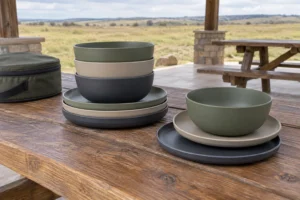
Direct answer: Choose camping plate and bowl sizes together by mapping real meals, usable food area, liquid depth, hand access and the final packed envelope. Start with functions rather than familiar household diameters. Approve a coordinated size ladder only after representative food trials, nesting checks, case clearance and evidence review confirm that every component works in the intended set.
A buyer selecting camping plate and bowl sizes is not choosing two isolated catalog items. The plate rim, bowl depth, base foot, wall angle and stack order interact with serving tasks, carry volume, stability, cleaning, decoration and replacement planning. A dimension that looks reasonable on a product sheet can fail when the complete system is assembled.
This guide produces a size architecture worksheet rather than a universal diameter recommendation. It does not confirm a Naike Dinner stock combination or promise that any illustrated geometry is available. Every example is buyer guidance that must be converted into controlled drawings, a component BOM, representative samples and written intended-use conditions.
Define meal tasks before discussing dimensions
Begin with what the user must do: carry a main meal, hold soup, contain cereal, serve snacks, share salad or store leftovers. The same nominal diameter can produce very different usable capacity because rim width, wall slope, corner radius and base geometry consume space. A size brief should therefore describe the task and the critical internal surfaces, not only an outside dimension.
Map every planned meal against the component expected to perform it. If a shallow bowl is supposed to replace both a plate and a soup bowl, state which foods, portions and handling conditions make that substitution acceptable. If the channel expects a separate plate and bowl, keep those functions distinct even when reducing the piece count appears attractive.
Use the published guide to define camping dinnerware set components before creating the size ladder. Then compare the allocation logic in shared and individual family-set pieces. Those records prevent a size discussion from hiding a missing function or an incomplete user setting.
Camping plate and bowl sizes: build a size architecture worksheet
The worksheet below separates buyer inputs from dimensions that remain to be confirmed. It can be issued with an RFQ and updated at drawing, sample and golden-sample stages. Do not fill unknown cells with values copied from unrelated products.
| Component | Primary meal task | Size fields to control | Relationship to other pieces | Approval evidence |
|---|---|---|---|---|
| Main plate | Main course, divided or mixed meal | Outside envelope, usable food area, rim width, wall height, base footprint | Must stack consistently and fit the declared case zone | Drawing plus representative meal and pack-out review |
| Shallow bowl | Pasta, salad, curry, breakfast or mixed meal | Top opening, usable depth, base area, wall angle, rim profile | May nest above or below the main plate without locking | Filled handling trial and nested-stack sample |
| Deep bowl | Soup, cereal, fruit or smaller portion | Opening, internal depth, stable base, hand clearance, fill reference | Must not create excessive stack height or trap moisture | Food-task review, cleaning check and packed sample |
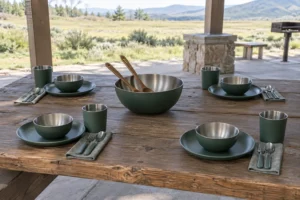
| Shared serving bowl | Group service or central food holding | Usable volume direction, opening, reach, base stability | Should justify its larger envelope and have a named storage position | Table-layout trial and complete-set pack review |
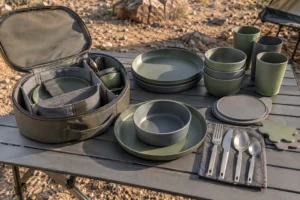
| Carry case zone | Transport and retention | Internal length, width, height, divider and closure clearance | Receives the complete dry component stack in an approved order | Case drawing, loaded sample and closure record |
The worksheet intentionally avoids a single “standard” size. Buyers can add target ranges after reviewing channel, meal and pack requirements, but final numbers remain project-specific. One drawing should identify whether each value is an outside maximum, an inside opening, a usable food area or a packed-stack dimension.
Separate outside size from usable food area
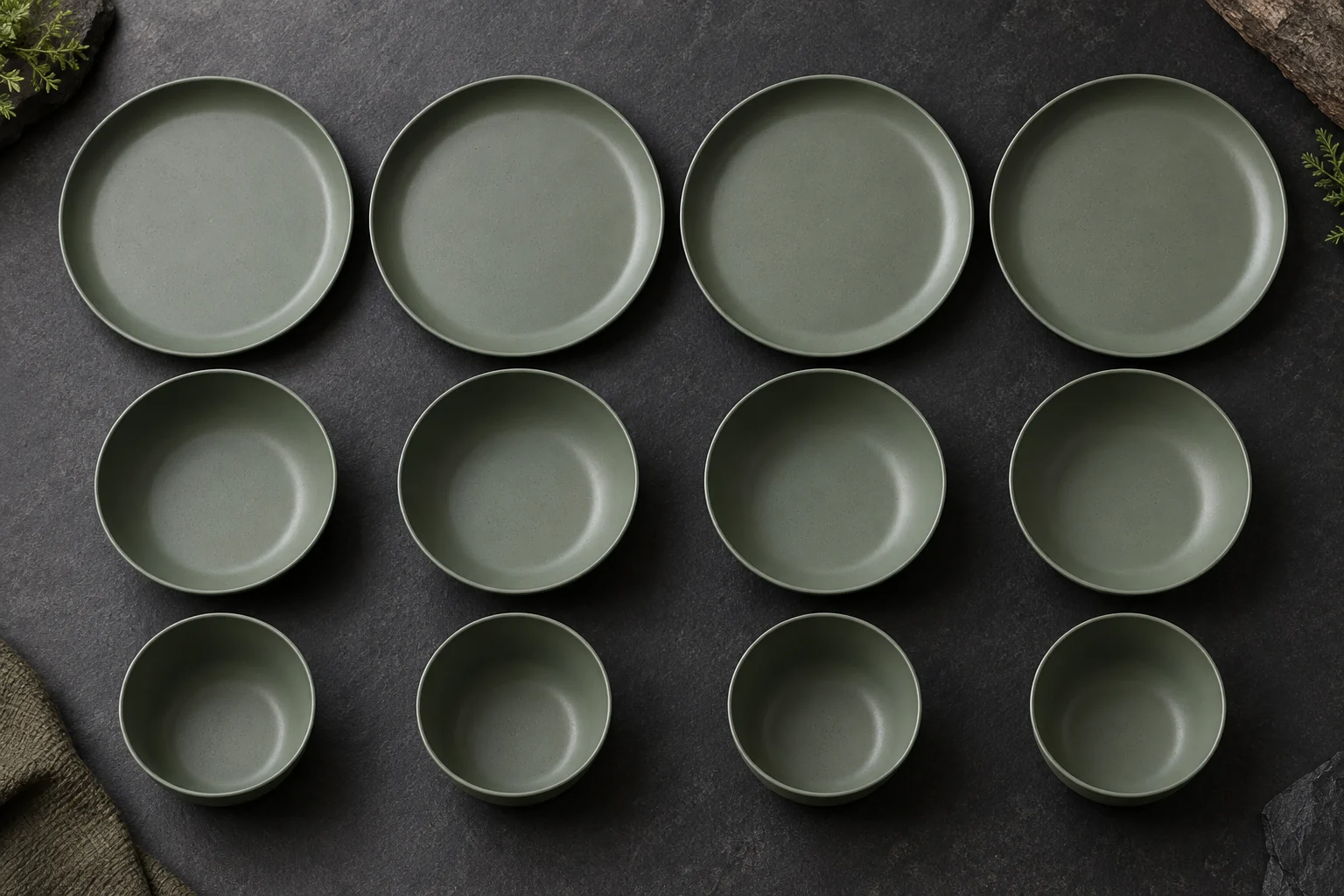
Outside diameter or width determines shelf, carton and case fit, while usable food area determines meal performance. A broad decorative rim can make a plate appear large without providing corresponding food space. A narrow rim can improve usable area but may reduce grip or spill control for the intended user.
Record both values. For non-round shapes, define the measurement direction and corner treatment so suppliers do not compare a diagonal dimension with a side-to-side dimension. If the plate has compartments, document usable area and depth by compartment because the outer envelope says little about portion separation.
Do the same for bowls. The top opening affects access, while the base area and wall angle influence stability and the amount of food that sits at the bottom. A buyer should not infer usable capacity from an outside diameter or from an image containing food.
Use a size ladder instead of unrelated components
A coordinated size ladder establishes deliberate steps between large plates, medium shallow bowls and smaller deep bowls. The steps should support function, nesting and visual coherence. They should not be created simply by selecting three nearby catalog sizes.
Write the ladder as relationships: the smaller component sits inside a defined upper opening; the rim remains accessible; the base does not wedge against the next wall; and the stack stays within the case envelope. Relationship language allows engineering review before final dimensions are frozen.
The ladder also supports range planning. A retailer may sell a core set and later add replacements or serving pieces. Consistent design language and documented interfaces help those extensions look intentional without promising cross-generation compatibility that has not been sampled.
Plate geometry changes the effective size
Rim width and wall height
A plate with a raised wall can contain sauces better than a flat plate, but the wall may reduce usable area and change stacking clearance. A wide rim may help carrying and presentation while increasing the outside envelope. Review rim decisions with representative meals and the intended hand position.
Do not call a rim “spill proof” or “easy grip” without a defined claim and evidence. Instead, describe the geometry, the user task and the acceptance observation. The project sample should show whether food can be cut, scooped and carried under the declared conditions.
Round, square and rounded-square formats
Round pieces can provide predictable rotational nesting, while rounded-square forms can use rectangular case space differently. Corners may add usable zones or introduce pressure points, depending on geometry. The correct choice depends on the carry case, table area, styling direction and molding feasibility.
Never compare shape families using only their widest dimension. Record side-to-side, diagonal or diameter references consistently, then evaluate the actual occupied envelope. A rounded-square plate can have a smaller side dimension but a diagonal that controls case fit.
Bowl depth changes handling, cleaning and packing
A deeper bowl can support liquid or loose food tasks, yet additional depth raises the packed stack if the pieces do not nest efficiently. It can also change spoon access, visibility and drying. Depth is therefore a functional variable and a pack-out variable at the same time.
A shallow bowl may bridge plate and bowl tasks, but that versatility must be demonstrated with the actual menu. Buyers should not replace a dedicated soup bowl merely to simplify the BOM if the resulting profile makes carrying liquid impractical. Conversely, a deep bowl should not be added when the channel has no meal that requires it.
Control internal depth separately from total height. Base feet, rim steps and exterior contours add height without increasing food space. For nesting, record how much vertical height each additional identical piece contributes after the first piece.
Translate user scenarios into size priorities
Family car camping
Family car-camping programs may accept a larger envelope in exchange for complete individual settings and a useful shared bowl. Table crowding and easy allocation can matter more than minimal pack size. Test the full set on the smallest realistic table rather than a large styling surface.
RV and caravan kitchens
An RV program must consider cabinet, drawer, sink and drying-space limits. Outside dimensions may need to align with storage zones, while bowl depth should still support the intended meals. Do not assume a household plate size fits compact mobile storage.
Rental, tour and group use
Rental operators need easy counting, stable stacks and replacement identification. Closely similar sizes can create sorting mistakes, while overly different sizes may waste space. Use distinct component codes and a return-count layout so size families remain recognizable.
Retail shelf and e-commerce bundles
Retail sets must reconcile the product promise with a visible, packable component mix. E-commerce adds parcel and handling constraints, but the smallest outer carton is not automatically the best user system. Establish product function first, then optimize the approved geometry and protective pack.

Measure packed height as an incremental system
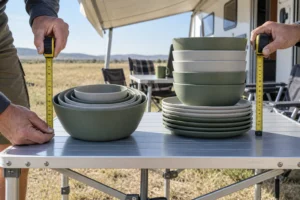
A stack of four plates is not necessarily four times the height of one plate. Properly designed identical pieces overlap, so the first piece establishes a base height and each additional piece adds an incremental height. Bowls can behave differently because wall angle, foot ring and rim steps determine how deeply they enter one another.
Ask the drawing to identify the contact surfaces that stop each nested piece. Those points control incremental height, friction and the risk of wedging. A rendered image cannot establish clearance, and a loose sample from another mold cannot approve the final interface.
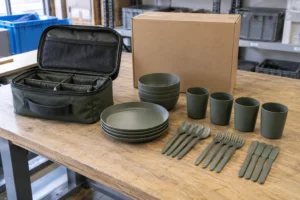
Record the complete dry stack in the exact order intended for packing. Include dividers, sleeves and lids in a separate controlled line. If the system changes from four to six users, recalculate the incremental stack rather than adding a rough percentage.
Protect finger access and avoid locked stacks
A compact nest is useful only if users can separate the pieces. Provide accessible rim offsets or another deliberate removal feature. Closely aligned rims can look tidy but may be difficult to grip, especially when the components are wet or cold.
Review vacuum or surface adhesion risk where broad smooth surfaces approach one another. The appropriate solution depends on shape, texture, vent paths and material behavior. Do not add arbitrary bumps or channels before confirming their effect on cleaning, appearance, tooling and the final fit.
Define acceptance in observable terms: components separate without tools, no unrelated pieces must be unloaded first, and intended users can identify the removal sequence. If a force limit or cycle claim is required, create a project-specific method and approval value rather than inventing one.
Stability must be evaluated on realistic outdoor surfaces
Large outside size does not guarantee stability. Base footprint, center of mass, food position and table condition all matter. A deep bowl with a narrow base can occupy little pack area but may be less forgiving on slatted or uneven tables.
Use representative surfaces from the intended channel: picnic-table boards, compact RV counters or stable outdoor trays. Keep loose ground and direct-fire contexts outside dinnerware evaluation unless the product brief specifically addresses them. Dinnerware must never be implied to be cookware or flame suitable without product-specific evidence.
Record the observation and the surface. “Stable outdoors” is too broad for a specification. A buyer-friendly record states what component, load condition, surface and user action were reviewed, while reserving any formal performance claim for an agreed test.
Cleaning access can disqualify an efficient size
Deep profiles and narrow transitions may retain food or water. Rim steps that improve nesting can create cleaning zones. Evaluate washing, rinsing, drying and repacking using the final surface and geometry, not a generic material assumption.
Machine-washing suitability is a separate claim. The published guide on camping dinnerware dishwasher review explains why every relevant component and condition must be included. A coordinated size system cannot inherit a dishwasher claim from one sample or one material name.
If pieces pack while wet, define whether drainage, separation or a removable textile component is required. Do not imply antimicrobial or odor resistance from a vented case. Those claims require their own evidence and final-product scope.
Food-contact evidence follows the final size and construction
Size selection does not establish compliance, but geometry can affect intended use and test planning. In the European Union, Regulation (EC) No 1935/2004 provides the general framework for materials intended to contact food. It does not approve a generic camping set or any size shown here.
For plastic food-contact materials, Commission Regulation (EU) No 10/2011 contains material-specific requirements and migration concepts. For United States projects, the FDA describes its framework for food-contact substances. Buyers must match records to the final material, color, decoration, food type, time and temperature conditions.
A deeper bowl may be intended for different foods or contact conditions than a dry-snack plate. Capture those intended uses in the evidence matrix. Do not treat one declaration or test report as covering every component unless its scope clearly matches the final set.
Compare candidate systems with a decision table
| Decision dimension | Compact size ladder | Meal-led size ladder | Buyer question |
|---|---|---|---|
| Primary objective | Reduce packed envelope | Protect distinct meal functions | Which functions can genuinely share one vessel? |
| Plate usable area | May be constrained by case width | Derived from representative main meals | What food area remains after rim and compartments? |
| Bowl depth | Limited to preserve nesting height | Selected for liquid and spoon-access needs | Which planned food requires this profile? |
| Nesting relationship | Strong priority | Balanced with access and cleaning | Can pieces separate and dry under intended use? |
| Range expansion | Fewer closely related forms | Distinct roles and optional serving pieces | Which replacements or add-ons need interface control? |
| Main commercial risk | Functions compromised to fit the case | Larger carton and more component complexity | Has the buyer approved the trade-off in writing? |
Neither column is automatically correct. A backpacking-oriented system may favor a compact ladder, while a family retail program may protect meal functions. The decision record should state which objective won and what evidence supports it.
Common specification failures and commercial risks
Using only nominal diameter
Two plates with the same nominal diameter can have different usable areas and packed envelopes. This creates quotation mismatch and late-stage meal failures. Require a dimensioned section and agreed measurement convention.
Copying household proportions
Household dinnerware is not automatically suited to camping storage, handling or transport. Familiar proportions can exceed the case or crowd a picnic table. Treat household items as visual references only unless their geometry is intentionally adopted and sampled.
Optimizing the case before the meal
A preset case can force every food vessel into an arbitrary footprint. The resulting set may pack efficiently but fail its primary tasks. Freeze meal functions and user allocation before finalizing case cavities and dividers.
Assuming visual fit equals compatibility
Components can appear to nest while contacting at the wrong surfaces or trapping one another. Compatibility to be confirmed by project sample and drawing. Use interface sections, a loaded sample and an approved pack sequence.
Changing one size without revision control
A minor rim or foot change can alter stack height, case clearance, artwork position and evidence scope. Link every component drawing to the BOM revision. Repeat affected checks after any change rather than treating it as cosmetic.
Procurement sequence for approving the size system
Step 1: freeze users, meals and channels
State the user count, meal examples, serving method, cleaning context, carry mode and sales channel. Identify individual and shared pieces. Do not ask suppliers to choose sizes from a vague request for a “complete set.”
Step 2: issue the worksheet with measurement definitions
For each component, define which outside, inside and usable dimensions matter. Mark unknown values “To be confirmed for the project.” Ask the supplier to return assumptions visibly rather than silently changing the measurement basis.
Step 3: review drawings as a connected family
Overlay or compare sections for every intended stack and nest. Check rim access, foot contacts, incremental height, case envelope and divider zones. Review component codes and revision numbers at the same meeting.
Step 4: run representative meal and table trials
Use the foods and portions that matter to the channel. Observe usable area, spoon and fork access, carrying, passing shared dishes and table crowding. Convert observations into clear acceptance notes rather than broad adjectives.
Step 5: approve the complete dry pack-out
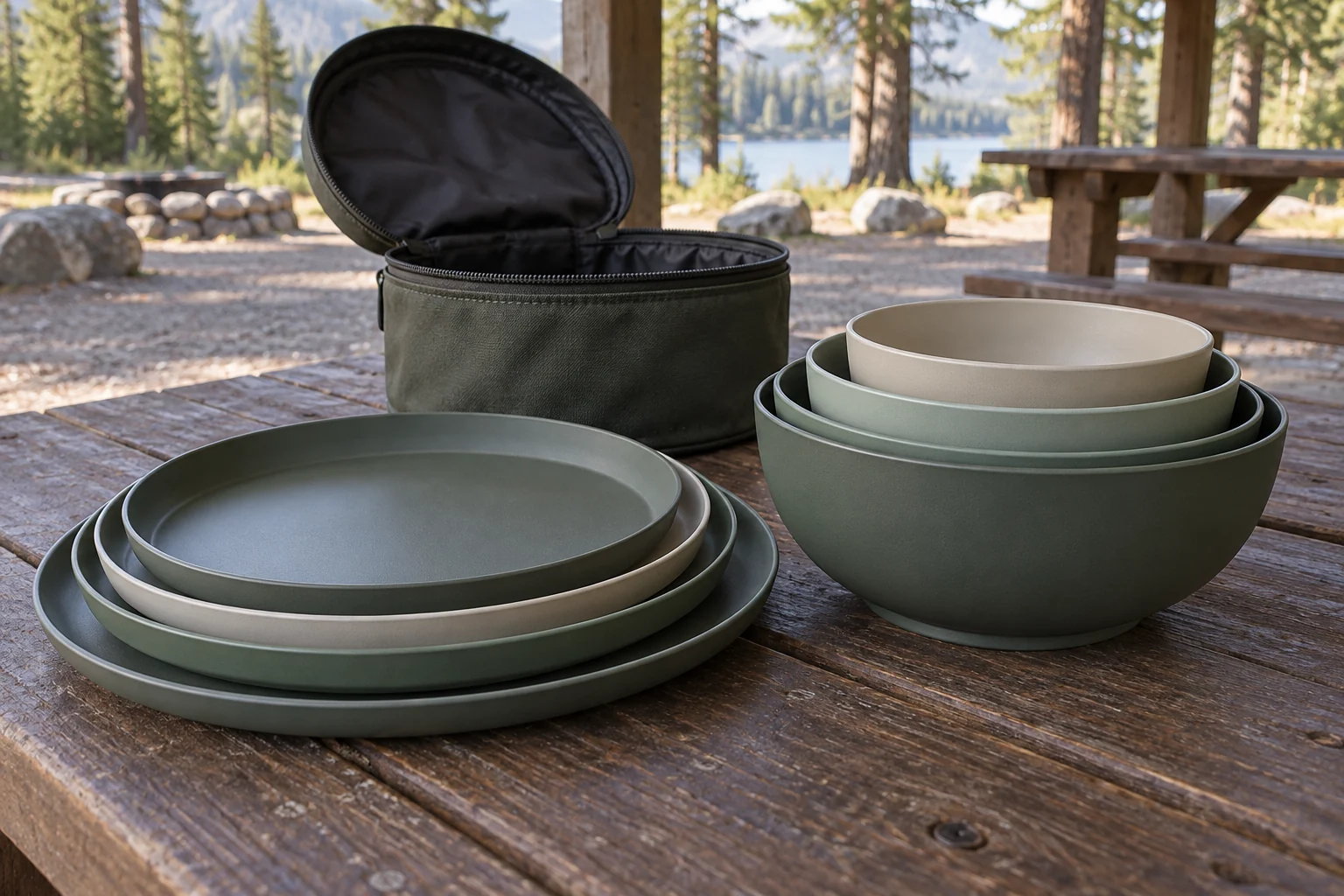
Pack the exact quantity in the controlled order with every divider, sleeve and case component. Confirm closure, access, orientation and identification. Photograph the approved arrangement for recognition, while keeping drawings and BOM as the controlling records.
Step 6: reconcile evidence, artwork and packaging
Match food-contact records to final materials and intended uses. Check that decoration stays within approved areas and that packaging images show the approved component count and proportions. Any later size change should trigger a documented review of all affected files.
B2B Buyer Checklist
| Check | Question | Why It Matters |
|---|---|---|
| Meal map | Which planned food task belongs to each plate and bowl? | Prevents accessories without a justified use. |
| Measurement basis | Are outside, opening, usable and packed dimensions clearly distinguished? | Makes quotations and drawings comparable. |
| Usable area | How much working food area remains after rim and compartments? | Nominal size can overstate meal capacity. |
| Depth | Does each bowl profile suit its food and utensil access? | Balances liquid handling with cleaning and packing. |
| Nesting | Where do pieces contact, stop and remain accessible? | Reduces wedging and unexpected stack height. |
| Case envelope | Does the complete controlled quantity fit with dividers and closure clearance? | Prevents a component-only approval from failing at assembly. |
| Evidence scope | Do records match every final material, color, decoration and use? | A generic statement does not cover the complete set. |
| Revision control | Are BOM, drawings, artwork and sample levels aligned? | Stops an unreviewed size change reaching production. |
Sequential buyer FAQs
1. Is there one standard camping plate diameter?
No universal diameter fits every program. Meal tasks, usable food area, user group, case size and channel determine the direction. Request a worksheet and drawing rather than copying a number from an unrelated item.
2. Should the bowl fit inside the plate?
Only if that relationship supports the intended pack order without wedging, unstable contact or poor access. A bowl may nest with other bowls and stack beside plates instead. Compatibility to be confirmed by project sample and drawing.
3. Can one shallow bowl replace a plate?
It can be evaluated when representative meals and users support the combined function. The decision should consider cutting, scooping, liquid control, usable area and cleaning. Do not make the substitution only to reduce piece count.
4. How should irregular shapes be measured?
Define the measurement direction in the drawing, including side-to-side, diagonal, opening and outside envelope where relevant. Use the same convention for every quotation. Add a section view for wall, rim and base relationships.
5. Does a deeper bowl always hold more?
Not necessarily. Opening, wall angle, base area and rim geometry affect usable volume. Capacity and intended fill should be confirmed with the final geometry and an agreed method rather than inferred from total height.
6. How can buyers control stack height?
Record the first-piece height, incremental height for each additional identical piece and the complete mixed-stack envelope. Identify the stop surfaces in drawings. Confirm the final quantity with a loaded case sample.
7. Can existing plates and bowls be combined with a new case?
Existing components can be assessed, but their actual drawings, samples and revisions must be checked against the case. A visually similar part may not fit. Case tooling or inserts should not be approved before the component stack is frozen.
8. What information is needed for a size-system review?
Provide users, meal examples, desired components, individual/shared allocation, material direction, target markets, cleaning context, carry and carton limits, styling references and evidence requests. Attach any existing drawings or samples and label all unknowns clearly.
Request a plate-and-bowl size architecture review
Send Naike Dinner your user count, meal map, component matrix, shape direction, packed-envelope target, destination markets, cleaning assumptions, artwork areas and evidence requirements. We can separate confirmed inputs from project questions before a documented sample or quotation review.
Request a camping plate and bowl size review. For a faster technical response, use the same contact form to attach the size worksheet, drawings and intended pack sequence.