
Last Updated:
Direct answer: Hold rental camping dinnerware spare parts from observed component loss and write-off rates, not a universal percentage. For each component, calculate demand through the next approved replenishment, add a buyer-selected service buffer, subtract usable and approved inbound stock, then round up to the actual purchase-pack multiple. Recalculate after every defined operating cycle.
This is a buyer-entered planning model, not a stock, availability or performance promise. It separates plates, bowls, cups, cutlery, cases and lunch boxes because their loss, damage, interface and replenishment patterns can differ. Materials, compatibility, evidence, MOQ, price and lead time remain project-specific.
1. Define eight rental camping dinnerware spare parts inputs
Use one row per controlled component and one consistent operating cycle, such as a rental turn, month or event batch. Do not mix cycles in the same calculation. The model needs deployed component count (D), observed losses (L), observed write-offs (W), observed cycles (C), replenishment review cycles (R), service-buffer cycles (S), purchase-pack multiple (P), usable on-hand stock (O) and approved inbound stock (Q). Although nine symbols appear, L and W are recorded as two outcomes within the observed-incident input.
Link every row to a released component identity. The camping dinnerware BOM revision register helps keep the model tied to the correct part, while the replacement-parts service matrix covers identification, packaging and compatibility decisions.

2. Copy the rental camping dinnerware spare parts calculation
| Step | Calculation | Buyer decision or evidence |
|---|---|---|
| Observed event rate | r = (L + W) / (D × C) | Use counted losses and approved write-offs; do not include repairable or quarantined pieces until disposition is decided. |
| Demand until review | d = D × r × R | R must cover the interval until the next quantity can be reviewed and approved. |
| Service buffer | b = D × r × S | S is a buyer-selected policy input, not an industry benchmark. |
| Preliminary need | n = d + b − O − Q | Count only usable on-hand and approved inbound stock for the same revision. |
| Order quantity | order = max(0, ceil(n / P) × P) | Round to the confirmed purchase-pack multiple only after compatibility and commercial review. |
If D or C is zero, do not calculate a rate. Mark the rental camping dinnerware spare parts row “insufficient history,” choose a clearly provisional buyer quantity, and set a review date. If a fleet changes component revision or operating conditions, begin a new observation series rather than blending incompatible history.
3. Rental camping dinnerware spare parts example
The following numbers are deliberately hypothetical and do not describe Naike inventory, a customer fleet or an expected failure rate. Assume a buyer records 400 bowls deployed for 12 cycles, 18 lost, 6 written off, a six-cycle review interval, a two-cycle service buffer, 20 usable spares, 8 approved inbound bowls and a purchase pack of 12.
| Calculation | Substitution | Result |
|---|---|---|
| Observed rate | (18 + 6) / (400 × 12) | 0.005 events per deployed bowl per cycle |
| Review demand | 400 × 0.005 × 6 | 12 bowls |
| Buffer | 400 × 0.005 × 2 | 4 bowls |
| Preliminary need | 12 + 4 − 20 − 8 | −12 bowls |
| Rounded order | max(0, ceil(−12 / 12) × 12) | 0 bowls for this review |
A zero output does not approve inaction forever. It means current buyer-entered stock covers the modeled review and buffer window. Recalculate at the next defined cycle and investigate sudden changes separately.
4. Use a rental camping dinnerware spare parts matrix
| Component group | Count separately because | Approval checkpoint |
|---|---|---|
| Plate | Loss and edge damage may differ from bowls | Diameter, stack height, finish and pack position |
| Bowl | Nesting and return handling create a distinct history | Depth, nesting release and case closure |
| Cup | Shared-use disappearance can differ from breakage | Handle/profile, storage position and intended use |
| Cutlery group | Individual utensils can be lost independently | Profile, count, sleeve or tray fit and edge control |
| Lunch box or lid | Interface-sensitive parts can become revision-specific | Compatibility to be confirmed by project sample and drawing. |
| Case, insert or divider | One change may move several component positions | Loaded pack-out, closure and released BOM revision |
5. Sort every return before updating the rate
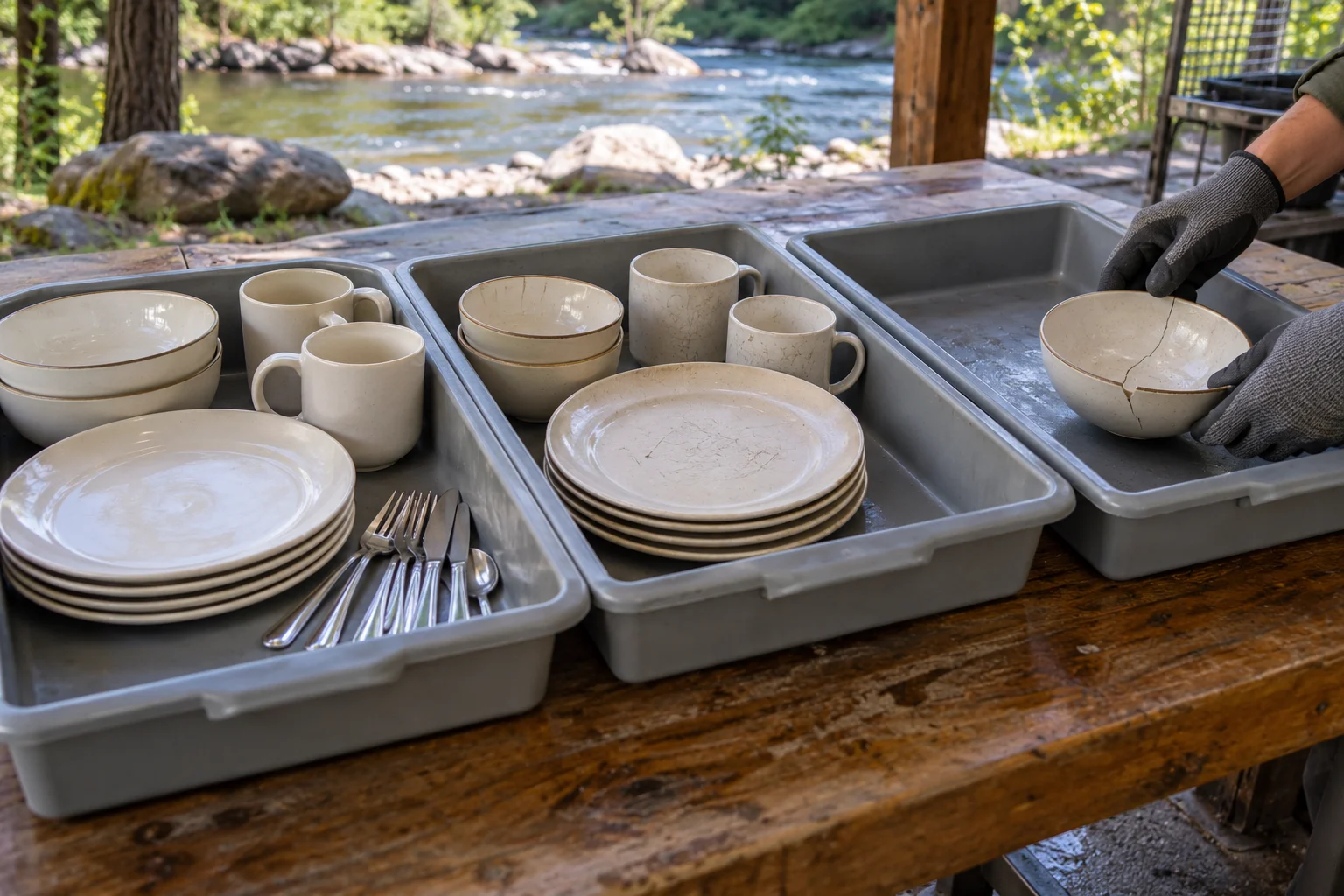
Use mutually exclusive statuses for rental camping dinnerware spare parts: usable, cleaning hold, repair or review, write-off, and missing. A worn-looking item should not automatically enter W. Record the disposition owner and reason. The replacement-component inspection checklist provides a receiving sequence, and the component change-control map helps prevent a revised part from silently entering the old history.
Keep evidence boundaries clear. The US FDA food-contact notification inventory, European Commission food-contact materials overview and EU General Product Safety Regulation can frame destination-market questions; none verifies an unspecified rental-fleet component.
6. Separate usable, quarantined and inbound stock

O should include only physically usable rental camping dinnerware spare parts of the approved revision. Q should include only inbound quantity with an approved order, compatible revision and credible receiving route. Keep unverified returns, obsolete revisions, samples and damaged stock outside both numbers. Reconcile the physical count with the service register before each calculation.
7. Rental camping dinnerware spare parts buyer checklist
| Request from operations | Verify with sourcing | Approve before order |
|---|---|---|
| Deployed count and cycle definition | Component code, drawing and BOM revision | One controlled row per component |
| Loss and write-off event log | Usable and inbound stock status | Observation window and review interval |
| Quarantine and repair disposition | Fit, nesting and pack compatibility | Buffer policy and purchase-pack multiple |
| Unexpected change explanation | Evidence and destination-market scope | Order quantity, price and lead time after confirmation |
8. Frequently asked questions
Is ten percent a safe spare ratio for every component?
No. A universal percentage ignores component-specific history, current stock, review interval and revision risk. Use observed data or label the starting quantity provisional.
Should repairable pieces count as write-offs?
Not until the buyer’s disposition rule classifies them as unusable. Keep repair, quarantine and write-off statuses separate.
Can plate and bowl losses be combined?
No. Calculate independently because deployment, handling, geometry and replacement routes can differ.
What if the purchase-pack multiple is unknown?
Keep the calculated preliminary need and mark the order quantity “To be confirmed for the project.” Do not invent a rounding unit.
When should the rate be restarted?
Start a new series after a relevant revision, operating-method change, fleet reconfiguration or other condition that makes the prior observations non-comparable.
9. Next procurement action
Prepare the component-level deployment count, observed cycles, loss and write-off log, usable and inbound stock, current BOM and drawings, review interval, buffer policy and destination market. Then send the rental-fleet spare-parts worksheet, request a compatibility review or ask for a project quotation scope. Commercial and technical values remain to be confirmed for the project.