Last Updated:
Direct answer: Plan camping dinnerware replacement parts by linking each service piece to a demand reason, exact compatible revision, evidence boundary, identification method, packaging unit and reorder trigger. Do not treat every component as a spare. Hold only pieces that buyers can identify, receive, verify and fit to the intended master set without creating uncontrolled variants.
This camping dinnerware replacement parts matrix is a buyer planning tool, not an inventory promise. It helps a brand, distributor or rental operator decide which plates, bowls, cups, cutlery, lids, dividers or carry elements deserve separate service control. Actual availability, dimensions, materials, compatibility, MOQ, price, lead time and compliance evidence remain project-specific.
1. Start with the service problem, not a percentage
A replacement program should answer a defined failure or loss pattern. One buyer may need individual cups because they disappear in shared facilities. Another may need lids because a removable interface is damaged. A rental fleet may need quick field counts. Record the reason before choosing a spare quantity. A fixed percentage applied to every component hides differences in use, breakage, cleaning and replenishment.
Keep the service scope tied to the released set. The camping dinnerware BOM revision guide explains how drawings, BOM lines and component releases stay linked. When a service piece becomes independently orderable, the replacement-piece SKU decision process helps determine whether it needs its own controlled identifier.
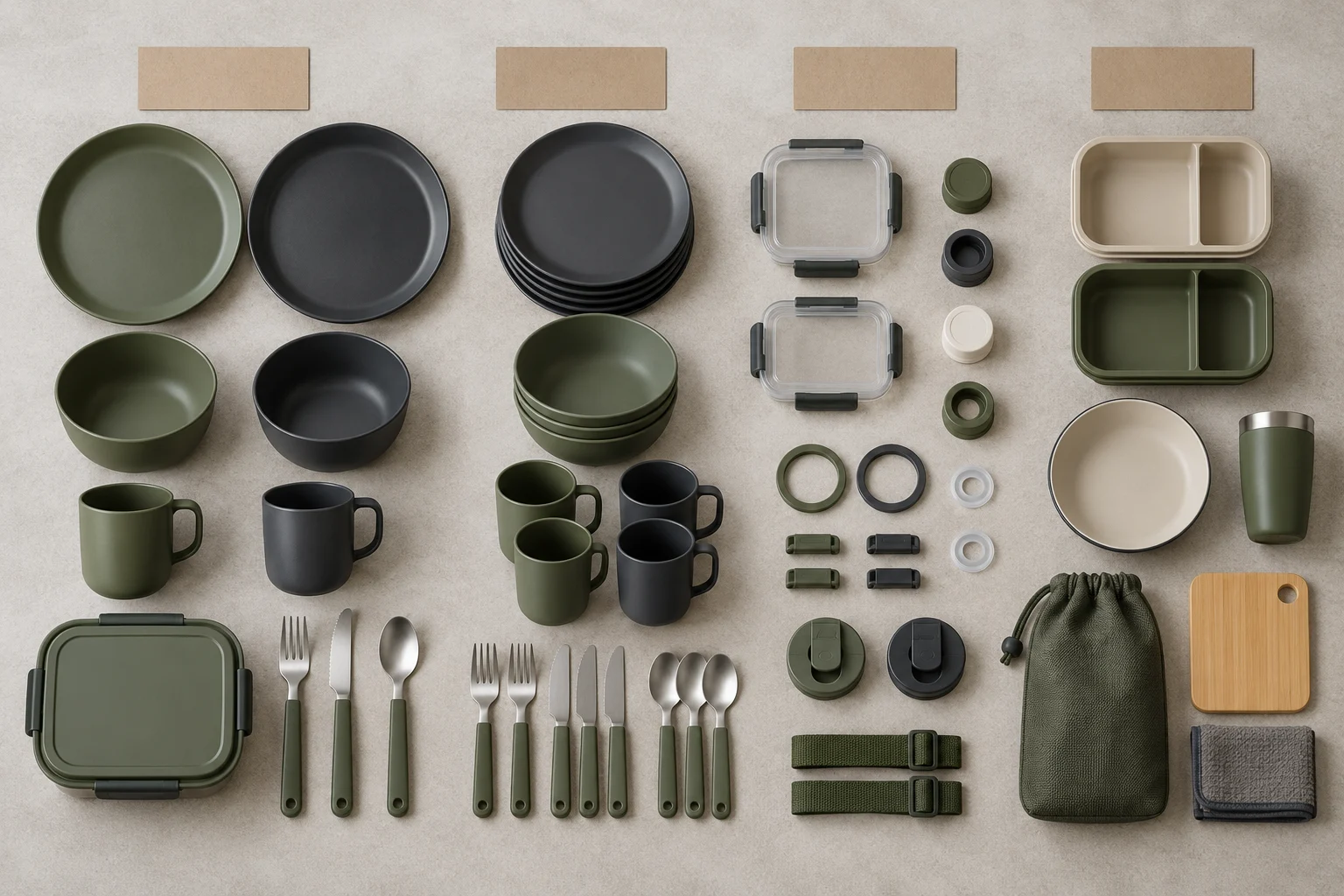
2. Copy this camping dinnerware replacement parts matrix
| Decision field | Buyer record | Approval rule | Risk if missing |
|---|---|---|---|
| Service reason | Loss, wear, damage, hygiene rotation, or program continuity | One observable reason per proposed spare | Stock is purchased without a use case |
| Master-set identity | Set SKU, BOM revision, drawing revision and color/finish release | Exact reference must be present on order and receipt | A visually similar piece may not fit |
| Component identity | Part name, controlled code and revision | Separate code when service handling requires it | Sales and receiving cannot distinguish versions |
| Compatibility | Fit, nesting, retention and pack interaction | Compatibility to be confirmed by project sample and drawing | Part fits alone but disrupts the packed system |
| Evidence scope | Material, color, finish, decoration and intended-use record | Evidence must match the finished service piece | Old reports are applied to an changed part |
| Identification | Mark, label, bag, carton or service list reference | Buyer can identify the piece without opening unrelated stock | Picking errors and undocumented substitutions |
| Service packaging | Unit protection, count, contact control and carton scope | Packaging preserves the part and food-contact surfaces | Spare arrives scuffed, mixed or contaminated |
| Reorder trigger | Minimum balance, loss event or review date | Buyer-owned trigger uses actual consumption data | Emergency orders replace planned replenishment |
| Obsolescence action | Use-up, segregation, relabel, replacement or disposal decision | Old and new revisions cannot mix silently | Legacy stock remains available without status |
3. Which pieces should enter the replacement program?
For camping dinnerware replacement parts, prioritize components that are frequently handled, independently identifiable and realistically replaceable without rebuilding the full set. A plate or cup may be straightforward when its dimensions, finish and pack position are controlled. A lid, divider, clip or tray can be more sensitive because small interface changes affect fit, release or containment. A carry-case insert may influence every component position and therefore require a larger approval scope.
| Candidate | Usually easier to service when | Needs deeper review when |
|---|---|---|
| Plate, bowl or cup | Geometry, stack position, finish and identity are stable | It locks, nests tightly or changes packed height |
| Knife, fork or spoon | Profile and storage channel are controlled | Handle geometry affects loops, trays or lids |
| Lid or divider | Mating surfaces and revision are explicit | Seal, retention or food-use claims may change |
| Case, tray or retention part | Complete interface set can be checked | One change moves several component positions |
| Decorated component | Artwork, ink and placement match the release | Decoration changes evidence or contact boundaries |
4. Verify fit against the master set
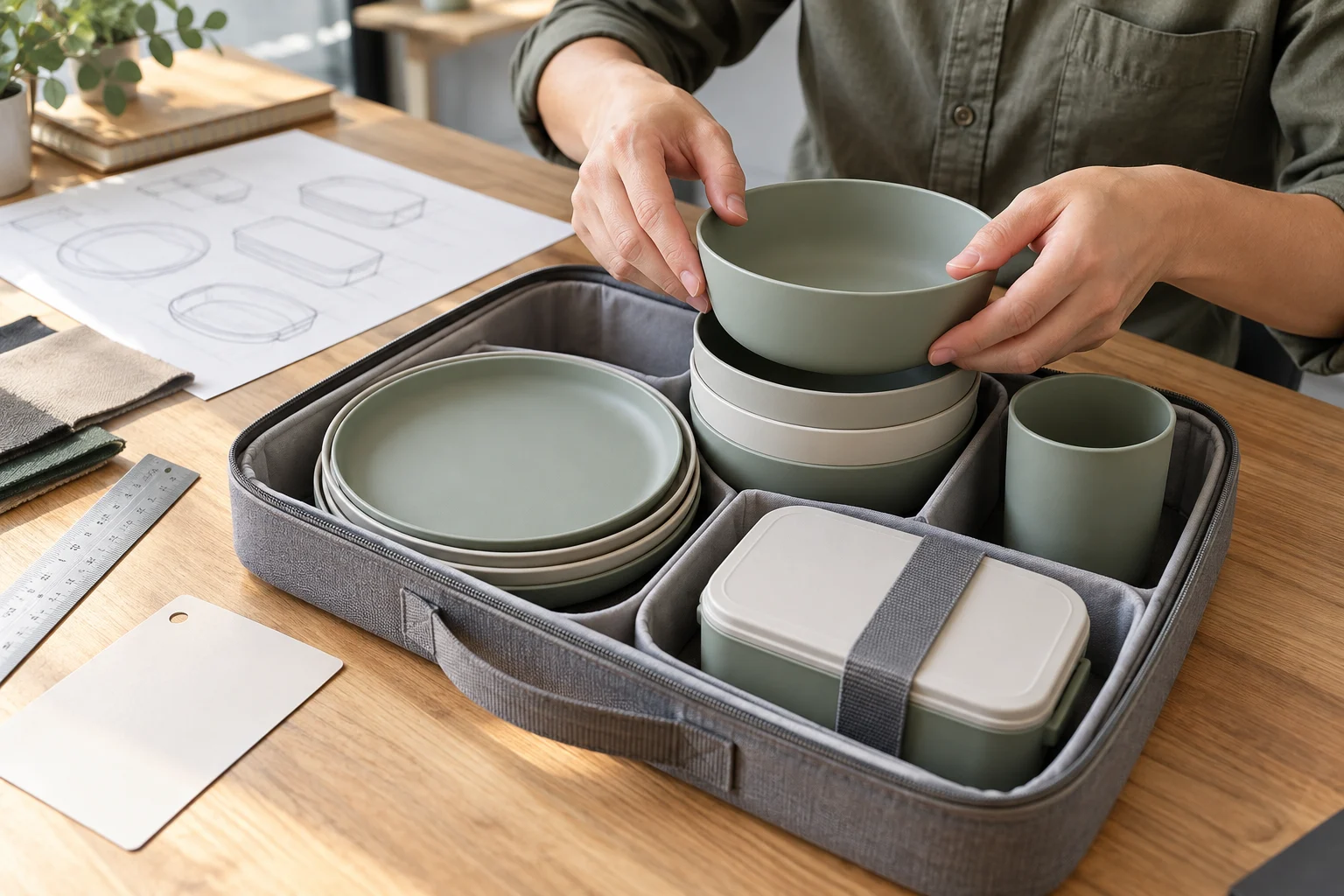
Check more than visible diameter. Review nesting depth, stack height, release after washing, contact points, retention clearance, case closure and the accessibility of adjacent parts. Use the current master set, drawing and packed sample. The replacement-component inspection checklist provides a receiving path, while the component change-control map shows how one substitution can affect fit, evidence, artwork and packaging.
Record the limits of the check. One approved sample does not prove all future production, and a dimensional match does not automatically prove material, color, decoration or regulatory equivalence.
5. Keep the evidence file component-specific
The replacement piece may be sold or shipped independently, but its evidence still depends on the finished component and intended use. The US FDA food-contact notification inventory can help buyers frame substance and use questions; it does not certify an unspecified finished item. The European Commission food-contact materials overview summarizes the EU framework, while the EU General Product Safety Regulation remains relevant to finished-product obligations. Apply current legal and market requirements to the actual product, business role and destination.
6. Package camping dinnerware replacement parts as their own pack-out

A spare bowl placed loose in a carton does not inherit the master set’s protection. Define the service unit, surface separation, bag or sleeve, count per inner, carton label reference and receiving condition. Avoid packaging that makes a food-contact surface rub against cutlery edges or decoration. If several revisions remain in circulation, keep them physically and administratively separated.
The service pack may differ from the retail pack, but that difference should be intentional. Buyers should know whether the replacement arrives consumer-ready, as a protected warehouse unit, or as a bulk service component.
7. Use buyer-entered data for reorder quantities
Do not invent a universal spare ratio for camping dinnerware replacement parts. Start with deployed set count, observation period, component losses, damage events, current balance, replenishment interval and desired buffer. A simple planning relationship is:
Planned service quantity = expected replacement demand during the review period + approved buffer − usable on-hand balance.
Every input belongs to the buyer. Separate loss from damage and separate actual consumption from a policy buffer. A new program with no history should begin with an explicitly provisional quantity and a review date, not a false precision.
8. Buyer checklist
| Request from the supplier | Verify in the sample | Freeze before reorder |
|---|---|---|
| Master-set and component revision references | Fit, stack, retention and case closure | Approved compatible revision |
| Finished-component evidence scope | Color, finish, decoration and contact surfaces | Evidence and artwork references |
| Service pack and count proposal | Protection, identification and receiving clarity | Unit, inner, carton and label scope |
| Project-specific commercial confirmation | Availability and replacement workflow | Quantity, price and lead time after review |
9. Frequently asked questions
Should every dinnerware component have a replacement SKU?
No. Camping dinnerware replacement parts need separate control only when the service need, identity, compatibility and handling justify it. Otherwise, replacement may remain a quoted project line tied to the master set.
Can an older bowl be replaced by the newest version?
Only after revision, fit, pack and evidence review. Similar appearance is not proof of compatibility.
How many spares should a buyer order?
Use buyer-owned loss, damage, deployed-set and replenishment data. If history is unavailable, label the starting quantity provisional and schedule a review.
Can replacement pieces use simpler packaging?
They can use a different service pack if it still protects surfaces, controls count and identity, and matches the receiving route.
10. Next procurement action
Prepare the current master-set BOM, drawing revision, deployed quantity, observed loss or damage data, candidate service pieces, destination market and preferred receiving unit. Then send the replacement-parts brief for a project-specific review. Use the same Contact route to request a compatibility review and ask for a quotation scope. Unconfirmed values remain to be confirmed for the project.