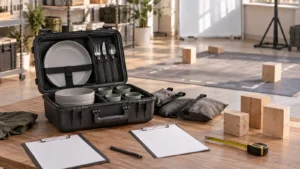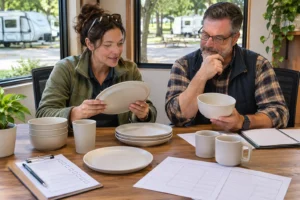
A usable camping dinnerware retail insert design begins with the approved component envelopes, not a stock cavity pattern. Map every contact zone, finger-access cutout, vertical restraint and food-surface separation on one controlled drawing. Then verify the packed set against the drawing, record movement after handling, and approve the insert only with the exact BOM and retail-box revision.
Freeze inputs for camping dinnerware retail insert design
The insert is part of the assembled pack. A camping dinnerware retail insert design should reference the approved BOM revision, component drawing or measured sample, retail-box inside dimensions, orientation, decoration protection, intended distribution channel and removal sequence. A substitute cup, deeper bowl or revised handle can invalidate an apparently unchanged insert.
| Input | Record on the drawing | Hold if missing |
|---|---|---|
| Component envelope | Maximum approved length, width, height and critical rim or handle location | Do not infer dimensions from a concept image. |
| Box envelope | Inside dimensions, board allowance, closure and opening direction | Confirm the supplied box sample and drawing revision. |
| Pack sequence | Layer number, face direction, nesting order and removal path | Resolve collisions before approving tooling. |
| Evidence scope | Visual check, movement check and any agreed distribution procedure | Do not convert a handling check into a transport claim. |
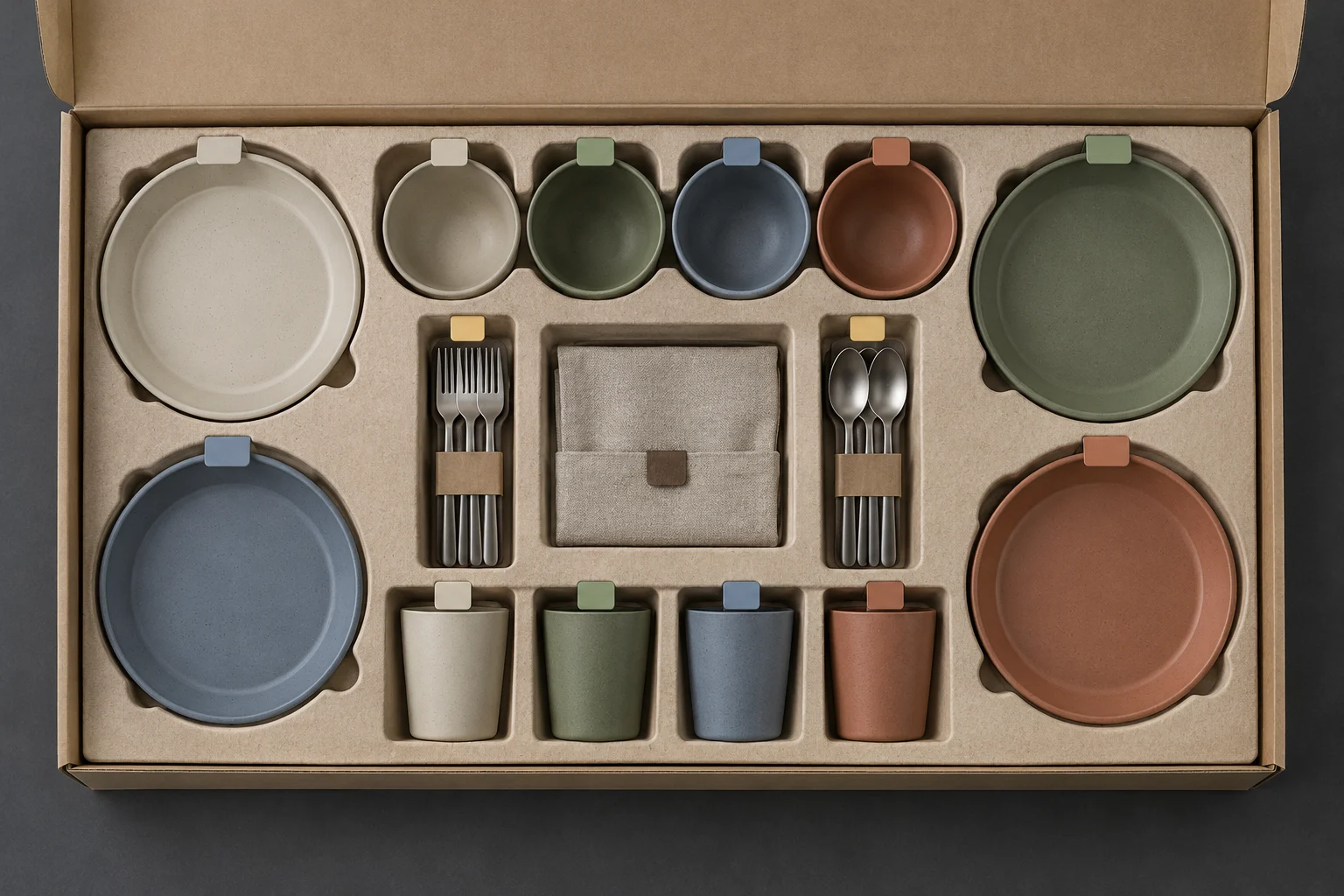
Insert-to-component retention drawing
Assign a zone ID to every component group. The table below is a drawing record, not a specification of Naike capability or a universal tolerance.
| Zone | Component and contact map | Drawing callouts and approval evidence |
|---|---|---|
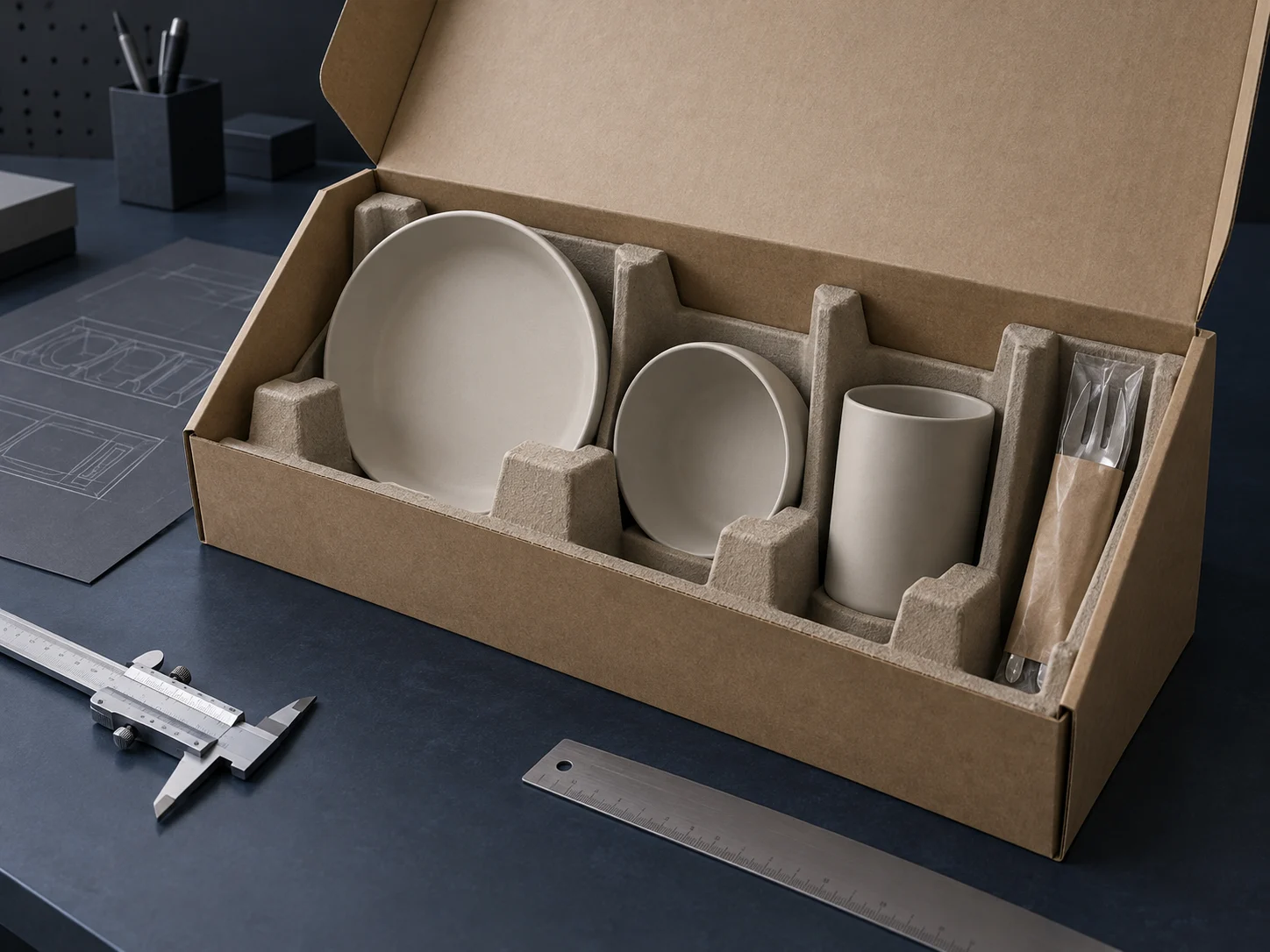
| Z1 plate stack | Rim-support shoulder, base relief and lift notch | Approved maximum rim envelope; shoulder location; finger-access width; movement result. |
| Z2 bowl nest | Base seat plus controlled side contacts; no point load on a decorative rim | Nesting order; engaged wall height; removal path; visible-contact photograph. |
| Z3 cup cells | Four separate cells or a controlled nested group | Handle orientation if present; top restraint; surface separator decision. |
| Z4 cutlery channel | Utensils restrained away from food-contact faces | Count, divider, tie or sleeve route; sharp-edge clearance; opening sequence. |
| Z5 accessory pocket | Instructions, textile item or project-specific accessory | Maximum envelope, migration barrier and document revision. |
| Z6 box interface | Insert perimeter, corners and closure compression zones | Box inside dimensions; side gap; top gap; closure state and pack-out photograph. |
Use section views to control retention without damage
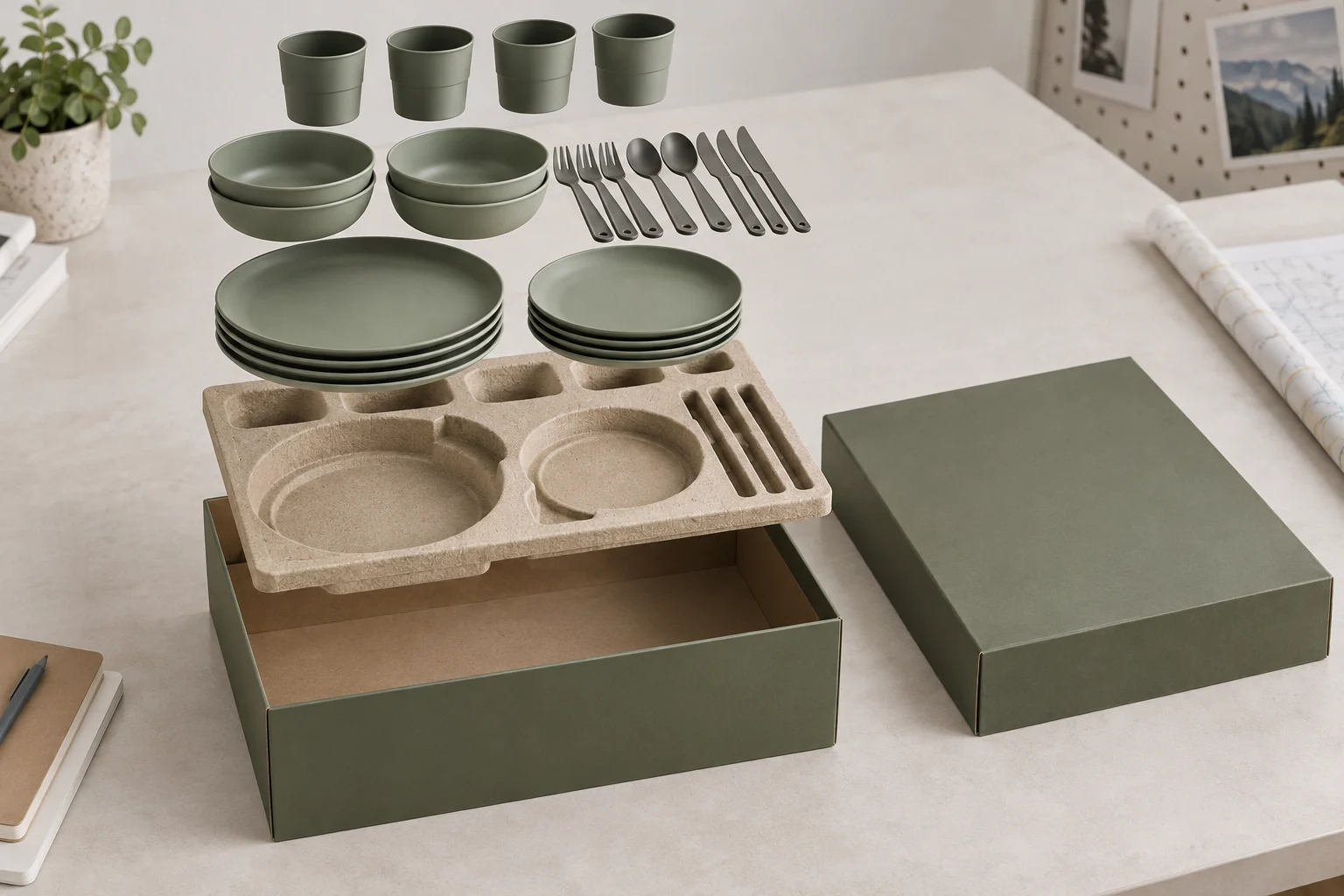
A top view can hide the most important risks. Add section views through the plate rim, bowl wall, cup cell, utensil channel and the tallest point beneath the lid.
| Check | Calculation or evidence | Decision boundary |
|---|---|---|
| Engaged wall ratio | Engaged insert-wall height ÷ component height × 100% | Set the required value from the component geometry and handling route; no universal percentage is assumed. |
| Top clearance | Closed-box inside height − packed component height − insert layers | Positive clearance alone is not approval; verify movement and compression at the real closure state. |
| Removal access | Finger or tool access shown in plan and section | The buyer must be able to remove a component without levering against another food-contact item. |
| Contact risk | Mark every hard contact, rub zone and decorated surface | Add separation, revise geometry or document the accepted contact condition. |
Close a controlled insert approval record
Approve the camping dinnerware retail insert design only against one identified box, BOM and pack-out state. Record the sample IDs, drawing revision, operator, date, photographs and disposition. For distribution planning, use the ISTA procedure directory to select an agreed route rather than treating a bench check as certification. Packaging that may contact food-contact surfaces also needs an evidence review against the intended use; the US FDA food-contact substances overview explains the regulatory framework. Waste and source-reduction decisions can be framed with the US EPA materials-management hierarchy.
Link the record to the BOM revision guide, the loaded carry-case inspection method and the packed-surface contact map. These checks cover dinnerware packaging; cookware requires separate heat, mass and performance evidence.
Buyer checklist
| Request | Verify | Approve or hold |
|---|---|---|
| Controlled BOM, component envelopes, box drawing and intended channel | Zone IDs, plan and section views, contact map, pack sequence, four image records and change history | Approve one named revision, or hold for dimensional, contact, removal or evidence gaps. |
Procurement FAQ
Can the supplier select an insert from a standard library?
A standard construction may be evaluated, but retention and clearance still need approval against the controlled components and box.
Should an insert clamp every component tightly?
No universal clamp condition is appropriate. Retention must control movement without damaging rims, decoration or food-contact surfaces.
Does a concept image prove molded-fiber availability?
No. The images explain geometry only. Material, process, evidence, tooling and availability remain project decisions.
When should the drawing be revised?
Revise it when any controlled component, orientation, box, separator, accessory, removal route or evidence requirement changes.
What should an RFQ include?
Send the BOM, maximum component envelopes, box drawing, channel, target markets, pack sequence, artwork protection needs and required evidence.
Request an insert drawing review
Send the controlled BOM, component drawings or samples, retail-box inside dimensions, target channel and approval evidence to Naike. Use the contact form for drawings or submit an RFQ brief.
Last reviewed .