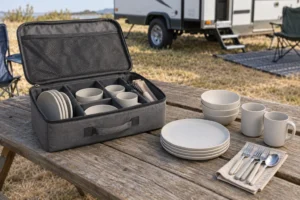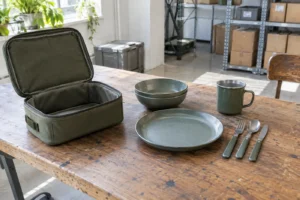
For a camping dinnerware case fit decision, do not approve a new carry case from the dinnerware’s nominal diameter or a flat photograph. Check the actual component revision, largest loaded envelope, entry sequence, closure clearance and contact protection. Put every open dimension on a component-to-case drawing checklist, then repeat the pack-out with physical samples before approving the case.
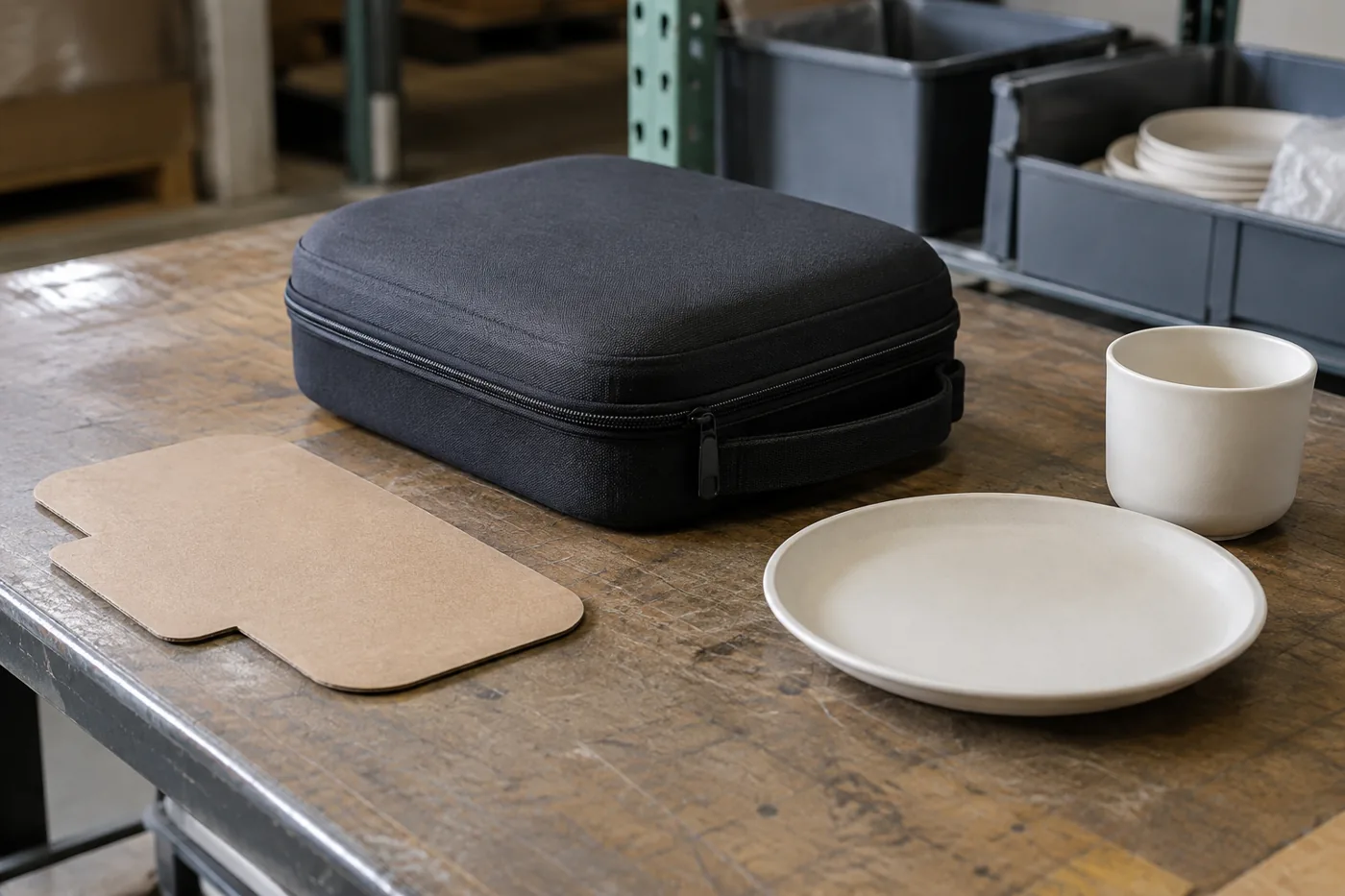
This is a diagnostic for a buyer who already has plates, bowls, cups and utensils but wants a different carry case. The deliverable is a drawing checklist with revision, owner, measurement method and a physical-sample sign-off for each interface. The illustrations are concepts, not measurements, verified Naike Dinner SKUs or evidence that any pictured pieces fit a particular case.
First identify what must stay unchanged
Freeze the component list before discussing case style. Ask for the current drawing or approved sample revision of every plate, bowl, cup, utensil, lid and optional container; record how many of each will travel together. If a bowl has been redesigned or a cup now has a handle, the old packed arrangement is not proof for the revised set.
Separate the product question from the shipping question. An inner carry case organizes dinnerware during use, while an outer retail box or mailer protects the complete trade item in distribution. A successful bench pack-out does not establish transit performance, food-contact compliance or safe retention after repeated cleaning. The published modular-set interface guide helps buyers identify which components and cases need a controlled shared interface; this checklist makes one proposed pairing reviewable.
Use a version-controlled bundle identifier in the review. The approved contents, individual component revisions, case revision, divider or sleeve revision and any insert must all be named on the same sheet. “Current plate” or “standard bag” is not a drawing reference.
What evidence belongs on the fit drawing?
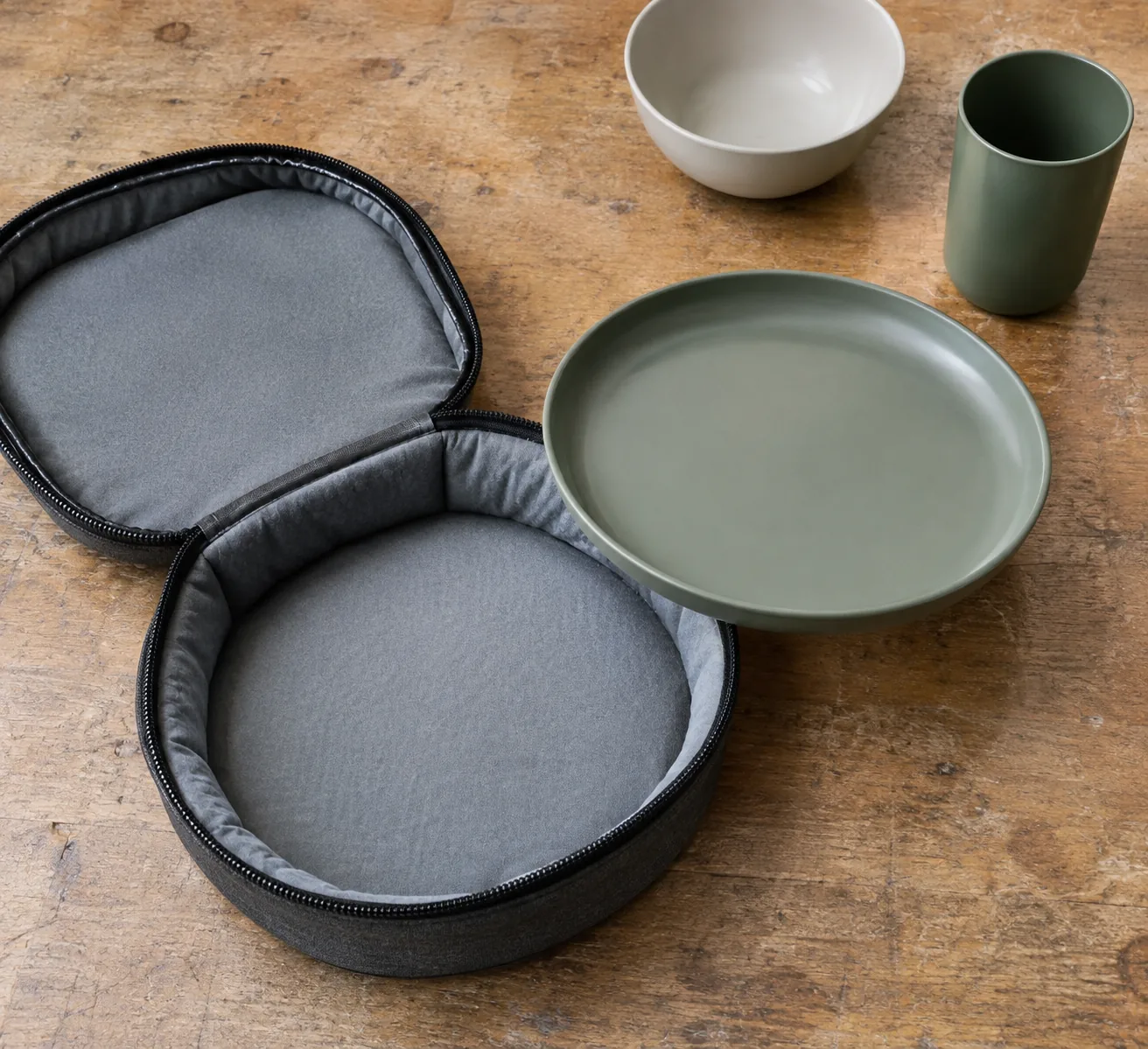
Start with actual sample measurements and controlled drawings, not a single catalog size. Record outer rim dimensions and local protrusions at the thickest point, bowl stack height, cup height and widest section, cutlery length with any sleeve, and lunch-box closure features. For the proposed case, request usable internal dimensions after lining and dividers, the opening throat, seam and zipper path, corner radii, handle attachment and any pocket depth. A rigid object may clear the case cavity but fail to pass through its opening.
Specify how the dimensions were obtained, the revision measured and the conditions under which a flexible case is evaluated. NIST’s dimensional-calibration discussion explains why a measured number needs a defensible uncertainty boundary; it does not prescribe a camping-case clearance. The buyer and supplier must agree which critical gaps require measurement and what acceptance range is appropriate. Do not convert a photographed gap into a tolerance.
If molded plastic dinnerware is involved, ISO 20457:2026 describes a framework for tolerances and acceptance conditions for molded plastic parts. Its scope does not automatically extend to fabric seams, foam inserts or a finished multi-part carry set, and it does not supply a universal clearance value for this project. Request part-specific drawing tolerances and a case-specific assembly review instead of copying one number across materials.
Camping dinnerware case fit: 10 drawing checks
Use one row per physical interface. Fill the two blank decision fields with measured values, drawing references and a named approver; mark unresolved rows “open,” never “pass by appearance.” The worksheet deliberately contains no invented dimensions or results. An optional lunch box requires its own row because its lid or divider may change the packed envelope.
| Interface or view | Drawing and sample evidence to request | Buyer observation | Open issue / owner | Acceptance record |
|---|---|---|---|---|
| Component identity | Part number, material/finish, revision, quantity and dated drawing for every piece | Is the sample the same revision as the proposed set? | Enter mismatch and owner | Approved component index |
| Largest plate or rim | Maximum outer profile, rim height, thickness and orientation drawing | Can it pass through the case opening without forced flex? | Enter interference location | Measured opening/plate review |
| Nested bowl stack | Stacked height at the planned count; actual contact surfaces | Does the stack release after packing, without pressure on the rim? | Enter variation or sticking | Sample pack and release observation |
| Cup and handle, if present | Widest cup profile, lip, handle projection and pocket drawing | Can the cup be inserted and removed in the intended sequence? | Enter blocked motion | Insertion/removal record |
| Cutlery and sleeve | Longest utensil, sleeve thickness and retention location | Can edges avoid rubbing food-contact faces or the zipper? | Enter contact point | Packed-contact map |
| Optional food container | Lid, divider, latch and fully assembled outer envelope | Does adding it displace required dining pieces? | Enter alternate configuration | Separate option approval |
| Internal case cavity | Usable internal profile after seams, lining, dividers and pads | Where are the tightest corners and compressible zones? | Enter measurement method | Case drawing with section views |
| Opening and closure | Unobstructed opening, zipper path and packed cross-section | Does closure occur without forcing or component load on hardware? | Enter bulge/obstruction | Closed-case photo plus observation |
| Loaded handling | Handle/strap attachment and packed center-of-mass review | Does the loaded case keep pieces retained when carried? | Enter movement or collision | Handling-trial record |
| Outer package | Case exterior and retail/mail pack layout | Does the final packed unit still fit the intended channel pack? | Enter pack or artwork change | Separate distribution review |
Attach orthographic views and a cross-section showing the packed sequence. Mark rigid profiles, flexible zones and removal direction separately. A single internal length-by-width-by-height figure misses zipper lips, corner radii and the practical path of a plate through the opening. For the nesting-versus-stacking decision, record the actual stack order and interface rather than assuming “nesting” means every component occupies the same footprint.
A camping dinnerware case fit record should identify the drawing view and sample that supports each row, rather than merely marking a green box. This makes a later change to the cup, zipper or divider traceable to the affected interface.
Run a repeatable pack-out, not a staged closure photo
Give a reviewer the component index, the proposed instruction and the sample case. Ask them to load in the stated order, close without pressing on hard pieces, carry it in normal orientations, reopen and remove each piece. Record the component revision, reviewer, location of any snag, observed rubbing, rattling or unretained part, and whether the reviewer had to change the sequence. Do not call this a formal transport or durability test.
Repeat the exercise with the intended optional combinations and with the largest and smallest representative samples when variation matters. If a revised cup or thicker utensil sleeve is part of the approved assortment, test that revision; an earlier smooth mock-up is not enough. Photograph the case open and closed, but keep the drawing and observation sheet authoritative. The relevant question is not merely “does the zipper meet?” but “can another person pack and retrieve the complete controlled set without forcing, mixing or damaging pieces?”
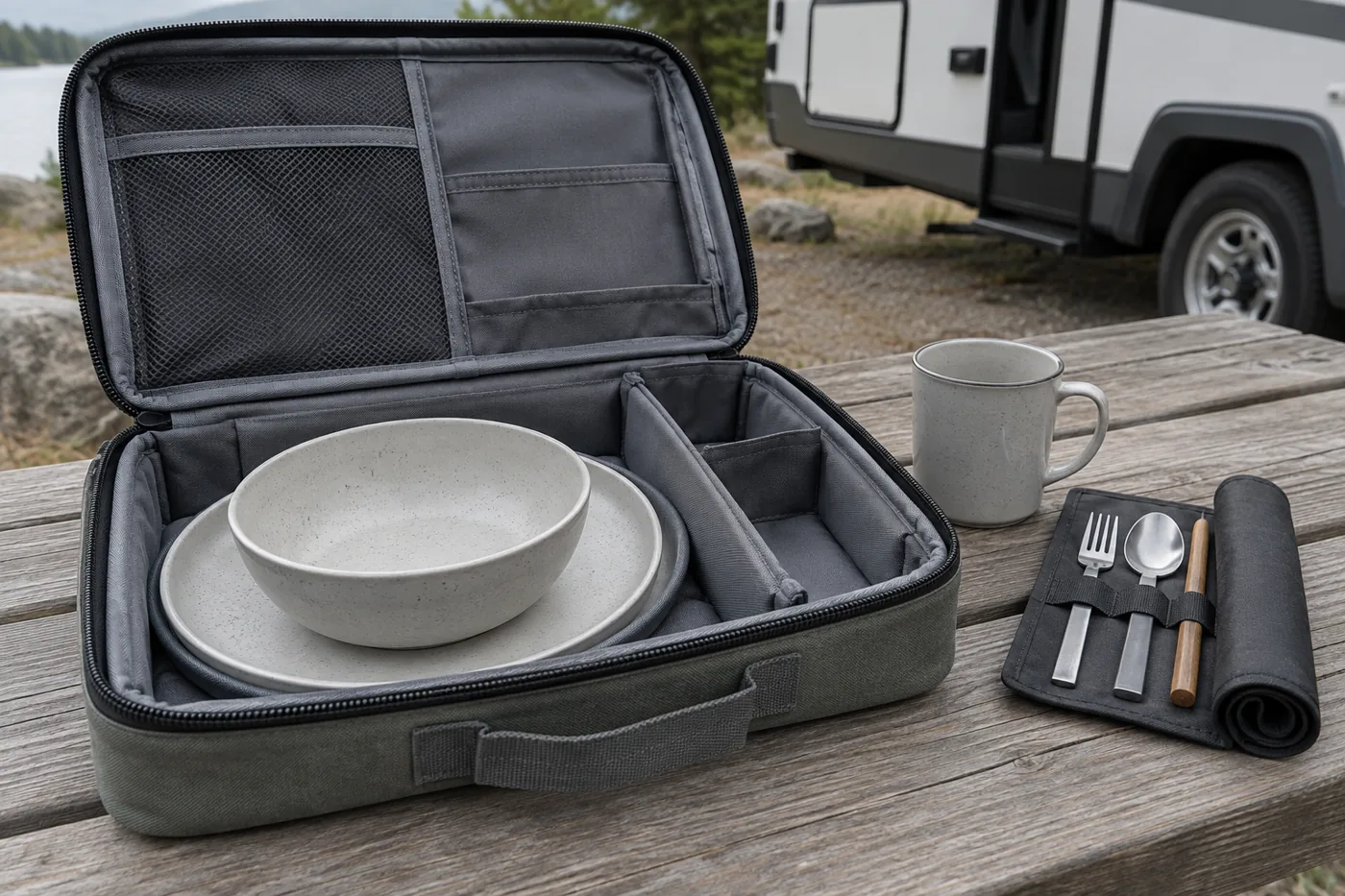
Inspect contact surfaces after the trial. A retained fork can still rub a plate; a cup can knock against a lunch-box latch; a fabric divider may fold under a bowl and change the loaded height. These are buyer inspection prompts, not assertions that any pictured product has passed. The existing rattle-control guide addresses that narrower failure mode once an arrangement has been proposed.
Choose the review depth for the selling scenario
Existing components, new case only
Keep the dinnerware BOM fixed and request a case drawing around its actual outer profiles. This is the cleanest comparison because changes to fit can be traced to case dimensions, opening, dividers or packing sequence. The buyer should still ask whether the component revision in inventory matches the sample. A finish or handle change may invalidate the seemingly unchanged design.
Case with optional lunch container
Make a separate pack-out drawing for the base set and the optional container combination. If the container replaces a plate position rather than adding capacity, say so in the assortment and product listing. A removable divider does not guarantee the box and utensils can share one cavity. Compatibility to be confirmed by project sample and drawing.
Retail or e-commerce shipment
The closed case must also be evaluated inside its actual sales pack. ISTA notes that changes to a packaged product’s size, components, interior packaging or closure can trigger a retest review. This does not mean this case has passed an ISTA procedure or that one specific test is mandatory for every channel. Record the distribution route and ask a packaging specialist to choose the applicable plan after the packed unit is finalized.
Rental or shared-use replenishment
Review whether one missing component can be replaced and loaded without changing the rest of the set. A pocket shaped for a single utensil revision may not accept its replacement. Record the spare-part revision and its designated position, then trial the full loaded count. A flexible case can simplify service, but that is a design hypothesis to verify, not a proven outcome.
Where a visual fit check is misleading
A bag photographed open may look roomy because the walls are unsupported and the pieces are outside it. Soft goods also change shape when lifted. A case with a nominally generous volume can have a narrow entry path, seam allowance or zipper pull that interferes with the largest plate. Conversely, a small gap in a drawing may be acceptable only after the supplier and buyer have agreed the part variation, handling method and protection requirement. No universal clearance is asserted here.
Do not promote this drawing exercise into a food-safety conclusion. The case may not contact food in the intended use, while the plate, bowl, cup and lunch container do. For US markets, the FDA describes how the regulatory status of food-contact material components depends on their composition and authorized use. A replacement case does not transfer a plate’s evidence to another material or decoration. Keep the final-component use conditions and market documentation separate from mechanical fit.
Nor does an outdoor dinnerware set become cookware because it is pictured at a campsite. Burner, campfire, direct-flame, microwave, dishwasher, leakproof and temperature claims require product-specific evidence for the exact part and use condition. Do not infer them from the bag design or scene.
B2B Buyer Checklist
| Check | Question | Why It Matters |
|---|---|---|
| Controlled contents | Are counts and component revisions frozen for each proposed configuration? | Otherwise the fit conclusion has no stable subject. |
| Real envelope | Were the largest protrusions and stacked heights measured on samples? | Catalog diameter alone omits handles, lids and rims. |
| Opening path | Can the largest rigid piece pass the lined opening in the intended orientation? | A roomy cavity can have an unusable throat. |
| Retention | Do dividers and sleeves hold pieces without food-surface rubbing? | Closure is not the same as controlled contact. |
| Sequence | Can a new reviewer pack and remove the set from a written instruction? | Exposes a fragile, designer-only arrangement. |
| Options | Has each optional lunch-box or cup configuration been drawn and trialed? | Base fit does not prove upgraded fit. |
| Evidence boundary | Are food-use and transport claims supported separately for the finished revision? | A fit review cannot validate unrelated performance. |
| Approval | Who signs the open issues, drawing revision and packed sample? | Prevents an unresolved concept from becoming a listing claim. |
Case-fit procurement FAQs
Can we choose a case from the plate diameter alone?
No. Plate rim, stack thickness, opening geometry, lining and packing sequence all matter. Request the component drawing and a case cross-section, then pack the actual revision before approval.
What if the bowl nests inside the plate?
Record their loaded height and contact surfaces, then check release after the full pack-out. An attractive nested photograph does not establish retention, separation or repeatable removal.
Is a soft case automatically more forgiving than a molded tray?
Its walls can flex, but the zipper, seams, pockets and loaded handling still create constraints. Compare a sample in the intended carry orientations and record whether flexibility causes rubbing or shifts the components.
Does a closed zipper prove a successful fit?
No. A forced closure can load a rim or hardware, and the contents may move when carried. The acceptance record should include easy closure, removal, retention and contact observations.
Can the same case be sold with a lunch-box add-on?
Only if the add-on configuration has its own approved component list, drawing and sample pack-out. Compatibility to be confirmed by project sample and drawing.
When should transport testing be considered?
After the actual inner case and outer sales or shipment pack are defined. Choose a channel-appropriate procedure with a packaging specialist; a bench fit check alone cannot predict parcel handling outcomes.
Send the drawing pack, not just the case photograph
Prepare the existing component drawings and revision list, physical samples, intended base and optional counts, desired carry method, target markets, packing sequence and channel packaging brief. Ask for a proposed case plan with internal sections, opening path, component placement, unresolved clearances and a sample-review schedule. Request a case-fit drawing review with these inputs, making clear which items already exist and which are only proposed.
Only after the measured drawing and blind pack-out agree should the buyer release a controlled case specification. Supplier capability, material, dimensions, tooling route, availability, pricing and lead time all require project confirmation. For a written quotation or sample discussion, send the completed component-to-case checklist and ask the team to identify verified capabilities and open questions separately.