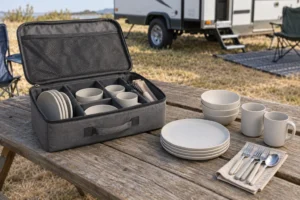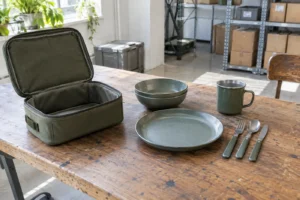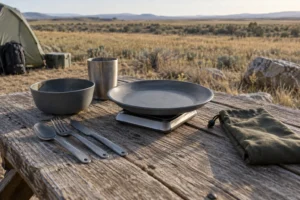
A mixed material camping dinnerware set makes sense when different component roles genuinely need different properties and the gain survives a complete-set sample review. Assign materials only after defining food, temperature, cleaning, impact, mass, packout and market conditions. If the additional interfaces, evidence files and replacement parts cannot be controlled, a simpler single-material assortment may be the better procurement decision.
Start with the use condition, not the material label
Mixed material is not itself a product benefit. A plate, bowl, cup, lunch box, utensil and carrier perform different jobs, so there can be a defensible reason to select different constructions for them. The buyer’s first output should be a component-role matrix, not a mood board that names attractive materials without identifying the loads, food contacts and cleaning events they must withstand.
Record the intended user count and whether every place setting has its own plate, bowl, cup and utensils. Then identify shared pieces, lids, spacers, sleeves and packaging that a promotional photograph might omit. Our component-list guide provides a useful starting inventory, but the approved list for this project must name each part and revision separately.
This is neutral buyer guidance, not a declaration that every pictured material or construction is supplied by Naike Dinner. Images illustrate questions to resolve; they do not establish product availability, composition, performance or test results. Dinnerware is for serving and eating under verified conditions, while cookware is a separate class; no item pictured here is represented as suitable for a stove, burner, oven, campfire or direct flame.
The evidence has to follow the finished component
For European Union sales, the general framework for food-contact materials is Regulation (EC) No 1935/2004, while Regulation (EC) No 2023/2006 addresses good manufacturing practice. Neither text approves a camping set because its marketing copy says “food grade” or “mixed material.” The buyer needs an evidence trail for each finished food-contact article under its actual intended use, including color, decoration, contact conditions and relevant revisions.
In Australia and New Zealand, Food Standards Australia New Zealand’s food-packaging guidance helps businesses frame food-contact responsibilities. It is guidance, not a certificate for a concept image or an assembled set. North American projects likewise need a destination-market review tied to the specified material and use conditions rather than importing a claim from another region’s label.
Ask for a bill of materials that distinguishes the contact surface from a non-contact grip, closure, insert, coating, pigment or bag. A mixed material camping dinnerware set creates several boundaries: a bowl may have a different base from its sidewall, a lunch box may use a separate lid or gasket, and cutlery may have a handle distinct from the eating end. The document register should map each report or declaration to its exact part number, drawing revision and intended use; an unrelated raw-material document does not close that gap.
Build a role-by-role decision matrix
The table is a worksheet, not an assertion that a candidate material passes any test. Replace its conditional language with evidence from the actual sample and ask one owner to sign each decision. Add a “not applicable” entry where a proposed component does not belong in the assortment, so a missing role cannot disappear between a rendering and the quotation.
| Component role | Reason a different construction might help | Interface or trade-off to check | Approval evidence |
|---|---|---|---|
| Main plate | Stable serving surface and familiar handling may favor a rigid profile. | Rim contact with bowl bases, scratching and packed footprint. | Loaded carry, flatness and sample drawing. |
| Meal bowl | A deeper or different-surface bowl may serve different foods. | Fit against plate stack, spoon pressure and wash access. | Food-use boundary and cleaned sample review. |
| Drinking cup | A lighter or differently gripped cup may suit a channel. | Rim stability, hot-drink claims, handle clearance and nesting. | Specified beverage conditions and grip observation. |
| Lunch box | Divider and closure design can reflect packed meal use. | Lid, gasket, hinge, staining, leaks and transport orientation. | Closure drawing and loaded handling protocol. |
| Fork, spoon and table knife | A different stiffness or handle geometry may improve use. | Contact edge, sleeve fit, washing and loss prevention. | Utensil drawing and repeated handling record. |
| Carrier or separator | Textile or another non-contact construction can organize parts. | Moisture retention, abrasion, drying and access order. | Loaded packout and cleaning workflow. |
Give each row a decision owner and a reason to accept, reject or hold. A good matrix makes it possible to compare a single-material alternative with a mixed version using the same user count and component list. If the proposed mix changes quantities or eliminates a lid, normalize the proposals before discussing weight, price or shipping volume.
When the additional complexity earns its place
A mixed set can be justified when a plate needs one geometry while the bowl needs another, or when a washable eating surface is separated from a protective carrier. The buyer should describe the specific failure avoided: for example, a poorly supported bowl in a stacked kit, a utensil that rattles against a cup, or a carrier that traps damp parts. “Premium feel” is not a test method and cannot replace a measurable user or logistics problem.
Map each proposed difference to a corresponding observation. If the goal is a more compact packed arrangement, measure the complete loaded envelope with lids, utensils, dividers and bag; our pack-volume method explains why external volume and real nesting space differ. If the goal is easier washing, inspect every crevice, detachable interface, drying position and reassembly step instead of simply counting material names.
Use channel context to set weights. An RV retailer may value drawer fit and rattle control; a family picnic program may value stable table use, intuitive identification and replacement of a lost cup; a group catering buyer may need strict piece counts and fast visual reconciliation. None of these priorities automatically proves a material is suitable. Each makes a different sample protocol and buyer sign-off appropriate.

Inspect the places where materials meet
Most mixed-set failures are visible at the system boundary rather than on an isolated plate. A rigid edge can mark a softer neighboring piece; a damp textile sleeve can delay drying; a changed utensil handle can no longer fit its pocket. Build a contact map showing what touches what during packing, carrying, washing and storage, then photograph the exact sample arrangement for the approval file.
Use the rattle-prevention review to identify hard-on-hard interfaces and the parts that need controlled separation. Add a trial in the intended travel orientation, followed by inspection for abrasion, unwanted movement and missing pieces. Do not describe a material as shockproof or scratchproof unless the claim is supported for the finished item and use condition.
Distinguish intentionally removable parts from permanently assembled ones. For a lid, gasket, handle, coating or bonding layer, document how the user cleans the joint and whether a replacement part can be specified without changing fit. The buyer should not infer food-contact suitability from a base material when a coating, adhesive or decoration could be the surface actually touching food.

Translate scenarios into controlled configurations
Family campsite and park picnic
Begin with the food and carrying workflow, not an assumed four-person piece count. If family members need individual bowls but share serving pieces, write both quantities explicitly and define where the serving items travel. Check whether a child-oriented component has different grip, edge or cleaning requirements, and avoid transferring any adult-use claim to a different age group without assessment.
Photograph one fully laid-out setting and one complete packed setting from the same approved sample. A retailer can then compare displayed contents with the packing list and the replacement-parts plan. Any visualized component that is not included in the sellable configuration should be clearly identified as an optional concept, not allowed to inflate a piece count.
Caravan or RV storage
Measure the actual drawer, cabinet or shelf opening and the complete closed carrier. A circular cup footprint can look compact until a handle projects beyond the plate stack, while a lunch-box divider may force a different packing sequence. Note which items must be accessible at a roadside stop and which can sit deeper in the pack.
Test removal and repacking with damp but cleaned parts if that resembles intended use, without pretending that a concept image demonstrates hygiene or water resistance. A moisture-sensitive carrier is an operating constraint; it may need a separate drying instruction or a design change. Record the loaded mass and external dimensions from a sample rather than estimating from component material names.
Retail assortment or outdoor catering
Retail buyers need a consistent component statement, market-specific claims review and a display sample that matches the sellable pack. Catering buyers may place more weight on sorting, inventory and repeated wash-and-dry cycles. In both channels, a mix is useful only if the extra components remain traceable and replaceable without creating an uncontrolled color or geometry mismatch.
Ask two reviewers to pack the same components independently, then compare their arrangements and missing-piece checks. If the result depends on a single expert’s memory, the packing system is not yet ready for a high-volume program. Include an assembly diagram or a simple numbered pocket map only after the configuration is fixed.

Name the costs and limitations before approval
Every additional material can create another document, color matching task, tooling interface, inventory line and supplier-change notification. That does not mean a mixed set is wrong, but those costs should be included in the comparison. A purported saving in pack volume is not useful if protective dividers, extra lids or a larger carrier erase it in the finished pack.
Mixed surfaces can look coordinated in a render yet differ under real lighting or after the intended cleaning workflow. Request physical color and finish samples, define acceptable variation using an agreed reference, and document which parts are visible together on shelf. Do not invent a universal color tolerance or wash lifetime; let the buyer specify the acceptance method and evidence required by the market.
Material substitution is a change-control event, not a silent purchasing shortcut. A different resin, alloy, coating, pigment, gasket or adhesive can affect contact evidence, cleaning instructions and the fit of nested pieces. Require a written revision notice and determine which declarations, samples and tests need renewal before a substitute can enter the approved bill of materials.
Plan replacement service at the component level, too. Record whether a missing cup can be replenished independently, whether an updated lid still fits an earlier box and how a buyer identifies the correct revision without guessing from color. A replacement policy is particularly important for sets sold through retail channels where one lost part can make an otherwise usable kit feel incomplete.
Keep material claims separate from end-of-life claims. A set containing several materials is not automatically recyclable as one item, and a fiber-filled component is not automatically biodegradable in ordinary conditions. If a sustainability statement matters to the program, define its exact scope, disposal pathway, market and substantiating evidence. When that evidence is absent, describe the components neutrally and prioritize durability, replaceability and truthful instructions over an unsupported environmental slogan.
Keep heat language disciplined. A metal-looking bowl is not automatically cookware, and a polymer-looking cup is not automatically safe for every hot beverage. A buyer brief must define food temperature and contact time; direct-flame or burner suitability cannot be inferred from dinnerware construction. When those use conditions are unresolved, label them open questions rather than claiming a margin of safety.
Compare two proposals without changing the question
Ask suppliers to quote against one dated component matrix and one market/use-condition sheet. Separate the bill of materials from carrier, packaging, artwork, tooling review and evidence scope. If one proposal omits a lunch box or includes only three utensil groups, flag it as a different configuration rather than treating its lower apparent cost or mass as a material advantage.
A practical comparison sheet needs columns for component ID, role, candidate construction, finished-article evidence, sample revision, packed location, cleaning instruction, open risk and approver. Add a line for every lid, insert and separator. A decision can then be traced from a buyer problem through the sample and declaration to the final pack, which matters more than a generalized “best material” ranking.
| Comparison control | Single-material proposal | Mixed-material proposal | Buyer action |
|---|---|---|---|
| Component completeness | Check each role and count. | Check the same roles and counts. | Normalize before comparing. |
| Loaded envelope | Measure full pack. | Measure full pack including separators. | Record dimensions and orientation. |
| Contact evidence | Map each finished article. | Map every distinct surface and assembly. | Mark gaps and revision numbers. |
| Cleaning | Observe wash and dry workflow. | Inspect every additional interface. | Approve instructions from sample. |
| Change control | Record material and color revisions. | Record substitutions and fit dependencies. | Name the reapproval trigger. |
Run a complete-set sample review
Start with the finished bill of materials and mark each part as food-contact, incidental-contact or non-contact according to the intended use. Then review the empty pieces individually for accessible surfaces, sharp edges, finish, fit and orientation. This first stage catches ambiguous part identities before a full set hides them inside nested stacks.
Next load the exact component quantities into the proposed carrier and document removal order, stack interference, rattle, closure behavior and the external envelope. Observe normal serving, drinking and utensil handling with the intended food categories and users, then wash, dry and repack according to proposed instructions. Keep observations distinct from formal laboratory results; a buyer handling session cannot be relabeled as a certification or migration test.
Finally reconcile the sample against the declarations, component drawing, color reference, packaging list and market claims. If one document names a different revision or a food-contact surface is not identified, hold approval until the discrepancy is resolved. The sign-off record should state what was examined, what remains open, who owns each action and which changes force a new review.
B2B Buyer Checklist
| Check | Question | Why It Matters |
|---|---|---|
| Use case | Which foods, temperatures, users and cleaning methods are in scope? | Material evidence has meaning only within defined conditions. |
| Role matrix | Does every personal and shared component have a count and function? | It prevents a visually attractive but incomplete set. |
| Contact map | Which finished surfaces touch food, utensils or other components? | It identifies evidence and abrasion boundaries. |
| Packout | Does the full sample fit, close and reopen in the intended envelope? | Accessory parts can erase a theoretical volume gain. |
| Evidence register | Do declarations and reports match part, revision and conditions? | Generic material paperwork does not approve an assembly. |
| Cleaning | Can each interface be washed, inspected and dried? | Hidden crevices or damp carriers can undermine use. |
| Change notice | What happens if a material, finish, part or supplier changes? | Uncontrolled substitution invalidates a prior decision. |
| Commercial scope | Are packaging, tooling review and replacement parts separately defined? | It keeps quotations comparable and open risks visible. |
Keep this checklist with a dated sample photograph and controlled drawing, not as a generic approval stamp. Each unanswered question should have an owner and a due date in the buyer’s project record. A mixed material camping dinnerware set is ready for commercial evaluation only when the proposed advantage is documented against the simpler alternative and the evidence gaps are explicit.
One practical final check is to ask someone outside the development team to identify every packed component from the approved list. If that reviewer cannot tell which lid belongs to which box, where damp utensils should dry, or which document covers a contact surface, improve the marking, instructions or evidence register before approval. That independent check exposes assumptions hidden by familiarity with the prototype.
Buyer FAQs
1. Is a mixed material camping dinnerware set automatically better than a uniform set?
No. It is better only if the component-role benefits justify the extra interface, documentation and inventory complexity for the actual channel. Compare complete samples with identical roles and user counts before deciding.
2. Should all pieces use the same color if their materials differ?
That is a merchandising choice, not a compliance rule. Approve physical color and finish references under relevant lighting, and distinguish an intentional coordinated palette from a claim of identical appearance after cleaning or use.
3. Can a metal bowl or plate from the set be used on a burner?
Do not assume so. Dinnerware and cookware are different use classes; burner, stove and flame suitability require product-specific verified design and use evidence. Leave such an instruction off the set until it is substantiated for that exact item.
4. What if a supplier provides only a raw-material certificate?
Ask how it relates to the finished component, color, decoration, contact surface and use conditions. A raw-material document can be part of a file, but it does not by itself resolve every assembly or destination-market question.
5. How should a buyer compare packed volume?
Measure the closed, fully loaded carrier in a defined orientation, including lids, cutlery, dividers and protective sleeves. Record dimensions and sample revision, then compare the same functional component list for both proposals rather than comparing empty nested stacks.
6. Can a component be replaced after the set is approved?
Yes, but treat the replacement as a change request. Confirm dimensions, interfaces, cleaning, evidence mapping, color and packaging before accepting it into the approved configuration. Preserve the earlier revision record so buyers know which packs contain which part.
7. What should be included in a written quotation request?
Provide the user count, dated role matrix, intended food and cleaning conditions, market list, drawing or sample references, carrier envelope, color and artwork brief, packaging requirement and evidence expectations. Ask for confirmed scope and unresolved development decisions to be listed separately.
Send a controlled set brief for review
A useful inquiry is a single configuration request, not a collection of attractive but incompatible material names. Share the component-role matrix, intended markets, food and temperature conditions, cleaning method, target packed envelope, artwork, packaging and available drawings or reference samples through the Naike Dinner contact form. Ask the team to separate confirmed company capability from options requiring feasibility review.
Request a written list of open questions and a sample-review plan before adopting material or performance language in your catalog. If comparing a mixed construction with a simpler alternative, send both configuration briefs so the same roles, evidence boundaries and packout measurements can be assessed. No MOQ, price, lead time, compatibility or production claim is inferred from these concept images.