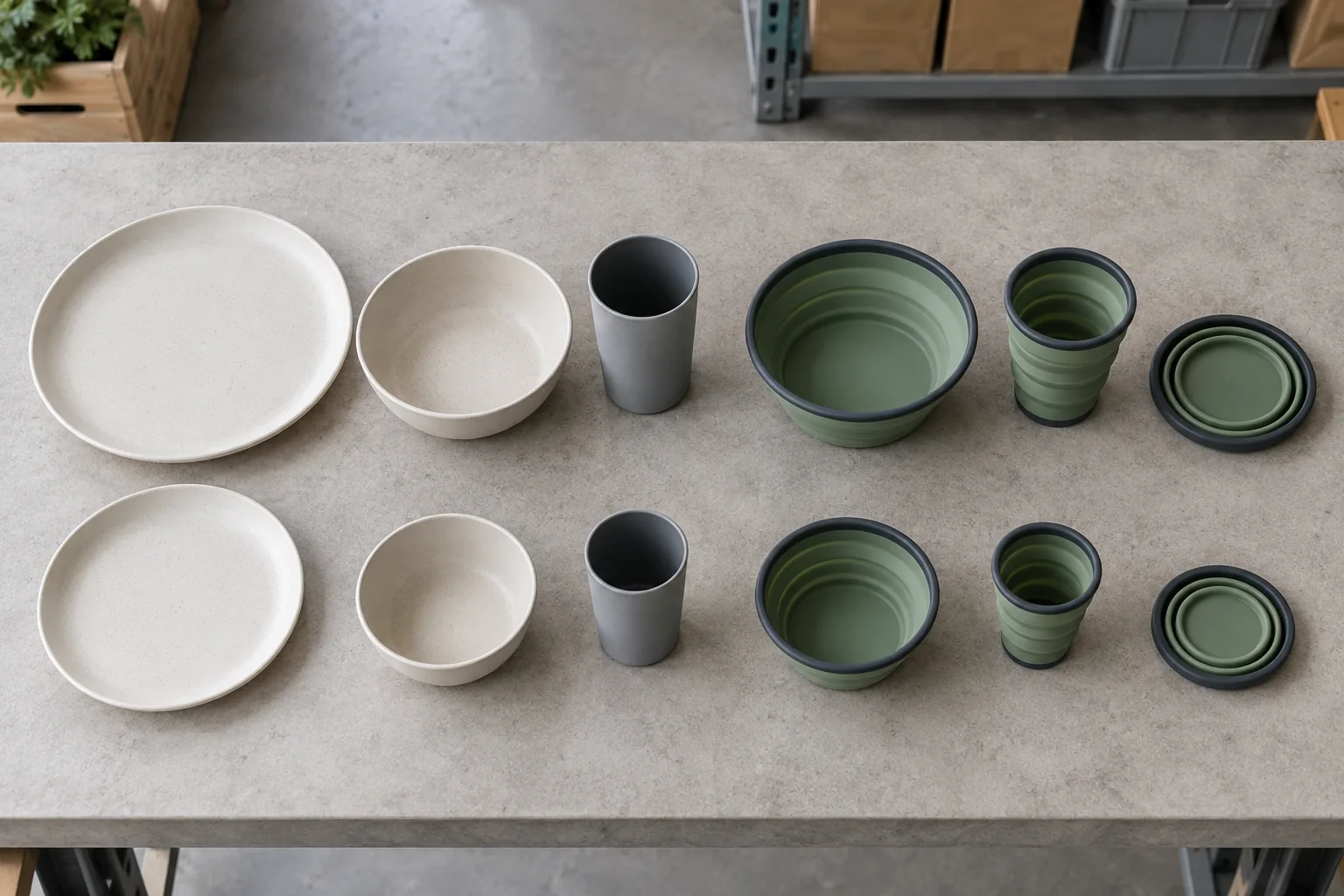
Use rigid components where shape retention, stable carrying and predictable stacking control the user experience. Use collapsible components where saved height is valuable and the part can still open, drain and clean reliably. Most buyers should evaluate a hybrid set role by role, then approve measured samples rather than choosing one construction for every plate, bowl, cup and container.
Make a component decision, not a material slogan
A rigid vs collapsible camping dinnerware decision should begin with the job performed by each component. A dinner plate carries food across a table, a bowl resists side pressure from a spoon, a cup must stay upright when partly filled, and a lunch box must protect food during transport. Those roles create different requirements even when every piece travels in the same bag.
Write the full component matrix before asking a supplier for a compact set. Record user count, individual and shared pieces, meal types, food temperatures, cleaning method, packed location, removal order, target markets and the maximum storage envelope. Without that matrix, a collapsible concept may look smaller in a photograph while omitting lids, cutlery, separators or the rigid frame needed in actual use.
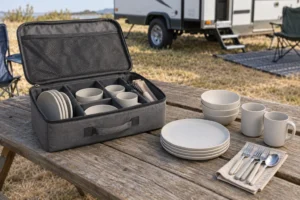
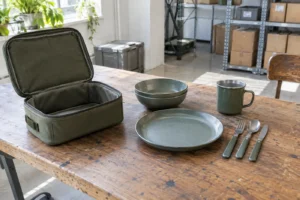
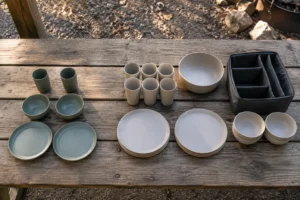
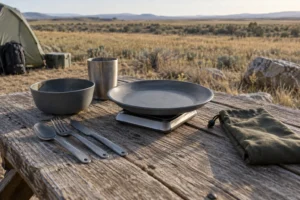
This article is neutral buyer guidance. Its images illustrate procurement questions and do not prove that an exact illustrated set is a stocked Naike Dinner product. Materials, geometry, claims, test evidence, compatibility and production feasibility must be confirmed for the project. Dinnerware is not cookware, and no component shown here is presented as suitable for a burner, stove, campfire or direct flame.
Define the evidence boundary before comparing samples
For European Union programs, Regulation (EC) No 1935/2004 establishes general requirements for food-contact materials and articles, while Regulation (EC) No 2023/2006 addresses good manufacturing practice. These texts do not approve a product because it is described as rigid, collapsible, silicone, PP or another material. The buyer still needs evidence tied to the exact finished article and its intended conditions of use.
For Australia and New Zealand programs, FSANZ food-packaging guidance can help frame business responsibilities. It is not a certificate for a pictured component. Compliance teams should review the bill of materials, pigments, additives, contact conditions, cleaning instructions and market claims for the final configuration rather than accepting a generic material report.
Collapsible geometry introduces an additional mapping problem. The flexible wall, rigid rim, base insert, bonding interface and lid may use different materials or constructions. Ask the supplier to identify every food-contact and non-food-contact part, how they are joined, and which sample revision is covered by each declaration or report. A document for a resin family does not by itself cover an assembled multi-material bowl.
Use a hybrid-set decision matrix
| Component role | Rigid construction may be preferable when | Collapsible construction may be preferable when | Buyer evidence |
|---|---|---|---|
| Main plate | One-hand carrying, cutting support and flat presentation matter. | Only when the proposed profile stays stable and usable after expansion. | Loaded carry observation, flatness and rim-deflection record. |
| Meal bowl | Users stir firmly, serve soup or expect a stable rim. | Pack-height reduction is valuable and the expanded wall resists normal handling. | Filled handling, spoon pressure, drainage and fold recovery checks. |
| Drinking cup | Tip resistance, grip and predictable rim shape dominate. | The folded volume matters and the deployed cup keeps a stable base and rim. | Base stability, grip, fill level and collapse-risk observation. |
| Lunch box | Lid alignment, stacking and transport protection are primary. | A validated collapsible wall does not compromise closure or cleaning. | Loaded closure, leak-risk boundary, nesting and wash inspection. |
| Shared serving bowl | The bowl is passed, scraped or used for repeated group service. | It travels empty and is supported during serving. | Two-hand lift, serving-tool pressure and table stability review. |
| Cutlery | Controlled stiffness and familiar function are required. | Folding hardware solves a verified length problem without trapping soil. | Joint inspection, cleaning access and deployed locking check. |
| Carry frame | The set needs stack protection, shape control or drawer registration. | A soft bag alone adequately controls movement and impact. | Loaded packout, compression and removal-sequence record. |
| Lid or separator | Flatness, seal alignment or load distribution matters. | A flexible cover meets the intended closure and cleaning needs. | Fit map, contact points, drying observation and revision control. |
Score the matrix for the intended channel instead of declaring a universal winner. Give each criterion a weight, define the sample method and name the approver. For an RV drawer program, packed height and rattle control may carry more weight than backpack mass. For family park dining, table stability and cleaning access may dominate.
A useful output is a signed role allocation such as: rigid plates, collapsible bowls, rigid cups, rigid lunch boxes and a soft bag with a removable frame. Another project may reach the opposite conclusion. The value is not the particular answer; it is the traceable reason each role received its construction.
Calculate saved volume from the complete pack
Collapsibility is valuable only when it reduces the verified sales-pack or use-pack envelope. Measure every component in its packed state, including rigid rims, bases, lids, sleeves, separators and the carrier. Then measure the complete loaded bag or case. A bowl that folds by 30 millimetres may save nothing if a fixed rim still defines the stack height or if the cutlery tray occupies the released space.
Record length, width and height at the same compression condition. Pack volume is length × width × height, but the number is meaningful only when the contents and protection level are equal. Compare identical user counts, component roles and packaging functions. Do not compare a bare flexible bowl stack with a retail-ready rigid set containing lids, instructions and a protective case.
Create a simple utilization map. For each layer, show which part defines height, where voids remain, and whether the void can accept another approved component without creating contact damage. The published camping tableware pack-volume method can be used to standardize measurements and distinguish geometric volume from usable packing efficiency.
Report both the absolute envelope and the saving relative to the approved baseline. For example, state that a candidate configuration reduced measured loaded height under a specified packing sequence; do not advertise a percentage until the baseline, conditioning and method are documented. Generated imagery must never be used to derive measurements.
Check deployed stability and fold recovery
A collapsible component has at least two relevant states: packed and deployed. Buyers should also inspect intermediate and incorrectly deployed states because users may stop before the wall fully locks into shape. Observe whether the base sits flat, the rim remains level, the wall resists ordinary grip pressure and the component gives clear visual or tactile feedback when fully opened.
Run the check with representative contents rather than an empty article only. A cup can appear stable when empty but deform when lifted at a normal fill level. A bowl may stand correctly until a spoon presses against one wall. The aim is not to invent a universal load threshold; it is to define normal foreseeable actions and record how the exact sample behaves.
After repeated folding, inspect the same reference points: wall symmetry, rim alignment, base flatness, whitening, cracking, delamination, permanent creases and changes in deployment effort. Cycle count and acceptance criteria must be agreed before testing. This article does not claim a cycle life for any illustrated component.
Treat cleaning and drying as design requirements
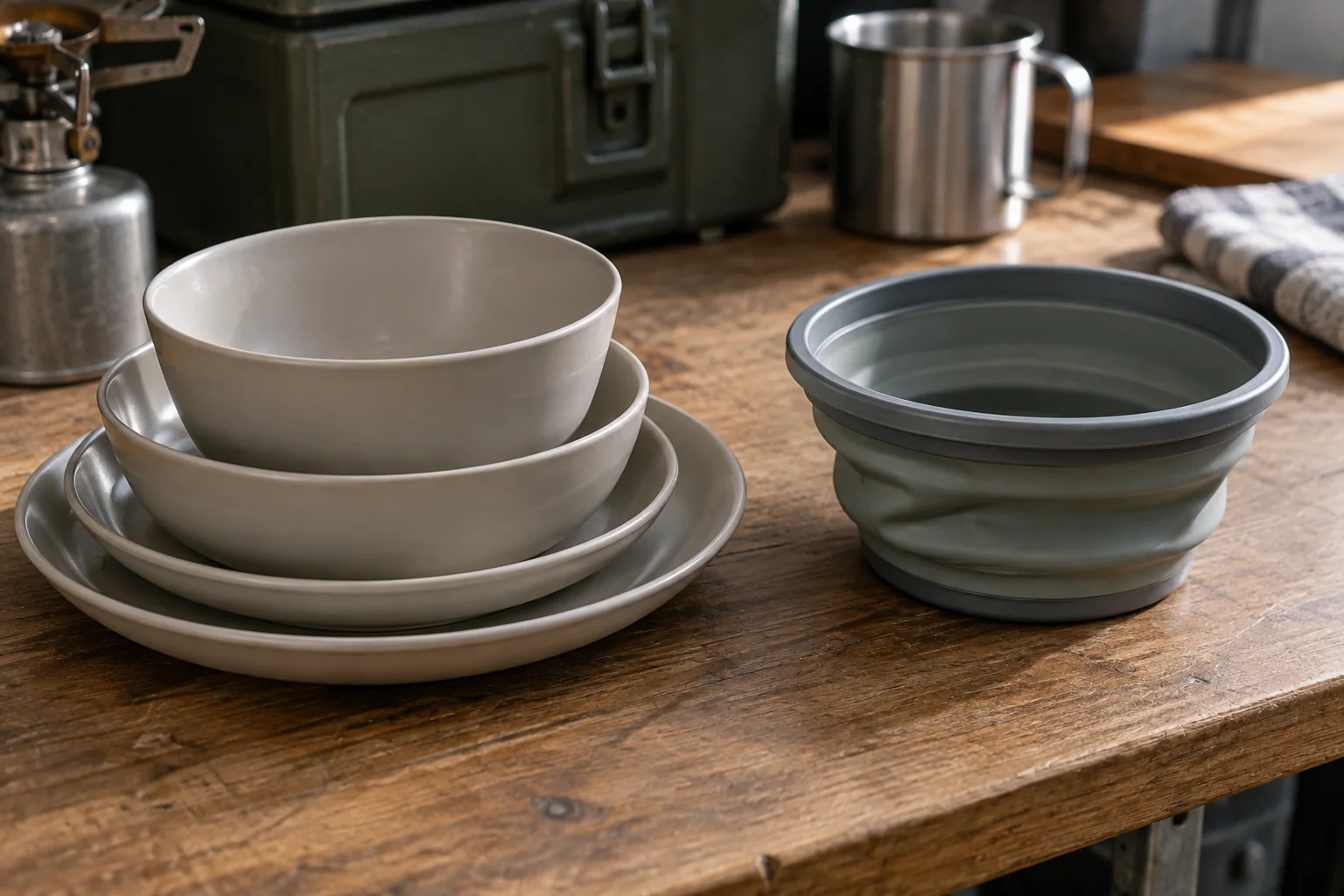
Rigid articles often present fewer moving folds, but ribs, textured undersides, hollow handles and tight nesting gaps can still retain water or soil. Collapsible articles add fold valleys, material interfaces and areas that change shape during washing. Review the complete cleaning workflow: separation, washing, rinsing, drainage, drying, inspection and repacking.
Ask whether the flexible wall can be inverted or opened enough for visual inspection without damage. Check whether the rigid rim blocks drainage when the item is placed upside down. If a component needs a special drying position, document it in the proposed user instruction and confirm that the carry system does not encourage damp repacking.
Do not infer dishwasher, boiling-water, microwave, freezer or sanitizing suitability from the words collapsible, silicone, PP or rigid. Those are product-specific claims involving materials, construction, dimensions and use conditions. Require written instructions and applicable evidence for the exact finished revision.
Match construction to channel and use scenario
Vehicle and RV storage
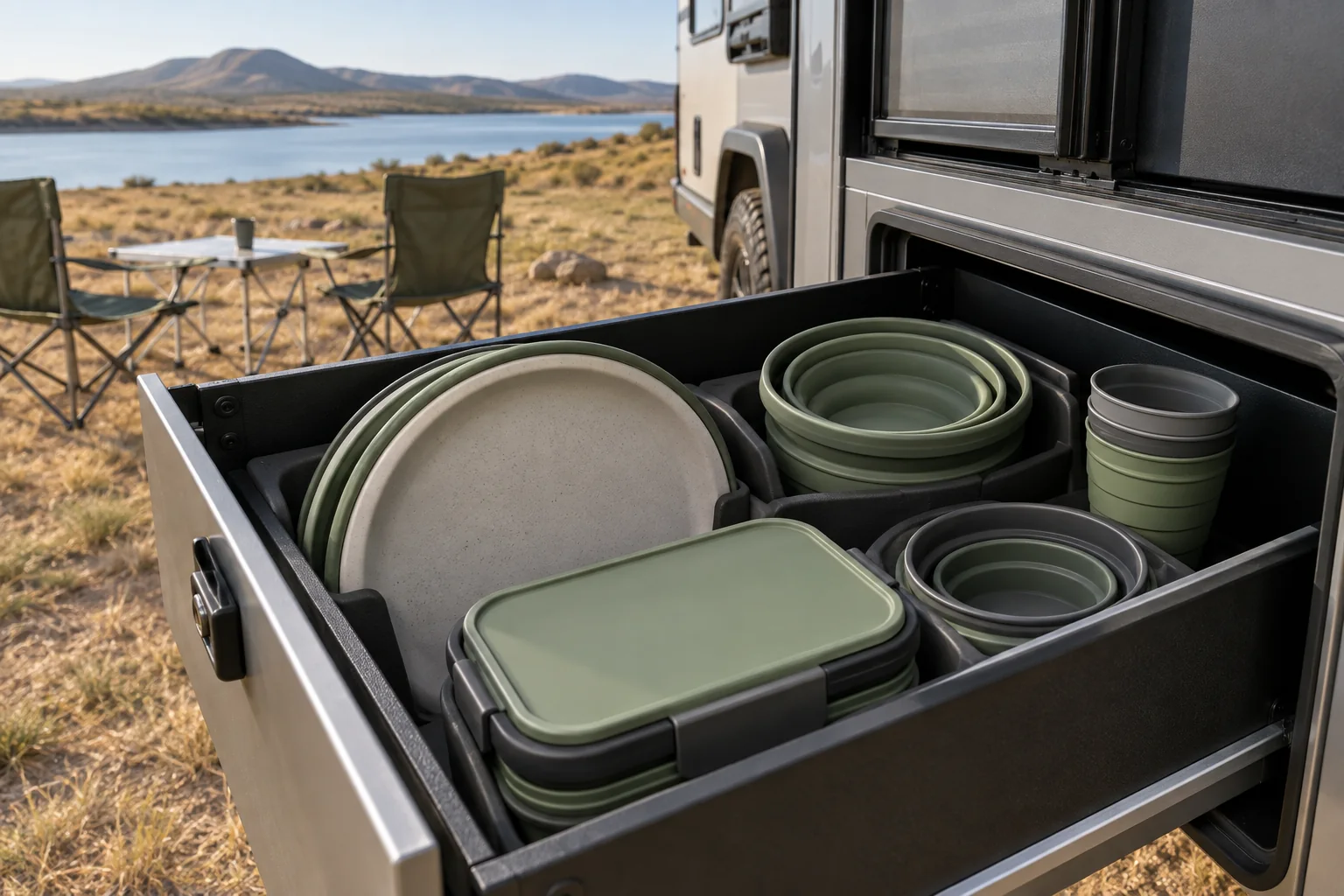
In an RV drawer, the set has a defined storage cavity and may face vibration during travel. A hybrid solution can use rigid plates or boxes to establish a protective layer while collapsible bowls occupy height-sensitive zones. The buyer should map every contact point, add retention only where needed and verify that the drawer closes without compressing flexible rims into permanent deformation.
Use the camping dinnerware rattle checklist to separate noise control from damage control. A soft separator may quiet rigid components but trap moisture; an over-tight strap may prevent movement but distort collapsible walls. Observe the complete loaded drawer under the intended orientation.
Family and car camping
Family sets usually prioritize clear place settings, stable eating surfaces and fast washing over the smallest theoretical pack. Rigid plates and lunch boxes can protect the stack, while collapsible shared bowls may reduce height. Colour or texture can help users identify pieces, but any pigment, decoration or age-related claim requires configuration-specific review.
Count personal and shared roles explicitly. The camping dinnerware component framework helps prevent a low piece count from being achieved by omitting useful roles. A 20-piece rigid set and a 20-piece hybrid set are not equivalent if one counts lids, sleeves or shared utensils differently.
Backpacking and compact personal kits
Mass and volume constraints are stronger, but reliability remains role-specific. A collapsible cup or bowl may be useful when deployed stability is proven, while a rigid plate can double as protection for other pieces. Buyers should compare complete kit mass, packed envelope, setup steps and cleaning burden rather than focusing on one dramatic folding feature.
For folding cutlery, inspect the joint and lock as a food-soil and hand-safety system. If the length saving is small relative to the packed case, ordinary rigid cutlery may be the cleaner solution. Record the decision against the target pack, not a generic “ultralight” label.
Rental, catering and institutional use
Repeated handling increases the importance of quick inspection and replacement rules. Rigid components may simplify visual sorting, while collapsible parts require staff to check full deployment, fold condition and drying. Build a defect reference set and train staff to remove pieces according to defined conditions rather than material prejudice.
Replacement compatibility is also commercial. If a collapsible bowl revision changes rim diameter, it may no longer fit an existing lid or carrier. If a rigid plate profile changes, the stack height may affect every pack. Keep revision identifiers visible in controlled records and decide whether replacement lots must be physically interchangeable.
Write limitations and misuse boundaries into the specification
The first risk is unintended collapse. Identify where users grip, press, scrape and lift the article, then observe whether those actions can initiate folding. The second is hidden soil or moisture in folds and interfaces. The third is false pack efficiency, where a collapsed article saves component height but requires a bulky frame or protective insert.
Rigid components have different risks: cracking, warpage, edge discomfort, abrasive contact, poor nesting release and concentrated impact. “Rigid” is not a durability result. Geometry, material, wall distribution and manufacturing control determine actual performance. Compare failure modes under one approved use scenario rather than treating one construction as inherently premium.
Keep direct-heat claims outside the dinnerware specification unless exact product evidence supports them. A campsite context, metal-looking frame or heat-resistant material name does not establish burner, oven or flame suitability. The same caution applies to leakproof, unbreakable, stainproof and lifetime claims: each requires a defined method and traceable result.
Commercial risk appears when marketing copy outruns the approval record. A buyer may call a set “space saving” without publishing the reference pack, or “easy clean” without checking fold valleys. Require every comparative claim to cite the sample revision, method and boundary used internally, even if consumer-facing copy is shorter.
Run a controlled sample plan
Issue one sample brief containing the component matrix, drawings or target envelopes, intended foods, fill levels, temperatures, contact times, cleaning method, user group, target markets, packing sequence and evidence list. Mark unknowns as open. Do not let a candidate supplier silently choose component counts or substitute a different rigid rim merely to make the sample pack smaller.
On receipt, verify identity before functional review. Check sample codes, individual roles, quantities, declared materials, colours, lids, sleeves and carrier. Photograph the complete unpacked set and the packed configuration. Measure each component and the loaded outer envelope under the defined method.
Observe deployment, normal handling, filling, carrying, utensil pressure, emptying, cleaning, drainage and repacking. For collapsible parts, record incomplete deployment and fold recovery. For rigid parts, record flatness, nesting, separation force and contact marks. Use the same operators and instructions when comparing candidates.
Plan changes deliberately. A new wall material, durometer, rim, base, pigment, lid, hinge, strap or packaging insert can affect fit, evidence and performance. The approval record should state which checks repeat after each change. A visually similar sample is not automatically the same controlled configuration.
B2B buyer checklist
| Check | Question | Why It Matters |
|---|---|---|
| Role matrix | Is every personal and shared component assigned a function and count? | Prevents missing pieces from appearing as pack efficiency. |
| Construction choice | Why is each role rigid or collapsible? | Connects geometry to a buyer need rather than a trend. |
| Loaded envelope | Was the complete protected set measured in its approved packing order? | Confirms actual volume instead of theoretical folded height. |
| Deployment | Can users identify and achieve the fully opened state? | Reduces instability and unintended collapse. |
| Cleaning | Can folds, interfaces, rims and carrier zones be washed, inspected and dried? | Controls hygiene workflow and damp repacking risk. |
| Evidence mapping | Does each document identify the exact finished article and use conditions? | Avoids applying generic material evidence to an assembly. |
| Change control | Which fit, evidence and performance checks repeat after a revision? | Protects approval when geometry or materials change. |
| Claims | Are space-saving, heat, cleaning and durability statements supported? | Keeps commercial copy within verified boundaries. |
Normalize the quotation around one approved matrix
Require every quotation to repeat the same role-and-count matrix, construction description, individual mass, loaded pack dimensions, carrier components, packaging, evidence supplied, evidence outstanding and sample revision. Price, MOQ and lead time must come from a written supplier quotation; none is invented in this guidance.
Separate confirmed facts from targets. “Target pack height” is an engineering objective. “Sampled pack height” is a measurement tied to a specific loaded sample. “Approved pack height” is the controlled value accepted by the buyer. These labels stop an early visual concept from becoming an accidental production commitment.
Ask each candidate to identify exclusions as clearly as inclusions. If the quotation omits a lid, carrier insert, replacement policy, evidence item or packing operation, place that gap beside the price rather than in a footnote. This keeps the commercial comparison connected to the actual hybrid set the channel intends to sell.
If candidates propose different hybrid allocations, compare both against the same weighted matrix. Record why the difference exists and what it changes downstream: tooling, cleaning instructions, packout, evidence or replacement policy. A lower quoted cost is not comparable if it removes a rigid frame, reduces component count or leaves multi-material evidence unresolved.
Buyer FAQs
1. Should every bowl and cup be collapsible to save the most space?
No. The maximum component-level collapse may not create the best complete set. Stability, cleaning, lids, rigid rims and the carrier can determine the final envelope. Allocate construction by role, then measure the complete protected pack.
2. Are collapsible components less durable than rigid ones?
That cannot be concluded from the format alone. Collapsible parts introduce fold and interface failure modes; rigid parts introduce impact, warpage and nesting risks. Define normal use, methods, sample count and acceptance rules for the exact finished articles.
3. What is the best place to use a collapsible component?
A role with meaningful height savings, adequate deployed stability and accessible cleaning is a good candidate. Shared bowls are often worth evaluating, but the correct answer depends on food, user behaviour, pack architecture and verified samples.
4. Can a rigid rim solve collapsible bowl stability?
It may help control rim shape, but it can also define the packed diameter or height and add a material interface. Review the whole geometry, bonding method, drainage and evidence mapping rather than assuming the rim solves every risk.
5. How should buyers evaluate fold life?
Approve a cycle method that reflects intended folding, cleaning and conditioning, then inspect predefined locations and functions. Do not select a cycle count after results are known, and do not claim a life beyond the tested article and method.
6. Can rigid and collapsible pieces share one lid?
Only after fit, closure, contact and cleaning are confirmed for the exact parts. Compatibility to be confirmed by project sample and drawing. Revision control is essential because a small rim change can remove interchangeability.
7. Does collapsible dinnerware count as cookware?
No. Dinnerware and cookware are separate product boundaries. Do not infer stove, burner, oven or direct-flame use from a material or outdoor image. Require product-specific construction, instructions and evidence for any heat claim.
Request a hybrid-set sample and specification review
Send the user count, complete component matrix, intended foods, fill levels, temperature and cleaning assumptions, target markets, loaded storage envelope, carrier concept, colour direction, artwork zones, evidence expectations and the decision weights your team will use. Ask the supplier to return a marked matrix that separates available components, new development, open questions and unsupported claims.
Request a rigid and collapsible component review with the proposed packing sequence and replacement policy. The review should identify which roles need drawings, which can proceed to samples and which claims require additional evidence.
Use the same controlled brief when requesting a sample plan and written quotation. That creates a comparable procurement record and keeps pack volume, stability, cleaning, compliance and commercial copy connected to the exact hybrid camping dinnerware set.