
Wheat Straw Composite Material Explained: PP Ratio, Durability & Safety
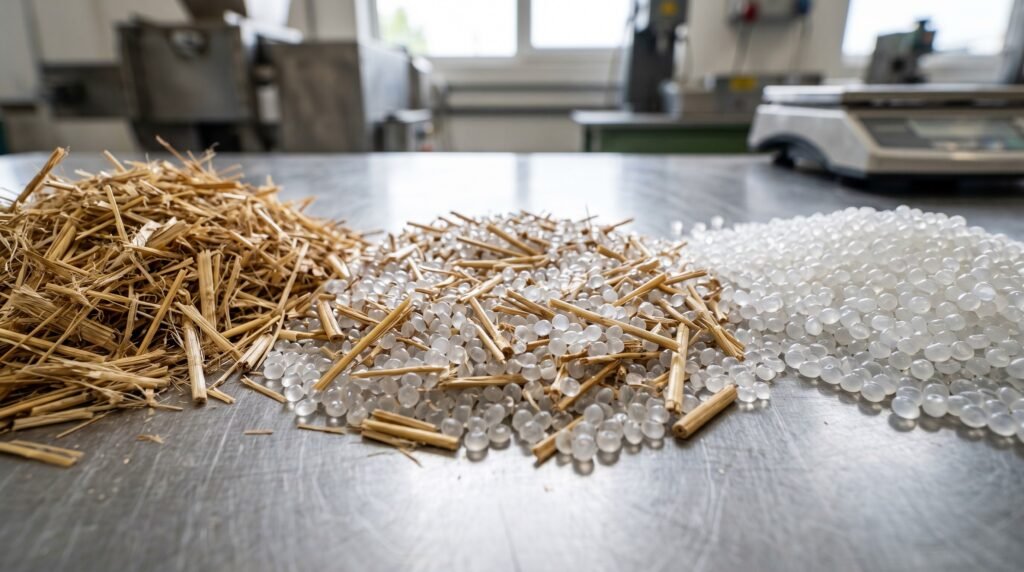
If you are a B2B buyer sourcing “eco-friendly” tableware, you have likely encountered a dozen different names for the same thing: wheat straw plastic, bio-composite, plant-fiber resin, or simply wheat straw tableware. But here is the reality from the factory floor: Wheat straw composite material is not a single “magic” substance. It is a carefully engineered formula where a 5% difference in the PP ratio can be the difference between a high-end retail product and a brittle shipment that fails customs.
In our manufacturing work since 2008, I have seen the “wheat straw boom” move from a niche innovation to a global standard. However, as the market matures, so does the scrutiny. EU and US buyers are no longer satisfied with the word “natural”—they want to know the exact polymer binder used, the migration limits under high heat, and the life cycle of the product.
This guide is for the serious importer. We are going to strip away the marketing jargon and look at the actual material science behind wheat straw composite material. We will explore the critical PP ratio, the mechanics of durability, and the rigorous food contact safety standards that separate professional manufacturers from opportunistic traders.
What Exactly is Wheat Straw Composite Material?
At its core, wheat straw composite material is a type of bio-based plastic, specifically a “Wood Plastic Composite” (WPC) variant where agricultural waste (wheat straw) serves as the filler and a thermoplastic (usually Polypropylene) serves as the matrix.
The Anatomy of the Blend
To understand the material, you have to look at what happens inside the compounding machine. It is a three-part system:
- Natural Wheat Straw Fiber (30% – 50%): This is the agricultural byproduct. We take the stalks left over after the wheat grain is harvested, clean them, dry them, and grind them into a fine micron-sized powder. This fiber provides the “eco” credentials and the unique natural aesthetic.
- Polymer Matrix (usually Food-Grade PP): This is the binder. Without it, the wheat straw would just be a pile of dust. The PP (Polypropylene) provides the structural integrity, the heat resistance, and the water-proof qualities that make the tableware functional.
- Coupling Agents & Stabilizers (1% – 5%): These are the “secret sauce” of the factory. Natural fiber and plastic don’t naturally like to stick together (polar vs. non-polar). Coupling agents create a chemical bridge between the wheat straw and the PP, ensuring the material doesn’t delaminate or crack under stress.
For buyers looking to understand how these materials are priced in bulk, our Wheat Straw Tableware Quotation Breakdown explains how material grades affect your bottom line.
The “Golden Ratio”: Why the PP Percentage Matters
One of the most frequent questions I get from B2B procurement teams is: “What is the percentage of wheat straw in your products?”
While buyers often push for “more fiber” to increase their sustainability claims, there is a technical limit known as the Saturation Point.
The Strength-to-Fiber Curve
| Wheat Straw % | PP Binder % | Material Characteristics | Ideal Use Case |
|---|---|---|---|
| 10% – 20% | 80% – 90% | High gloss, feels like standard plastic, very durable. | Low-cost promotional items, single-use high-volume. |
| 30% – 40% | 60% – 70% | The Industry Standard. Visible fiber specks, matte finish, high durability, microwave safe. | Retail sets, supermarket chains, premium private label. |
| 50% | 50% | Rougher texture, higher “natural” scent, slightly lower impact resistance. | “Deep Green” brands, eco-boutiques, outdoor/camping sets. |
| 60% + | < 40% | Brittle, difficult to mold, high failure rate in dishwasher tests. | Not recommended for reusable tableware. |
The Risk of High Fiber Content
When the wheat straw content exceeds 50%, the material becomes significantly more difficult to process via injection molding. It requires higher pressures and lower speeds, which increases the cycle time and the unit cost. More importantly, at very high fiber loads, the PP matrix is “starved”—there isn’t enough plastic to fully coat and protect every fiber. This results in a porous surface that can absorb food oils and bacteria, leading to a failure in food contact safety audits.
Comparative Material Science: Wheat Straw vs. The Competition
To truly appreciate wheat straw composite material, we must look at how it stacks up against other “bio-based” alternatives currently flooding the market. Many B2B buyers find themselves confused by the overlapping claims of PLA, bamboo fiber, and cornstarch.
1. Wheat Straw vs. PLA (Polylactic Acid)
PLA is a bioplastic derived from fermented plant starch (usually corn).
- The Heat Gap: PLA is notorious for its low glass transition temperature (around 55°C – 60°C). A PLA cup filled with hot coffee will often soften and deform. Wheat straw + PP composite handles up to 120°C comfortably.
- The Cost Gap: PLA is currently 2.5x to 4x more expensive than wheat straw composite granules.
- The End-of-Life Gap: While PLA is technically “compostable,” it only breaks down in industrial facilities. In a home compost bin, it lasts almost as long as traditional plastic. Wheat straw composite focuses on the “Reduce” and “Reuse” part of the cycle.
2. Wheat Straw vs. Bamboo Fiber (Melamine Bonded)
This was the dominant “eco” tableware for a decade until the EU bans.
- Binder Safety: Most bamboo fiber plates use Melamine-Formaldehyde as the glue. As mentioned, this creates high migration risks. Wheat straw composite uses PP, which is inherently more stable and non-toxic.
- Aesthetic: Bamboo fiber has a “powdery” matte look. Wheat straw has a “flecked” textured look.
- Durability: Bamboo fiber is prone to chipping if dropped. Wheat straw composite has superior impact resistance due to the flexible PP matrix.
3. Wheat Straw vs. Bagasse (Sugarcane Fiber)
Bagasse is excellent for single-use disposables, but it fails in the “Reusable” category.
- The “Soggy” Factor: Bagasse absorbs liquid over time. Wheat straw composite is 100% waterproof.
- Cleaning: You cannot effectively “wash” a bagasse plate for 500 cycles. It is a one-and-done material.
| Feature | Wheat Straw + PP | PLA | Bamboo + Melamine | Bagasse |
|---|---|---|---|---|
| Microwave Safe | Yes (120°C) | No | Limited (Risk) | Yes (Disposable) |
| Dishwasher Safe | Yes (500+ cycles) | No | Yes (Low temp) | No |
| BPA Free | Yes | Yes | No | Yes |
| Impact Strength | High | Low | Low (Chipping) | Very Low |
| B2B Unit Cost | Medium-Low | High | Medium-High | Low (Disposable) |
Manufacturing Deep Dive: Troubleshooting the Molding Process
For our OEM partners, understanding the “Material Temperament” of wheat straw composite material is essential during the mold design phase. Because this is a fiber-filled material, it behaves differently than virgin plastic.
1. Managing “Fibre Orientation” and Warping
Natural fibers are anisotropic—they have a length and a width. During injection, they align with the flow of the melt. This can cause “Differential Shrinkage,” leading to warping in long, flat products like large dinner plates.
- Factory Solution: we use “Balanced Gating” and central injection points to ensure the fiber orientation is radial and symmetrical.
- Buyer Tip: If your plates are arriving warped, the factory likely didn’t dry the material long enough or is using a single-side gate that causes uneven stress.
2. The Battle Against “Silvering” and Splay
If you see silver streaks on the surface of your wheat straw bowls, that is moisture turning to steam inside the injection barrel. Natural wheat straw is hydrophilic (it loves water). Even if it is stored in a warehouse, it can absorb 1-2% moisture from the air.
- The Process: we dry the composite granules at 80°C for at least 4 hours before they touch the molding machine. We use de-humidifying dryers to ensure the moisture content is below 0.05%.
3. Surface Finish: The “Sparkle” Effect
Ever wonder why some wheat straw products look “dirty” while others look “premium”? It comes down to the grind size of the fiber.
- 30-60 Mesh: Large visible chunks. Good for a “rustic” look but can feel rough to the hand.
- 100-200 Mesh: Fine specks. Provides a smooth, high-end feel while still maintaining the natural visual cue.
At Naike Dinner, we specialize in High-Precision Injection Molding, using 120-mesh fiber to ensure every plate meets retail-shelf standards. Learn more about our process in the How to Import Wheat Straw Tableware from China guide.
Sustainability & Life Cycle Assessment (LCA)
As a wheat straw composite material manufacturer, we have to look beyond the “Green” label. What is the actual environmental impact of a wheat straw bowl compared to a ceramic one?
1. Carbon Sequestration
Wheat straw is part of a 12-month carbon cycle. As the wheat grows, it pulls CO2 from the atmosphere. By capturing that straw and locking it into a durable plate, we are effectively “storing” that carbon for the 5-10 year lifespan of the product.
2. Energy in Production
- Ceramic: Requires firing in kilns at 1,200°C for 12-24 hours. Massive energy consumption.
- Wheat Straw Composite: Molded at 180°C with cycle times of 20-30 seconds.
- Result: The “Energy Footprint” of a wheat straw set is roughly 40% lower than an equivalent ceramic set.
3. Recyclability
Contrary to popular belief, wheat straw composite is recyclable. It is a “Grade 5” (PP) material. It can be reground and used to make non-food items like industrial pallets, storage crates, or garden furniture. We actively encourage our B2B partners to set up “Closed Loop” return programs for their bulk customers.
For advice on how to communicate these benefits without overstepping, read our guide on Lifecycle Claims for Wheat Straw Tableware.
Common Myths vs. Factory Reality
Let’s clear up some “industry legends” that often mislead B2B buyers.
Myth 1: “You can smell the wheat in the plate.” Reality: If your plate smells strongly like wheat, it usually means the fiber content is too high or the material wasn’t stabilized. A high-quality plate should be Sensory Neutral. If there is a smell, it can migrate to the food—causing a failure in the LFGB Taste and Odor test.
Myth 2: “Wheat straw plates are 100% biodegradable in the ocean.” Reality: Absolutely not. No high-durability reusable plate is ocean-biodegradable. These are designed to last for years. If a supplier tells you they will disappear in the ocean in 6 months, they are greenwashing.
Myth 3: “Adding wheat straw makes the plastic weaker.” Reality: On the contrary, natural fibers act as a reinforcement. While they slightly reduce the “Impact Strength” (how hard you can hit it before it cracks), they significantly increase the Tensorial Strength and Flexural Modulus (how much weight it can hold without bending).
Detailed B2B Buyer FAQ: The Material Science Edition
Q: Can we use 100% recycled PP with wheat straw fiber?
A: We don’t recommend it for food contact safety. Recycled PP often contains “Post-Consumer Waste” from unknown sources. For dinnerware, we use only 100% Virgin Food-Grade PP. Recycled content is fine for the outer packaging, but not the plate itself.
Q: What is the maximum temperature for “Short Term” contact?
A: The material can handle 140°C for up to 60 seconds (think pouring boiling water for noodles). However, for continuous use, we specify 120°C to prevent any risk of polymer degradation.
Q: Does the wheat straw fiber contain gluten?
A: This is a vital question for the “Allergy-Friendly” market. The “straw” is the stem of the plant, not the grain. However, to be 100% safe, we perform Gluten-Free verification on our fiber batches. Most wheat straw composites are gluten-free, but you must ask for the lab proof.
Q: Why does the color fade slightly after 2 years?
A: All natural-fiber composites are UV-sensitive. Over years of exposure to sunlight and harsh dishwasher chemicals, the pigment can fade by 5-8%. This is a natural aging process and does not affect the safety of the product.
At Naike Dinner, we typically lock our standard production at a 35% wheat straw / 65% food-grade PP ratio. This provides the best balance of visual “eco” cues and long-term durability. If you are planning a specific project, you can see our existing range in the Wheat Straw Dinnerware Manufacturer Catalog.
Durability Benchmarks: Is It Really “Unbreakable”?
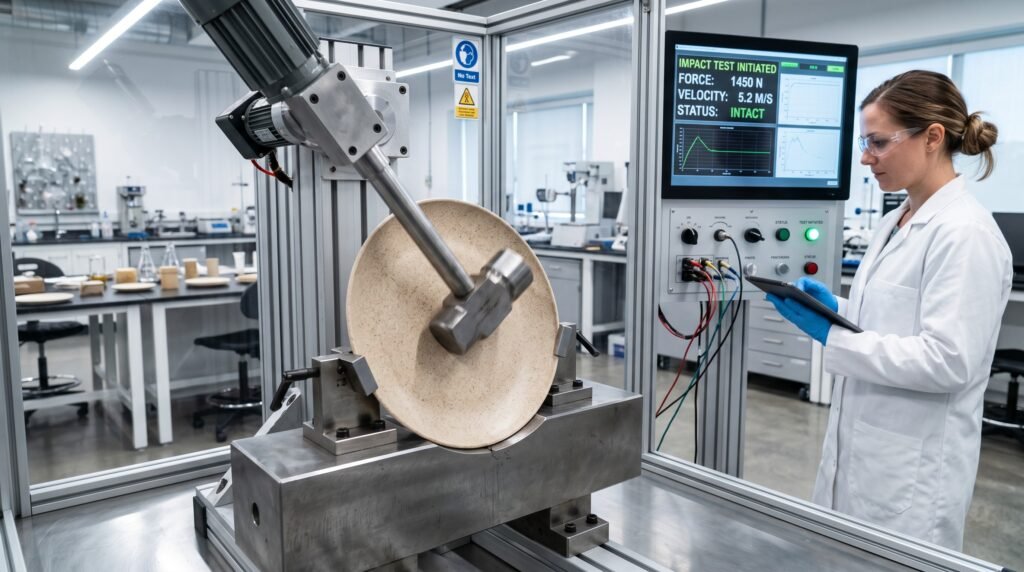
In the B2B world, the term “unbreakable” is a relative one. Compared to ceramic or glass, yes—wheat straw composite material is exceptionally durable. However, not all composites are created equal.
1. Impact Resistance (The Drop Test)
Because PP is a semi-crystalline polymer, it has a natural “give.” When a wheat straw bowl is dropped from a height of 1.5 meters onto a hard floor, it should bounce, not shatter. In our internal QC, we perform a 10-cycle drop test on 5% of every production batch.
- Premium Grade: No cracking after 10 drops.
- Low Grade (High recycled content): Micro-cracks visible after 2-3 drops.
2. Heat Resistance and Microwave Performance
Standard food-grade PP has a melting point around 160°C (320°F), but its heat deflection temperature (where it starts to soften) is lower, typically around 100°C – 120°C. When we add wheat straw fiber, we actually increase the material’s thermal stability. The fibers act like a reinforcing skeleton, allowing the product to maintain its shape in the microwave.
- Safe usage: Up to 120°C (248°F) for 3-5 minutes.
- Factory Advice: Avoid “High Fat” or “High Sugar” foods in the microwave, as these can reach temperatures exceeding 150°C, which may cause localized surface scarring on the composite.
3. Dishwasher Durability
This is where many “eco” materials fail. PLA (Polylactic Acid) often warps at 55°C. Bamboo-melamine can lose its surface gloss. True wheat straw composite material using a PP matrix is dishwasher safe for the top rack. Over 500+ cycles, the material will maintain its structural integrity, though it may develop a slightly more “matte” patina over years of use due to the natural fibers becoming more exposed on the surface.
If you’re interested in the specific testing protocols we use, check our guide on Composite Tableware Chemical Testing.
Food Contact Safety: The Regulatory Reality
Safety is the non-negotiable part of the B2B relationship. When you import wheat straw composite material, you are responsible for the health of the end consumer.
The Big Two: LFGB vs. FDA
There is a common misconception that if a product is “FDA Approved,” it is ready for the world. In the tableware industry, this is dangerously incorrect.
- FDA (USA): Focuses primarily on the extraction of substances. If the material doesn’t leach more than a certain amount of “non-volatile extractives” in distilled water or n-heptane, it passes.
- LFGB (Germany/EU): The gold standard. LFGB goes much deeper. It includes Sensory Testing (Odor and Taste). If the wheat straw material makes a cup of water taste like “grass” or “plastic,” it fails LFGB, even if it is chemically non-toxic.
For a detailed breakdown of these differences, read our LFGB Testing for Wheat Straw Dinnerware and FDA Food Contact Requirements guides.
Migration Limits: The Invisible Risk
The primary concern with any plastic composite is Specific Migration Limits (SML).
- BPA: Our composite is 100% BPA-free because we use pure PP resin.
- Heavy Metals: Pigments must be Lead, Cadmium, and Mercury-free.
- Melamine/Formaldehyde: This is the most critical point. Many “Bamboo” products were recently banned in the EU because they used Melamine Resin as a binder. Wheat straw + PP composite does NOT contain melamine. This makes it a much safer long-term bet for EU importers.
Manufacturing Insights: How the “Natural” Look is Created
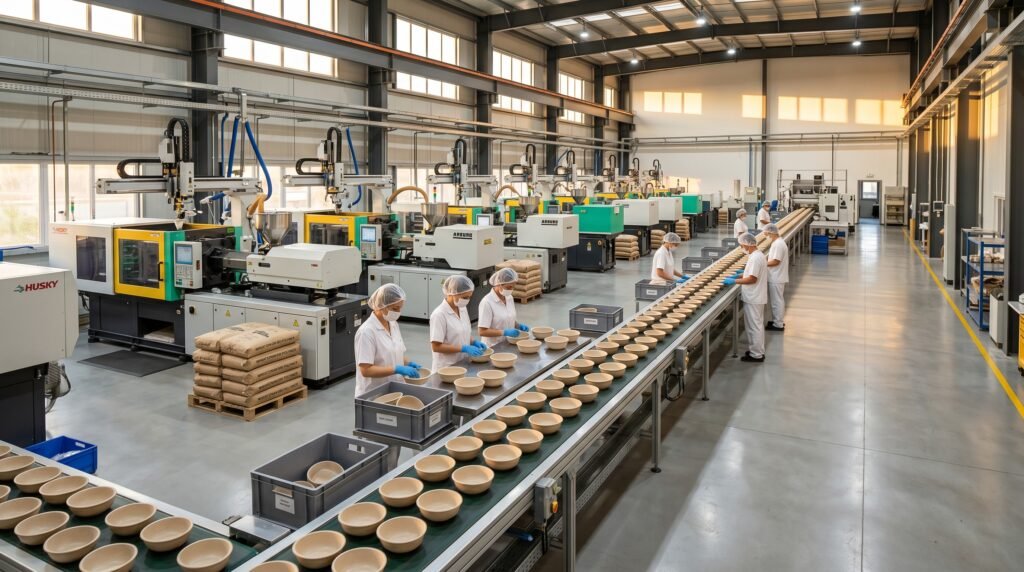
As a factory insider, I can tell you that the “look” of wheat straw dinnerware is a carefully managed process.
The Injection Molding Cycle
The manufacturing process for wheat straw composite material is similar to standard plastic injection molding, but with three key differences:
- Lower Melt Temperature: We must keep the temperature below 190°C. If the heat goes too high, the natural wheat fibers will “char” (burn), turning the product a dark, muddy brown and creating a burnt smell.
- Venting: Natural fibers hold moisture. Even after drying, they release gases during molding. Advanced “vacuum venting” on the injection barrels is required to prevent surface bubbles or silver streaks.
- Color Management: Because the raw material already has a beige tone, creating bright whites or vibrant yellows is nearly impossible. This is why you mostly see wheat straw in pastels (pinks, blues, greens) and natural earth tones.
If you are a brand owner looking to launch a unique line, our Private Label Wheat Straw Dinnerware guide explains how we handle color approvals and logo placements at the factory level.
B2B Buyer Checklist: How to Verify Material Quality
Before you sign a contract for wheat straw composite material, use this factory-grade checklist to audit your supplier.
1. Request the “TDS” (Technical Data Sheet)
Don’t just ask for a catalog. Ask for the TDS of the raw composite granules. A professional manufacturer should be able to provide:
- Density (g/cm³)
- Melt Flow Index (MFI)
- Notched Izod Impact Strength
- Flexural Modulus
2. The “Burn and Sniff” Test
If you have a sample, try the burn test (outdoors).
- Pure PP: Smells like candle wax (paraffin).
- Wheat Straw Composite: Smells like burnt popcorn or toasted bread. If it smells acrid, like burnt hair or chemicals, there may be hidden resins or low-grade binders involved.
3. Surface Porosity Check
Apply a dark sauce (like soy sauce or balsamic vinegar) to the surface of a sample and let it sit for 24 hours. Wash it off with standard dish soap. If a permanent stain remains, the PP ratio is too low or the coupling agents are failing, meaning the material is absorbing food particles.
4. Certification Traceability
Ensure the test report (SGS, TÜV, or Intertek) lists the specific material composition. A report that says “Plastic Bowl” is useless. It should say “Wheat Straw Fiber + Polypropylene Composite Bowl.”
For more tips on choosing a partner, see our guide on How to Import Wheat Straw Tableware from China.
The Future of Wheat Straw: 100% Biodegradable?
There is a lot of “greenwashing” around the term biodegradable. Current wheat straw + PP composites are reusable and recyclable, but they are not home-compostable. The PP binder will not break down in your garden.
However, at Naike Dinner, we are currently testing Wheat Straw + PLA and Wheat Straw + PBAT blends. These are truly biodegradable in industrial composting facilities. The trade-off? They are currently 3x more expensive and have lower heat resistance. For 90% of our B2B customers, the Wheat Straw + PP reusable model is the best ROI because it reduces virgin plastic use while providing a product that lasts for years.
Conclusion: Why This Material Wins in the B2B Market
The success of wheat straw composite material isn’t just about being “green.” It wins because it solves a fundamental problem: it provides a sustainable alternative that doesn’t sacrifice the performance of modern plastic.
It is lighter than ceramic, safer than melamine, more heat-stable than PLA, and significantly more aesthetically pleasing than virgin plastic. For importers, it represents a high-margin product category that aligns with the global shift toward the circular economy.
If you understand the science—the PP ratio, the migration limits, and the molding constraints—you can source with confidence and build a brand that stands up to regulatory scrutiny.
Ready to Deep Dive into Our Material Specs?
At Naike Dinner, transparency is our core value. We don’t hide our formulas—we document them. Whether you are a retail buyer needing LFGB reports or an OEM brand developing a custom mold, our team is ready to provide the technical evidence you need.
👉 Request a Detailed Material Specification Sheet
👉 Download the 2026 Wheat Straw Dinnerware Catalog
👉 Start Your OEM/ODM Custom Project Consultation
👉 Read: How to Avoid Hidden Costs in Your Tableware Quotation
CONTACT US
Shared Serving Pieces vs Individual Place Settings for Group Camping
A procurement framework for deciding which camping dinnerware components should be issued per person and which should remain shared across a group.
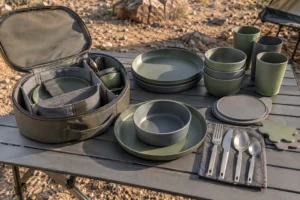
How to Prevent Rattle in a Nested Camping Dinnerware Set
A practical diagnostic for finding and controlling movement, impact and rubbing inside nested camping dinnerware sets without hiding problems behind unsupported claims.
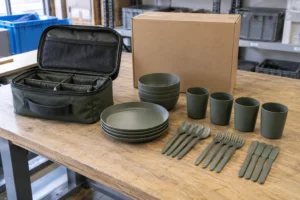
How to Calculate Pack Volume for Camping Tableware
A practical procurement worksheet for measuring the complete camping tableware sales unit, calculating its external cube and separating real pack efficiency from unsupported freight claims.
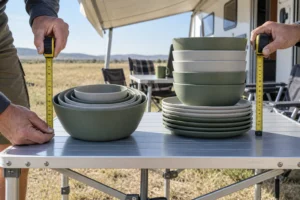
Nesting vs Stacking: How the Two Designs Change Pack-Out
A buyer-focused geometry and pack-out comparison for choosing nested, stacked or hybrid camping dinnerware systems without confusing compact appearance with approved performance.
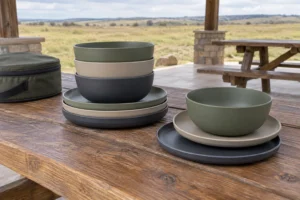
What Makes Camping Dinnerware Truly Stackable?
A procurement acceptance framework for reviewing stack rise, contact interfaces, separation, stability, mixed-component order, drainage and retained pack-out.
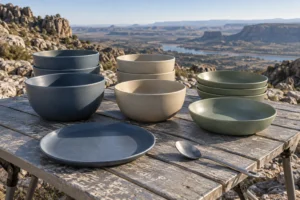
Deep Bowls vs Shallow Bowls for Outdoor Meal Sets
A procurement decision table for selecting deep and shallow camping bowl profiles by meal function, user access, stability, cleaning and packed-set architecture.
Safety interpretation
Is Wheat-Straw + PP Safe? Evaluate the Finished Article
The presence of wheat-straw filler does not by itself prove or disprove food-contact suitability. A sourcing decision should identify the PP resin, filler, colorant and any additives, then match the finished SKU to its intended food type, temperature, contact time and destination-market requirements. “Natural,” “BPA-free” or “food grade” is not a substitute for this specification.
For an outdoor range, also confirm drop performance, odor after conditioning, staining, dimensional change and cleaning conditions. The correct conclusion is project-specific: request material documentation and test evidence for the exact product rather than applying one claim to an entire category. See the testing workflow and wheat-straw composite sourcing page.
6 Responses