
Wheat Straw vs PLA vs Bamboo Tableware: Material Guide
“Eco-friendly tableware” is not a single material. It is a family of materials with completely different properties.
A buyer who assumes wheat straw, PLA, and bamboo fiber are interchangeable will make costly sourcing mistakes.
At Naike Dinner, we manufacture wheat straw tableware and have tested every competing bio-based material in our lab.
This guide compares wheat straw vs PLA vs bamboo fiber tableware across the factors that matter most to B2B buyers: heat resistance, durability, food safety, cost, and regulatory compliance.
We will also recommend which material fits which market segment, so you can source with confidence.
Material Overview: What Each One Actually Is
Before comparing performance, you need to understand what each material is made of.
Wheat Straw Composite Tableware
Wheat straw tableware is a composite of 30-50% natural wheat straw fiber and 50-70% food-grade polypropylene (PP) binder.
The wheat straw is the stalk left over after grain harvest — an agricultural byproduct that would otherwise be burned or wasted.
The PP binder provides structural integrity, heat resistance, and waterproofing.
The result is a durable, reusable product with visible natural fiber specks and a matte texture — the finish you can see on our 24-piece wheat straw dinnerware set.
PLA (Polylactic Acid) Tableware
PLA is a bioplastic derived from fermented plant starch, usually corn.
It is a polymer that can be molded into tableware shapes, but it behaves fundamentally differently from PP composites.
PLA is compostable under industrial conditions, which is its primary environmental selling point.
However, it has significant limitations in heat resistance and durability.
Bamboo Fiber Composite Tableware
Bamboo fiber tableware is a composite of bamboo fiber and a binder — most commonly melamine-formaldehyde resin.
The bamboo fiber provides the “natural” look. The melamine resin provides the rigidity.
This combination has caused significant regulatory problems in recent years, as we will examine in the safety section.
Performance Comparison: Wheat Straw vs PLA vs Bamboo Tableware
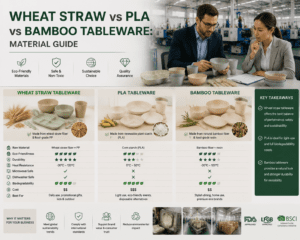
This comparison table is based on our lab testing and industry-standard data. It shows the performance differences across nine critical dimensions.
| Dimension | Wheat Straw + PP | PLA | Bamboo + Melamine |
|---|---|---|---|
| Max heat resistance | 120°C | 55-60°C | 100°C (decomposition risk) |
| Microwave safe | Yes (up to 120°C) | No (warps easily) | Limited (melamine risk) |
| Dishwasher safe | Yes (500+ cycles) | No (warping at 55°C+) | Yes (low temp only) |
| Impact resistance | High (bounces) | Low (cracks) | Low (chips) |
| Durability | 3-5 years of daily use | 6-12 months | 1-3 years |
| Food contact safety | Excellent (PP is stable) | Good (but heat-sensitive) | Problematic (melamine/formaldehyde) |
| Home compostable | No (recyclable as PP) | Yes (industrial only) | No |
| Relative cost | Medium | High | Medium |
| Regulatory risk | Low | Low | High (EU scrutiny) |
The table reveals a clear pattern. Wheat straw + PP wins on durability, heat resistance, and food safety — which is why our wheat straw bowl collection and cup collection are built around this material.
PLA wins only on compostability — a claim that requires industrial facilities most consumers do not have access to.
Bamboo + melamine has the most serious regulatory exposure of the three.
Heat Resistance: Where Wheat Straw vs PLA vs Bamboo Fail Differently
Heat is the most common point of failure in eco-friendly tableware. Each material fails in a different way.
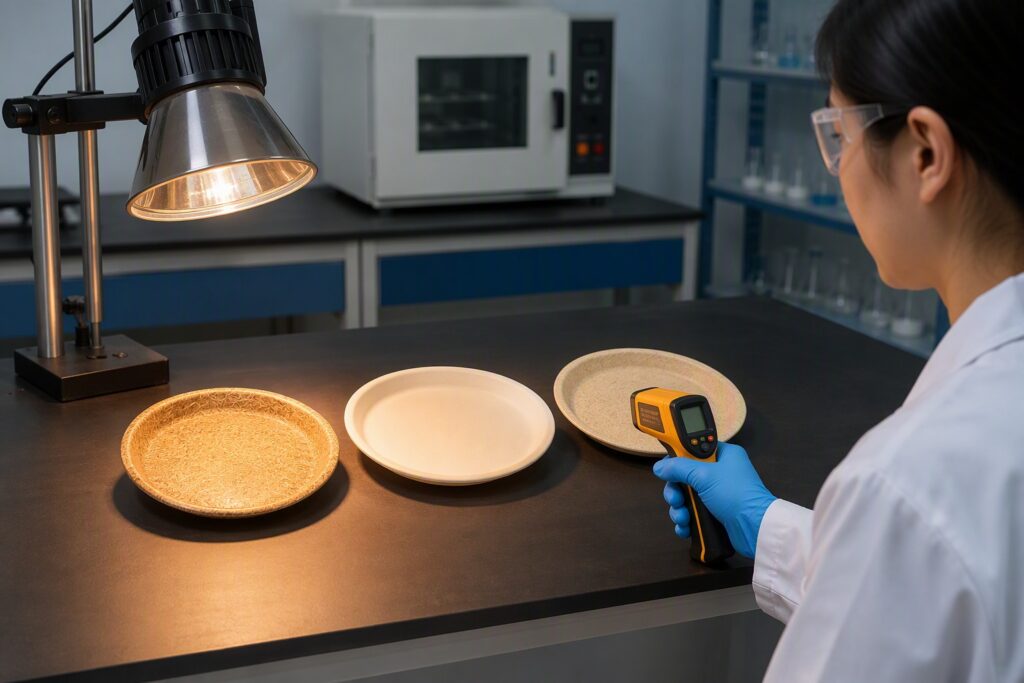
Wheat Straw + PP Heat Behavior
The PP binder has a melting point around 160°C and a heat deflection temperature of 100-120°C.
The wheat straw fibers act as a reinforcing scaffold, slightly increasing the material’s thermal stability.
A wheat straw plate can be microwaved with fatty food at 800W for several minutes without deforming.
It is also dishwasher safe at standard home temperatures through the top rack.
PLA Heat Behavior
PLA has a glass transition temperature of only 55-60°C.
Above this temperature, the material softens and loses its shape.
A PLA cup filled with hot coffee will deform within minutes. A PLA plate under hot food will bow in the center.
PLA is not microwave safe and is not dishwasher safe at standard temperatures.
For any application involving hot food, PLA is fundamentally unsuitable for reusable tableware.
Bamboo + Melamine Heat Behavior
Bamboo composite can tolerate moderate heat, but melamine-formaldehyde resin degrades at high temperatures.
Under heat, particularly with acidic food, melamine and formaldehyde can migrate into the food at levels exceeding the Specific Migration Limits under EU Regulation 10/2011.
This migration risk is the reason the EU has flagged bamboo-fiber tableware with melamine binders for intensified enforcement.
Food Safety: The Regulatory Reality of Each Material
Food safety is where the three materials diverge most dramatically. The regulatory landscape has shifted significantly in recent years — and the EU food contact materials framework is the reference point for most export markets.
Wheat Straw + PP Safety Profile
PP is one of the most thoroughly tested food contact polymers in existence.
When manufactured with virgin food-grade PP and certified pigments, wheat straw tableware passes all relevant migration tests.
It is BPA-free by design, since PP does not use BPA in its production.
It does not require formaldehyde or melamine in any part of the formula.
This makes wheat straw + PP the safest of the three materials for food contact.
PLA Safety Profile
PLA itself is food safe. The risk is operational, not chemical.
At temperatures above 60°C, PLA can release lactic acid and begin to degrade, which may affect food quality.
More importantly, PLA products that claim “compostable” must meet specific biodegradability standards — and products that are not actually compostable in home conditions can mislead consumers under the EU single-use plastics rules.
Bamboo + Melamine Safety Profile
Bamboo fiber tableware with melamine-formaldehyde resin has the most serious safety issues.
The EU has specifically investigated “bamboo-zling” products — bamboo fiber items made with melamine binders — after finding melamine and formaldehyde migration above legal limits.
Many European countries have removed these products from shelves.
If you are sourcing for the EU market, bamboo + melamine products carry significant regulatory risk that can result in shipments being blocked at customs.
For a deeper explanation of these testing requirements, our composite tableware chemical testing guide covers migration testing in detail.
Microstructure: Why Wheat Straw vs PLA vs Bamboo Behave Differently
The performance differences we observed trace back to how each material is structured at the microscopic level.
Wheat Straw + PP Microstructure
Wheat straw composite is a fiber-reinforced polymer matrix.
The wheat straw fibers — typically ground to 100-200 mesh — are embedded in a continuous PP matrix.
The PP matrix provides the toughness and flexibility. The fibers provide stiffness and the natural aesthetic.
This is the same engineering principle used in fiberglass and carbon-fiber composites, scaled for tableware.
The fiber-matrix bond is created by coupling agents that chemically bridge the polar fibers and non-polar PP.
This bond is what gives wheat straw tableware its impact resistance — the fibers distribute impact energy across the matrix instead of concentrating it at a single point.
PLA Microstructure
PLA is a homopolymer — a single chemical chain with no reinforcing fibers.
Its structure is rigid but brittle, similar to polystyrene.
When stress is applied, PLA does not deform gradually. It reaches its limit and cracks.
This explains the impact behavior we observed: a PLA plate dropped from 1.5 meters cracks rather than bounces.
The low glass transition temperature also means the polymer chains begin moving at just 55-60°C, which is why the material softens and warps under heat.
Bamboo + Melamine Microstructure
Bamboo composite is a fiber-reinforced thermoset.
Unlike PP, which melts and can be remolded, melamine-formaldehyde resin cross-links permanently during molding.
This gives bamboo tableware its rigidity — but also its brittleness.
The cross-linked structure cannot absorb impact like a thermoplastic. It chips and cracks.
The melamine resin matrix is also the source of the formaldehyde and melamine migration risk under heat and acidic conditions.
Environmental Impact: Wheat Straw vs PLA vs Bamboo Life Cycles
Each material tells a different environmental story. The professional buyer should understand the full life cycle.
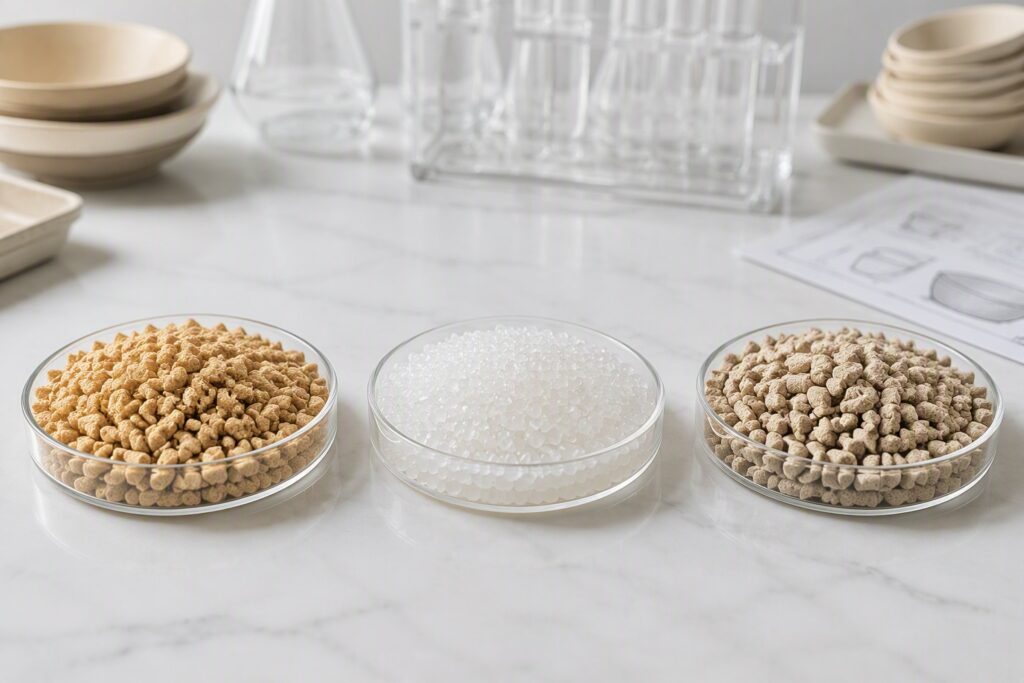
Wheat Straw + PP Life Cycle
Wheat straw is an agricultural byproduct that would otherwise be burned or composted.
Capturing it in a durable tableware product sequesters the carbon for 3-5 years of use.
The PP binder does require fossil resources, but the product replaces single-use items and lasts for years.
At end of life, the composite is recyclable as Grade 5 plastic under the ASTM D7611 resin identification code.
The net environmental benefit depends on the product being reused rather than discarded after one use.
PLA Life Cycle
PLA is derived from renewable corn starch, which gives it a strong renewable-material story.
However, the environmental benefit depends entirely on the disposal path.
PLA is only compostable in industrial facilities operating at specific temperatures — most home compost bins cannot break it down.
If a PLA product ends up in a landfill, it behaves like conventional plastic.
The “compostable” claim without access to industrial composting facilities is a common greenwashing trap. Our EU import compliance guide explains the documentation buyers must hold before making any environmental claim.
Bamboo + Melamine Life Cycle
Bamboo is a fast-growing renewable material.
However, the melamine-formaldehyde binder is a synthetic resin that is not compostable or recyclable in standard streams.
The environmental concern is secondary to the safety concern: products that fail regulatory scrutiny create waste before their intended life span.
A recalled shipment of bamboo tableware has a worse environmental outcome than any material comparison would suggest.
Supply Chain: Sourcing Wheat Straw vs PLA vs Bamboo at Scale
Beyond product performance, material choice affects your supply chain reliability.
Wheat Straw + PP Supply
Wheat straw is an agricultural byproduct available in massive volumes across North America, Europe, and Asia.
The supply is stable and the price is predictable.
PP is a commodity plastic with mature global supply chains.
This makes wheat straw composite one of the most reliable materials for large-volume B2B orders. For a look at how our factory plans capacity for these programs, see about Naike Dinner.
PLA Supply
PLA is manufactured by a small number of global producers.
Supply is concentrated and pricing can be volatile, particularly when corn prices fluctuate.
The raw material cost is structurally higher, and capacity constraints occasionally create allocation issues.
For large-volume orders, PLA supply risk is higher than wheat straw.
Bamboo + Melamine Supply
Bamboo fiber and melamine resin are both widely available.
However, the regulatory scrutiny on melamine-based tableware has caused some factories to exit the category.
This shrinking supplier base can create quality inconsistency as remaining factories struggle to maintain standards.
A buyer relying on bamboo + melamine may face increasing difficulty finding compliant suppliers.
Cost Comparison: Wheat Straw vs PLA vs Bamboo for B2B Buyers
Cost is where short-term thinking causes long-term losses. The raw material price is only part of the equation.
Unit Price Comparison
| Material | Raw Material Cost Index | Typical Unit Price (10″ plate) | Hidden Costs |
|---|---|---|---|
| Wheat straw + PP | 1.0 (baseline) | 0.60−0.60−0.90 | Low — stable supply chain |
| PLA | 2.5-4.0x | 1.50−1.50−2.50 | High — heat failures increase returns |
| Bamboo + melamine | 1.2-1.5x | 0.70−0.70−1.10 | High — regulatory risk, potential recall |
PLA is 2.5-4 times more expensive than wheat straw composite at the raw material level.
Bamboo + melamine is moderately more expensive than wheat straw but carries the highest hidden cost: regulatory risk.
A shipment of bamboo + melamine tableware blocked at EU customs represents a total loss far exceeding any material cost saving.
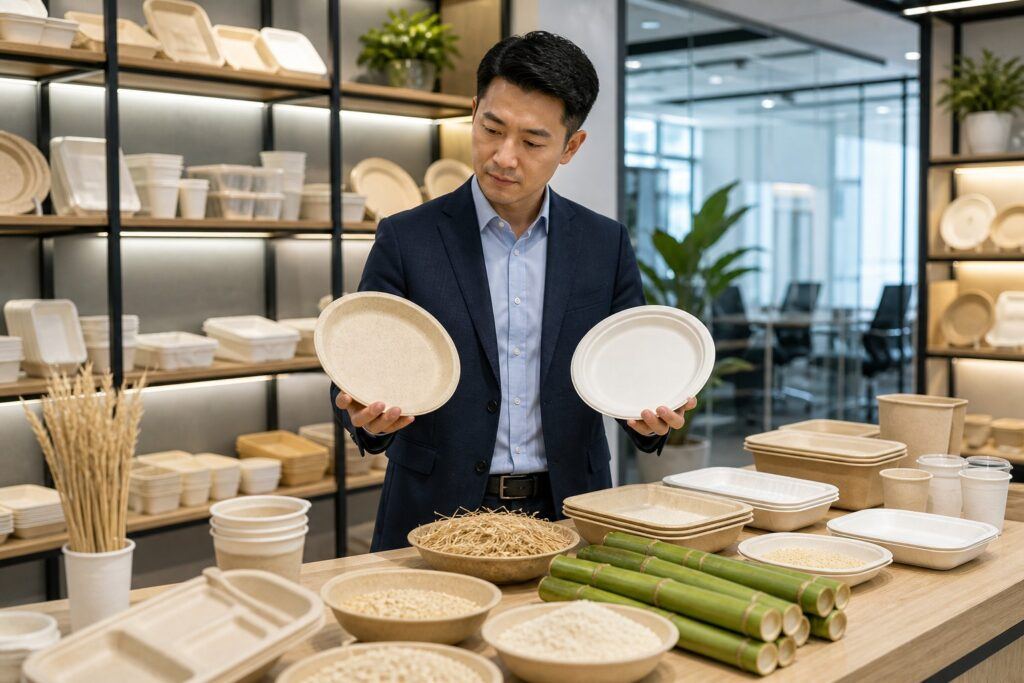
Total Cost of Ownership
The professional buyer calculates total cost of ownership, not unit price.
Consider a wheat straw plate at 0.75thatsurvives500dishwashercyclesversusaPLAplateat0.75thatsurvives500dishwashercyclesversusaPLAplateat1.80 that fails after 50 cycles.
The wheat straw plate delivers 10 times the usable life at 40% of the unit price.
Over three years, the wheat straw product’s total cost of ownership is dramatically lower — the value engineering we apply to our custom reusable plates.
Market Fit: Where Wheat Straw vs PLA vs Bamboo Tableware Belongs
Different markets have different demands. Here is how we match materials to market segments.
Reusable Home Tableware
Best choice: wheat straw + PP. It offers durability, dishwasher and microwave safety, and an eco-friendly story without regulatory risk.
This is the largest market segment for eco-tableware, and wheat straw is the clear leader.
Browse our wheat straw dinnerware set to see the product configurations available.
Single-Use / Disposable Tableware
Best choice: PLA (for certified compostable needs) or bagasse. PLA makes sense only when the buyer explicitly needs compostable single-use items and has access to industrial composting facilities.
For general single-use, wheat straw is not ideal — it is designed for reuse.
Hospitality and Institutional Use
Best choice: wheat straw + PP. Cafeterias, hotels, and catering companies run every piece through commercial dishwashers at 60-70°C, several times per day.
PLA cannot survive these conditions, and bamboo + melamine carries unacceptable regulatory risk in EU hospitality.
Wheat straw’s stackability, impact resistance, and 500+ cycle dishwasher durability make it the standard choice for high-turnover operations.
Children’s Tableware
Best choice: wheat straw + PP. The safety profile and durability are unmatched for children’s products.
Melamine-based bamboo is particularly inappropriate for children due to the formaldehyde risk.
Our kids’ tableware guide covers children’s product requirements in detail.
Premium / Gift Segment
Best choice: wheat straw + PP with premium packaging. The material’s natural fiber texture photographs beautifully and supports a premium price point.
Our custom dinnerware sets show how wheat straw supports premium branding.
B2B Buyer Checklist: Wheat Straw vs PLA vs Bamboo Selection
Use this checklist when choosing between wheat straw vs PLA vs bamboo fiber tableware.
| Check | Question | Why It Matters |
|---|---|---|
| ☐ | Is hot food involved? | If yes, PLA is unsuitable. Wheat straw handles 120°C. |
| ☐ | Is dishwasher durability required? | If yes, wheat straw is the only reusable option. PLA fails at 55°C. |
| ☐ | Is the target market the EU? | If yes, avoid bamboo + melamine entirely. Regulatory risk is severe. |
| ☐ | Is microwave safety required? | If yes, wheat straw is the clear choice. |
| ☐ | Is the product single-use? | If yes, consider PLA only with industrial composting access. |
| ☐ | Is the product for children? | If yes, choose wheat straw for the safest chemical profile. |
| ☐ | Does the brand claim “compostable”? | If yes, only PLA can support this claim — and only with certification. |
| ☐ | Is regulatory compliance documentation required? | If yes, wheat straw + PP has the lowest compliance burden. |
B2B Buyer FAQ: Wheat Straw vs PLA vs Bamboo
Why is PLA so much more expensive than wheat straw composite?
PLA raw material is 2.5-4 times more expensive than the PP used in wheat straw composite. The fermentation and refining process for corn-based bioplastic is more complex than the compounding process for fiber-reinforced PP. The price difference is structural, not temporary.
Can bamboo fiber tableware be made without melamine?
Yes, in theory — bamboo fiber can be bound with PP or other food-grade polymers. However, most commercial bamboo tableware uses melamine-formaldehyde resin because it is cheap and rigid. If a supplier offers “bamboo tableware,” always ask for the exact binder chemistry and a melamine migration test report.
Is wheat straw tableware compostable?
No. Wheat straw + PP composite is recyclable as a Grade 5 (PP) plastic but is not compostable. The PP binder does not biodegrade. If your brand needs a compostable claim, you must switch to a PLA blend or accept that the claim is not applicable.
Which material has the lowest regulatory risk?
Wheat straw + PP has the lowest regulatory risk of the three. PP is a well-established food contact polymer. PLA is low-risk but heat-sensitive. Bamboo + melamine has the highest risk due to EU enforcement actions on melamine and formaldehyde migration.
Can I mix materials within one product line?
Yes, and many successful brands do. Use wheat straw + PP for the reusable core — plates, bowls, cups — and reserve PLA only for a certified compostable single-use line if your market demands it.
Just keep the claims separate: never advertise a wheat straw plate as compostable, and never present PLA as dishwasher-safe.
How do I verify a material’s safety claims?
Request the material composition declaration and third-party migration test reports from an ISO 17025-accredited laboratory. Our BPA-free verification guide explains the documentation you need.
Common Misconceptions About Wheat Straw vs PLA vs Bamboo
Three misconceptions about bio-based tableware cause the most sourcing errors.
Misconception 1: “All eco-materials are biodegradable.”
Only some are. Wheat straw + PP and bamboo + melamine are not biodegradable.
Only PLA — under industrial conditions — is certified compostable.
Buyers who market wheat straw products as “biodegradable” expose themselves to greenwashing accusations — precisely the practice the EU’s green claims proposal is designed to stop.
Misconception 2: “Bamboo tableware is automatically safe because it is natural.”
The bamboo fiber is natural. The melamine-formaldehyde binder is not.
The binder is the source of the migration risk that has triggered EU enforcement actions.
Always verify the binder chemistry before assuming a “natural” product is safe.
Misconception 3: “Higher price means better material.”
PLA is the most expensive of the three materials but the weakest for reusable tableware.
Price reflects raw material cost and production complexity, not performance.
The right material for your market may be the mid-priced wheat straw composite, not the premium-priced PLA.
For buyers evaluating any of these claims, our wheat straw dinnerware manufacturer catalog shows the products we back with full test documentation.
Conclusion: Choosing Between Wheat Straw vs PLA vs Bamboo Tableware
The wheat straw vs PLA vs bamboo fiber tableware decision comes down to three factors: heat, durability, and regulatory risk.
Wheat straw + PP wins on heat resistance, dishwasher durability, and food safety. It is the right choice for reusable home tableware, children’s products, and premium brands.
PLA wins only on industrial compostability. It is the right choice for a narrow niche: certified compostable single-use items with access to industrial facilities.
Bamboo + melamine carries the highest regulatory risk and is the weakest choice for EU markets. The melamine and formaldehyde migration issues make it a liability rather than an asset.
For most B2B buyers, wheat straw tableware is the optimal material — balancing performance, safety, cost, and sustainability.
Ready to Choose Your Material?
Tell us your product concept and target market. We will recommend the right material and provide the compliance documentation you need.
Request a Material Recommendation & Quote
Browse the Wheat Straw Plates Collection
CONTACT US
Can Wheat Straw Tableware Go in the Freezer?
Can wheat straw tableware go in the freezer? This evidence-led B2B guide explains frozen-storage conditions, material variables, freeze-thaw testing, compliance documents and the questions buyers should ask before approving a freezer-safe claim.
EU GPSR Wheat Straw Tableware: A Traceability Guide
A factory-side guide to GPSR traceability, technical documentation, responsible-person information, online listings and corrective-action planning for EU wheat straw tableware programs.
Does Wheat Straw Tableware Contain Gluten?
A factory-insider guide for B2B buyers evaluating wheat straw material sources, gluten-related claims, testing scope, food-contact compliance and supplier controls.
Bulk Wheat Straw Dinnerware Order: 30 Supplier Questions
Ask these 30 bulk wheat straw dinnerware order questions before you sign. Avoid costly mistakes with our supplier checklist. Send your inquiry with confidence now.
Complete Wheat Straw Dinnerware Product Line: Build Guide
Build a complete wheat straw dinnerware product line with plates, bowls, cups and cutlery. Learn assortment strategy, SKU planning and margin optimization. Get your line quote.
Wheat Straw vs PLA vs Bamboo Tableware: Material Guide
Compare wheat straw vs PLA vs bamboo tableware for B2B sourcing. Learn heat resistance, cost, and safety differences. Get material recommendations now.