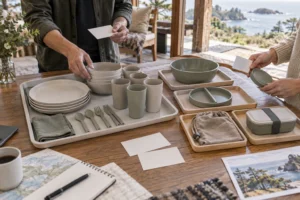
Camping set artwork approval should use one controlled asset register that links the carry bag, every decorated dinnerware component and each retail-pack panel to its own production file, drawing and physical proof. Release only when revisions, scale, color references, process, substrate, placement and approvers agree across all assets; any later component, material or packaging change must trigger an impact review.
Start with one cross-asset artwork register
A portable camping dinnerware program can carry the same brand system on unlike objects: a sewn case, molded or formed plates and bowls, curved cups, small cutlery handles, lunch-box lids, labels, inserts and an outer carton. Visual similarity does not make the production files interchangeable. Each surface has its own usable envelope, orientation, process limits and revision dependency. The buyer therefore needs a register that identifies every decorated asset and shows which controlled file, drawing and proof authorizes it.
A disciplined camping set artwork approval register prevents a common release failure: the bag is approved from the newest artwork while a component supplier uses an older mark and the carton still shows the previous component count. A meeting or email thread cannot reliably control that relationship. Use a dated record with named owners and explicit statuses such as Draft, Proof Requested, Sample Under Review, Approved, Superseded and Blocked.

| Register field | Buyer entry | Release evidence |
|---|---|---|
| Asset identity | Bag panel, component code, label or pack panel | BOM and drawing reference |
| Artwork identity | File name, revision, owner and source format | Checksum or controlled repository record |
| Placement | Surface, side, orientation and maximum envelope | Dimensioned artwork template |
| Substrate and finish | Confirmed value or pending status | Linked material/finish approval |
| Production process | Requested route without assumed capability | Written feasibility and limits |
| Color control | Reference, viewing condition and tolerance method | Approved final-process sample |
| Pack relationship | Product depiction, count, claims and legal copy | Pack proof against final BOM |
| Release | Approver, sample ID, date and exceptions | Signed record and retained reference |
Do not fill unknown fields with assumptions. If substrate, coating, decoration route or packaging construction is unsettled, mark the asset blocked. This is especially important where food-contact, mouth-contact, cleaning or abrasion exposure may affect what evidence is needed. The register is a coordination tool, not a claim that any process is suitable.
Keep one brand system but separate production files
The master brand artwork should define the approved logo geometry, protected space, hierarchy and color references. Production files then translate that system into each asset’s real envelope. A textile patch may need stitch or border allowances; a curved cup may need distortion compensation; a plate underside may need clearance from a foot ring; a lunch-box lid must avoid locks and hinges; a carton panel needs bleed, safe area, codes and destination-market copy.
| Asset | Do not reuse blindly | Asset-specific control |
|---|---|---|
| Carry bag | Flat component print file | Constructed panel, seam, fold, zipper and handle clearances |
| Plate or bowl | Carton logo at arbitrary scale | Drawing-linked surface, orientation, nesting and contact zones |
| Cup | Undistorted flat artwork | Curvature, rim, grip and holder-contact review |
| Cutlery | Full brand lock-up | Minimum feature, edge clearance and hand comfort |
| Lunch box | Label-sized placement | Hinge, lock, stack, lid and wash boundaries |
| Retail pack | Product mockup from an old BOM | Panel map, bleed, copy, count and current product depiction |
Use the component logo-placement map to define candidate zones, the multi-substrate color approval record to control appearance, and the drawing review log to connect artwork envelopes to current geometry. These records answer different questions and should not be collapsed into a single visual mockup.

A practical camping set artwork approval sequence
Use the camping set artwork approval sequence as a gated release, not as a visual-preference checklist.
- Freeze the review baseline. Record the current BOM, drawings, materials, finishes, component counts, packaging structure and intended markets.
- Build the asset list. Include every printed, molded, engraved, labeled, embroidered or otherwise decorated surface plus pack panels that depict the product.
- Assign controlled files. Give each asset a unique file name and revision; link derivative files back to the approved master.
- Run feasibility review. Ask the responsible producer to state the proposed process, usable area and limits for the confirmed substrate and finish.
- Approve digital structure. Check content, spelling, hierarchy, scale, orientation, clearances, counts, panel mapping and revision references.
- Approve physical proofs. Review production-representative decoration on final substrates and a constructed bag and pack where relevant.
- Compare the complete set. Put all proofs together under defined lighting; record intentional differences rather than forcing unlike processes to look identical.
- Release as a package. Sign one cross-asset record listing every approved file and physical reference; block unlisted or superseded files.
- Retain and recheck. Store the approval record and samples, then define which changes require partial or full reapproval.
Color-management standards and profiles can support file communication, but they do not replace final-substrate review. The International Color Consortium specification resources describe profile-based color management. The FDA Food Labeling Guide provides primary guidance for food-label content questions in the United States, but market-specific review is still required. NIST traceability guidance explains how measurement results relate through documented calibration chains. None of these sources validates a particular supplier process, decoration durability or finished product.
Use a change-impact matrix before revising one file
| Change | Assets to review | Minimum buyer action |
|---|---|---|
| Logo geometry or legal name | All decorated parts and all pack panels | New master plus complete asset audit |
| Component geometry | That component, restraints, case depiction and pack count/image | New drawing template and pack comparison |
| Material or finish | Affected component and any color-matched assets | Feasibility and final-process sample |
| Bag construction | Bag artwork, patch, insert, pack envelope and product image | Constructed case proof and loaded review |
| Set count or configuration | BOM, case, insert, labels, carton copy and product depiction | Cross-document count reconciliation |
| Destination market | Legal copy, symbols, language and claims | Market-specific review by responsible specialists |
Separate visual approval from performance or compliance claims. A matching logo does not demonstrate adhesion, abrasion resistance, wash durability, migration performance or legal suitability. Define each required claim, method, final construction and acceptance authority before adding it to packaging or sales material. If evidence is incomplete, remove or qualify the claim rather than treating artwork approval as proof.
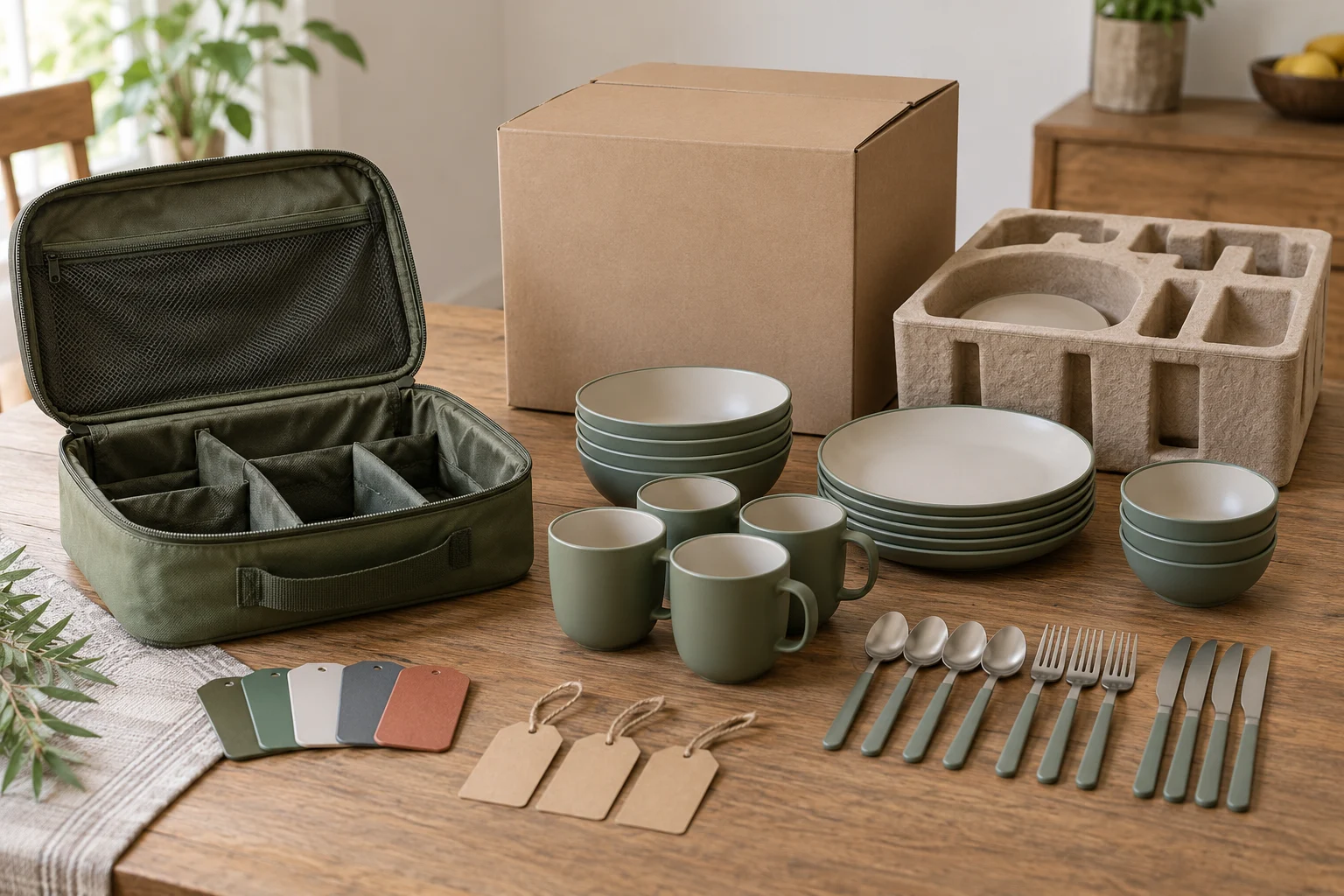
Camping Set Artwork Approval Buyer Checklist
This camping set artwork approval checklist gives the buyer one auditable output for every release decision.
| Check | Buyer question | Required output |
|---|---|---|
| Baseline | Are BOM, drawings, materials and pack structure current? | Dated baseline list |
| Coverage | Is every decorated or product-depicting asset listed? | Cross-asset register |
| Identity | Can every file be traced to a master and revision? | Controlled file index |
| Placement | Are surface, scale, orientation and clearances dimensioned? | Asset-specific template |
| Process | Is feasibility confirmed for the final substrate? | Written process review |
| Appearance | Were unlike processes compared as a family? | Physical proof comparison |
| Pack accuracy | Do count, image, claims and configuration match the BOM? | Pack-to-product check |
| Release | Are files, samples, approvers and triggers recorded? | Signed release record |
Buyer FAQs
Can the same artwork file be sent to every producer?
Use the same approved brand master, but issue asset-specific production files tied to the final dimensions, substrate, process and placement.
Is a PDF mockup enough for approval?
It can approve content and layout structure, but it cannot establish final color, tactile result, distortion, adhesion, wear or constructed-pack behavior.
Should bag and rigid-component colors match exactly?
Do not assume unlike substrates and processes can match identically. Define the desired relationship and approve representative physical samples together.
What if only the component count changes?
Review the BOM, case restraints, insert, pack copy, imagery, labels and any count-dependent claims. A count change can affect more than one file.
Who should sign the release?
Name buyer-side and supplier-side owners for brand, product, packaging and technical scope. The record should show who approved which evidence.
What should be sent for quotation and sample review?
Send the current BOM, drawings, material/finish status, master artwork, asset list, target markets, packaging structure, intended claims and required evidence.
Request an artwork register and sample-scope review
Send your controlled component list, drawings, material and finish status, brand master, bag construction, packaging map, destination markets and expected claims. Naike Dinner can identify the asset-specific files, physical proofs and written confirmations needed before release.
Send your artwork approval brief or use the inquiry form beside this article. Contact Naike Dinner for a written review.