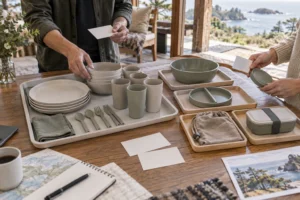
Camping dinnerware logo placement should begin only after mapping food-contact, grip, nesting, wear and cleaning zones for every component. Use non-food-contact outer surfaces when practical, keep artwork away from mating edges and high-abrasion contacts, and approve each placement on the final material, finish and process. One location cannot be assumed suitable across plates, bowls, cups, cutlery, lunch boxes and textile cases.
Map the whole set before choosing a logo location
A multi-part camping dinnerware set creates several different decoration questions. A plate center is visually prominent but may be a food-contact and utensil-wear area. A bowl exterior avoids direct food contact but may rub against another piece during nesting. A cup side may be visible in use but can sit inside a holder or contact an adjacent cup in the case. A cutlery handle may offer little area and receives frequent grip, washing and abrasion. A lunch-box lid can provide a broad panel, yet closures, hinges and stacked contact paths must remain clear. A textile case has large visible surfaces, but seams, folds, zipper paths and handle loads limit placement.
The buyer-facing output should therefore be a component-by-component placement map, not a single instruction such as “logo on each item.” Start with the exact BOM and drawing revision. Mark food-contact surfaces, mouth-contact rims, grip zones, closure interfaces, nesting contacts, retaining straps, likely scuff paths, washing exposure and the normal presentation face. Unknown materials, finishes or processes must remain open decisions because suitability cannot be inferred from the picture alone.
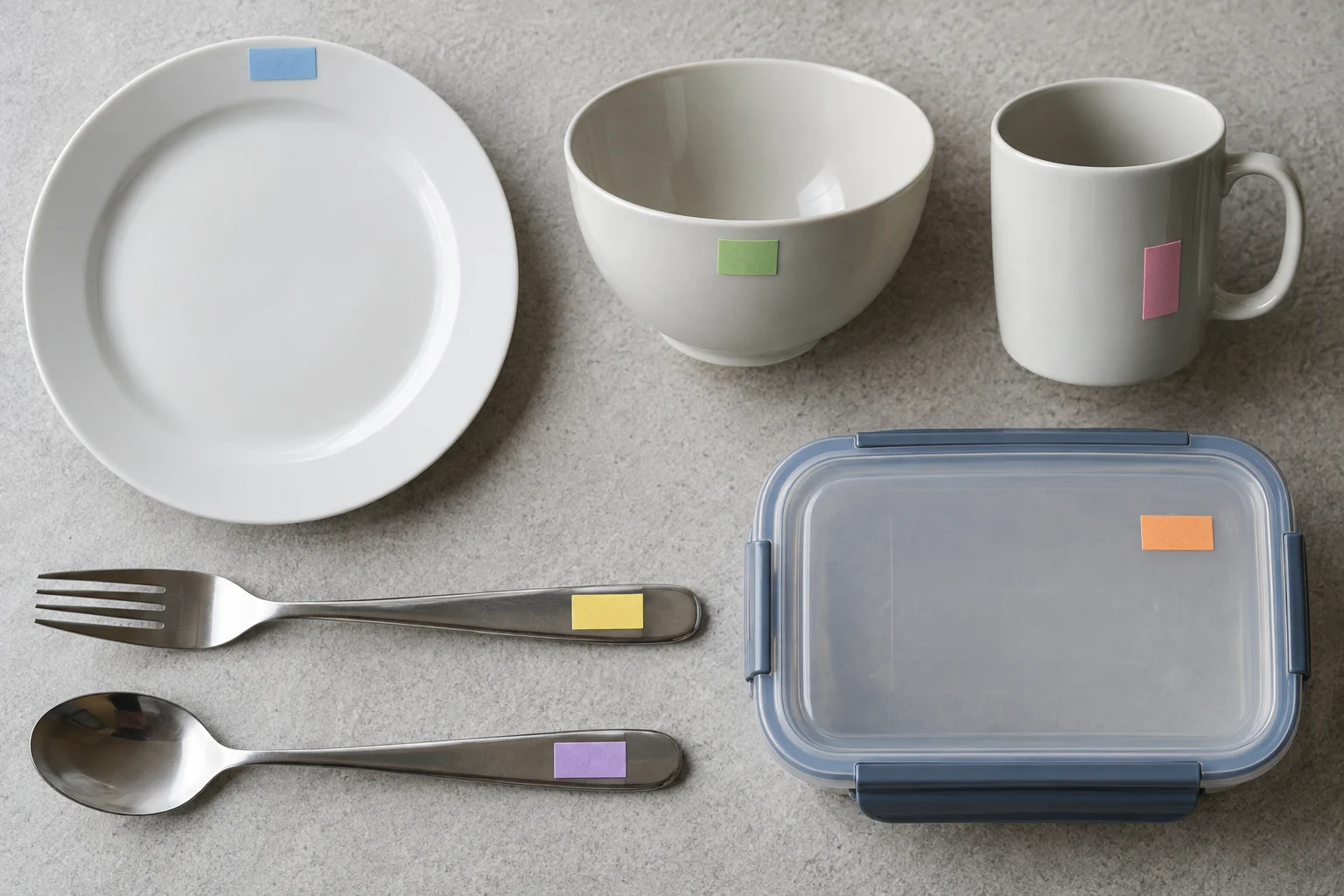
Camping dinnerware logo placement matrix
| Component | Candidate location | Reject or investigate when | Approval evidence |
|---|---|---|---|
| Plate | Outer underside or non-contact rim zone, subject to design | Food contact, utensil wear, stacking feet or unstable marking surface | Drawing callout and final-process sample |
| Bowl | Outer wall or underside outside the support ring | Nesting contact, curved distortion, grip or base instability | Nested and separated sample review |
| Cup | Outer body away from rim and grip-critical areas | Mouth contact, sleeve/holder contact or severe curvature | Use orientation and wash-sample review |
| Cutlery | Handle zone with adequate flat area | Hand comfort, edge proximity, flex, abrasion or very small artwork | Scale proof and handled sample |
| Lunch box | Lid top or outer side clear of locks and hinges | Closure motion, stacked contact, textured surface or label removal need | Open/closed sample and pack-out check |
| Carry case | Stable exterior panel or removable patch | Seam, fold, zipper, handle load path or hidden packed face | Constructed case sample, not loose fabric alone |
| Retail pack | Main display panel linked to the approved product artwork | Product and packaging artwork revisions can diverge | Cross-asset artwork release record |
This matrix identifies questions; it does not certify a decoration method. The actual process—molded mark, engraving, print, transfer, label, embroidery, woven patch or another route—must be reviewed against the confirmed substrate, finish, intended use and applicable evidence. Do not claim wash resistance, migration performance, outdoor durability or abrasion life without a defined method and verified result for the final construction.

Copyable contact-surface and artwork placement record
| Record field | Buyer entry | Supplier confirmation | Status |
|---|---|---|---|
| Program and revision | Set code, market and BOM revision | Matching quotation and drawing set | Open / linked |
| Component identity | Part name and code | Final geometry revision | Confirmed / pending |
| Material and finish | Confirmed value or “to be confirmed” | Process-compatible substrate record | Confirmed / pending |
| Contact class | Food, mouth, hand, mating or non-contact | Marked drawing or controlled image | Mapped / missing |
| Candidate artwork zone | Surface, side, orientation and maximum envelope | Artwork template tied to drawing | Approved / revise |
| Decoration process | Requested effect; no assumed capability | Verified process proposal and limitations | Feasible / unconfirmed |
| Wear and cleaning | Expected contacts and cleaning route | Sample/test plan and claim boundary | Defined / missing |
| Color and contrast | Reference and acceptable appearance | Final-substrate process proof | Approved / open |
| Pack-out check | Artwork visible, protected or intentionally hidden | Loaded-set photographs and observation | Pass / revise |
| Release | Approver, sample ID and date | Retained reference and change triggers | Released / blocked |
Review artwork on the final component, not a screen mockup
- Freeze identity. Confirm component, drawing, material, finish and artwork revision before judging placement.
- Inspect the blank surface. Note curvature, texture, parting lines, ribs, feet, seams and molded details that can distort or interrupt artwork.
- Mark all contact paths. Include food and mouth contact, grip, stacking, nesting, closure and case-retention contact.
- Place the artwork at final scale. Check readable size, orientation, edge clearance and visibility in normal use and pack-out.
- Review the real process proof. A digital rendering cannot establish adhesion, engraving depth, print distortion, color or tactile effect.
- Evaluate cleaning and wear separately. Define the cleaning route, contact or abrasion question, method and acceptance boundary before making a claim.
- Approve one controlled reference. Record component and artwork revisions, sample ID, exceptions, owner and reapproval triggers.
Food-contact evidence must remain tied to the final material, decoration and intended use. The U.S. FDA food-contact substances overview explains the regulatory context for substances used in food-contact articles. The EU Framework Regulation (EC) No 1935/2004 sets general requirements for food-contact materials. Neither source approves a logo location or validates a specific ink, adhesive or decoration process. For measurement traceability, NIST guidance explains traceability principles but does not certify the product.
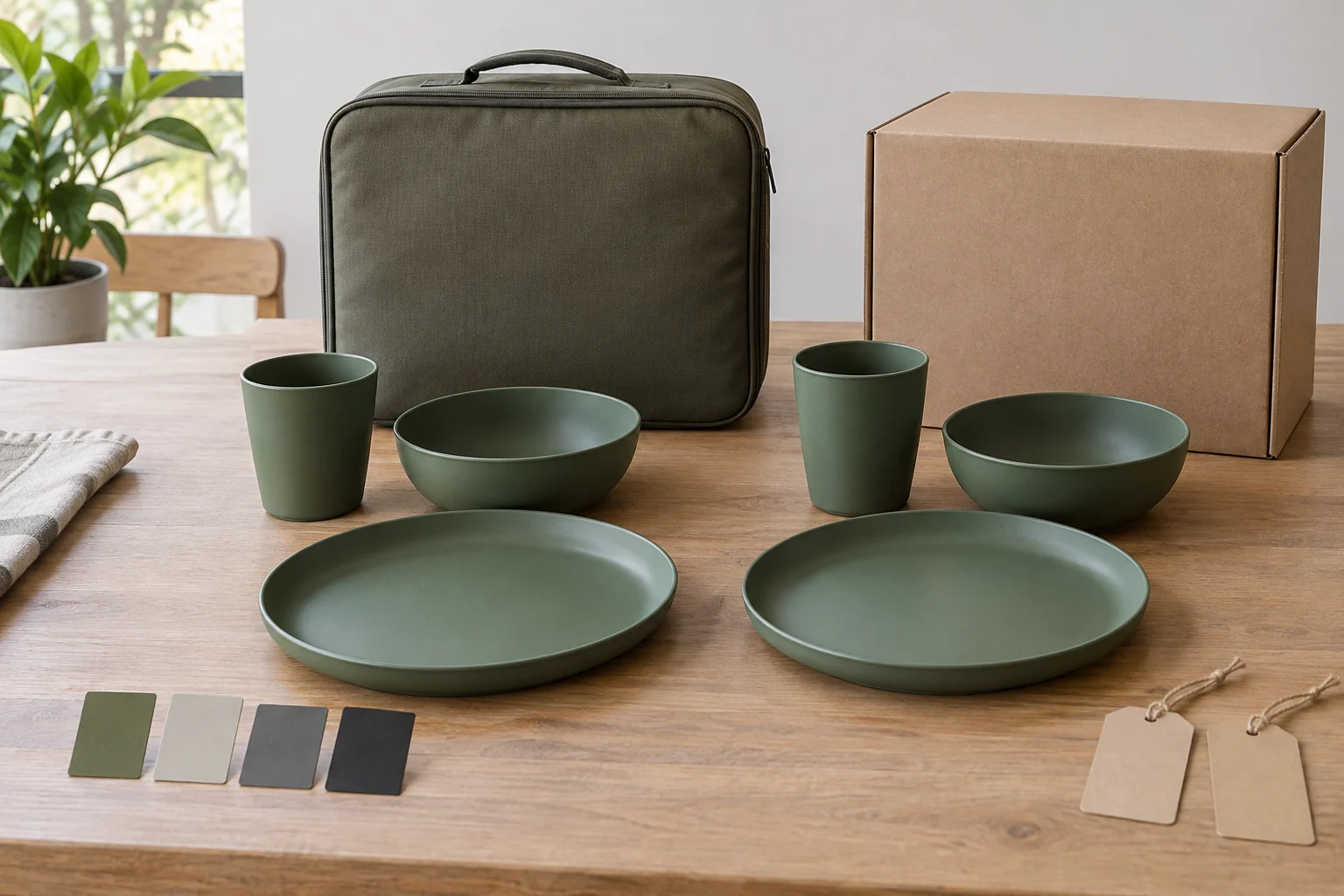
Commercial risks to resolve before artwork release
| Risk | Failure mode | Buyer control |
|---|---|---|
| One artwork file for every part | Incorrect scale, distortion or inconsistent orientation | Component-specific templates and revision IDs |
| Logo inside the nesting path | Scuffing or transfer between packed components | Loaded-set contact map and sample review |
| Screen-only color approval | Final substrate and process appearance differs | Physical process proof linked to color approval |
| Unverified durability wording | Marketing promises exceed tested scope | Claim-to-evidence record for the final construction |
| Artwork and BOM revisions diverge | Old logo lands on a changed component or case | Linked artwork, drawing and BOM release |
| Case panel approved as loose fabric | Seams, padding and folds change placement | Approval on a constructed case sample |
Connect this decision to the multi-substrate color approval record, drawing comparison log and custom set brief. A change to material, finish, geometry, logo size, print process, ink, adhesive, coating, case panel or packaging layout should trigger a documented review rather than silent reuse of an older approval.
Camping Dinnerware Logo Placement Buyer Checklist
| Check | Buyer question | Required output |
|---|---|---|
| Identity | Are BOM, drawing and artwork revisions linked? | Revision register |
| Contact | Which food, mouth, grip and mating zones are excluded? | Contact-surface map |
| Geometry | Does curvature, texture or a seam affect the mark? | Component-specific artwork template |
| Process | Is the proposed method verified for the final substrate? | Written feasibility and limits |
| Scale | Is final size and orientation approved? | Process proof at 1:1 scale |
| Use | What cleaning and wear exposure applies? | Scoped validation plan |
| Pack | Will nesting, straps or closures abrade the mark? | Loaded-set observation |
| Release | What sample controls production and what triggers reapproval? | Signed retained-sample record |
Buyer FAQs
Can a logo be printed in the center of a plate?
Do not assume so. Review food contact, utensil wear, the final material and decoration evidence before approving any plate-center mark.
Is the underside always safe for decoration?
No. Feet, stacking rings, table contact and nesting surfaces can still create abrasion, stability or process constraints.
Can one logo size work across every component?
Usually the available flat area and viewing distance differ. Use component-specific artwork templates while maintaining a deliberate brand hierarchy.
Is a digital mockup enough to release production?
No. It supports placement discussion but cannot establish final color, distortion, adhesion, depth, feel, wear or cleaning behavior.
Should the carry case use the same decoration process?
Not necessarily. Textile construction and panel loading differ from rigid dinnerware surfaces, so evaluate a case-specific process and constructed sample.
What should be sent for a placement review?
Send the component matrix, drawings, confirmed materials and finishes, intended uses, logo files, target artwork hierarchy, cleaning route, packaging layout and any claim expectations.
Request a logo placement and sample-scope review
Send the controlled component list, drawings, material/finish status, contact-zone assumptions, artwork files, target markets, cleaning route, packaging plan and desired visual hierarchy. Naike Dinner can review the request against verified capabilities and identify the samples and written confirmations needed before release.
Send your logo placement brief or use the inquiry form beside this article. Contact Naike Dinner for a written review.