Compare two set drawings by revision, component count, controlled dimensions, interfaces, use conditions and unresolved decisions—not by appearance alone. Build one line-by-line variance table, assign every open issue an owner and due point, then release samples only when both drawings describe the same quotation scope and each sample has a written decision purpose.
Start with identity before comparing geometry
A camping dinnerware drawing review fails when two PDFs are treated as pictures instead of controlled product definitions. First record the supplier, drawing number, revision, date, component name, material status and associated set or BOM revision. If either file lacks a controlled identity, mark that gap before debating shape. A screenshot, render or concept sheet may help discussion, but it is not automatically a released drawing.
Define the comparison baseline in one sentence: for example, “four-person dinnerware set with plate, bowl, handleless cup, fork, knife, spoon, divided lunch box and carry case.” List optional and excluded parts separately. Do not let lids, dividers, shared pieces or packaging inserts shift the piece count silently. This review covers dinnerware, utensils, food containers and their carry system; it does not establish cookware, flame, burner or direct-heat suitability.
Before paying for samples, ask what the sample must decide. A visual sample can answer color or appearance questions but may not prove production material, tolerances, food-contact compliance, packed fit or repeatability. A fit sample needs controlled interface dimensions and revision identity. A pre-production sample needs an approved BOM, artwork and evidence scope. Write the purpose before the purchase order.
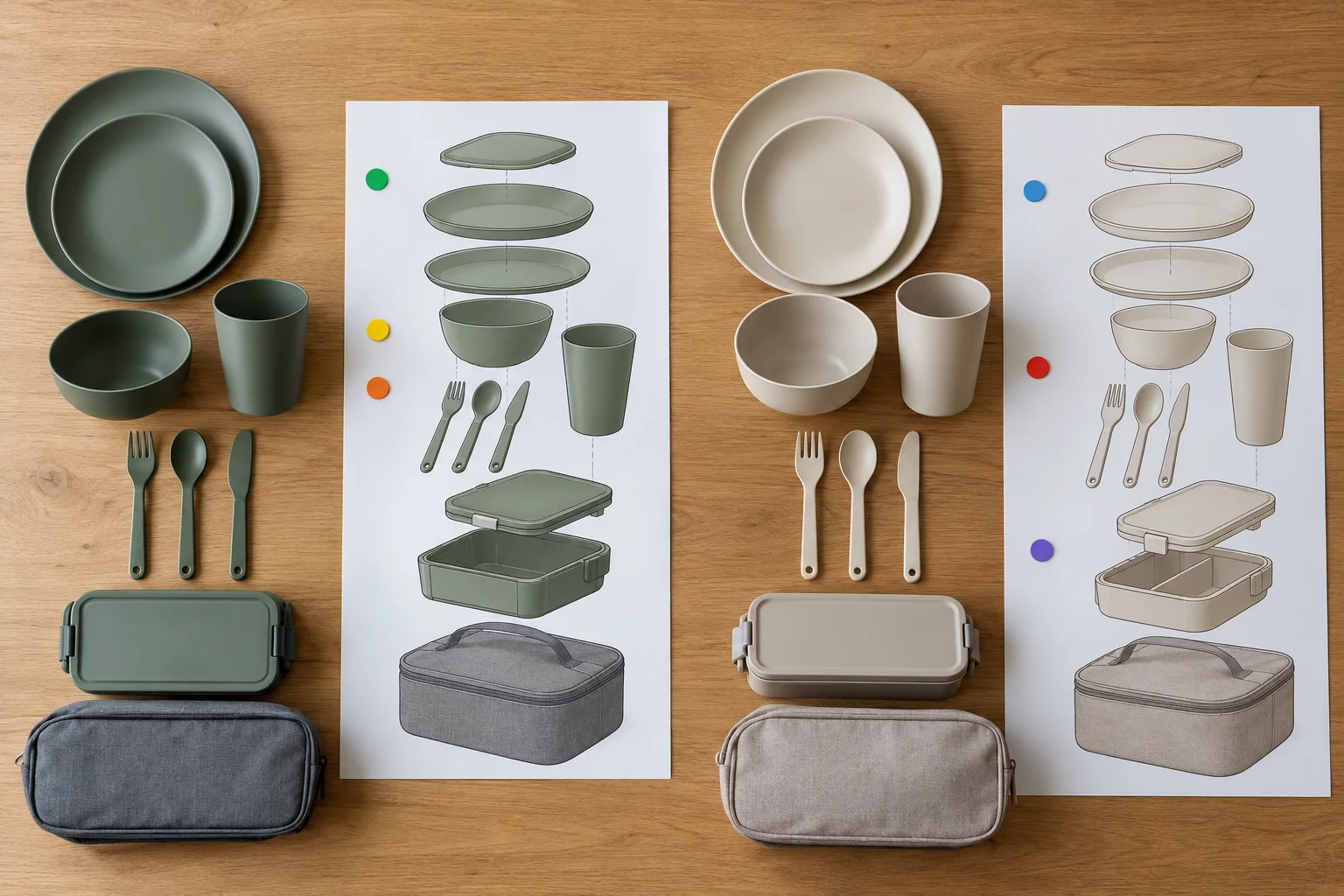
Copyable drawing comparison and variance matrix
| Review field | Drawing A | Drawing B | Buyer decision or evidence |
|---|---|---|---|
| Identity | Number, revision, date, author/status | Number, revision, date, author/status | Confirm which revision may be quoted and sampled |
| Set/BOM link | Associated set and component code | Associated set and component code | Reconcile every component with the same BOM |
| Component count | Core, shared, optional and excluded items | Core, shared, optional and excluded items | Freeze one comparable quotation scope |
| Overall envelope | Length, width, height and orientation | Length, width, height and orientation | Identify pack and case consequences |
| Functional geometry | Eating area, rim, base, wall and handle | Eating area, rim, base, wall and handle | Connect differences to use and cleaning |
| Interfaces | Nesting, lid, divider, slot and retention points | Nesting, lid, divider, slot and retention points | Define mating dimensions and fit checks |
| Material/finish | Specified, proposed or unconfirmed | Specified, proposed or unconfirmed | Do not infer evidence from an old material |
| Tolerances | Critical and general tolerances | Critical and general tolerances | Ask how stack-up affects complete-set fit |
| Artwork | Logo zone, process and artwork revision | Logo zone, process and artwork revision | Keep food-contact and high-wear areas controlled |
| Case/pack | Position, removal path and contact surfaces | Position, removal path and contact surfaces | Review closure, rattle, abrasion and count control |
| Evidence scope | Claims and documents linked to revision | Claims and documents linked to revision | List verified, required and prohibited claims |
| Open issues | Question, owner and status | Question, owner and status | Close or explicitly carry into the sample plan |
Use values exactly as shown in the controlled documents. If a field is missing, write “not shown” rather than estimating from the page scale or render. If the supplier uses a general-tolerance note, identify which dimensions remain function-critical and need explicit review. Compatibility to be confirmed by project sample and drawing.
Compare the component system, not isolated parts
A plate can look unchanged while its rim alters bowl nesting, sleeve clearance and packed height. A cup may keep the same capacity but change taper enough to jam after washing. A lunch-box divider can move without changing the outside envelope, yet affect cleaning access and lid seating. Review each part twice: once as an object and once as a member of the complete set.
| Component | Geometry to compare | System consequence to record |
|---|---|---|
| Plate | Eating area, rim profile, base ring, stack direction | Grip, spill control, bowl contact, abrasion and case slot |
| Bowl | Depth, wall angle, base, rim and nesting stop | Meal use, stability, release and packed height |
| Cup | Taper, rim, base and handle decision | Pocket fit, stack release and drinking clearance |
| Lunch box | Lid seat, latch, divider and corner radii | Cleaning, retention, storage position and claim boundary |
| Cutlery | Length, head profile, edge and grip | Utensil rail, food-contact protection and count control |
| Carry case | Internal bays, opening, closure and handle | Loaded balance, removal sequence and complete pack envelope |
Connect the review to the nested-set tolerance register, component-to-case fit checklist and repeatable pack-out instruction. These outputs should share the same revision identifiers.

Create an open-issue log that can stop sample release
| Issue ID | Observed difference | Decision owner | Required closure | Release effect |
|---|---|---|---|---|
| DR-01 | Component count differs from RFQ matrix | Buyer merchandising | Approved inclusion/exclusion list | Blocks comparable quote |
| DR-02 | Bowl nesting interface not dimensioned | Development team | Controlled mating dimensions and fit method | Blocks fit sample |
| DR-03 | Lunch-box lid claim not defined | Buyer product/compliance | Permitted wording and verification plan | Blocks claim approval |
| DR-04 | Case bay reflects prior component revision | Supplier engineering | Updated case drawing and pack-out | Blocks complete-set sample |
| DR-05 | Logo zone overlaps contact or wear area | Buyer brand/quality | Revised placement and process review | Blocks artwork release |
Every issue needs a neutral description, source revision, owner, target decision point and closure evidence. “Discussed” is not a status. Use open, answered, verified in drawing, verified in sample, accepted with limitation or rejected. If an issue is intentionally carried into sampling, put the exact observation method and acceptance boundary in the sample brief.
Match evidence to the final revision
Drawings do not prove food-contact compliance or performance. They identify the component, material proposal, geometry and use conditions to which evidence must be linked. The FDA food-contact substances overview explains the U.S. framework. The EU Framework Regulation (EC) No 1935/2004 sets general food-contact requirements, and the EU plastics regulation is relevant when the final plastic material and scope apply. None of these sources approves an unspecified concept.
For measured comparisons, record the method, sample revision, instrument and decision rule. NIST traceability guidance gives useful context for measurement traceability; it does not certify the product. Material identity, color, finish, decoration, cleaning and intended food/temperature conditions can change evidence needs.
Use three sample-release scenarios
Scenario 1: visual direction only
Release a visual model only if the team needs to choose proportion, color direction or general arrangement. State that material, interfaces, tolerances and claims are not approved.
Scenario 2: component-fit sample
Release after mating revisions, critical interfaces, stack-up questions and case envelope are identified. Define the pack sequence, wash/temperature condition if relevant, observations and allowed limitations.
Scenario 3: approval sample
Release only when the component matrix, BOM, drawings, material/finish, artwork and packaging references are controlled. Specify which evidence is already verified and which remains outstanding; never call an approval sample a substitute for required testing.
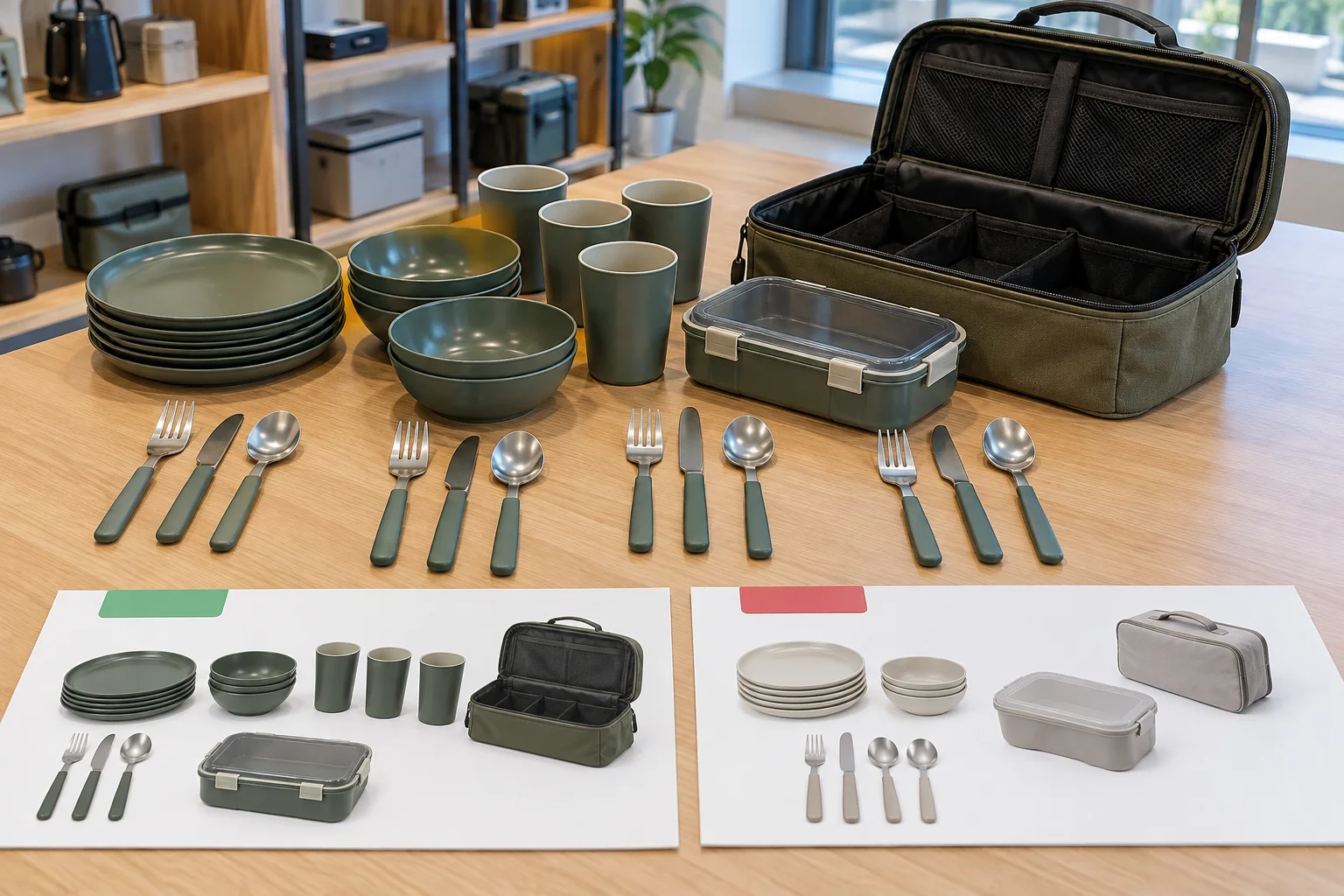
Commercial risks when drawings are compared informally
Informal comparison can make suppliers quote different sets, allow an obsolete case drawing to reach sampling, approve artwork on changing geometry, or attach evidence from a different material or color. It also creates false economy: a low sample price is not comparable when one supplier includes a complete fit set and another supplies only appearance models.
Do not resolve a conflict by choosing the drawing with more detail. Choose the revision that represents the approved buyer scope, then close its missing decisions. If both contain useful elements, issue a reconciled revision rather than annotating two competing “final” files.
B2B Buyer Checklist
| Check | Buyer question | Required output |
|---|---|---|
| Identity | Are drawing numbers, revisions and dates controlled? | Comparison cover record |
| Scope | Do both drawings match one component matrix? | Reconciled inclusion list |
| Interfaces | Are mating dimensions and pack consequences visible? | Interface variance table |
| Tolerances | Which stack-ups can change fit or release? | Critical-dimension register |
| Evidence | Does each claim match the final revision and use? | Evidence-gap list |
| Issues | Does every difference have an owner and closure? | Open-issue log |
| Sample | What exact decision will the sample answer? | Revision-matched sample brief |
| Release | Can one file set control quote, sample and approval? | Written release record |
Buyer FAQs
Can buyers compare dimensions from PDF scale?
Only when the drawing explicitly authorizes that use and the file has not been rescaled. Critical values should be stated and controlled rather than inferred.
What if the two drawings use different units?
Record the original units, convert in a separate comparison field and keep the conversion rule visible. Do not overwrite source values.
Should every difference block a sample?
No. Classify each variance by effect. Cosmetic questions may be intentional sample decisions; component count, interfaces, material identity or claim scope can block release.
Can a supplier drawing replace the buyer brief?
No. The buyer brief defines the required job and scope; the supplier drawing proposes how a controlled component may satisfy it.
How should comments be closed?
Close comments in a new controlled revision or a linked written approval record. Do not rely on untracked chat messages.
What should accompany a sample order?
Include drawing/BOM revisions, component matrix, open-issue disposition, sample purpose, observation method, acceptance limits and approval owner.
Request a drawing and sample-scope review
Send both drawing sets, revision history, component matrix, case envelope, intended users and meals, target markets, material/finish status, evidence expectations and the decisions the sample must answer. Naike Dinner can review the request against verified capabilities and identify missing drawings, interfaces, samples and written confirmations before quotation.
Send your drawing package or use the inquiry form beside this article. Contact Naike Dinner for a written sample-scope review.