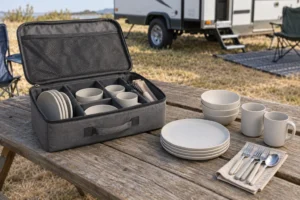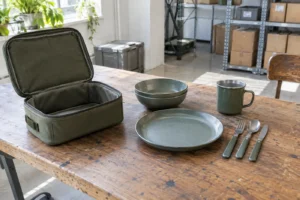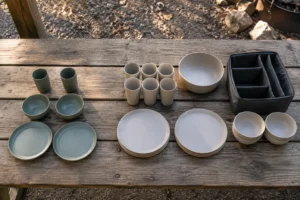
Choose enamel when a retail program needs a traditional outdoor look, a rigid hand feel and a story built around a coated steel article. Choose PP when low pack weight, quieter handling and flexible molded geometry matter more. Do not approve either material label alone: compare finished plates, packaging, claims and failure modes under the same channel conditions.
Start with the retail program, not the material reputation
An enamel vs PP camping plates decision changes with the sales channel. A specialty outdoor store can explain care instructions and inspect visible finishes before sale. A mass retailer needs fast shelf recognition, consistent barcode presentation and packaging that survives mixed handling. A direct-to-consumer program must also tolerate parcel drops, compression and customer expectations created by close-up photography.
Define the proposed plate system before requesting samples. Record user count, plate count, meal type, target outer envelope, target packed mass, nesting order, cleaning method, intended food contact, age group, target markets and whether the product is sold alone or inside a larger dinnerware set. This prevents a light two-plate PP pack from being compared with a heavier four-plate enamel pack as though material caused the entire difference.
This is neutral procurement guidance, not a statement that every illustrated plate is a current Naike Dinner product. Availability, construction, dimensions, colours, evidence and manufacturing feasibility must be confirmed for the project. Camping plates are dinnerware; neither an enamel coating nor a campsite image proves burner, stove, campfire, oven or direct-flame suitability.
Separate regulatory scope from a marketing claim
For European Union programs, the general food-contact framework requires materials and articles to be manufactured so that, under normal or foreseeable conditions of use, they do not transfer constituents in quantities that could endanger health, cause an unacceptable change in food composition or deteriorate organoleptic characteristics. Buyers should review the current text of Regulation (EC) No 1935/2004 and the good-manufacturing-practice requirements in Regulation (EC) No 2023/2006 with their compliance adviser.
Those rules do not make the words “enamel” or “PP” a certificate. PP programs may need a declaration and supporting evidence appropriate to the exact polymer formulation, additives, pigments and intended use. For Australia and New Zealand programs, buyers can use FSANZ food-packaging guidance to frame responsibilities, but applicability still depends on the finished article and use conditions.
Enamel plates require their own finished-article evidence strategy. The substrate, coating system, colour, firing control, decorated areas, rim construction and intended food contact can affect what evidence is relevant. Ask the supplier to identify the exact sample and production configuration covered by each report; do not accept a report for a different colour, coating, substrate or article without a documented rationale.
Use a channel-specific plate comparison
| Retail decision | Enamel plate review | PP plate review | Buyer output |
|---|---|---|---|
| Shelf story | Traditional coated-metal appearance can support heritage or camp-kitchen positioning. | Colour, molded geometry and coordinated set architecture can support family or lightweight positioning. | Approved claim and image brief. |
| Pack weight | Steel substrate commonly raises packed mass; verify the finished configuration. | Finished PP plates can support a lower-weight pack, subject to geometry and count. | Measured sample and packed mass. |
| Damage mode | Review chips, edge exposure, dents, scratches and coating defects. | Review warpage, stress whitening, scratches, distortion and impact damage. | Defect catalogue with acceptance rules. |
| Nesting | Rigid profiles may stack predictably but rim and coating protection matter. | Molded ribs and draft can tune nesting, but excessive wedging is a risk. | Stack height and release-force record. |
| Noise and touch | Metal contact can sound sharper; coating and edge form influence hand feel. | Handling is generally quieter; surface texture and stiffness need sample review. | Panel notes under a defined method. |
| Parcel shipping | Protect coated edges and stop plate-to-plate abrasion. | Control bending, rubbing and concentrated compression. | Approved packout and transit test plan. |
| Cleaning | Inspect coating continuity, rim details and care boundaries. | Inspect ribs, texture, recesses and declared temperature limits. | Cleaning protocol and label copy. |
| Colour control | Review fired coating and decoration variation against an approved master. | Review resin/pigment lot variation, gloss and visible flow or weld features. | Colour standard and viewing conditions. |
| Claims evidence | Require finished-article evidence matched to coating, colour and use. | Require finished-article evidence matched to formulation, pigment and use. | Market-specific evidence matrix. |
The matrix should be scored by program, not copied as a universal ranking. Give each criterion a weight, identify the person who owns the decision and define the evidence required for approval. A criterion without a method or owner becomes an opinion and tends to reappear as a dispute after samples arrive.
Inspect the rim before discussing durability
Rim construction affects comfort, coating protection, stiffness, stack behaviour and visible quality. On an enamel plate, document whether the edge is rolled, folded or otherwise finished, whether food can contact the rim, and how the coating terminates. Look for sharpness, discontinuity, exposed substrate, waviness and local damage using an agreed visual and tactile inspection method.
On a PP plate, review rim width, edge radius, draft, local thickness transitions, ribs and any features intended to improve grip. A broad grip rim may improve handling but increase the nesting diameter; a thin edge may save material but feel less rigid. These are finished-design questions and cannot be inferred from “PP” alone.
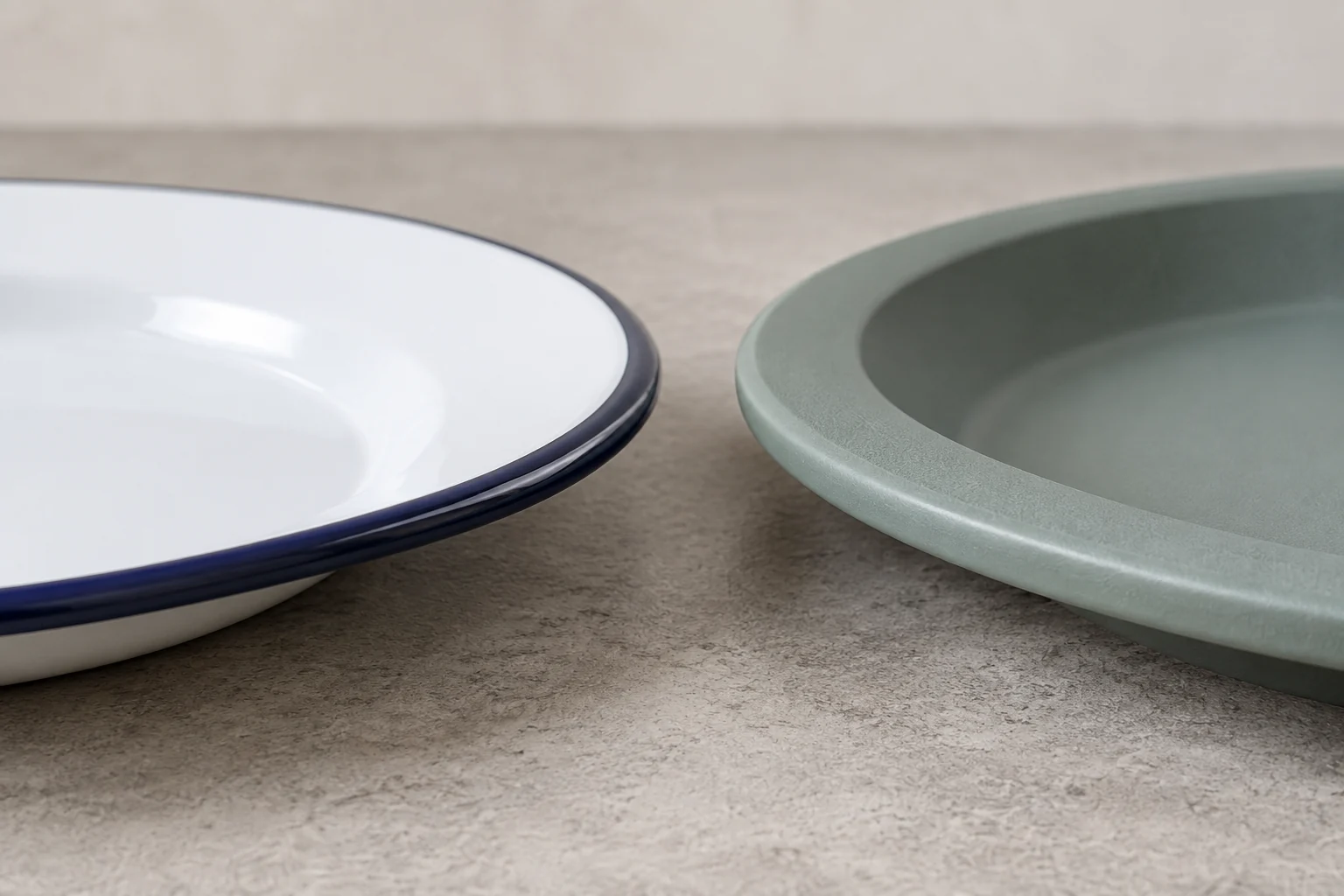
Build a defect reference set from approved, borderline and rejected samples. Photograph each condition at a fixed distance and lighting setup, then describe its location and severity in words. Avoid a vague instruction such as “no defects,” because a microscopic mark, a functional sharp edge and a large visible chip are not equivalent risks.
Match the plate to the channel scenario
Specialty outdoor retail
A specialist store can support a more detailed material story and explain care. Enamel may suit programs where tactile rigidity, classic aesthetics and coordinated cookware-adjacent styling matter, provided the page and packaging do not imply direct-flame suitability for a dinnerware-only plate. PP may suit lightweight family kits, colourful assortments and modular set building where component replacement or expansion is part of the proposition.
For either route, give store staff a concise comparison sheet. It should identify what the plate is, intended food and cleaning conditions, what is not claimed, and how it fits the rest of the set. This prevents sales language from expanding beyond the reviewed evidence.
Mass retail and promotional programs
High-volume channels magnify small ambiguities. Carton labels, colour names, piece counts, insert diagrams and product photography must describe the same configuration. A nested set shown with four plates but packed with two creates a simple and expensive customer-expectation failure, regardless of material.
PP can help control shipping mass and allows molded registration features, but the buyer must validate stiffness, flatness and nesting release. Enamel can provide a strong shelf cue, but the packout must prevent rim collision and surface abrasion. Ask packaging and product engineers to sign the same configuration record before quotation comparison.
Direct-to-consumer parcel delivery
DTC programs need an e-commerce photo set that shows real component count, scale and nesting. Enamel plates require controlled separators and edge protection; PP plates require support against bending and concentrated compression. Test the complete sales pack rather than a bare plate because the retail box, dividers, bag and master carton determine much of the delivery risk.
Returns data should be coded by failure mode. “Damaged” is too broad. Separate chipped coating, exposed edge, dent, scratch, warped plate, stress whitening, crushed pack, missing component and colour mismatch so corrective action targets the actual mechanism.
Rental, institutional and outdoor hospitality
For repeated-use programs, create a cleaning and inspection workflow before purchase. Enamel pieces may be removed when coating damage exceeds the approved limit; PP pieces may be removed for deformation, deep damage or other conditions defined by the buyer. The replacement policy, spare ratio and visual identity of replacement lots can matter more commercially than the initial material comparison.
Treat packaging as part of the plate system
Measure the plates in their actual nested order. Record stack height at the intended count, maximum diameter, any protruding rim, separator thickness, bag or sleeve dimensions, retail box dimensions and master-carton arrangement. Use the measured pack, not nominal plate diameter, when estimating shelf footprint, parcel size and container utilization.
For enamel, separators should prevent hard surface-to-surface rubbing and protect vulnerable edges without creating excessive packing labour. For PP, the pack should limit bending and prevent tight wedging while avoiding unnecessary volume. Neither approach should rely on decorative inserts that hide the product or make repacking impractical for the customer.
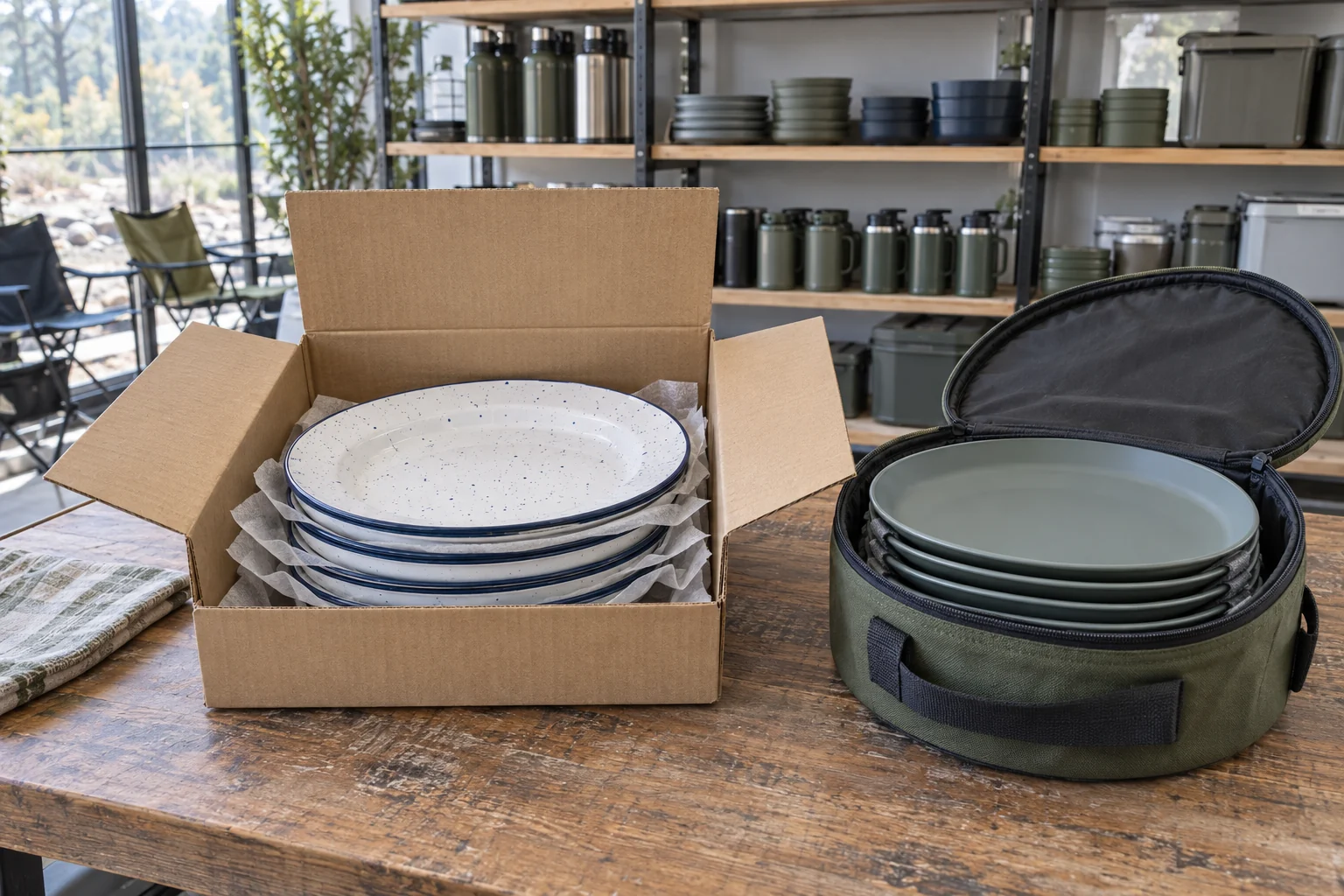
Calculate pack volume from the verified outer dimensions: length × width × height. Then compare usable plate count per retail pack and per master carton, while keeping protective performance constant. A smaller box that causes scuffing or distortion is not an efficiency gain; it transfers cost to inspection, returns and brand damage.
Run one controlled sample comparison
Issue the same sample brief to each candidate supplier. Include a component drawing or target envelope, plate count, user group, intended foods, contact time, temperature assumptions, cleaning method, target markets, colour direction, decoration zones, packaging constraints and required documents. Mark every unknown as open instead of allowing it to be silently filled by a supplier assumption.
On receipt, verify identity before performance. Check sample code, material declaration, colour, component count, measured dimensions, mass, nesting order and packaging. Photograph the complete set and critical details. If the sample differs from the quotation or evidence record, pause the comparison until the mapping is corrected.
Use repeatable checks that reflect the program: flatness on a defined surface, rim feel, nested stack height, separation effort, normal handling, cleaning according to the proposed instructions, and sales-pack transit evaluation. Do not invent pass/fail thresholds after testing. Approve the method, conditioning, sample count and acceptance rule before results are known.
Compare changes as revisions. If pigment, coating colour, decoration, rim, wall profile or packaging changes, identify which evidence and tests must be reviewed again. A signed revision log prevents a visually attractive late sample from replacing the validated construction without an impact assessment.
Write the misuse boundary into the specification
Do not call an enamel camping plate cookware merely because its substrate is steel. A coated dinnerware article has its own construction and intended-use limits. Likewise, do not infer microwave, dishwasher, freezer, oven, boiling-water or high-temperature suitability for PP from the polymer name. Every use claim requires product-specific confirmation and appropriate evidence.
Illustrations are scenario concepts, not proof of a production SKU, factory process, test result or customer order. The coastal scene below shows a plausible dining context only. It does not establish heat resistance, weathering performance, food-contact compliance or compatibility with any stove or storage system.

Build an approval record that survives handover
A retail plate program often passes through sourcing, product, quality, compliance, packaging, merchandising and e-commerce teams. If each function stores a different description, the final listing can drift from the approved sample. Create one controlled approval record with the project code, plate revision, material/construction description, colour reference, component count, intended use, cleaning instructions, packaging revision, evidence index and named approvers.
Attach photographs that show the whole plate, front, back, rim, base, decoration and nested stack under consistent lighting. A photograph should identify the sample revision rather than act as an unlabelled mood image. Measurements belong in the controlled specification, not drawn onto a generated picture. Keep visual references, measured data and test evidence separate so a buyer can see which type of record supports each decision.
For enamel, record the approved appearance of the coating at broad surfaces, curved transitions, underside and rim. State how small visual variations are judged and which conditions are functional failures. For PP, record approved gloss or texture, flatness, colour, visible flow features and any acceptable gate or ejector evidence. These records should come from the actual controlled sample; generic descriptions do not establish acceptance.
Link every packaging record to the product revision. If the rim changes, a separator may no longer protect the highest contact point. If a PP plate gains a deeper rib, the stack may become taller and change carton compression. The approval workflow should trigger packout review when geometry changes, even if the commercial product name remains the same.
Translate technical differences into commercial risk
Retail buyers do not need a laboratory lecture; they need to know how a failure reaches the customer. A visible enamel chip may create an immediate appearance complaint and require removal under the buyer’s defect rules. A warped PP plate may rock on a table or prevent a set from nesting correctly. Both can generate returns, poor reviews or replacement cost, but their detection and prevention routes differ.
Map each failure mode to the point where it can be prevented or detected: design review, incoming material control, production inspection, final inspection, packing, transit evaluation, warehouse handling or customer instructions. Assign responsibility and evidence. A risk with no owner is not controlled simply because it appears in a checklist.
Set review frequency according to change and risk. A new coating colour, decoration, pigment, mold revision, rim profile, packaging material or supplier site may justify additional verification. Do not assume that a previous report or golden sample automatically covers a changed article. Ask a competent compliance and quality team to document why existing evidence remains applicable or what must be repeated.
Finally, keep sales claims narrower than the approved record. Words such as durable, lightweight, dishwasher safe, food safe, chip resistant, unbreakable or heat resistant can imply measurable performance or a use boundary. Use them only when the exact finished product, method, result and market context support the statement. A restrained, traceable claim is more valuable than a broad claim that the team cannot defend.
B2B buyer checklist
| Check | Question | Why It Matters |
|---|---|---|
| Configuration | Are plate count, diameter, profile and set role identical across quotations? | Prevents component differences from being mistaken for material differences. |
| Intended use | Are food, temperature, contact time, cleaning and misuse boundaries written? | Defines the evidence and label scope. |
| Construction | Are substrate/coating or PP formulation, pigment and rim details identified? | Connects the finished sample to production controls. |
| Damage modes | Are chips, dents, scratches, warpage and stress whitening defined visually? | Turns subjective inspection into an actionable defect catalogue. |
| Nesting | Is stack height and separation behaviour checked at the actual sales count? | Protects pack volume and customer usability. |
| Packaging | Has the complete retail and master pack been tested? | Captures edge, abrasion, bending and transit risks. |
| Evidence | Does every document map to the exact article, colour and intended market? | Avoids relying on unrelated or over-broad reports. |
| Revision control | Who approves changes to colour, geometry, coating, decoration or packout? | Stops unreviewed substitutions after sample approval. |
Normalize quotations before comparing cost
Request the same line items from every candidate: exact component list, material and construction declaration, colour and decoration scope, individual and packed mass, retail packaging, master-carton arrangement, evidence supplied, evidence still required, sample status and open decisions. Price and MOQ must come from a written supplier quotation; this article does not invent either value.
Record assumptions separately from commitments. “Target” means the supplier is evaluating it, “sampled” means a specific sample was observed, and “approved” means the buyer accepted a controlled revision against written criteria. These labels make comparison more honest and reduce the risk of treating an early concept as a production promise.
If you are assembling plates with bowls, cups, cutlery or lunch boxes, use the camping plate and bowl size guide and the component-list framework to confirm role and pack logic. For a metal alternative, the published stainless steel vs enamel plate comparison helps separate coating-related questions from formed-metal questions.
Buyer FAQs
1. Is enamel automatically more durable than PP?
No. They have different failure modes, and finished construction matters. Enamel review should address coating, edge, dent and abrasion conditions; PP review should address stiffness, deformation, scratching and stress whitening. Define the channel’s likely handling and inspect equivalent finished plates.
2. Is PP always the lighter retail option?
A PP plate system can support a lower packed mass, but component count, diameter, wall profile, ribs and packaging determine the actual result. Compare measured samples and complete packs rather than relying on material density as the purchase decision.
3. Can enamel camping plates be used over a flame?
Do not make that inference. A dinnerware plate is not cookware unless the exact product has verified construction, instructions and evidence for that use. Keep direct-flame, burner, oven and stove claims out of copy unless product-specific records support them.
4. Which material is better for a children’s outdoor set?
Start with the defined age group, foreseeable use, geometry, mass, edges, cleaning and market-specific safety requirements. Material name alone does not establish suitability. Review the finished plate and its evidence with a competent compliance adviser.
5. What should a golden sample include?
Keep the approved finished plate, colour reference, decoration position, measured dimensions and mass, packaging configuration, revision code, dated photographs and signed approval record together. If multiple colours are commercially significant, define whether each needs its own controlled reference.
6. How should buyers compare pack efficiency?
Measure the complete retail pack and calculate volume from verified outer dimensions. Compare equal plate counts and equivalent protection. Include master-carton utilization, packing labour, separator material and observed damage; a smaller but failure-prone pack is not efficient.
Request a plate-system sample and evidence review
Send the intended market, user count, plate count, target envelope, meal types, temperatures, cleaning method, colour direction, decoration zones, retail channel, pack constraints and evidence expectations. Ask for a written response that separates confirmed construction, sampled attributes, open targets and unavailable claims.
Request an enamel or PP camping plate specification review before selecting a retail direction. For a set-level project, include the bowl, cup, cutlery, lunch-box and carry-system roles so compatibility can be checked by project sample and drawing.
Use the same brief when requesting a sample plan and written quotation. This creates a comparable decision record and keeps aesthetics, packaging, evidence and use conditions connected to the exact finished configuration.