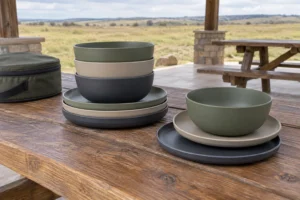
Calculate camping tableware pack volume from the closed, saleable pack—not from the loose components. Fix the final component list and packing sequence, measure the maximum external length, width and height, then multiply those dimensions using one unit system. Record internal voids, compression, protrusions and carton orientation separately. The result is a planning cube, not proof of freight cost or packaging performance.
Camping tableware pack volume needs one controlled boundary
Pack-volume discussions go wrong when suppliers and buyers measure different objects. One quotation may report only the nested bowls, another the zipped carry bag, and another the retail box. Those figures can all be mathematically correct while being commercially incomparable. The worksheet must name exactly which boundary each dimension describes.
Start with the saleable unit that a customer will receive. Include every declared plate, bowl, cup, lunch box, lid, utensil, divider, strap, instruction and permanent protective part. If a component is optional, calculate a separate configuration instead of mixing it into the main result. If the final choice is unresolved, mark it “To be confirmed for the project.”
Use three nested boundaries: the retained component pack, the closed carry case or retail unit, and the master carton. The first helps product engineering, the second helps assortment and storage decisions, and the third supports logistics planning. A single unlabeled volume number cannot serve all three purposes.
The buyer worksheet: dimensions, formula and evidence
| Worksheet field | Buyer entry | How to obtain it | Why it matters |
|---|---|---|---|
| Configuration ID | Project and revision reference | Copy from the controlled BOM and sample label | Prevents measurements from being detached from the approved set |
| Measurement boundary | Component pack, closed sales unit or master carton | Name the physical object and its closure state | Makes bidder figures comparable |
| Orientation | Face, edge and top reference | Photograph the agreed measuring position | Prevents dimensions changing when the pack is rotated |
| Maximum length | Measured value and unit | Use the outermost rigid or stable contact planes | Captures handles, hinges and protrusions that define the envelope |
| Maximum width | Measured value and unit | Measure perpendicular to length | Defines shelf, case and carton fit |
| Maximum height | Measured value and unit | Measure the normally closed pack without forced compression | Exposes overfilled or unstable pack-outs |
| Rectangular planning cube | L × W × H | Multiply in one unit system | Provides a repeatable comparison envelope |
| Allowable compression | None or project-defined condition | State load, duration and recovery method if compression is allowed | Stops a soft bag being squeezed arbitrarily for a smaller claim |
| Internal void observations | Location and cause | Open the pack and map unusable gaps | Shows where geometry or retention can improve |
| Master-carton arrangement | Count, orientation and dividers | Build the actual proposed carton pack-out | Converts sales-unit geometry into a logistics decision |
The basic rectangular formula is straightforward. The difficult work is controlling the inputs. Use millimetres, centimetres or inches consistently; do not multiply mixed units. State whether dimensions are nominal drawing values, observed sample values or carton-maker values, because those sources carry different uncertainty.
Do not round early. Keep the measured figures through the calculation, then round the reported result according to the project rule. If two proposals are close, compare the unrounded values and the dimensional variation rather than declaring a winner from a cosmetically rounded number.
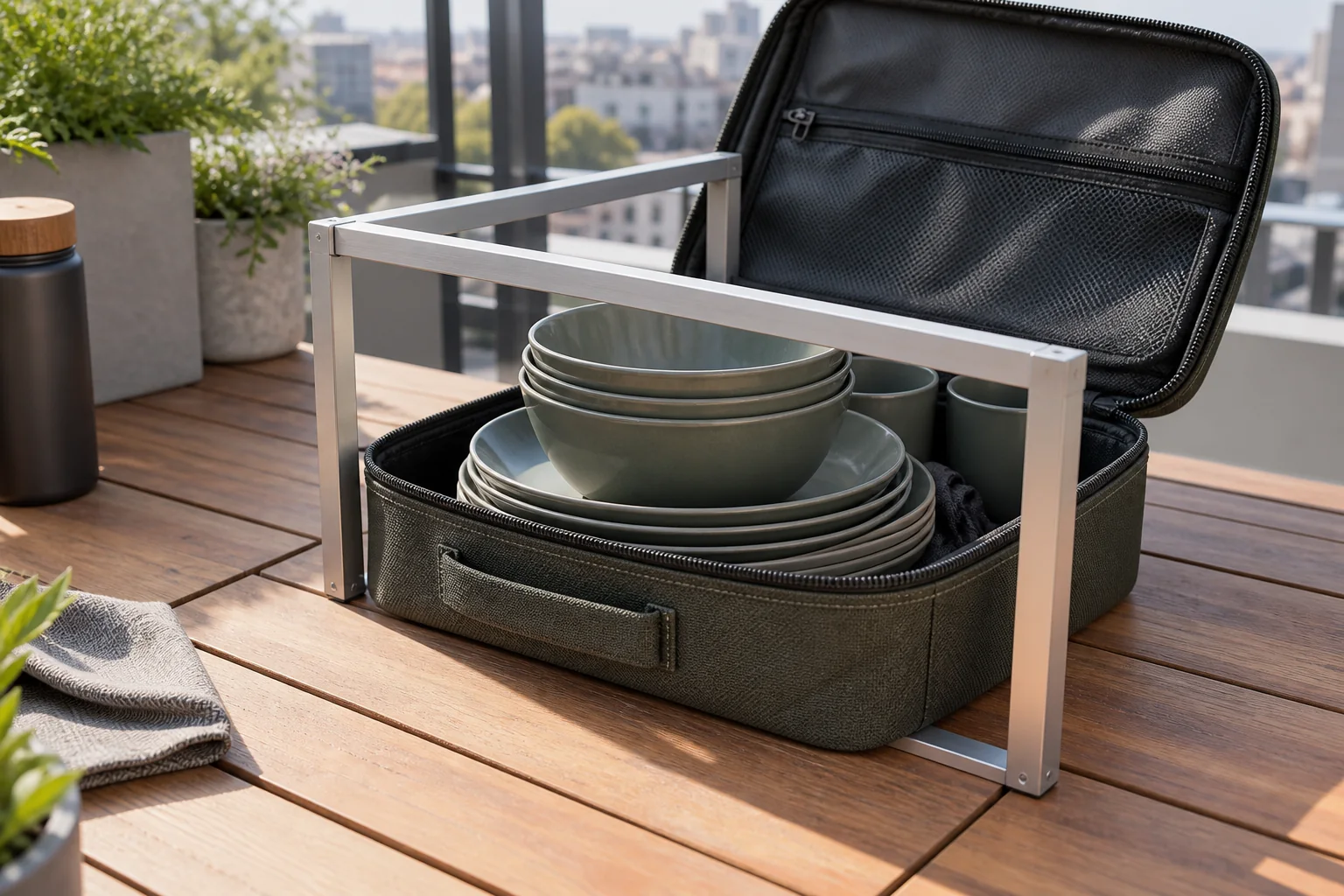
Step 1: freeze the component and quantity matrix
Volume cannot be optimized against a moving component list. Freeze the user count, meal functions, personal pieces, shared pieces and optional modules before comparing layouts. A four-user set with four plates, four bowls and four cups is not equivalent to a four-user set that also includes lunch boxes, lids, cutlery and a serving bowl.
Use the published camping dinnerware component matrix to assign every piece a job. Remove components that exist only to inflate piece count, and separate shared pieces from individual place settings. Record lids and detachable subparts clearly so a “piece” definition cannot change between bidders.
The matrix should include the component identifier, revision, quantity, material direction, intended location and packing relationship. Mark each relationship as nested, stacked, sleeved, pocketed, loose or separately boxed. This creates a traceable bridge between product architecture and the volume worksheet.
If alternative configurations are commercially useful, give each one a distinct suffix. Calculate the base set, lunch-box set and serving-piece set separately. That allows merchandising teams to compare real bundles without pretending one envelope applies to every variant.
Step 2: define the closed condition without forcing it
A zippered case is closed when the zipper follows its normal path without unusual force and the panels sit in their intended shape. A rigid case is closed when its designed latches engage. A carton is closed when its flaps and seals follow the proposed packaging method. Photograph the condition before measuring.
Do not kneel on a soft bag, over-tighten an adjustable strap or remove a permanent divider to obtain a lower number. If the design deliberately uses compression, specify the hardware, adjustment position and recovery expectation. Otherwise one operator can create a result that the next sample cannot reproduce.
Handles present a boundary decision. A folding handle that always lies flat may be excluded from height if its stowed position is controlled; a fixed handle or buckle that remains proud must be included. Record the decision in the measurement note instead of relying on an unlabeled photograph.
The same rule applies to flexible bulges. Measure the maximum stable envelope of the properly closed unit. If fill variation changes the shape, take repeated measurements across representative samples and report the range rather than selecting the smallest result.
Step 3: measure maximum length, width and height
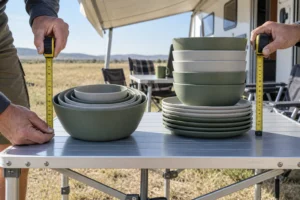
Place the pack on a level surface in the declared orientation. Establish mutually perpendicular reference planes and locate the outermost contact on each axis. For a soft case, avoid crushing the fabric; for a carton, include normal panel bow and closure geometry where they affect the stable envelope.
Record the instrument or fixture, resolution, operator, date, sample revision and environmental condition when these details can materially affect repeatability. The goal is not laboratory theatre. It is enough information for another qualified person to understand how the number was obtained and repeat the practical check.
Measure the full quantity. A two-bowl demonstration cannot represent a six-bowl saleable stack because incremental rise and divider pressure can accumulate. Likewise, an empty carry bag does not represent the filled unit. The measured object must match the controlled configuration ID.
For irregular shapes, the rectangular planning cube intentionally includes some air around the object. That makes it useful for shelf, carton and freight comparisons, but it is not the physical material volume. Keep those concepts separate in the worksheet.
Step 4: calculate and label the planning cube
For a rectangular envelope, calculate volume as length multiplied by width multiplied by height. If dimensions are recorded in centimetres, the result is cubic centimetres; dividing by one thousand converts cubic centimetres to litres. If dimensions are in millimetres, divide cubic millimetres by one million to obtain litres. State the units beside every result.
Example with deliberately hypothetical figures: a closed sample envelope of 40 cm × 30 cm × 18 cm would produce 21,600 cm³, or 21.6 litres. This example teaches the arithmetic only and is not a Naike Dinner product specification. Replace every example value with verified project measurements before using it in a quotation, listing or logistics record.
Add a field called “calculation source.” It should reference the measurement record or approved drawing revision used. If a drawing gives nominal dimensions while the physical sample bulges beyond them, do not silently keep the smaller drawing cube. Reconcile the discrepancy and decide which boundary governs the commercial decision.
When comparing proposals, calculate both absolute cube and cube per user or per complete place setting. The normalized figure can reveal architectural differences, but it should not reward removing useful pieces. Always display it beside the exact component matrix.
Step 5: distinguish occupied volume from usable case volume
The external cube includes case walls, closures, dividers and unavoidable air. Internal efficiency asks how much of that envelope supports required components. It is tempting to calculate an impressive percentage, but irregular parts and flexible materials make exact occupied volume difficult to establish without a controlled method.
Use a practical void map first. Photograph the open case from a fixed angle and mark where gaps occur: above low components, around circular bowls in square corners, beside handles, under curved plate rims or between incompatible modules. Describe whether each void is functional clearance, finger access, protective spacing or genuinely unused space.
Do not remove all voids. Users need grip clearance, parts need release space, food-contact surfaces may need protection, and wet components may require airflow before final drying. The objective is a controlled pack, not the highest theoretical fill ratio.
Compare the void map with the nesting versus stacking pack-out guide. A lower bowl nest can create broad unused corners, while a taller stack may fit beside vertical plates. The complete layout determines whether a geometric saving becomes useful volume.
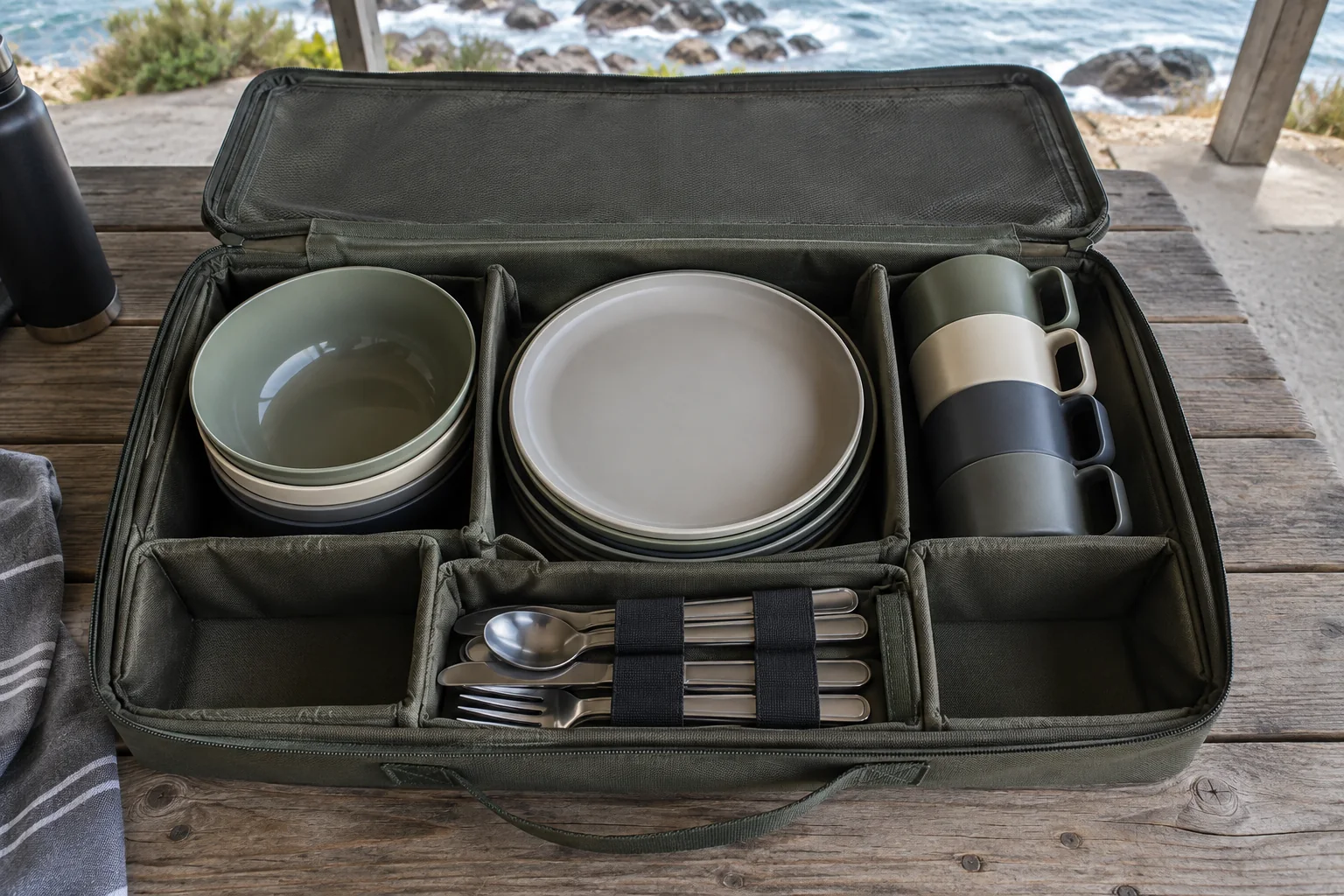
Step 6: test the packing sequence and access cost
A compact volume can hide a poor user sequence. If every plate must be removed to reach one cup, or the full set must be rebuilt to return one bowl, the architecture can create service complaints. Record the unpack, distribute, return and close sequence with representative users.
Count the number of component groups that must move to reach each daily-use item. This is not a universal performance score, but it exposes tradeoffs. A slight increase in cube may be justified if it enables independent access, clearer counting or easier drying.
Observe whether users can identify the correct location without forcing parts. A divider that saves space but requires bending a plate or compressing a cup is not a stable solution. Compatibility to be confirmed by project sample and drawing.
Repeat the sequence after the declared cleaning process and full drying. Damp surfaces can alter release, friction and bag shape. Do not infer dishwasher suitability or hygiene performance from a pack-volume exercise; those claims require their own final-configuration evidence.
Step 7: convert the sales-unit cube into a carton plan
Multiplying the sales-unit cube by carton quantity gives a theoretical minimum, not an actual carton volume. Real cartons need orientation, clearances, dividers, cushioning where justified, closure space and dimensional tolerance. Build the proposed arrangement and measure the closed master carton.
Compare orientations deliberately. A wide soft case may pack more efficiently on edge, while a rigid case may require face-up stacking to protect closures. Confirm whether the orientation is acceptable for storage, artwork, product protection and warehouse handling.
Carton strength and distribution testing are separate decisions. The International Safe Transit Association test-procedure index helps packaging teams identify scoped distribution simulations, while the official USPS mailing standards for physical dimensions and weight show why the finished package boundary matters. Neither source proves that an untested carton will perform; select the method and severity with the responsible packaging specialist for the actual route.
For parcel networks, carriers may calculate dimensional or billable weight using service-specific rules. Review the current rule for the selected carrier and route, such as the official UPS guidance on package dimensions and weight. Do not convert a product cube into a universal freight charge because divisors, rounding and service conditions can change.
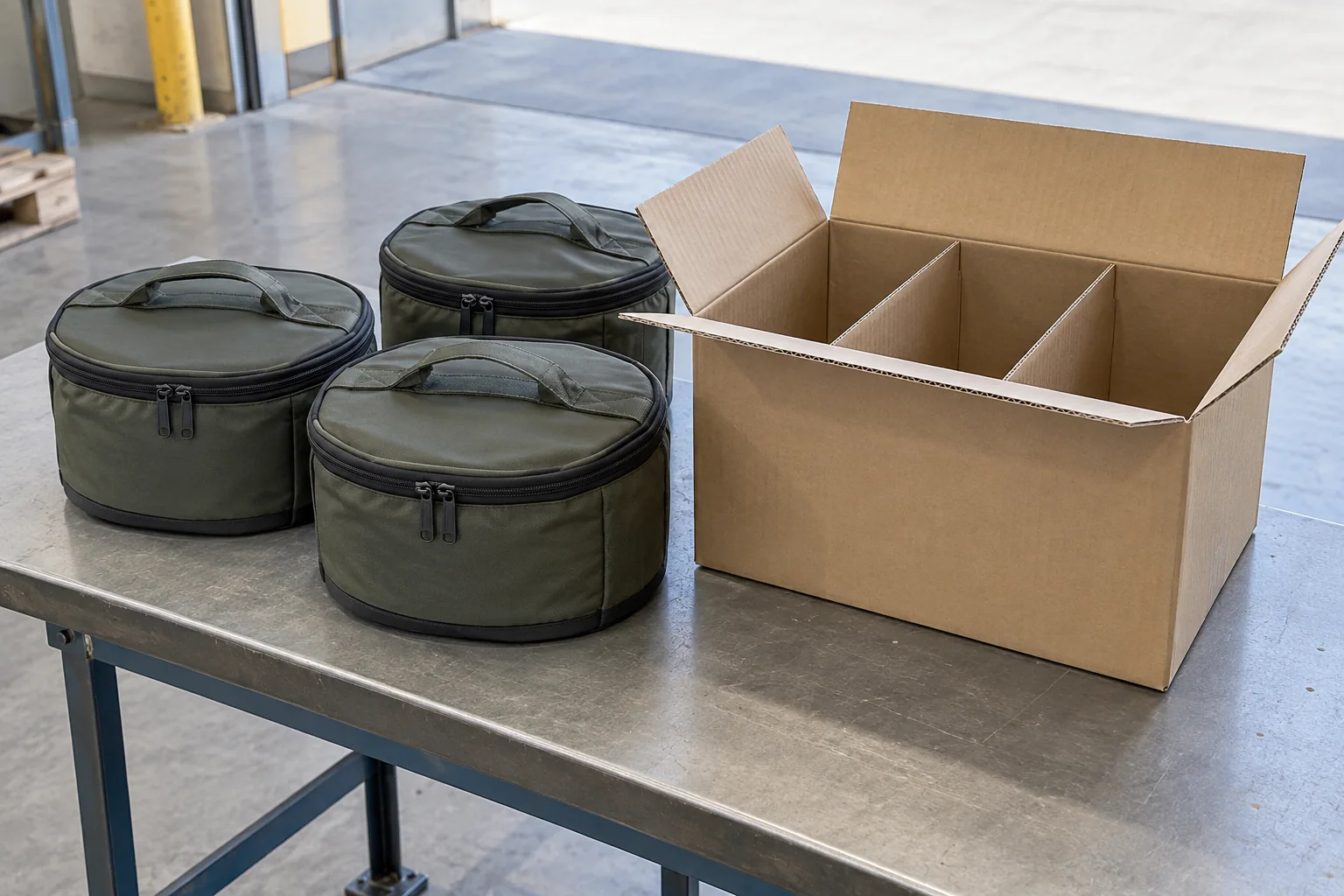
Compare two pack designs without hiding scope changes
| Comparison check | Proposal A | Proposal B | Decision rule |
|---|---|---|---|
| Component equivalence | List IDs and quantities | List IDs and quantities | Reject cube comparison until functions and quantities match |
| Closed sales-unit cube | Measured L × W × H | Measured L × W × H | Use the same orientation and closure condition |
| Cube per user | Total cube ÷ declared users | Total cube ÷ declared users | Display beside the component matrix |
| Access sequence | Groups moved for daily items | Groups moved for daily items | Prefer the better program tradeoff, not automatically the smaller cube |
| Void classification | Functional and unused gaps | Functional and unused gaps | Remove only unjustified voids |
| Carton arrangement | Count and orientation | Count and orientation | Measure the built master carton |
| Variation | Observed measurement range | Observed measurement range | Confirm tolerance and closure remain acceptable |
| Evidence status | Drawing/sample/test references | Drawing/sample/test references | Keep assumptions separate from verified records |
This table prevents a common sourcing error: awarding the apparently smaller proposal after it has quietly deleted a shared bowl, reduced cup count or omitted protective retention. First compare equivalent functions. Then choose the pack architecture that best balances volume, access, protection, cleaning and channel requirements.
Apply the calculation to different channels
Family car-camping retail
Retail buyers need a component story that matches the box, photography and shelf footprint. Calculate the complete retail unit and confirm that the case can be repacked by an unfamiliar user. A small cube does not help if returned components no longer fit or the closure must be forced.
RV and caravan storage
Cabinet width, depth and access direction can matter more than the smallest total cube. Record the intended shelf or drawer boundary and compare alternative orientations. A low broad pack and a tall narrow pack can have similar volume but very different storage compatibility.
E-commerce bundle
Measure the finished parcel configuration rather than the naked carry case. Product carton, protective structure and shipping container must be reconciled with the selected fulfillment method. Check current carrier rules at quotation time instead of publishing a permanent dimensional-weight promise.
Rental fleet or guided group
Fast count and replacement visibility may justify dedicated pockets that add volume. Use the family component allocation table to keep personal and shared roles explicit. Measure operational value alongside cube.
Limitations, misuse boundaries and commercial risks
Pack volume does not prove product weight, freight price, drop resistance, carton compression strength, waterproofing, food-contact conformity, dishwasher suitability, insulation or durability. It is one geometric input. Each performance or compliance statement requires evidence matched to the final configuration and intended use.
Dinnerware is not cookware. No plate, bowl, cup, lunch box or carry-case component should be placed on a stove, burner, campfire or direct flame without product-specific verified evidence. A compact pack shown at a campsite does not imply heat-source suitability.
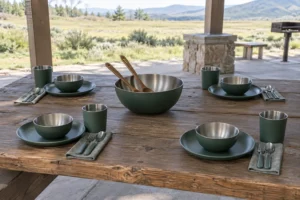
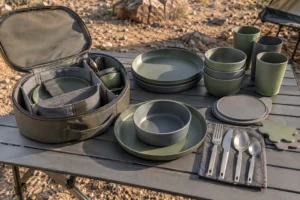
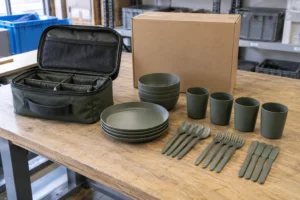
Concept images can explain measurement boundaries and layout choices, but they cannot establish dimensions, materials, available components, capacity or test results. Controlled drawings, BOMs, approved samples and written evidence govern the project.
A late component change can invalidate the calculation. A thicker rim, revised bowl taper, new cup handle, different zipper, added instruction booklet or stronger carton can change one or more boundaries. Link the calculation sheet to revision control and recalculate after every approved change that affects the envelope.
B2B buyer checklist
| Check | Question | Why It Matters |
|---|---|---|
| Configuration | Does the measured pack match the final BOM and exact quantities? | Prevents a smaller incomplete set from winning the comparison |
| Boundary | Are we measuring components, closed sales unit or master carton? | Stops unlike numbers being compared |
| Closure | Does the pack close normally without forced compression? | Protects repeatability and user experience |
| Dimensions | Were maximum L, W and H taken from controlled reference planes? | Captures protrusions and real shelf fit |
| Units | Are all inputs and conversions in one declared unit system? | Avoids calculation errors |
| Voids | Which gaps are functional and which are unused? | Guides redesign without removing needed access or protection |
| Sequence | Can users unpack and repack the set without forcing parts? | Balances cube against daily usability |
| Carton | Was the actual master-carton arrangement built and measured? | Turns theoretical cube into a logistics input |
| Revision | What drawing, BOM and sample revision produced the result? | Keeps the calculation traceable |
Procurement recommendation
Request one completed worksheet per proposed sales-unit configuration. Require the controlled component matrix, three external dimensions, closed-condition photograph, calculation with units, void map, packing sequence, master-carton arrangement and evidence status. Keep theoretical numbers visually separate from measured numbers.
Use volume as a constraint, not the only score. Approve the smallest architecture only if it also meets access, retention, cleaning, replacement, merchandising and evidence needs. When bidders propose different pieces or packaging, normalize scope before comparing cube.
Ask the supplier and packaging partner to sign off the final measured sample and carton revision. If a carrier quotation is needed, send the current external parcel dimensions, weight, route and service to the selected provider. Do not ask a dinnerware image to carry that commercial proof.
Sequential buyer FAQs
1. Should buyers measure the carry bag or the products inside it?
Measure both for different purposes, but use the closed saleable unit for the main commercial pack-volume comparison. Label the retained component envelope separately so engineering teams can understand how much space the case and retention system add.
2. Can a soft bag be compressed before measurement?
Only if the final product deliberately uses a defined compression system and the project states its condition. Arbitrary hand pressure produces a non-repeatable number. Otherwise measure the normally closed, stable bag without forcing it smaller.
3. Is litres-per-person a fair comparison?
It can normalize configurations with different user counts, but only when the included functions are visible. Show the component matrix beside the figure so deleting useful pieces cannot create an artificially attractive result.
4. How should irregular cases be calculated?
Use the maximum rectangular envelope for shelf and carton planning, and note that it includes air around the shape. If a more detailed method is needed, define it before measurement and apply it consistently to every proposal.
5. Does lower pack volume always reduce freight cost?
No. Freight can depend on actual weight, dimensional rules, service, route, rounding, parcel count and current carrier terms. Pack volume is an input, not a universal price formula.
6. Should protective dividers be included?
Yes, if they are part of the saleable or shipping configuration. Removing permanent protection to improve the number makes the calculation unrepresentative. Temporary development materials should be identified separately.
7. When should the calculation be repeated?
Repeat it after any approved revision that can change geometry, packing order, retention, closure or carton construction. The final pre-production sample and final carton should reconcile with the released worksheet.
Request a pack-volume specification review
Send the user count, component matrix, drawings or reference samples, desired carry method, maximum storage envelope, retail or e-commerce channel, proposed carton count, destination markets and any current logistics constraints. We can separate verified inputs from unresolved assumptions and prepare the questions needed for a sample, specification review or written quotation.
Request a camping tableware pack-volume review. Attach the current BOM and pack sketch through the project inquiry page; dimensions, packaging, price, MOQ, schedule and any development path must be confirmed in writing for the specific project.