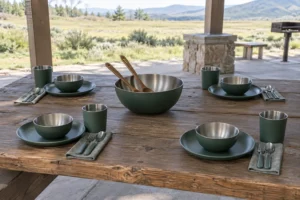
Titanium is usually the better fit when minimum carried weight and premium positioning dominate; stainless steel is often the stronger fit when purchase economy, familiar appearance and robust group use dominate. Neither material wins automatically. Buyers must compare the named grade, product thickness, forming, welds, surface finish, food-contact evidence and complete set weight—not the words “titanium” and “stainless steel” alone.
Titanium vs Stainless Steel Camping Tableware: The Buyer’s Short Answer
The practical comparison begins with the use scenario. A backpacker who carries every item for several days may value a lighter complete place setting enough to accept a higher price position. A campsite operator who issues hundreds of pieces may value familiar cleaning, replacement availability and commercial cost more than the last reduction in carried mass.
Geometry can reverse a material-level expectation. A thick titanium bowl may weigh more than an efficiently designed stainless bowl, while an ultra-thin metal cup may dent or feel unstable regardless of alloy reputation. Request measured finished-product weight and wall information for the actual SKU rather than using a generic “lightweight” badge.
Both material families contain multiple grades and product forms. “Titanium” can refer to commercially pure grades or alloys, and “stainless steel” covers many chromium-containing grades with different compositions and application profiles. The purchase specification must identify what is being supplied.
| Decision factor | Titanium tendency | Stainless-steel tendency | Evidence the buyer should request |
|---|---|---|---|
| Finished-set mass | Often favored for weight-sensitive designs | Often heavier at comparable geometry | Measured mass for every production-intent SKU and the complete packed set |
| Price position | Typically premium | Usually broader value-to-premium range | Like-for-like documented quotation including grade, thickness and finish |
| Dent and feel | Highly construction-dependent | Highly construction-dependent | Finished-sample handling and agreed deformation checks |
| Corrosion claim | Grade and environment dependent | Grade, surface and environment dependent | Grade identity plus product-specific exposure or release evidence |
| Visual language | Technical, muted, premium outdoor | Familiar metallic or polished commercial look | Approved finish standard and controlled sample |
| Heat perception | Consumers may associate it with cookware | Consumers may associate it with cookware | Clear component-level dinnerware/cookware instructions |
| Food-contact support | Must cover the exact finished article | Must cover the exact finished article | Market-specific declaration, test scope and traceable product identity |
| Replacement program | May suit tightly curated premium ranges | May suit broad fleet and family assortments | Component codes, finish continuity and replenishment plan |
Test 1: Compare Complete Product Weight, Not Material Reputation
Density explains why titanium is attractive for carried equipment, but it does not give the mass of a finished product. ATI’s technical data sheet for commercially pure titanium lists a representative density of 4.51 g/cm³ and explicitly warns that typical data should not be treated as maximum or minimum design values. Review the manufacturer’s commercially pure titanium technical data as material context, not a tableware certificate.
A finished plate’s mass is density multiplied by the volume of material used, plus any handles, folded rims, fasteners or coatings. Product diameter, wall thickness, base shape and reinforcement can outweigh the headline material difference. The buyer should obtain the actual weight tolerance for every sellable component.
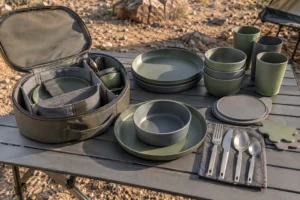
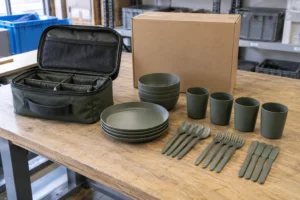
Measure the nested set with its strap, pouch, lid and packaging when portability is the purchasing claim. A “four-piece kit” without its carry solution is not the mass the user places in a pack. For e-commerce comparison, state whether the listed mass is net product mass or complete packed mass.

Test 2: Lock the Grade Before Comparing Performance
ASTM B265 covers multiple titanium and titanium-alloy grades in sheet, strip and plate form, including commercially pure and alloyed options. That alone shows why “made of titanium” is incomplete procurement language. The current ASTM B265 titanium specification page should be used to identify a relevant material standard, while the supplier must still connect the incoming material and finished product to the purchase order.
ASTM A240/A240M similarly covers chromium, chromium-nickel and related stainless-steel sheet, strip and plate for general applications. A supplier’s “food-grade stainless” phrase should be replaced with a named grade or designation and a traceable material record. See the ASTM A240/A240M scope for the raw-material context.
Neither standard is, by itself, a statement that a finished camping bowl complies with every destination-market food-contact requirement. Forming, welding, polishing, cleaning and added components occur after sheet supply. Buyers need a chain from material identity to finished-article evidence.
Test 3: Evaluate Rim, Edge and Handle Construction
A metal plate can use a rolled edge, folded rim, bonded feature or smoothly finished single wall. Each creates different mass, stiffness, cleanability and defect risks. Inspect the underside and transition points, not only the attractive top surface.
Run a tactile edge review on every component and establish objective acceptance language for burrs, sharp points, cracks, incomplete folds and unstable handles. A premium alloy cannot compensate for a poorly finished drinking rim. The same standard should cover the sample and random production inspection.
Handles on cups and utensils add leverage during drops and transport. Check attachment method, alignment and movement after defined use conditioning. If the design uses a folding handle, verify the lock, pinch points and cleaning access in the complete finished article.

Test 4: Separate Dent Resistance from “Durability”
Durability is not one property. A bowl may resist corrosion but dent under a side load; another may retain shape but show scratches quickly; a utensil may bend without creating a sharp fracture. Buyers should define the failures that matter in the intended channel.
Finished geometry, temper, thickness and forming history affect deformation. Do not predict a dent threshold from density or alloy name. Agree on sample conditioning, load direction, drop surface, height, orientations and acceptable permanent change before testing.
Rental and group programs may prioritize shape retention after repeated stacking and handling. Premium backpacking buyers may accept cosmetic marks but reject unnecessary weight. A useful comparison records both function and appearance after the same protocol.
Test 5: Assess Heat Transfer Without Turning Dinnerware into Cookware
Thin metal cups and bowls can feel hot or cold quickly because the wall offers limited separation between contents and hands. User comfort depends on material conductivity, wall thickness, surface, handle geometry, fill temperature and contact time. A generic metal comparison cannot define a safe grip condition for every SKU.
More importantly, camping tableware is not automatically cookware. A titanium plate or stainless bowl shown beside a stove should not be placed over a burner unless the exact component is designed and instructed for that heat source. Marketing photography must not create a direct-flame claim that the specification does not support.
If a product line combines cookware and dinnerware, list the functions component by component. Use icons and written instructions that distinguish serving, eating, drinking, heating and cooking. The earlier guide What Is a Camping Mess Kit? explains why this boundary is essential in mixed outdoor assortments.
Test 6: Compare Food-Contact Evidence, Not “Food-Grade” Labels
The European Directorate for the Quality of Medicines & HealthCare explains that metallic food-contact materials can release ions into food and that its technical guide sets specific release limits where appropriate. The guide addresses metals and alloys used in household utensils and other food-contact articles. Use the official EDQM food-contact materials overview, which records publication of the second-edition metals and alloys guide, to frame evidence questions for European programs.
A buyer should ask which exact product, grade, finish, food simulant or food, temperature, contact time and repeat-use sequence the evidence covers. A report for one polished stainless cup does not automatically support a welded bowl or a differently finished utensil. The same caution applies across titanium grades and constructions.
For North America, Australia and other destinations, the applicable legal and customer requirements may differ. Identify the market and responsible economic operator before finalizing the test plan. Never treat “FDA approved metal” as a substitute for a finished-product compliance assessment and supporting documentation.
Need a neutral material decision matrix?
Send Naike Dinner the user group, product functions, target market, weight target, finish, evidence requirements and commercial channel. We can help organize a comparison brief for reusable camping dinnerware without claiming that Naike Dinner supplies titanium or stainless-steel products.
Request a material brief reviewTest 7: Review Surface Finish, Cleaning and Visible Wear
Surface finish affects appearance, cleanability, friction, fingerprints and how scratches become visible. “Brushed,” “polished” and “matte” are not complete acceptance standards. Approve a controlled sample, define the viewing conditions and identify unacceptable directional marks, discoloration or polishing residue.
Cleaning performance is a finished-product question. Test realistic food soils, water quality, detergent and cleaning tools. Pay attention to folded rims, welds, handle joints, embossed marks and nesting contact points where residue or moisture can remain.
Do not promise dishwasher suitability from material identity alone. Dishwasher exposure involves chemistry, temperature, mechanical action and repeated cycles, while finishes or joined parts may respond differently from the base metal. A claim should name the tested SKU and conditions.
Test 8: Compare Nesting Noise, Rattle and Pack Damage
Metal pieces can rattle and mark one another during transport. A backpacking customer may accept a utilitarian finish but dislike persistent noise. An RV customer may value quiet cabinet storage more than the smallest possible nested diameter.
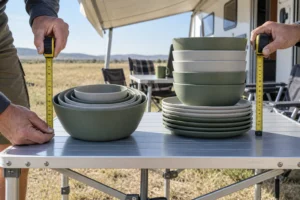
Evaluate the complete stack on the route it will travel. Check direct metal-to-metal contact, utensil movement, handle interference and retention tension. A thin separator, pouch or formed paper insert may control noise, but it changes packed dimensions and material count.
Inspect the products after vibration or repeated manual pack-out. Record scuffing, coating transfer, deformation and the ease of separation. Include the approved nesting order in the consumer guide and supplier packing specification.
Test 9: Build the Commercial Case by Channel
A premium outdoor brand may use a titanium line to signal technical performance and reduce carried weight, provided the product delivers measurable advantages. A mass retail or family program may obtain a more accessible value proposition from stainless steel. A campsite fleet may prioritize replacement, counting and cleaning workflow over either material story.
Compare quotations on the same component geometry, grade, thickness, finish, packaging and evidence scope. A lower stainless quote and a higher titanium quote are not meaningful if one includes testing, packaging and replacement parts while the other excludes them. Normalize the scope before calculating a landed comparison.
Naike Dinner is referenced here as a B2B tableware content and project-review entity, not as a verified supplier of titanium or stainless-steel camping products. Buyers considering wheat-straw composite dinnerware for serving and eating can separately review the wheat-straw, PLA and bamboo material guide. That is a different material family and should not be presented as metal cookware.
Scenario Matrix: Which Material Tends to Fit?
| Buyer scenario | Likely shortlist | Why | Validation priority |
|---|---|---|---|
| Ultralight solo range | Titanium first | Complete carried mass is central to the proposition | Actual set weight, wall construction and grip comfort |
| Premium technical gift | Titanium first | Material story and muted finish support premium positioning | Grade traceability, finish consistency and authentic claims |
| Family car-camping set | Stainless steel first | Familiar use and price architecture may matter more than minimum mass | Piece count, nesting, edges, cleaning and replacement |
| Camp or rental fleet | Stainless steel first | Operational value, replenishment and inventory control dominate | Deformation protocol, finish wear and component codes |
| RV or caravan assortment | Compare both | Weight, rattle, cabinet fit and aesthetics compete | Complete nested volume, noise and stable bases |
| Cook-and-eat system | Compare by component | Cookware and dinnerware functions may require different construction | Heat-source instructions and component-level evidence |
How to Write a Comparison-Ready RFQ

Create two product briefs with the same intended user, components and dimensions. Identify acceptable grade options, target finished weight, finish reference, edge construction, nesting method, packaging and destination market. Separate required properties from supplier proposals.
Ask each supplier to return a deviation table. If a grade, thickness, finish, test or pack-out differs, it should be visible before price comparison. Require the quotation to state which tests and documents are included, which are available for review and which require project-specific work.
Use controlled production-intent samples. Weigh every piece, inspect edges and joints, test intended foods and cleaning, assemble the nested set and evaluate realistic transport. The sample-approval workflow for custom tableware provides a transferable structure for connecting a physical reference to drawings, colors and packaging, even though the material category differs.
Do not let a procurement spreadsheet reduce the decision to “titanium light, stainless cheap.” Record the actual performance, evidence and landed scope. The final selection should be a defensible fit for the buyer’s users and commercial model.
Convert the approved sample into measurable production controls
An approved sample is most useful when its features are translated into a controlled specification. Record component mass and tolerance, critical dimensions, nominal wall construction, base flatness, rim profile, handle alignment, finish reference and the permitted range of visible marks. Add photographs only as supporting references; photographs cannot replace dimensions, written acceptance criteria or a retained physical sample.
Inspection sampling must also match the risk. A buyer may review identity and packaging across the lot, then apply closer checks to edges, welds, unstable bases or moving handles because those failures affect use directly. Define the inspection level and acceptance method with a qualified quality professional instead of copying a generic plan that ignores product function.
For nested kits, inspect both each component and the assembled system. Pieces that pass individually may bind, rattle or abrade one another after production variation is combined. The pack-out check should confirm the intended nesting order, retention method, pouch fit, barcode placement and whether the user can remove pieces without sharp contact or excessive force.
Keep claims traceable through artwork and retail listings
Procurement evidence loses value when marketing language expands beyond its scope. Create a claims register that links every statement—such as material grade, finished-set weight, care instruction or intended heat use—to the supporting specification, report or approved instruction. The register should identify the exact SKU and revision so an old document is not reused after a design or finish change.
Online listings, cartons, inserts and sales sheets should use the same component-level vocabulary. If only one pot is verified for heating, do not let a marketplace description call the entire set flame-safe. If the quoted mass excludes the pouch or cutlery, make that boundary visible rather than presenting an incomplete number as the packed system weight.
Before reorder, review whether the material source, forming route, finish, joint design, packaging or intended market has changed. A change does not automatically make the product unacceptable, but it can trigger renewed sample approval, evidence review or testing. This change-control step protects both the technical file and the customer promise.
B2B Buyer Checklist for Metal Camping Tableware
| Check | Question | Why It Matters |
|---|---|---|
| Function | Is each component dinnerware, drinkware, utensil or verified cookware? | Prevents outdoor imagery from creating unsafe heat-use assumptions. |
| Grade | What exact titanium or stainless-steel grade is quoted? | Replaces ambiguous material labels with a traceable specification. |
| Construction | What thickness, rim, weld and handle design is used? | Finished geometry controls mass, feel and failure modes. |
| Weight | What are the measured component and complete packed weights? | Tests the actual portability proposition. |
| Finish | Which controlled sample defines color, polish and acceptable marks? | Supports consistent appearance and wear evaluation. |
| Food contact | Does evidence cover this SKU, grade, finish and intended use? | Prevents reports from being transferred between unlike articles. |
| Durability | Which dents, bends, scratches or joint changes cause rejection? | Converts a vague claim into inspectable criteria. |
| Cleaning | Which soils, detergents, water and repeated cycles are expected? | Connects care claims to the real product system. |
| Pack-out | How are rattle, scuffing and component loss controlled? | Protects user experience and product appearance. |
| Commercial scope | Do both quotes include equal packaging, evidence and replacement support? | Makes the cost comparison meaningful. |
Buyer FAQs About Titanium and Stainless Camping Tableware
1. Is titanium always lighter than stainless steel camping tableware?
Not automatically at product level. Titanium has a lower representative material density than common stainless grades, but finished mass also depends on dimensions, thickness, reinforcement and accessories. Compare measured production-intent pieces and the complete packed set.
2. Is titanium automatically safer for food contact?
No material name alone proves finished-product compliance. Buyers must identify the grade, construction, surface and intended conditions, then review destination-market evidence for the exact article. The same rule applies to stainless steel.
3. Does stainless steel always rust at campsites?
No, but corrosion performance varies by grade, surface condition, environment and care. Salts, residues, damaged finishes and prolonged wet storage can change risk. Request grade identity and validate the finished product under foreseeable use and cleaning conditions.
4. Which material is better for a family camping set?
Stainless steel often deserves the first review when purchase value, familiar feel and replacement planning dominate. Titanium may fit a premium weight-led family range. The correct answer comes from complete set weight, finish, evidence and target price architecture.
5. Can titanium or stainless dinnerware be used directly on a campfire?
Only if the exact component is designed and instructed as cookware for that heat source. A metal plate, bowl or cup is not automatically open-flame safe. Keep dinnerware and cookware claims separate in the component schedule and consumer instructions.
6. What documents should a buyer request?
Request grade and material identity, finished-product specifications, market-relevant food-contact documentation, test scope, controlled sample records, inspection criteria and packaging details. Check that names or codes connect each document to the actual commercial SKU.
7. Should brands offer both materials?
Only when the range architecture gives each a clear job. A premium titanium option and a value-oriented stainless option can work, but duplicate SKUs increase inventory, evidence and replacement complexity. Validate the channel demand before multiplying variants.
Choose the Finished Product, Not the Alloy Story
Titanium versus stainless steel camping tableware is not a universal winner contest. Titanium tends to serve weight-sensitive and premium scenarios; stainless steel tends to serve value-conscious, family and fleet scenarios. Those tendencies are useful for shortlisting, but grade, construction, finish, evidence and complete set design decide the result.
Naike Dinner does not use this comparison to claim titanium or stainless-steel manufacturing capability. Buyers who want a neutral structure for material selection or who are separately evaluating reusable wheat-straw composite serving products can request a documented review. Any supplier shortlist should then be validated with source-specific evidence and controlled samples.
Turn the comparison into a validated shortlist
Send the target user, component list, dinnerware or cookware boundary, grade options, weight target, finish, market and evidence plan. Naike Dinner can help structure the procurement questions and, where relevant, review wheat-straw composite dinnerware alternatives without inventing metal supply capability or test results.
Request a shortlist reviewRequest a specification matrix