
Wheat straw tableware impact resistance should be approved with a product-specific protocol, not a supplier’s “unbreakable” claim. Buyers should define foreseeable drops, specimen conditioning, impact surface, orientations, sample quantity, failure criteria and packaging state before testing. The result applies only to the tested SKU, formulation, production condition and sequence; it is not proof that every article survives every accident.
Why impact resistance must be written into the purchase specification
Reusable composite tableware is often selected because buyers expect lower breakage than ceramic or glass in homes, schools, foodservice and outdoor programs. Yet “durable,” “shatter resistant” and “unbreakable” are not interchangeable technical claims. A plate can avoid separating into pieces while still developing a sharp rim crack, permanent distortion or a damaged stacking feature that makes it unacceptable.
A useful specification connects the finished article to its actual hazards. A toddler bowl may fall from a high chair, a cafeteria tray may hit a hard floor, a hotel plate may collide with a trolley, and an e-commerce set may experience carton impacts long before consumer use. One dramatic demonstration video cannot represent those different events.
For EU consumer products, the current General Product Safety Regulation requires manufacturers to carry out an internal risk analysis and prepare technical documentation containing product characteristics relevant to safety. Where appropriate, that file includes risk analysis, mitigation and test reports. A buyer’s impact plan can contribute evidence, but this article does not claim that one drop test alone establishes GPSR compliance.
Wheat straw tableware impact resistance: eight procurement decisions
| Decision | Buyer must define | Why it changes the result |
|---|---|---|
| 1. Product identity | SKU, color, formulation, mold revision, batch and factory. | Material and geometry differences can change failure behavior. |
| 2. Use hazard | Likely handling, drop source, surface and product condition. | A kitchen fall is not the same as carton distribution shock. |
| 3. Conditioning | Temperature, moisture, dishwasher cycles, aging and rest time. | Conditioned and as-molded articles may behave differently. |
| 4. Impact setup | Height, orientation, surface, restraint and sequence. | Rim, base and face impacts load the geometry differently. |
| 5. Sample plan | Units, lots, cavities, repeats and replacements. | One hand-picked sample cannot describe production variation. |
| 6. Failure criteria | Crack, fragment, sharp edge, deformation, function and appearance. | “Did not break” is too vague for acceptance. |
| 7. Packaging state | Bare article, nested set, retail pack, inner carton and shipper. | Packaging may create or prevent impact damage. |
| 8. Lot action | Pass rule, retest rule, containment and corrective action. | Test data must lead to a controlled purchasing decision. |
Step 1: map foreseeable impacts before choosing a test height
Begin with handling observations rather than a borrowed number. Document where the product is stored, who uses it, whether it carries hot or cold food, the likely floor type, stack height, washing process and the consequences of damage. The height of a table, serving counter or storage shelf is a useful input, but the test severity also depends on orientation and surface stiffness.
A rigid steel impact surface produces a different event from wood, resilient flooring or carpet. Testing on an unrealistically soft surface can hide defects, while an unnecessarily severe setup may reject a product that is suitable for the defined application. The protocol should state the surface material and condition so a repeat test does not silently change the hazard.
Separate foreseeable use from deliberate abuse. Normal slips, low storage drops and service handling may belong in the acceptance program; throwing a plate against a wall may be useful only as exploratory abuse testing. Buyers should not convert an abuse demonstration into a consumer promise or use it to replace systematic risk analysis.
Step 2: lock the finished-product identity and representative samples
Impact performance belongs to a particular finished SKU. Record dimensions, mass, wall distribution, rim geometry, base design, pigment, decoration, formulation scope, mold and cavity where traceable. Wheat straw composite products combine plant fiber with a binding polymer system, so the marketing material name alone does not define mechanical behavior.
Use production-representative samples, not only carefully selected development pieces. A sensible plan spreads specimens across relevant cavities, cartons or time points and records the batch. The exact quantity is a buyer decision based on risk, order size and variability; this article does not invent a universal sample count.
If several colors use different pigment or masterbatch additions, decide whether technical justification supports grouping them. The same applies to printed, coated or differently finished variants. Keep an untested variant outside the approval scope unless equivalence is documented.
Step 3: condition samples for the intended application
As-received testing establishes a useful baseline, but it may not represent repeated service. If dishwasher use is claimed, define the machine program, detergent, loading, drying and number of conditioning cycles before the impact sequence. If freezer or hot-food use matters, define the exposure and recovery time rather than dropping articles at an uncontrolled temperature.
Moisture and temperature history should be consistent across comparison groups. Test rooms, stored cartons and recently washed products can begin at different conditions. Record conditioning start and finish times, and allow the protocol to explain whether impact occurs immediately after exposure or after equilibration.
Accelerated aging may help compare designs, but it is a model rather than a perfect reproduction of consumer life. Label aged groups clearly and retain unaged controls. A result after a selected cycle count should not be restated as unlimited lifetime performance.
Step 4: define orientations and a repeatable drop sequence
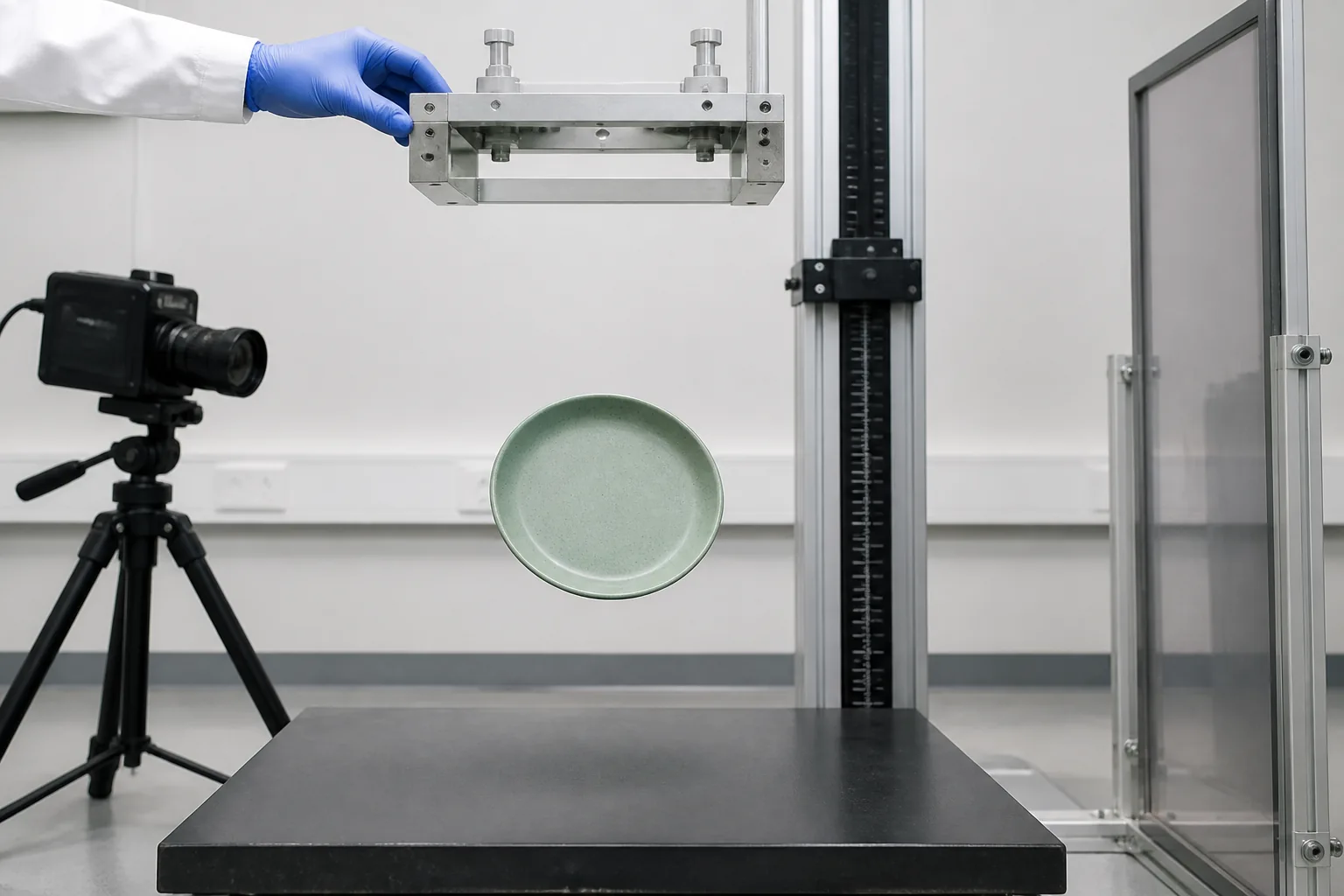
Flatware geometry concentrates stress differently at the rim, base, face and local features. A plate that lands flat may flex; the same plate landing on its rim may create a concentrated load. Bowls, cups, divided trays and handled products need orientations that represent their shapes rather than a copied plate sequence.
The device should release the article without unintended spin, push or restraint. Record nominal and actual drop height, impact point, orientation and sequence. If a human operator performs the test, document the release method and use video or high-speed observation where it improves repeatability.
Sequence matters because earlier drops can create hidden damage. State whether each unit receives one orientation, several orientations in order, or repeated impacts at the same location. If fresh specimens are used for each condition, keep results separate from cumulative testing.
Step 5: distinguish finished-article tests from material coupon tests
Instrumented impact, pendulum or falling-weight methods on standardized polymer specimens can support material development. They control geometry and may provide energy or force data, but a coupon is not a dinner plate. Ribs, wall transitions, gates, weld lines, fiber distribution and molded-in stress affect the finished article.
Conversely, a finished-product drop is easy to understand but may not isolate material properties. The strongest development program can use material-level methods to compare formulations and finished-product methods to validate commercial geometry. Procurement acceptance should be written around the delivered article and its intended use.
Do not cite a resin datasheet value as if it were a tested result for every SKU. Ask which specimen, method, conditioning and batch produced the value. Our guide to verifying wheat straw tableware claims explains how to preserve that connection between evidence and the product being purchased.
Step 6: write defect criteria before anyone sees the result
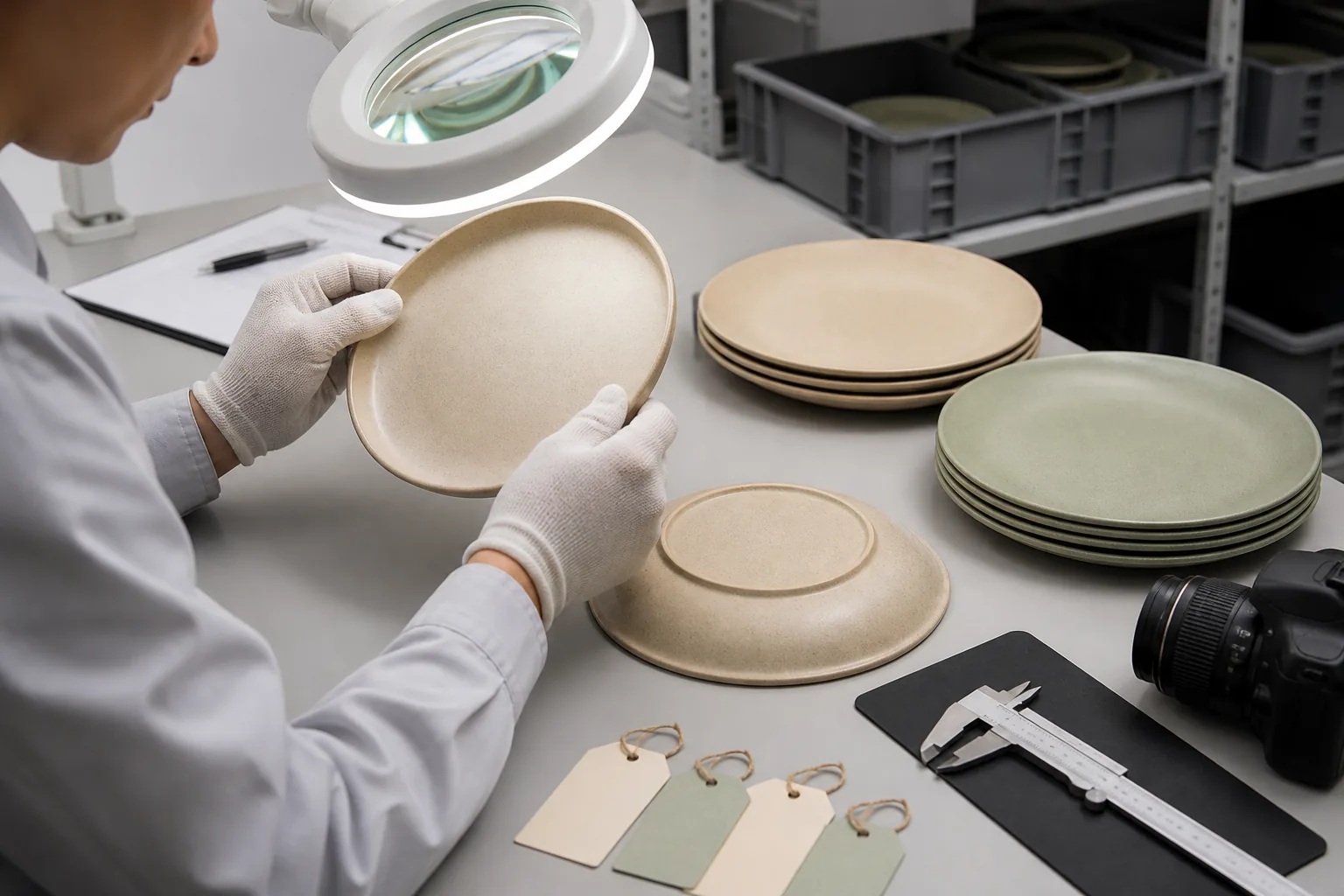
A binary “pass if not broken” rule misses important damage. Inspect for full separation, loose fragments, sharp points or edges, through-cracks, rim cracks, whitening, delamination, exposed rough areas, permanent warpage, rocking bases, damaged handles and loss of lid or stacking function. Photograph all sides before and after testing under consistent lighting.
Safety-related defects should be separated from cosmetic and functional defects. A minor surface mark may be commercially acceptable while a small sharp crack is not. Define measurement tools and judgment standards in advance so the supplier and buyer do not negotiate severity after a failure appears.
When food-contact surfaces are damaged, decide whether additional evaluation is necessary. An impact protocol does not itself determine migration, hygiene or long-term particle release. Keep mechanical, food-contact and cleaning evidence in connected but distinct sections of the technical file.
Step 7: test nesting and set-level interactions
Commercial tableware is often shipped and used as a stack. Nested rims can rub, lock or transfer impact loads through several pieces. Test the intended stack count, orientation, separators and storage method rather than assuming the single-article result predicts a complete set.
For restaurant, hotel, school and rental programs, repeated stacking may create small pre-damage before a drop occurs. A scenario test can condition products through defined stacking, trolley movement or washing steps and then apply the impact sequence. The protocol should keep these actions repeatable and clearly distinguish them from formal standards.
Replacement compatibility matters for operational buyers. After testing, verify that surviving pieces still nest, stand level and fit lids or racks where applicable. A product that remains intact but no longer works in the system may still be a procurement failure.
Need a SKU-specific impact test matrix?
Send Naike Dinner the plate, bowl, cup or tray dimensions, intended users, service environment, packaging configuration and target market. We can organize the sample variants and decision points that your laboratory or quality team should confirm.
Request an impact test matrixStep 8: validate retail and transport packaging separately
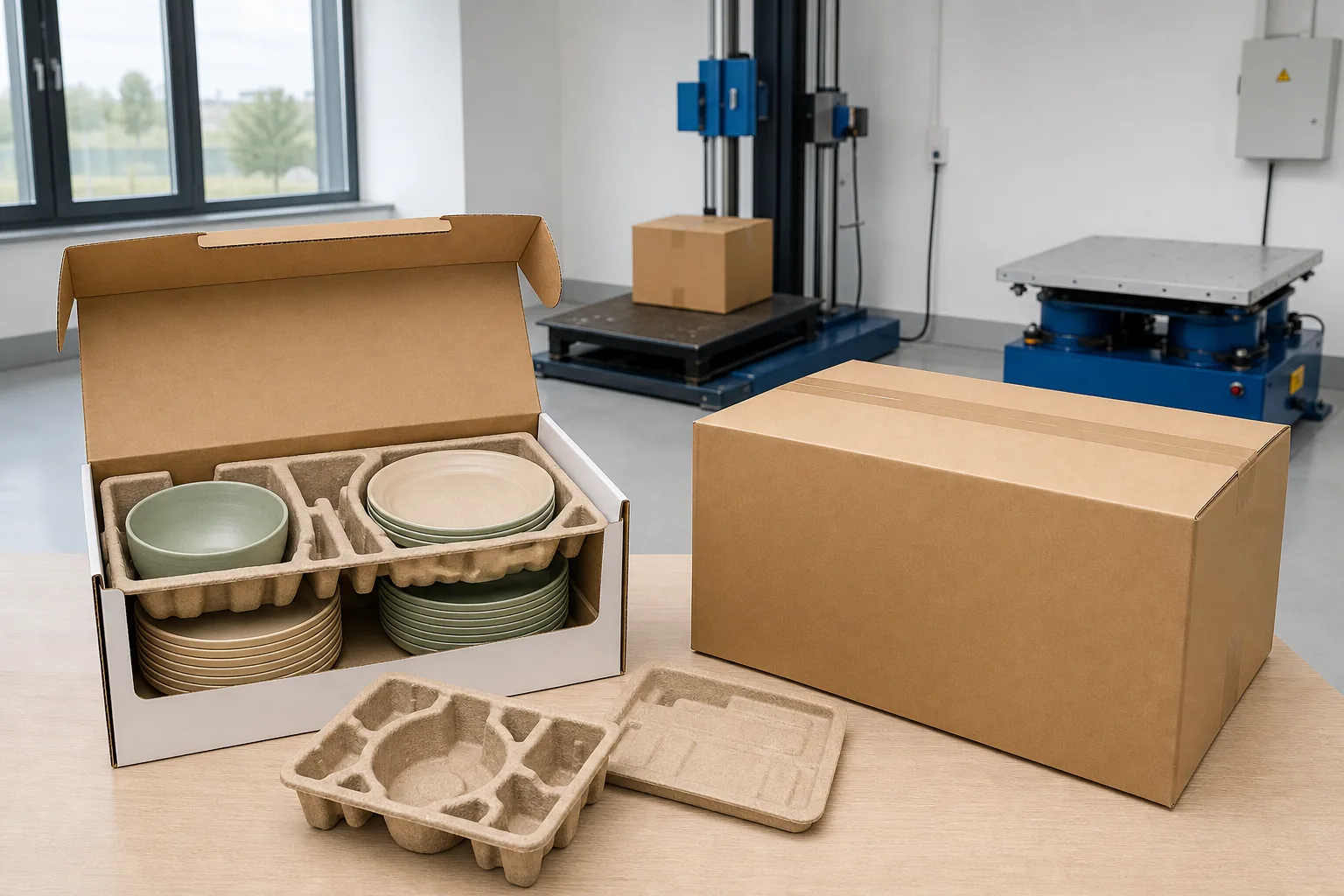
A consumer-use drop test does not prove the shipping carton protects its contents. Distribution testing evaluates the complete filled package or unit load, including retail boxes, sleeves, dividers, bags, inner cartons, master cartons and pallet configuration. The packaged product must be tested in the configuration that will actually move through the channel.
ASTM D5276-19 addresses drop testing of loaded containers to evaluate container shock resistance or the protection provided to contents during free-fall impact. Buyers must obtain and follow the applicable full standard, specify the complete filled package and agree the distribution sequence; this article is not a substitute for the controlled procedure.
Distribution hazards also include vibration and compression. ASTM lists D999-08(2023) for vibration testing of filled shipping containers and D642-20 for compressive resistance of shipping containers, components and unit loads. A drop-only carton approval can miss abrasion, settling, resonance, nested movement and stacking damage.
How to build a packaging validation sequence
Map the actual channel first: factory handling, export carton, palletization, container movement, destination warehouse, parcel carrier, retailer and consumer delivery. Select conditioning and hazards that represent that route. E-commerce parcel distribution may need a different program from palletized store replenishment.
Record pack quantity, nesting pattern, divider material, bag, retail pack, carton dimensions, gross mass, closure, pallet pattern and corner protection. If the supplier later reduces a divider, changes a carton grade or increases pack count, evaluate whether the previous result remains applicable.
Open cartons systematically after testing. Count and classify damage by SKU and position, inspect hidden nested surfaces and verify retail presentation. A master carton may remain externally acceptable while internal pieces rub, deform or crack.
Set acceptance rules that connect testing to the purchase order
The approved protocol should identify pre-production confirmation, golden samples, first-article checks and routine lot controls. Not every shipment needs a full development program, but the purchase agreement should state which quick checks are performed, how samples are selected and when full revalidation is triggered.
Define the lot disposition path before production. A failed sample may require containment, additional sampling, engineering review, root-cause analysis or rejection depending on defect severity and the agreed plan. Avoid automatic retesting until a pass appears; document why any retest is valid.
Connect impact defects to the inspection plan. Our AQL tableware inspection guide explains why random lot inspection and engineering validation answer different questions. AQL sampling can classify visible defects in a shipment, while a product-validation test demonstrates performance under a defined protocol.
Investigate failures without guessing at the cause
Start with failure location and pattern. Repeated cracking at the same gate, rib junction, rim section or handle root may point toward geometry or process concentration; random damage only in certain carton positions may point toward packaging or handling. These are investigation hypotheses, not automatic conclusions.
Compare retained samples, production records, material lots, cavity data, weights and dimensions. Review drying, mixing, molding, cooling and trimming records within the agreed disclosure scope. If the formulation or mold changed, do not assume earlier approvals remain representative.
Corrective action should address the verified cause and include confirmation testing. Adding excessive packaging may hide a weak part, while changing the part may create new nesting or food-contact questions. The buyer should approve the change and its revalidation scope before mass production resumes.
Translate results into defensible buyer and consumer claims
Prefer scoped language such as “passed the buyer’s defined finished-product drop protocol” with the report available for qualified review. Avoid “indestructible,” “never breaks” or “guaranteed shatterproof” unless the evidence and legal review support the exact wording. Real use contains surfaces, orientations and prior damage outside any laboratory sequence.
Keep the test date, report version, SKU list and limitations with sales assets. Distributors should not extend a natural-color plate result to every printed cup and tray. Online listings, packaging and customer-service scripts should use the same approved boundary.
Naike Dinner can connect the material, product, packaging and intended application in a project file, but should never invent a passing height or performance result before product-specific testing. Buyers can review our broader quality issue diagnostic guide for odor, color and brittleness checks that sit beside impact validation.
Compare supplier proposals on the same evidence basis
Ask every shortlisted supplier to respond to the same protocol draft and product specification. A quotation that says only “drop test passed” is not comparable with one that identifies SKU, conditioning, surface, orientations, sequence and defect criteria. Normalize those inputs before using impact performance as a sourcing advantage.
Separate evidence already available from work proposed after sample approval. Existing internal checks may help screen a design, while a new third-party report may be needed for a buyer program or market claim. Record who selects specimens, who witnesses testing, who owns the report and whether raw photographs or videos are included.
Do not rank suppliers by the highest advertised drop number alone. A severe single drop on a hand-picked piece can provide less procurement confidence than a moderate, repeatable sequence across representative production samples with clear defect classification. Consistency, traceability and corrective-action discipline are part of the commercial decision.
Build a durable impact-resistance evidence pack
The evidence pack should include the approved product drawing or specification, formulation scope, sample list, conditioning record, signed protocol, equipment identification, raw observations, photographs, defect log, final report, approval decision and any deviation. Give every file a version and connect it to the purchase order or project number.
Retain representative tested and untested samples when practical. If a field complaint later reports a cracked rim or broken handle, retained samples and original photographs help determine whether the complaint resembles the validation failure modes. They also allow a controlled comparison after a material, process or packaging investigation.
Define access and retention responsibilities between brand owner, importer, laboratory and factory. A certificate title without the underlying scope is difficult to defend during an audit or customer inquiry. The useful record shows what was tested, how it was tested, what happened and who accepted the result.
Review the file at planned intervals and after change triggers. Standards may be revised, packaging channels may change, and a retailer may add parcel delivery to a product originally approved for pallet shipment. Updating the test plan is a genuine content and technical change; it should be dated with the real review time rather than silently replacing the earlier decision.
B2B Buyer Checklist for Impact Resistance
| Check | Question | Why It Matters |
|---|---|---|
| Intended use | Where, by whom and over what service life will the SKU be handled? | Defines foreseeable impact hazards. |
| Product identity | Which formulation, color, mold, cavity and batch are represented? | Prevents evidence from drifting to untested variants. |
| Conditioning | Are temperature, moisture, washing and aging steps controlled? | Makes comparison and repetition meaningful. |
| Drop setup | Are height, surface, orientation, release and sequence recorded? | Controls the energy path and failure mode. |
| Defects | Which sharp, structural, functional and cosmetic outcomes fail? | Turns observation into an acceptance decision. |
| Packaging | Are bare article, nested set, retail pack and shipper evaluated separately? | Separates consumer durability from distribution protection. |
| Lot action | What happens after a failure or relevant production change? | Prevents informal retesting and uncontrolled shipment. |
| Claims | Does marketing preserve the tested SKU, conditions and limitations? | Reduces unsupported durability promises. |
Buyer FAQs about tableware impact testing
1. Is there one universal drop height for wheat straw tableware?
No. The buyer should derive severity from intended use, users, surfaces, geometry and consequences of failure. A height copied from another product may be too mild, too severe or irrelevant.
2. Does “unbreakable” mean the product cannot form a sharp crack?
No. The term is vague and can hide unacceptable damage. The protocol should separately classify fragments, cracks, sharp edges, deformation, stability and functional loss.
3. Can a resin impact value replace a finished-product drop test?
No. Standardized material specimens support formulation comparison, but molded geometry and processing affect the commercial article. Use finished-product validation for procurement approval.
4. Should products be tested before or after dishwasher conditioning?
Both groups may be useful when repeated washing is claimed. Define the dishwasher program and cycle count, retain an unconditioned control and limit conclusions to that conditioning sequence.
5. Is a package drop test enough for e-commerce approval?
Not always. Distribution can include vibration, compression and horizontal impact as well as drops. Build the test sequence around the actual shipping channel and complete pack configuration.
6. When must impact testing be repeated?
Review scope after relevant changes to formulation, pigment, geometry, mold, process, factory, pack count, divider or carton. Repeat testing when the technical justification no longer covers the delivered product.
Turn your use scenario into a signed acceptance protocol
Send Naike Dinner the target SKU list, users, likely drop surfaces, conditioning claims, retail pack, shipping route and defect priorities. We can prepare controlled samples and a project-specific decision matrix for your quality team or qualified laboratory, with every test boundary documented before approval.
Request controlled samplesRequest a protocol review