
LFGB Testing for Wheat Straw Dinnerware: What EU Buyers Should Ask Suppliers
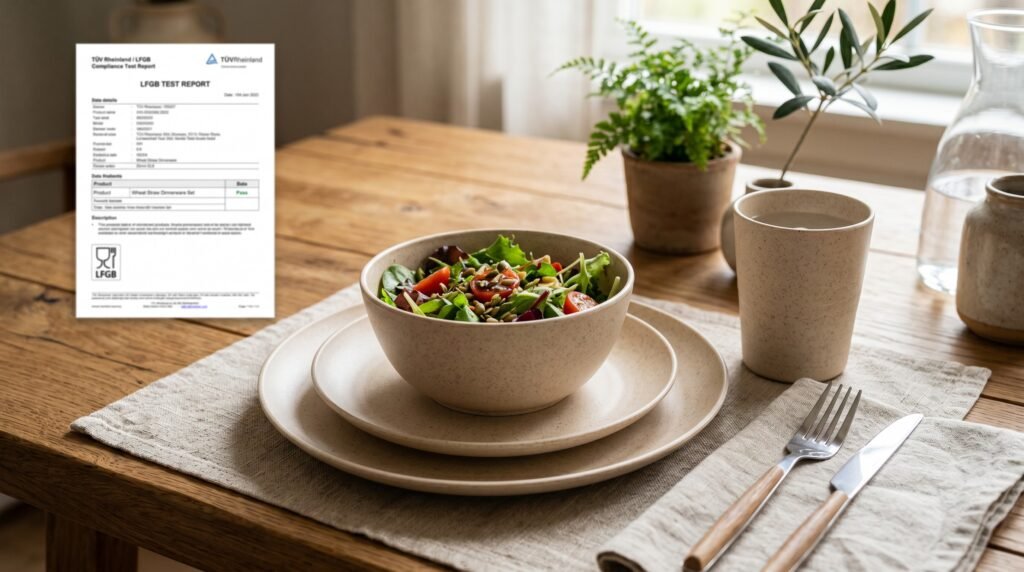
If you are importing wheat straw dinnerware into Europe, here is a fact most suppliers will not volunteer: LFGB Testing for Wheat Straw Dinnerware is not a checkbox. Saying “LFGB passed” on a quotation means nothing if you cannot read and verify the actual test report behind it.
At Naike Dinner, we talk to B2B buyers every day — importers, distributors, Amazon FBA sellers, retail chains, hospitality groups, promotional product companies, and private-label brands. The most common compliance mistake we see is not a failed test. It is accepting a supplier’s one-line claim without checking what the report actually covers.
This guide explains LFGB Testing for Wheat Straw Dinnerware from a buyer’s perspective: what the tests are, which questions expose weak compliance, and how to make sure the report in your hand protects your shipment — not just your supplier’s quotation.
What LFGB Testing for Wheat Straw Dinnerware Actually Means
LFGB stands for Lebensmittel-, Bedarfsgegenstände- und Futtermittelgesetzbuch — the German Food and Feed Code. In the tableware trade, LFGB Testing for Wheat Straw Dinnerware refers to a set of laboratory evaluations that verify a product does not transfer harmful substances into food and does not change food taste or odor during normal use.
LFGB is not a certification program. No government body issues an “LFGB certificate.” What you receive from an accredited lab is an LFGB test report — a document that shows whether your product passed the required migration and sensory tests under defined conditions.
So why does a German regulation matter for the whole EU?
Because German retailers — Aldi, Lidl, Kaufland, Rossmann, DM, and hundreds of mid-market chains — almost universally require LFGB-compliant test reports during vendor onboarding. Once your wheat straw dinnerware clears LFGB, it typically satisfies EU Framework Regulation (EC) No 1935/2004 and EU Regulation 10/2011 on plastic food contact materials. In practice, LFGB compliance is the de facto standard for tableware entering any EU market.
If your product also ships to the United States, FDA requirements are separate. We covered those in detail in our FDA Food Contact Requirements for Wheat Straw Tableware guide — the testing frameworks differ, and you need both for multi-market distribution.
The Material Reality Behind LFGB Testing for Wheat Straw Dinnerware
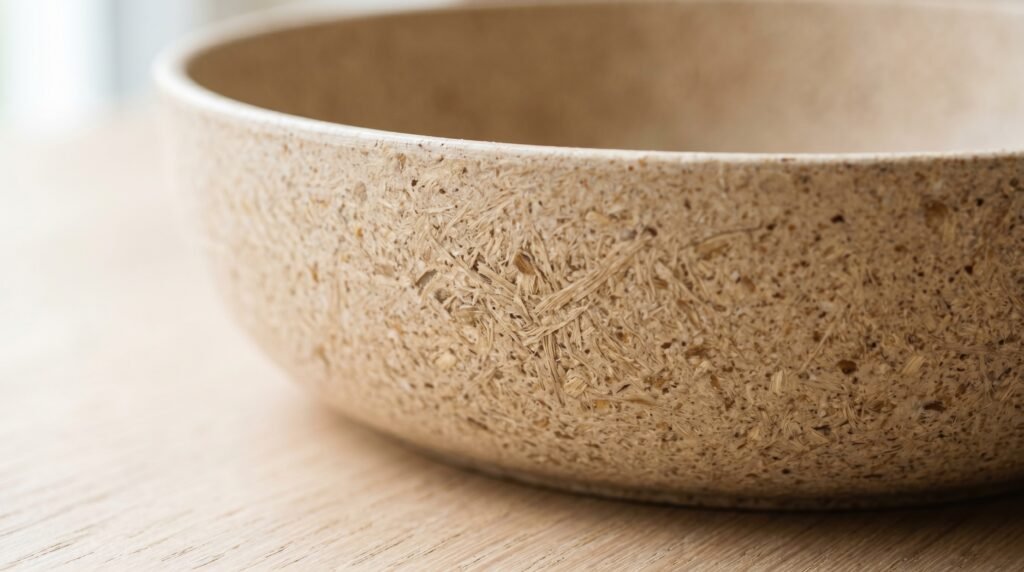
LFGB Testing for Wheat Straw Dinnerware cannot be understood without understanding what the product is made of.
Wheat straw dinnerware is a composite. There is no plate made from 100% wheat straw fiber — the natural fiber needs a binder to hold shape, resist heat, and survive repeated use. That binder determines your LFGB risk profile more than anything else.
Two Binder Paths, Two Very Different Compliance Stories
| Binder Type | Common Name | LFGB Risk Level | Typical Use |
|---|---|---|---|
| Food-grade PP (Polypropylene) | Wheat straw + PP composite | Low — well-understood, stable migration profile | Premium reusable dinnerware, baby products, microwave-safe items |
| Melamine-formaldehyde resin | Melamine bamboo / wheat straw composite | High — formaldehyde and melamine migration risk | Low-cost items, short-life promotional products |
The European Commission specifically flagged plant-fiber composites using melamine resin as a food safety concern in 2021. Under heat or acidic food contact — tomato sauce, lemon juice, hot soup — melamine and formaldehyde can migrate into food at levels exceeding the Specific Migration Limit (SML) of 2.5 mg/kg for melamine.
Practical takeaway: When a supplier hands you an LFGB report, the first line you check is the binder. If it says melamine-formaldehyde resin and you are importing for EU retail, you are carrying unnecessary risk — even if the current numbers pass.
We explored the chemistry behind this in our Composite Tableware Chemical Testing guide. If you are comparing supplier material specs, that article covers what BPA-free does and does not prove.
The 5 Tests Every LFGB Report Must Include
A legitimate LFGB Testing for Wheat Straw Dinnerware report is typically 6 to 12 pages. If your supplier hands you a one-page summary with a green checkmark, that is almost always a factory-internal inspection sheet — not an independent lab report.
Here are the five tests a real report covers.
1. Overall Migration Test
This is the baseline. The lab exposes your product to food simulants — distilled water, 3% acetic acid, 10% ethanol, and olive oil or an alternative fatty simulant — under standardized time and temperature conditions that simulate actual use.
Pass threshold: Total migration ≤ 10 mg/dm² (per EU 10/2011).
For reusable dinnerware, the test must run across three consecutive migration cycles, not one. A single-cycle result on a product meant for repeated use is incomplete.
2. Specific Migration — Melamine
The test that separates compliant wheat straw dinnerware from products that will get pulled from shelves.
Pass threshold: Melamine migration ≤ 2.5 mg/kg food simulant.
Ask which simulant was used. The 3% acetic acid simulant — representing acidic foods — is the most aggressive and most likely to trigger a failure. If the report only shows migration in distilled water, you do not have the full picture.
3. Specific Migration — Formaldehyde
Formaldehyde is a residual monomer from melamine-formaldehyde resins and certain processing aids. This is particularly important for products marketed as microwave-safe, because heat accelerates formaldehyde release.
Pass threshold: Formaldehyde migration ≤ 15 mg/kg (per EU 10/2011 SML).
4. Sensory Test — Odor
This is a distinctive LFGB requirement that FDA does not include. Trained sensory panelists evaluate whether the product imparts any detectable odor to food after contact.
Even if every chemical number passes, an odor failure means the product is not LFGB-compliant. We have seen products fail this test from residual processing chemicals or low-grade colorants — issues unrelated to the wheat straw fiber itself.
5. Sensory Test — Taste
Same principle as the odor test, but panelists evaluate whether food tastes different after contact. Taste failures are rarer than odor failures, but they happen — particularly with darker-colored products where pigment migration can subtly affect food flavor.
Bonus: Heavy Metals & Primary Aromatic Amines (PAAs)
For colored or printed wheat straw dinnerware, the LFGB report should also address:
- Heavy metals: Lead (Pb), Cadmium (Cd), Mercury (Hg), Hexavalent Chromium (Cr VI)
- Primary Aromatic Amines (PAAs): Migration limit ≤ 0.01 mg/kg — these can come from certain azo dyes used in colored plastics

10 Questions to Ask Before You Accept an LFGB Report
This is the supplier audit checklist we recommend every EU buyer use. If your supplier answers all ten clearly, you are in good hands.
Material Questions
1. “What is the exact binder-to-fiber ratio in this product?”
A quality wheat straw dinnerware formula typically has 30–50% natural wheat straw fiber, with the balance being food-grade PP and a small percentage of processing aids. If a supplier cannot or will not give you this ratio, they may not control their material formulation.
2. “Is the binder food-grade PP or melamine-formaldehyde resin?”
This is the single most important question for LFGB Testing for Wheat Straw Dinnerware. If the answer is melamine, ask for migration data in 3% acetic acid at 70°C for 2 hours — the worst-case scenario for hot acidic food. No data, no order.
Testing & Documentation Questions
3. “Can you share the full LFGB test report, not just the summary page?”
A legitimate report includes: test methodology, simulant types, temperature and time conditions, individual migration values, and the lab’s ISO 17025 accreditation number. A one-page summary is not enough.
4. “Which accredited lab performed the testing?”
Reputable LFGB labs include: TÜV Rheinland, TÜV SÜD, SGS, Intertek, Bureau Veritas, and Eurofins. If the report is not from a recognized ISO 17025-accredited lab, treat it as unverified.
5. “When was this report issued, and does it cover the exact SKU I am ordering?”
Reports older than 2 years are stale — material formulations change. A report for a wheat straw bowl does not automatically apply to a wheat straw plate. Different shapes, wall thicknesses, and surface-area-to-volume ratios affect migration behavior. Each SKU should have its own report or a technically justified extension.
6. “Were the test samples drawn from regular production or specially prepared?”
Some factories submit “golden samples” — specially prepared units with different material composition — for testing. Ask for a batch traceability number on the report. Better yet, include a random sampling clause in your purchase agreement.
Production & QC Questions
7. “Do you run in-house migration checks between certification cycles?”
Annual LFGB recertification is good, but batch-level QC matters more. A factory that runs internal overall migration spot-checks on every 2–3 production batches has far better process control than one that only tests once a year.
8. “What is your raw material traceability system?”
If the PP resin supplier changes, or the wheat straw fiber source switches regions, your migration profile can shift. A serious supplier traces any finished product to its raw material batch within 24 hours.
Business Protection Questions
9. “Will you include LFGB compliance as a contractually binding specification?”
Your purchase agreement should state: “Products must comply with LFGB §30 and §31, EU Regulation 1935/2004, and EU Regulation 10/2011. Supplier shall provide a valid third-party LFGB test report for each SKU, issued within 12 months of shipment date.” A WhatsApp promise is not a contract.
10. “What happens if my independent third-party test shows a failure?”
A legitimate manufacturer answers: return and replacement, shipping costs covered, root cause analysis within 30 days. If the supplier deflects, blames the lab, or offers a small discount “to make it right” — find another partner.
7 Red Flags That Expose a Weak LFGB Report
We see these in buyer conversations all the time. If your supplier’s report shows any of these, ask harder questions.
| Red Flag | Why It Matters |
|---|---|
| Report only shows overall migration — no specific migration | Melamine and formaldehyde are not tested |
| Test simulant is only distilled water | No simulation of acidic or fatty foods |
| Test temperature is 40°C or below | Most dinnerware contacts hot food — 70°C is the standard |
| No lab accreditation logo or number | Could be self-issued or from an unaccredited facility |
| Report date is more than 2 years old | Material sourcing and formulation may have changed |
| Report does not list the specific product model/SKU | Generic report that could apply to anything |
| Supplier refuses to share the full report | Legitimate factories are transparent |
LFGB vs. FDA: What Changes for Multi-Market Buyers
If you distribute to both the EU and the US, LFGB Testing for Wheat Straw Dinnerware and FDA compliance are separate workstreams. Here is the practical comparison:
| Dimension | LFGB (EU / Germany) | FDA (USA) |
|---|---|---|
| Sensory testing (odor/taste) | Required | Not required |
| Overall migration limit | ≤ 10 mg/dm² | No equivalent OML for most materials |
| Melamine SML | 2.5 mg/kg | No specific federal SML (indirect additive regulation) |
| Reusable product testing cycles | 3 consecutive cycles | Typically single extraction |
| Lab accreditation expectation | ISO 17025 expected by retailers | Varies by product category |
For U.S.-specific requirements, read our FDA Food Contact Requirements for Wheat Straw Tableware guide. It walks through the 7 essential checks for the American market.
How Naike Dinner Handles LFGB Testing for Wheat Straw Dinnerware
We want to be transparent about how we manage this, because the standard we describe here is the standard we meet ourselves.
Material Is Locked
We use food-grade virgin PP as the binder, with no melamine-formaldehyde resins in any food-contact product. Wheat straw fiber content is verified by incoming inspection before each production run. If you are comparing suppliers, this is the first and most important specification to confirm.
Testing Is Per-SKU, Not Per-Factory
Every product model that ships to EU customers carries its own LFGB test report from an ISO 17025-accredited third-party lab. We primarily work with SGS and TÜV Rheinland. Reports are refreshed annually and shared in full — not just the cover page.
Batch-Level QC Exists
Between annual certification cycles, our QC team runs internal overall migration spot-checks using standardized simulants and conditions. It does not replace third-party testing, but it catches process drift before it becomes a shipment-level problem.
Traceability Is Built In
Every finished product traces to its raw material batch — PP resin lot, wheat straw fiber source, and colorant batch — within one working day. If a question comes up six months after delivery, we can answer it.
We Support Your Compliance, Not Just Your Order
Whether you are launching a private-label dinnerware line, restocking for EU retail shelves, or entering a new European market for the first time, we can walk you through our documentation, help you understand what each test covers, and match the right product to your regulatory requirements.
If you are also sourcing for the U.S. market, our FDA Food Contact Requirements for Wheat Straw Tableware guide covers the separate testing framework you will need.
Ready to Source LFGB-Compliant Wheat Straw Dinnerware?
LFGB Testing for Wheat Straw Dinnerware does not need to be a headache. You do not need to become a food-contact-materials scientist. You just need a supplier who treats compliance documentation as seriously as you do — and who can answer all ten questions on the checklist above without hesitation.
If you have questions about LFGB compliance for a specific product, want to benchmark our documentation against what you are seeing from other suppliers, or are ready to request samples for your next EU project, reach out. Our team typically provides a compliance overview within one business day.
👉 Contact Naike Dinner — Request LFGB Documentation & Samples
👉 Browse Wheat Straw Dinnerware Collection
👉 Read: Composite Tableware Chemical Testing — Why BPA-Free Is Not Enough
👉 Read: How to Import Wheat Straw Tableware from China — Complete 2026 Guide
👉 Read: FDA Food Contact Requirements for Wheat Straw Tableware
CONTACT US
Shared Serving Pieces vs Individual Place Settings for Group Camping
A procurement framework for deciding which camping dinnerware components should be issued per person and which should remain shared across a group.
How to Prevent Rattle in a Nested Camping Dinnerware Set
A practical diagnostic for finding and controlling movement, impact and rubbing inside nested camping dinnerware sets without hiding problems behind unsupported claims.
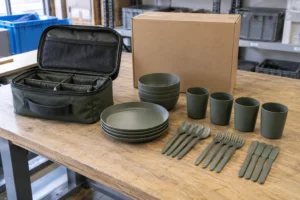
How to Calculate Pack Volume for Camping Tableware
A practical procurement worksheet for measuring the complete camping tableware sales unit, calculating its external cube and separating real pack efficiency from unsupported freight claims.
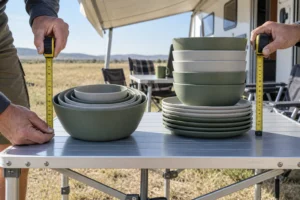
Nesting vs Stacking: How the Two Designs Change Pack-Out
A buyer-focused geometry and pack-out comparison for choosing nested, stacked or hybrid camping dinnerware systems without confusing compact appearance with approved performance.
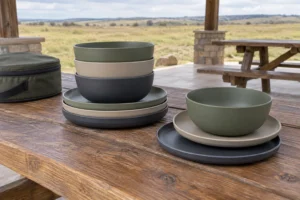
What Makes Camping Dinnerware Truly Stackable?
A procurement acceptance framework for reviewing stack rise, contact interfaces, separation, stability, mixed-component order, drainage and retained pack-out.
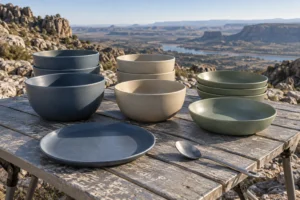
Deep Bowls vs Shallow Bowls for Outdoor Meal Sets
A procurement decision table for selecting deep and shallow camping bowl profiles by meal function, user access, stability, cleaning and packed-set architecture.