
Does wheat straw tableware release microplastics? The material name alone cannot answer that question. Wheat straw composite tableware normally contains plant fiber within a polymer matrix, and particle release can depend on formulation, surface finish, heat, abrasion, washing, ageing and test method. Buyers need product-specific, contamination-controlled evidence before making a “no release” claim.
What counts as a microplastic in this buyer question?
Definitions are still evolving across science and policy. The European Food Safety Authority’s current microplastics and nanoplastics topic page describes microplastics as plastic particles between 1 micrometre and 5 millimetres and nanoplastics as smaller particles from 1 to 1,000 nanometres. A laboratory report should state the definition and size range it can actually observe.
A wheat straw composite article contains agricultural fiber and a polymer binder or matrix. A visible beige fiber fragment is not automatically a microplastic, while a polymer-containing fragment may require chemical identification rather than visual judgment. The buyer should separate total particles, suspected plastic particles, confirmed polymer particles, fibers and non-plastic organic material.
This is why material composition matters. Our wheat straw composite material guide explains the difference between the plant fraction and the binding phase. “Made with wheat straw” does not mean polymer-free, and “composite” does not prove any particular release rate.
Nanoplastics create an additional measurement challenge because many routine particle-counting methods cannot reliably detect or characterize them. A report limited to particles above a stated size must not be paraphrased as evidence that no smaller particles exist. The detection window belongs in the conclusion, not only in a laboratory appendix.
Does wheat straw tableware release microplastics? Seven evidence checks
| Evidence check | Buyer should verify | Why it changes the answer |
|---|---|---|
| 1. Product identity | SKU, color, formulation, factory, batch and surface configuration. | Different inputs and finishes may age differently. |
| 2. Use scenario | Food type, temperature, contact time, washing, utensils and cycle count. | Release under one condition cannot represent every use. |
| 3. Particle definition | Size window, shape categories and polymer confirmation rule. | “Particle” and “microplastic” are not interchangeable. |
| 4. Contamination control | Field, equipment and procedural blanks plus covered samples. | Airborne fibers and laboratory plastics can create false signals. |
| 5. Analytical method | Collection, digestion, filtration, imaging and spectroscopy details. | Methods recover and identify different particles. |
| 6. Reporting basis | Particles per item, area, volume or cycle; uncertainty and detection limit. | Results cannot be compared without consistent units. |
| 7. Claim boundary | Exact wording, market, product variants and revalidation triggers. | A narrow test should not support a universal promise. |
The conclusion table is deliberately method-first. Published studies may report very different numbers because they use different vessels, filters, digestion procedures, microscopes, size cutoffs and polymer-confirmation steps. Buyers should compare methods before comparing counts.
What does current health evidence actually say?
The US Food and Drug Administration states on its microplastics and nanoplastics in foods page that important research gaps remain. FDA notes the lack of standardized definitions, reference materials, sample preparation procedures and quality controls, and says current science is limited in its ability to support regulatory risk assessment.
FDA also states that the overall scientific evidence does not currently demonstrate that levels found in foods pose a risk to human health, while continuing to monitor the issue. That is not the same as proving every product or exposure harmless. It is a current evidence statement that should be quoted with its uncertainty and updated when authorities publish new conclusions.
The World Health Organization’s review of dietary and inhalation exposure to micro- and nanoplastics likewise identifies major uncertainties and research needs. It considers particles, polymers, monomers, additives, adsorbed contaminants and biofilms as distinct aspects of potential concern. A tableware procurement file should therefore avoid turning one particle count into a complete toxicological assessment.
EFSA is developing an updated scientific opinion and highlights limited knowledge about dietary exposure, absorption, hazards and health effects, particularly for nanoplastics. The defensible B2B position is neither alarmist nor dismissive: identify the product-specific evidence, describe limitations and avoid safety conclusions that the cited authority has not made.
Which use conditions could influence particle release?
Mechanical wear is an obvious variable. Cutting, scraping, stacking, transport vibration and rough cleaning can alter a surface over time. The test plan should distinguish normal intended utensils and cleaning tools from deliberately severe abuse, and it should record force, duration, contact geometry and number of cycles where those variables matter.
Temperature and contact time can also affect materials and the release process. A short room-temperature rinse is not representative of repeated hot-food contact, and a single heating event is not a lifetime simulation. Buyers should define realistic high-use conditions without claiming that an accelerated test perfectly reproduces every household or foodservice environment.
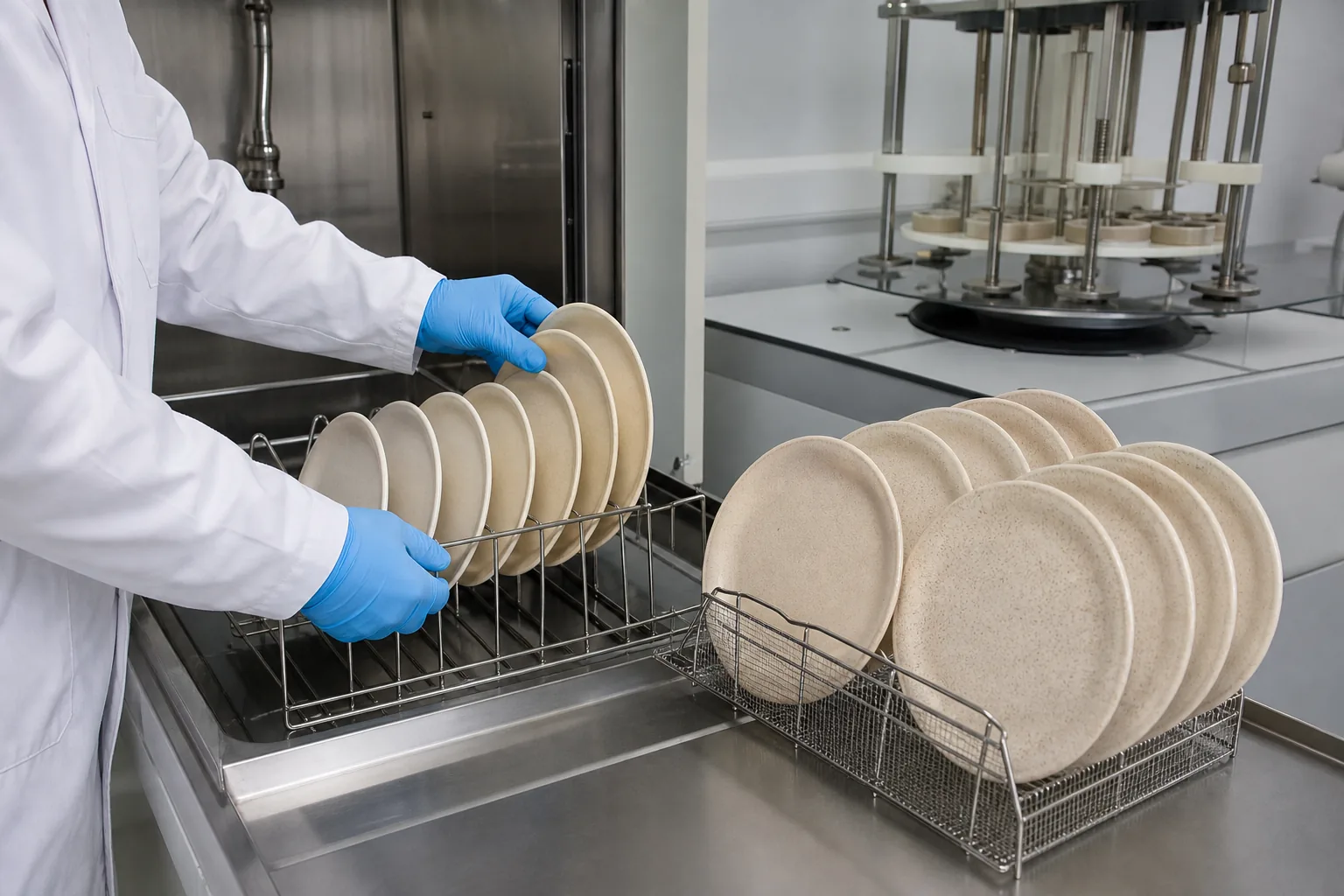
Dishwashing combines water, heat, detergent chemistry, spray action and handling. If the product is marketed for repeated machine washing, specimens should be conditioned through a defined program and inspected at meaningful intervals. Our general food-grade tableware testing guide helps procurement teams keep performance tests, migration evidence and product claims in their correct lanes.
Food composition may influence sample preparation and recovery. Oils, proteins, starches and pigments can interfere with filtration, imaging or spectroscopy and may require validated digestion or cleanup. A water-only test is easier to control, but it cannot automatically represent every food simulant or actual meal.
Ageing begins before consumer use. Molding conditions, trimming, packing abrasion, ultraviolet exposure, storage temperature and transport can affect surface condition. A test should identify whether it uses new production articles, artificially aged specimens, returned items or retained samples, because those populations answer different questions.
Why a normal food-contact migration test is not a microplastic test
Food-contact migration programs commonly measure substances that transfer into a food simulant under defined conditions. Particle-release testing asks about discrete particles, their sizes, shapes, counts and polymer identity. A report for overall or specific migration may be necessary for compliance, but it does not automatically contain a validated microplastic analysis.
The reverse is also true. Detecting or not detecting particles in a particular experiment does not replace the legal assessment of authorized food-contact substances and migration. Buyers should retain both evidence streams rather than presenting one report as a universal certificate.
Read the method pages of every report. A title such as “material safety test” is not enough. Our composite tableware chemical-testing guide shows how to connect a laboratory result to the correct specimen, analytes, conditions and destination market.
When a customer asks whether the product “leaches microplastics,” clarify whether they mean molecular migration, visible wear debris, confirmed microplastic particles or any material loss. The word “leach” is often used loosely, but laboratory design and regulatory interpretation require precise endpoints.
Need a product-specific evidence map?
Send Naike Dinner the SKU, formulation scope, target market, use conditions and proposed claim. We can identify which documents answer composition and migration questions and which particle-release questions require a separate laboratory plan.
Request an evidence reviewHow should a laboratory study be designed?
Start with a written decision question
“Test for microplastics” is too vague. A useful question might ask whether confirmed polymer particles within a stated size range are released above a buyer-defined reporting threshold after a specified sequence of hot-food contact and washing cycles. The laboratory should confirm that the requested endpoint is technically achievable before samples are shipped.
Define the product family carefully. Natural and pigmented versions may use different masterbatch; printed products add another surface system; lids and gaskets may use separate polymers. Either test relevant configurations separately or document why one specimen represents a broader group.
Control contamination from the environment
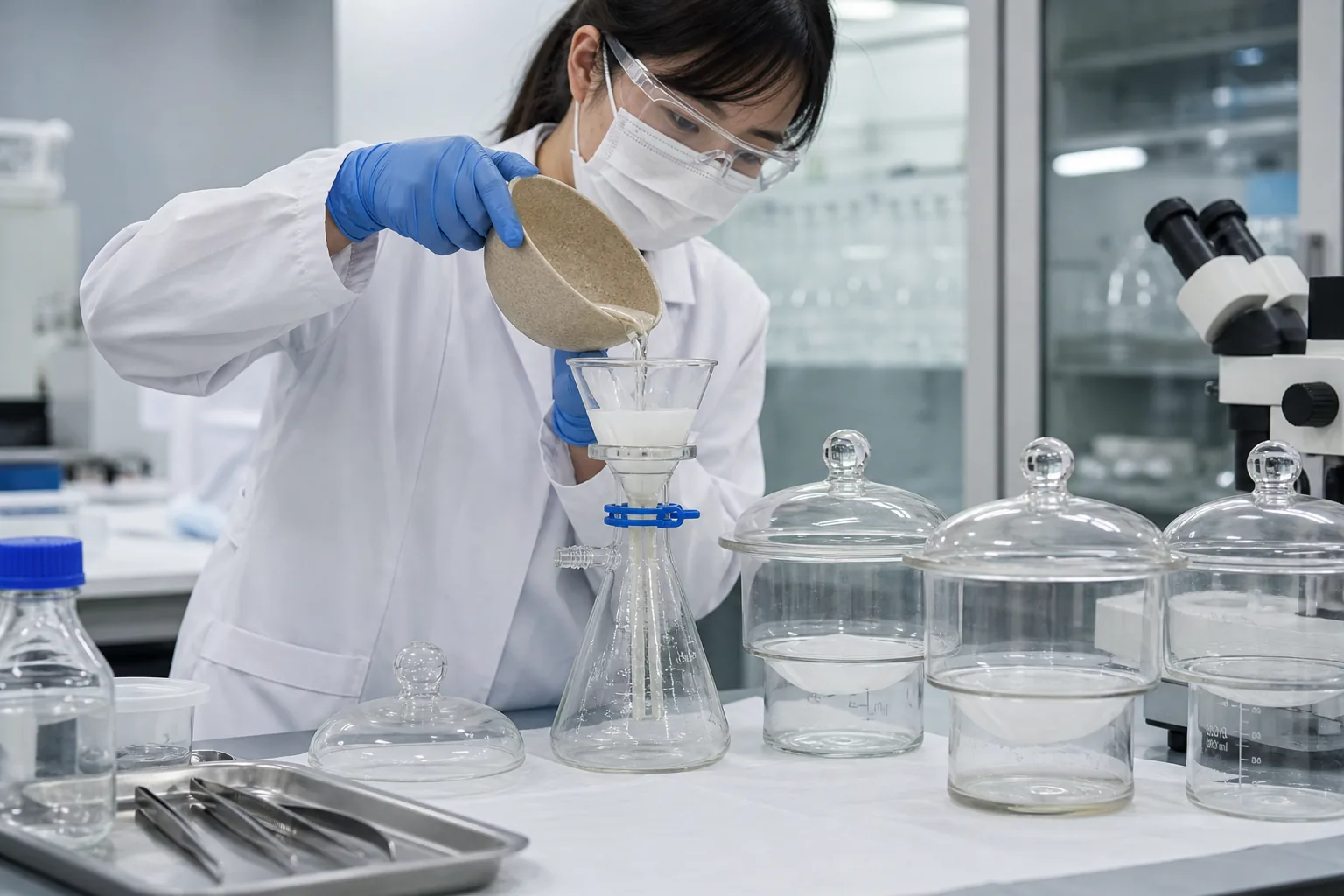
Microplastic analysis is highly vulnerable to contamination. Synthetic laboratory clothing, wipes, tubing, bottle caps, ambient dust and airborne fibers can add particles that did not come from the tableware. Use covered glass or appropriate low-background equipment, filtered reagents and documented cleaning procedures.
Procedural blanks should follow the same preparation steps without the test article. Field or transport blanks may also be relevant. Results should show how blank findings were evaluated or corrected, not simply state that “controls passed.”
Recover and identify particles
Sample collection may use filtration or another capture approach matched to the target size range. Organic material may require cleanup, but digestion must not destroy or alter the polymers being measured. Filter composition and pore size influence what can be retained and what analytical instruments can examine.
Visual microscopy can count suspected particles but cannot always prove polymer identity. Spectroscopic or thermal methods can provide chemical information, with different strengths, particle-size limits and throughput. The report should distinguish screened, suspected and chemically confirmed particles.
Report uncertainty and method limits
State the smallest reliably measured size, recovery information, blanks, false-positive controls, number of replicates and uncertainty where available. A result below the reporting limit is not mathematical zero. It means the method did not report a qualifying signal under the stated conditions.
Raw counts need a denominator. Particles per item, per square centimetre, per litre of contact liquid or per cycle describe different quantities. Retain enough detail to compare future batches using the same design rather than converting results into a context-free marketing number.
How should buyers interpret common report conclusions?
| Report wording | Reasonable interpretation | Overclaim to avoid |
|---|---|---|
| No particles observed above the method threshold | No qualifying particles were observed in that sample and size window. | “The product releases zero microplastics.” |
| Suspected particles counted visually | Morphology-based candidates were counted. | “Every counted object was confirmed plastic.” |
| Named polymer confirmed | The method identified that polymer in qualifying particles. | “All particles and all sources were identified.” |
| Lower count than a comparison item | Under matched methods and conditions, the tested sample had a lower result. | “Safer in every real-world use.” |
| After a defined cycle sequence | The result covers the specified conditioning and collection points. | “Proven for unlimited lifetime use.” |
Comparison studies require especially close method matching. Two laboratories may use different size cutoffs, blank correction, polymer confirmation and reporting units. A smaller published number is not necessarily better evidence if the method ignores a larger part of the particle population.
Buyer specifications should preserve the original report language. Sales teams can state that documentation is available for the tested product and conditions, but should not remove size limits, detection thresholds or sample identity. Qualified wording is a sign of evidence control, not weakness.
What can factories control before testing?
Formulation control is the starting point. The factory should maintain approved resin, fiber, pigments and additive specifications and notify the buyer before relevant changes. Recycled content, if used, must be assessed under the buyer’s program rather than assumed equivalent to a controlled virgin-grade formulation.
Processing consistency affects surface integrity. Drying, mixing, molding temperature, pressure, cycle time, cooling and trimming should remain within controlled ranges established for the product. This article does not assert a Naike Dinner process capability or release result; those require product-specific records and evidence.
Finished goods can be checked for cracks, severe warpage, rough flash, exposed damaged surfaces and other conditions that may indicate poor manufacture or handling. Visual inspection cannot detect microscopic release, but it can keep visibly compromised articles from representing acceptable production.
Packaging should reduce abrasion during transport. Dividers, sleeves, stack geometry and carton loading need to protect food-contact surfaces without adding uncontrolled debris. Retained samples from the inspected batch help investigate later questions about use, shipping or laboratory identity.
Change control is essential. A new resin grade, fiber treatment, pigment, coating, mold finish, trimming method or cleaning instruction may change the relevance of earlier evidence. Revalidation triggers should be written into the buyer-supplier agreement.
How should new and aged products be compared?
A new-article result answers a baseline question, while an aged-article result addresses a defined history of exposure. Both can be useful, but they should not be mixed without clear sample labels and matched blanks. The study should retain specimens from each stage so unexpected changes can be investigated.
Begin with visual and dimensional documentation before conditioning. Photograph the food-contact surface under consistent lighting, record mass if relevant, and note pre-existing fiber texture, gate marks or scratches. These observations do not measure microplastics, but they help identify whether later wear is associated with an obvious change in surface condition.
Conditioning needs a repeatable sequence. Specify contact liquid, temperature, duration, cooling, washing, drying, stacking and utensil actions. If release liquid is collected after several cycles, state whether the vessel was rinsed between cycles and whether the result is cumulative or cycle-specific.
A comparison should use the same sample area, collection volume, filter, instrument settings, size window and blank correction. If an aged sample is processed on a different day, include batch controls that can reveal laboratory drift. A higher or lower count is meaningful only when the analytical uncertainty and recovery support that comparison.
Do not assume that visible wear and confirmed particle release move together in a simple linear pattern. A smooth-looking surface may still produce particles below visual resolution, while an obvious plant-fiber texture may contribute non-plastic organic fragments. Chemical identification and controlled blanks remain central.
How do household, foodservice and retail scenarios differ?
Household reusable sets
Household use can involve varied foods, hand washing, domestic dishwashers and different utensils. A buyer may choose a representative high-use scenario and clearly limit the claim to that program. Instructions for use should match the tested temperature, cleaning and damage-inspection boundaries.
Consumer replacement behavior also matters. Articles with deep cuts, cracks, rough edges or permanent deformation should not be treated as normal-condition specimens indefinitely. A study can evaluate defined wear, but it cannot predict every misuse or end-of-life condition.
Restaurant and hotel operations
Foodservice programs may expose tableware to standardized commercial machines, stronger detergents, rapid stacking and repeated daily handling. The buyer should collect actual machine program, detergent, rack, utensil and service-flow information before setting laboratory cycles. A domestic cycle cannot automatically represent a commercial operation.
Operational inspections can remove visibly damaged pieces and preserve retained samples from new deliveries. This does not replace particle testing, but it connects laboratory evidence with a practical control system. Procurement teams should also define replacement stock and investigation steps before a complaint occurs.
Private-label retail claims
Retailers face an additional communication risk because a short package claim can lose every method qualifier. Legal and compliance teams should approve wording, market scope and evidence retention. If the report covers one natural-color plate, do not extend the statement to printed cups, lids or an entire assortment without technical justification.
Online product pages, distributor catalogs and customer-service scripts should use the same approved language. A retailer can explain that product-specific testing is available on request while preserving the size range, use conditions and report date. Consistency reduces the chance that a cautious laboratory conclusion becomes an absolute marketplace promise.
What should a quotation request include?
A laboratory quotation should name the article, number of specimens, conditioning sequence, collection points, blanks, target size range, filters, cleanup, imaging or spectroscopy, polymer library, reporting units and deliverables. Ask whether the method is validated for the composite matrix and whether recovery checks use relevant particle types and sizes.
Clarify which work is exploratory and which is intended for a buyer acceptance decision. Exploratory screening can identify practical problems before a formal study, but it may use a smaller sample set or broader uncertainty. A final report should preserve raw counts, confirmed identities, blank findings, photographs and calculation rules.
Request a timeline only after the laboratory confirms method scope and instrument availability. Naike Dinner should not invent a universal price or lead time for this emerging analysis. Costs can change with replicate count, size cutoff, spectroscopy workload, nanoplastic scope and the number of use conditions.
Define what happens if blanks are high, recovery is poor or the method cannot distinguish wheat fiber from the polymer matrix. The protocol may require repeating preparation, changing equipment or reporting the result as inconclusive. An honest inconclusive result is preferable to a confident claim built on contaminated controls.
How should the evidence be stored and updated?
Keep the approved protocol, laboratory quotation, chain of custody, product specification, batch record, photographs, raw data where available, final report and claim approval together. The file should show who selected samples and whether they were production goods, pilot parts or consumer-used articles.
Record the exact report version referenced by packaging and sales material. If a laboratory issues an amendment, withdraw superseded marketing evidence and update the approval record. Reports should not circulate as anonymous PDFs detached from sample identity and limitations.
Review the file on a risk-based schedule and whenever a trigger occurs. Regulatory definitions, analytical methods and official health assessments are developing rapidly, so a claim approved today may require narrower wording or stronger evidence later. Assign an owner to monitor relevant FDA, EFSA, WHO and destination-market updates.
Supplier audits should verify change-control practice rather than demand unsupported zero-release declarations. Confirm that approved inputs are used, relevant production changes are recorded, retained samples are available and complaints can be traced to a batch. These controls make future testing and investigation more reliable.
B2B Microplastic Evidence Buyer Checklist
| Check | Question | Why It Matters |
|---|---|---|
| Composition | Which fiber, polymer, pigments, additives and surface systems are in scope? | Defines possible particle identities and product variants. |
| Use claim | Which temperatures, foods, utensils, washing and cycle counts are claimed? | Connects testing to realistic application. |
| Size window | What minimum and maximum particle sizes can the method report? | Prevents a limited method from becoming a zero-release claim. |
| Blanks | Are procedural, equipment and environmental controls documented? | Reduces false signals from laboratory contamination. |
| Identification | Are particles only visual candidates or chemically confirmed polymers? | Separates debris counts from microplastic evidence. |
| Units | Are counts normalized per item, area, liquid volume or cycle? | Makes results interpretable and comparable. |
| Traceability | Can specimens be tied to SKU, color, batch, factory and date? | Connects evidence to commercial goods. |
| Change control | Which input or process changes trigger review or retesting? | Keeps evidence current after production changes. |
Buyer FAQs about wheat straw tableware and microplastics
1. Is wheat straw tableware plastic-free?
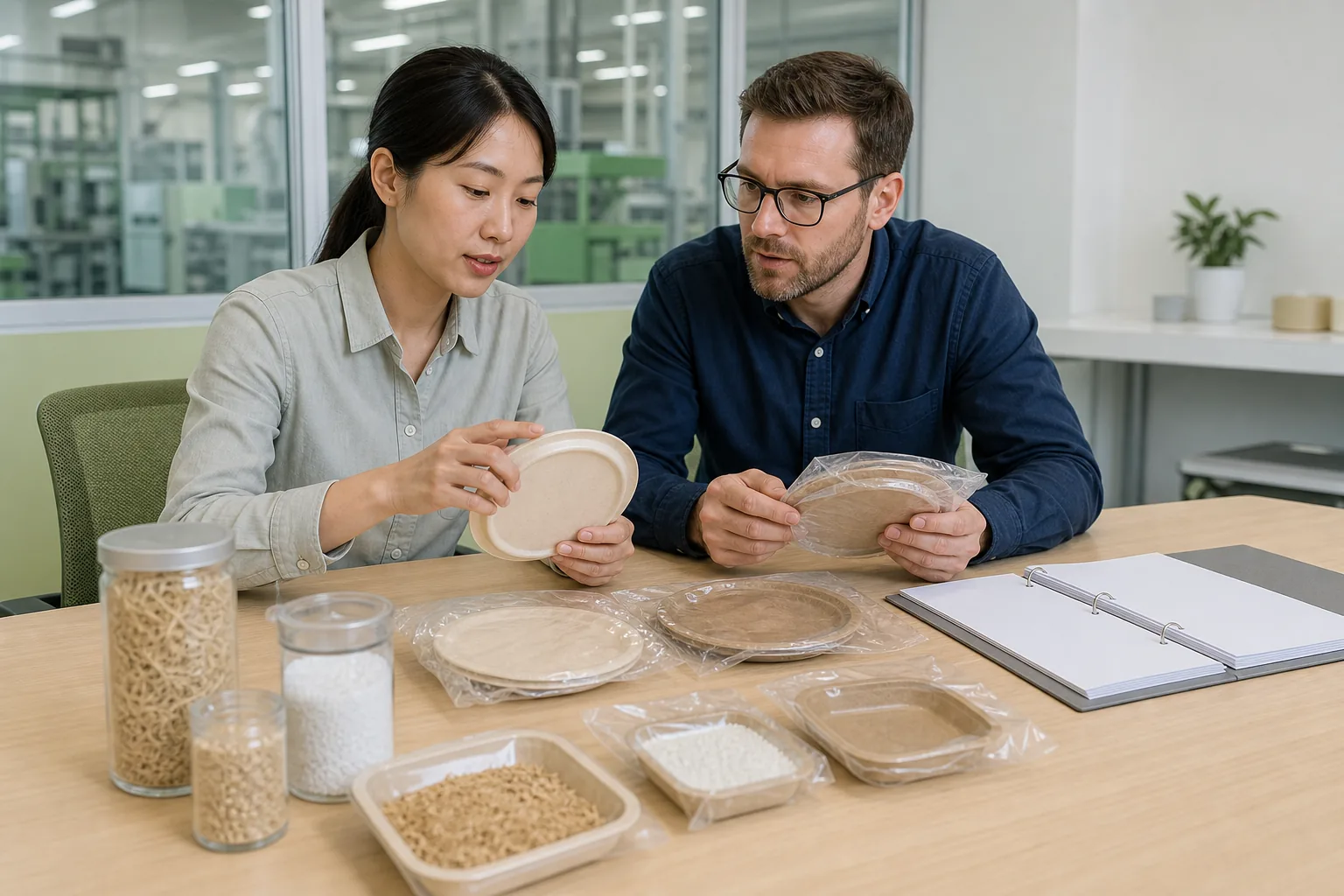
Not necessarily. Many reusable wheat straw products are composites that combine plant fiber with a polymer matrix. Buyers should request the actual formulation scope rather than infer it from the product name.
2. Does a food-contact certificate prove no microplastic release?
No. A conventional migration report may address chemical substances under specified conditions but not particle count, size and polymer identity. Check the methods and endpoints shown in the report.
3. Can one washing test prove lifetime performance?
No. It describes only the selected program, detergent, temperature, handling and number of cycles. Lifetime claims require a justified use model, intervals and product-specific evidence.
4. Does “not detected” mean zero particles?
No. It means no qualifying result was reported within the method’s scope and limits. Smaller particles, unmeasured polymers or conditions outside the test remain unanswered.
5. Can visual microscopy confirm microplastics?
It can identify suspected particles by appearance, but chemical confirmation may be needed to establish polymer identity. The report should state which particles were screened and which were confirmed.
6. When should testing be repeated?
Review evidence after relevant changes to polymer, fiber treatment, pigment, additives, coating, mold surface, process, factory, use claim or test standard. Also reconsider scope when authorities update definitions or methods.
Request a defensible particle-release test plan
Send Naike Dinner your target SKU, material configuration, market, intended temperatures, washing cycles, utensils, particle-size question and proposed claim. We can organize the product evidence, define representative samples and prepare questions for a qualified third-party laboratory—without promising a result before testing.
Request a test-plan reviewAsk for controlled samples