
AQL inspection for wheat straw tableware should be defined before production, not improvised at shipment. Buyers must specify the lot, inspection standard and edition, level, sampling plan, critical/major/minor defect definitions, acceptance numbers, test methods and release authority. AQL is a statistical acceptance tool; it does not guarantee that an accepted lot contains no defects.
Seven decisions for AQL inspection for wheat straw tableware
| Decision | Buyer must define | Risk if omitted |
|---|---|---|
| 1. Lot | SKU, color, batch, factory, quantity and completion status. | Samples may represent the wrong population. |
| 2. Standard | Named standard, edition and single/double/multiple plan. | Buyer and inspector can calculate different sample sizes. |
| 3. Inspection level | General or special level and normal/tightened/reduced state. | Inspection effort becomes arbitrary. |
| 4. Defect taxonomy | Critical, major and minor examples tied to approved samples. | The same flaw may be counted differently. |
| 5. Acceptance rule | AQL or other index plus acceptance/rejection numbers for each class. | “Pass” has no contractual basis. |
| 6. Test protocol | Methods, tools, conditions, units and component coverage. | Visual opinions replace repeatable evidence. |
| 7. Disposition | Release, hold, sorting, rework, resampling and reinspection authority. | A failed result causes delay and negotiation at the loading date. |
This sequence matters because AQL is only one layer of a quality agreement. It supplies a statistical decision rule for attribute inspection, while drawings, specifications, approved samples and test procedures define what counts as conforming. A perfect sampling calculation cannot rescue an ambiguous defect list.
Step 1: Choose the correct sampling framework
The current ISO 2859-1:2026 defines AQL-indexed sampling schemes for lot-by-lot inspection by attributes. ISO describes it as a system for a continuing series of lots and includes normal, tightened, reduced and skip-lot concepts. The US National Institute of Standards and Technology’s official overview of lot-acceptance sampling plans independently explains single, double, multiple, sequential and skip-lot approaches and the roles of AQL, producer’s risk and consumer’s risk.
For an isolated lot or a short series where switching rules are not applicable, ISO 2859-2:2020 provides limiting-quality plans for isolated-lot inspection. That is a different purchasing situation, not a substitute table to use whenever a buyer dislikes an ISO 2859-1 result. NIST’s official operating-characteristic curve guidance shows why acceptance probability changes with actual lot quality and the selected plan.
US buyers may use ANSI/ASQ Z1.4 under their quality system. Attribute plans count conforming/nonconforming units or nonconformities, while variables plans use continuous measurements. NIST’s population and sampling guidance emphasizes representativeness, sample size, population variability and desired precision; do not write “international AQL standard” without identifying which controlled document governs.
Naike Dinner and the buyer should not reproduce or reinterpret copyrighted sampling tables in an email. The responsible workflow is to use an authorized copy of the chosen standard, record the lot size and inspection parameters, and let a competent quality professional determine the code letter, sample size and acceptance/rejection criteria from that edition.
Step 2: Define a homogeneous inspection lot
A lot should represent goods produced under sufficiently consistent conditions. Record the product code, mold or cavity where relevant, material formulation revision, color, decoration, packaging version, production dates, production line and declared quantity. If two colors use different masterbatch or two items use different molds, combining them can hide a concentrated problem.
Buyers sometimes describe an entire purchase order as one lot even though it contains plates, bowls, cups and cutlery made in different processes. A sample dominated by the highest-volume plate cannot reliably decide the acceptance of a low-volume cup. Define separate inspection lots or a defensible stratified plan that ensures every commercially important component is represented.
The inspection should occur when enough goods are complete and packed to represent the shipment. Inspecting a convenient early stack while most production is unfinished increases selection bias and leaves later output outside the evidence. State the required completion percentage and packaging readiness in the booking instruction rather than negotiating it when the inspector arrives.
Lot identity should align with the approved wheat straw tableware sample-approval process. The inspector needs the same controlled sample, drawing, artwork and packaging specification used at approval. Otherwise, the inspection may consistently measure the wrong target.
Step 3: Build a product-specific defect taxonomy
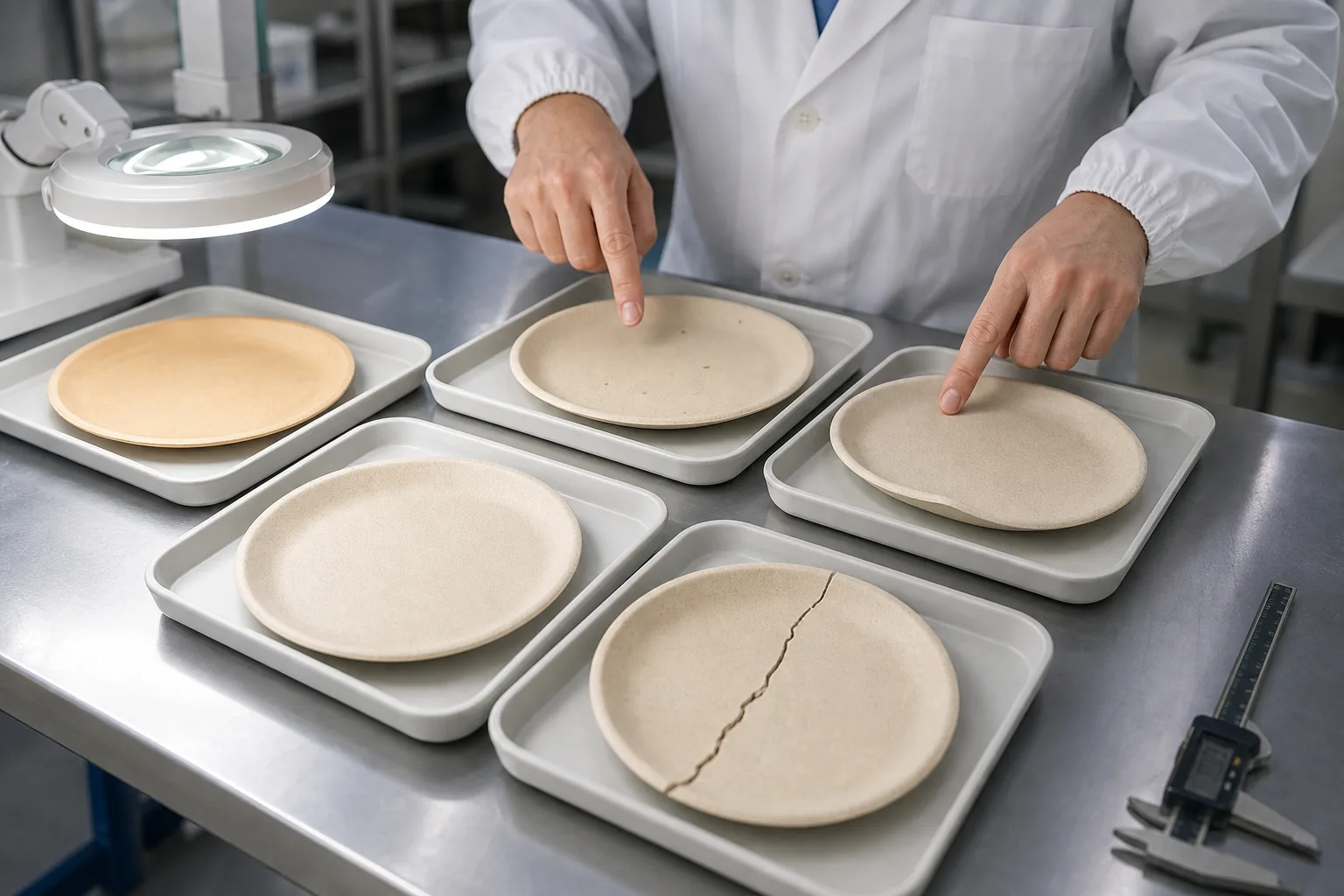
Defect classification translates product risk into countable inspection decisions. “Critical,” “major” and “minor” are not labels for how annoyed someone feels; they should be defined by safety, legal compliance, intended function, saleability and agreed appearance. Include photographs, measurement boundaries and reference samples wherever a verbal description could be interpreted two ways.
Critical defects
A critical defect is commonly reserved for a condition that can create an unreasonable safety or compliance risk. Product-specific examples could include a sharp edge accessible in normal use, foreign contamination, a component configuration that violates an applicable requirement, or incorrect traceability where that information is legally required. The buyer’s technical and legal teams must approve the actual list.
Do not assume that writing “critical AQL 0” proves zero critical defects in the lot. A sample examines only selected units, and statistical sampling always has limits. If the buyer requires zero acceptance for observed critical defects, state the acceptance number, response and any additional screening or process controls explicitly.
Major defects
A major defect is generally one that is likely to cause functional failure, customer rejection or material departure from the approved specification. For wheat straw tableware, possible buyer-defined examples include cracking under normal handling, severe warpage that prevents stable use, a lid that will not fit, materially wrong dimensions, unacceptable odor under the agreed method, or decoration that fails the specified adhesion check.
Severity depends on application. A small rim deformation may be major for an automated lid interface but minor for an open serving tray. Tie the classification to intended use, tolerance and measurable consequence rather than copying a generic defect catalog.
Minor defects
A minor defect may affect appearance or workmanship without materially reducing intended function. Controlled examples might include a small permissible speck, slight color variation within the approved boundary, a superficial flow mark or a limited gate witness. The specification should distinguish natural fiber visual character from actual contamination or poor molding.
The buyer should review the existing guide to diagnosing odor, color and brittleness issues, then convert relevant observations into product-specific criteria. That avoids counting normal wheat-fiber texture as a defect while still controlling objectionable variation.
Step 4: Select inspection level before seeing the goods
Inspection level influences sample size and therefore cost and discrimination. General levels are used for overall workmanship inspection, while special levels may be applied to specific destructive, time-consuming or expensive checks. The selected level should reflect risk, process history, inspection economics and the consequence of a missed defect.
Do not let the inspector select a convenient level after the lot condition is visible. The purchase order or inspection specification should state the level for each check and the circumstances that trigger a change. A new supplier, new mold, material change or repeated failure can justify more intensive review even when the commercial quantity is unchanged.
Normal, tightened and reduced inspection are also not interchangeable adjectives. Under continuing-lot schemes, switching rules use performance history to change inspection severity. If a buyer always orders normal inspection and ignores the standard’s switching logic, the stated scheme may not be operating as intended.
For one-off projects, consider whether an isolated-lot framework or a custom risk-based plan is more honest than pretending a continuing-lot switching system exists. Document the rationale and have a qualified quality professional confirm the plan. AQL is a procurement decision aid, not a ceremonial number on an inspection booking.
Need an executable inspection specification?
Share the SKU mix, lot structure, target markets, approved samples and buyer defect policy. Naike Dinner can map the product configuration to an inspection brief for review by your quality team and independent inspector.
Request an AQL project reviewStep 5: Set acceptance criteria without copying folklore
There is no single AQL value mandated for all wheat straw tableware. Different buyers use different risk policies, distribution channels, complaint costs and brand tolerances. A retailer’s cosmetic requirement, a restaurant chain’s functional priorities and a promotional program’s packaging needs can lead to different defect-class decisions.
AQL is an index used with a sampling scheme; it is not a promise that exactly that percentage of the delivered lot is defective. The chance of accepting a lot changes with its actual quality and the selected plan. Procurement teams should understand producer’s risk, consumer’s risk and the operating-characteristic concept before using AQL language in supplier penalties.
Use separate criteria for critical, major and minor defects only after the categories are defined. If the contract uses an acceptance number of zero for observed critical defects, say so directly. For major and minor categories, record the AQL or alternative index, sample plan, acceptance number and rejection number derived from the controlled standard.
The table below is a decision framework, not a universal set of numerical AQLs. It shows how buyers can choose the control logic without presenting Naike Dinner’s unverified internal limits or implying that a standard prescribes product-specific severity.
| Buyer context | Control emphasis | Questions before choosing criteria |
|---|---|---|
| Private-label retail set | Appearance, artwork, pack completeness and barcode accuracy. | What variation would cause shelf rejection or consumer return? |
| Restaurant or hotel program | Stability, fit, repeated handling and service function. | Which failures interrupt operations or create guest risk? |
| Promotional or seasonal order | Delivery window, assortment and decoration consistency. | Is the lot isolated, and can failed goods be replaced in time? |
| New mold or new material | Dimensions, warpage, cavity pattern and functional validation. | Which characteristics need measurements or destructive checks? |
| Repeat stable program | Continuity plus change-control verification. | Does the chosen standard permit switching based on documented history? |
Step 6: Make random sampling genuinely representative
Random selection means the factory should not present only its best cartons. The inspector needs access to the full completed lot and should select cartons across pallets, positions and production periods. Record which cartons and units were opened so the sample path can be reconstructed.
For mixed assortments, allocate samples so each SKU, color and component receives meaningful coverage. A mathematically random selection from a combined population can still miss a small but high-risk component. Stratification, separate lots or deliberate minimum coverage may be required, but those choices must be written before counting defects.
Replacement of a selected unit should be controlled. If a carton is inaccessible, damaged in logistics or already opened for another purpose, document why the sample changed. Allowing convenient substitutions introduces bias and can turn statistical inspection into staged demonstration.
Photograph pallet condition, selected carton locations, shipping marks where permitted, sample identity and representative defects. Images support traceability, but they do not replace counts, measurements or the inspector’s signed report. Retain matched units when an important classification may be disputed.

Step 7: Combine attribute counts with functional evidence
AQL attribute inspection answers whether sampled units meet defined criteria. Some tableware characteristics are better controlled by measured variables or functional tests: diameter, mass, flatness, lid fit, stack height, color difference, leakage, drop performance or resistance under a specified use condition. Define the instrument, conditioning and repetitions for each check.
Do not count every failed measurement as a generic cosmetic defect without a protocol. Specify whether one out-of-tolerance dimension makes the unit nonconforming, whether multiple failures on one unit count as one unit or several nonconformities, and how destructive test pieces affect the sample. The chosen sampling standard distinguishes units from nonconformities, so the counting basis matters.
Food-contact compliance and chemical testing also sit outside a visual AQL inspection. A passing inspection report cannot substitute for product-specific regulatory evidence, and a laboratory report cannot confirm that the shipment has correct artwork or quantities. Use the composite tableware chemical-testing guide to keep these evidence streams separate.
The most effective control plan combines approved inputs, in-process checks, finished-product tests and shipment sampling. AQL helps decide the lot from selected attributes; it does not diagnose every process cause or guarantee future batches. Supplier corrective action should address root cause, not merely sort the inspected shipment.
AQL sampling versus 100% inspection
AQL sampling and 100% inspection solve different problems. Sampling provides an economical acceptance decision based on a representative subset, while 100% inspection attempts to screen every unit for defined, detectable conditions. Neither method automatically controls hidden chemical, material or performance risks that require laboratory or process evidence.
Full screening may be appropriate after a failure when the defect is visible, consistently recognized and removable without damaging the product. It may also be specified for a narrowly defined critical characteristic. However, repetitive human inspection can miss subtle defects through fatigue, and handling every packed unit can introduce contamination, scuffing or packaging errors.
Sampling is more efficient and can support consistent lot decisions when the population and criteria are controlled. Its limitation is residual risk: uninspected units remain, and a poor lot can sometimes be accepted while a good lot can sometimes be rejected. The operating-characteristic behavior of the selected plan expresses those competing risks more honestly than the phrase “AQL passed.”
A strong buyer does not automatically choose the largest sample or demand full inspection for everything. Instead, use prevention for high-severity characteristics, capable manufacturing controls for measured features, targeted verification for compliance, and acceptance sampling for suitable finished-goods attributes. Escalate to sorting or enhanced inspection when evidence shows a specific problem.
How to structure the inspection report
The report should begin with identification: buyer, supplier, factory location, purchase order, SKU, quantity, color, lot or batch, production status and inspection date. It should name the sampling standard and edition, inspection severity, plan type, level, code letter where applicable, sample size and acceptance/rejection numbers for every defect class.
The results section should separate units inspected, nonconforming units and nonconformities if both are used. Each defect should carry its agreed classification, count, affected SKU and a clear photograph or measurement record. Repeated photographs of the same unit should not be mistaken for several defective units.
Functional tests need their own sample quantity, method, conditions and outcome. Record instrument identification or calibration status where required by the buyer’s system. If a method differs from the inspection specification, the deviation should be visible and approved rather than hidden in a general “pass” statement.
The conclusion must follow the agreed decision rule. Include the inspector’s recommendation, but preserve the buyer’s release authority and any pending laboratory or documentation gates. A visually accepted lot may still remain on hold until food-contact documents, artwork approval or shipment records are complete.
How supplier history should change the plan
Quality history is valuable only when comparable lots, defect definitions and results are recorded consistently. Track first-pass acceptance, defect-class trends, repeat failures, corrective-action effectiveness and changes in materials, molds, personnel or subcontractors. A headline pass rate without lot context can hide recurring low-frequency defects.
For a new product or process change, begin with enough oversight to understand real variation. When continuing-lot performance is stable, use the switching provisions of the selected standard if the contractual system permits them. Reduced inspection should be earned through documented performance, not granted solely to save the cost of an inspection.
Conversely, a pattern of failures should trigger tightened control, root-cause work and possibly suspension of normal acceptance sampling. The purpose is not punishment; it is to respond to evidence that the previous level no longer provides the intended protection. Define recovery conditions so both parties know how normal status can be restored.
Naike Dinner buyers can connect this history to the broader pre-shipment inspection checklist. The checklist establishes what to inspect, while the sampling specification establishes how many units are selected and how the lot decision is made.
What should happen when the sample fails?
The inspection specification should define immediate hold authority. A failed lot should not be loaded while the parties debate whether the report matters. The supplier should identify affected production, contain suspect goods, review the defect evidence and propose documented correction or disposition.
Sorting can remove visible nonconforming units when the defect is detectable and the method is reliable. It does not automatically solve a systemic material, dimensional or performance problem. After rework or sorting, use the agreed reinspection rule and a newly selected sample; do not simply delete failed units from the original count.
Repeated inspection is not a game where sampling continues until one sample passes. The applicable standard and contract should govern resubmission, tightened inspection or discontinuation. Record the original failure, corrective action, new lot identity and reinspection result so quality history remains complete.
Commercial remedies—rework, replacement, concession, partial shipment or cancellation—belong in the purchasing agreement. Quality staff provide evidence and risk assessment, while authorized buyer personnel decide whether any deviation is acceptable. A concession should name quantity, defect, shipment and validity; it should not silently rewrite future specifications.
B2B AQL Inspection Buyer Checklist
| Check | Question | Why It Matters |
|---|---|---|
| Standard | Which sampling standard and edition govern? | Locks the tables, terminology and switching logic. |
| Lot | Are SKU, color, batch, quantity and completion status defined? | Ensures samples represent the commercial population. |
| Level | Which inspection level applies to each check? | Controls sample effort before the result is known. |
| Defects | Are critical, major and minor examples objective and product-specific? | Prevents inconsistent classification. |
| Acceptance | Are AQL/index and Ac/Re numbers recorded for every class? | Makes the lot decision reproducible. |
| Sampling | Can the inspector access and randomly select the completed lot? | Reduces presentation and convenience bias. |
| Tests | Are methods, tools, conditions and units specified? | Turns opinions into comparable evidence. |
| Disposition | Who can release, hold, sort, rework or accept a deviation? | Avoids shipment-day disputes and unauthorized release. |

Buyer FAQs about AQL inspection
1. Does an AQL pass mean the whole lot is defect-free?
No. The result means the selected sample met the acceptance rule under the stated plan. Sampling does not inspect every unit and therefore cannot prove zero defects across the shipment.
2. What AQL should buyers use for wheat straw tableware?
There is no universal value. The buyer should set product-specific criteria based on safety, function, appearance, market, complaint cost, supplier history and the chosen sampling standard, with professional quality input.
3. Can critical defects use an acceptance number of zero?
A buyer can specify zero acceptance for observed critical defects, but that is not the same as proving zero critical defects in the lot. Additional process controls or broader screening may be necessary for high-severity risks.
4. Should every SKU be inspected separately?
Separate lots are appropriate when products, molds, colors, materials or processes differ materially. A documented stratified plan may cover a related family, but each commercially important component still needs representative coverage.
5. Can a third-party inspector choose the sampling level?
The inspector can advise, but the buyer should approve the standard, level and acceptance rules before inspection. Leaving the choice open can create inconsistent cost and risk between shipments.
6. What happens after a rejected inspection?
Hold the lot, investigate the defects, define correction or disposition, and reinspect under the agreed rule using a new representative sample. Preserve the original failure and corrective-action evidence.
Turn your quality expectations into an inspection brief
Send Naike Dinner your SKU list, quantities, target market, approved samples, risk priorities and preferred sampling standard. We can prepare a product-specific defect matrix and evidence checklist for your quality team or independent inspector to approve before production and quotation finalization.
Request an inspection-plan reviewAsk for documented samples