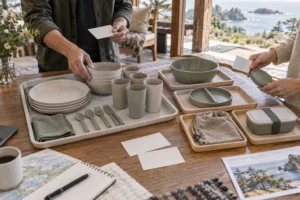
Hotels should choose wheat straw tableware for breakfast buffets only after a site-specific pilot confirms food-contact suitability, commercial warewashing compatibility, stain and odor behavior, stack stability, guest handling, breakage or deformation risk, and replacement logistics. The best set is not simply “eco-friendly.” It must fit the hotel’s menu, equipment, hygiene plan, service volume, brand standard, and destination-market requirements.
A breakfast buffet compresses many operating risks into a short service window. Plates move from storage to the buffet, guest tables, clearing stations, washing racks, drying areas, and back to service while staff manage hot food, acidic fruit, oily dishes, coffee, cereal, and rapid replenishment.
That workflow makes hospitality procurement different from buying tableware for a household or promotional gift. A product can look attractive in a sample box but fail commercially if it nests too tightly, traps wash water, stains around textured areas, tips in a rack, does not fit the plate dispenser, or cannot be replaced in a matching batch.
This guide is written for hotel groups, restaurant operators, hospitality distributors, procurement managers, executive chefs, housekeeping teams, and food-and-beverage directors evaluating reusable wheat-straw composite tableware. It explains what to test, what evidence to request, and which limitations should be written into the purchase specification before a rollout.
Quick Decision Table for Hotel Breakfast Buffet Tableware
| Decision area | Hotel question | Evidence before rollout | Reject or revise when |
|---|---|---|---|
| Food-contact scope | Does the evidence match the material, colors, foods, temperatures and repeated use? | Product-specific documentation and test scope | Reports cover a different formula, article or use condition |
| Warewashing | Can the item complete the hotel’s real wash, rinse, sanitizing and drying cycle? | Site pilot with recorded program and repeated cycles | Warping, odor, residue, nesting or incomplete drying occurs |
| Menu fit | Are shapes suitable for eggs, oils, fruit, sauces, cereal, coffee and pastries? | Food trial across representative breakfast items | Staining, leakage, softening or unsuitable capacity appears |
| Service flow | Do stacks, dispensers, trays and clearing stations work safely? | Pre-opening service simulation | Items jam, slide, tip, overstack or slow staff |
| Guest experience | Are rim, weight, grip, temperature feel and appearance acceptable? | Guest and staff pilot feedback | Items feel unstable, sharp, too hot, too light or visibly inconsistent |
| Inventory | Can the supplier replenish matching items and components? | SKU list, retained master, change-control and replacement plan | Only full sets can be reordered or colors cannot be maintained |
| Total cost | What is the cost per usable service cycle? | Pilot loss rate, labor effect, replacement and freight model | Price analysis ignores short life, labor or incompatible equipment |
Start with the Hotel’s Real Breakfast Operating Profile
Before discussing colors or logos, document the service profile. Record seats, occupancy range, peak covers per hour, buffet duration, number of tableware turns, menu categories, self-service or assisted stations, clearing routes, washing capacity, storage locations, and emergency stock.
A 60-room boutique hotel serving plated breakfast has a different requirement from a 500-room airport property running a high-volume buffet. The smaller property may prioritize presentation and coordinated colors, while the larger operation may prioritize rack density, fast drying, stack handling, and component replenishment.
Map the menu by food type and serving condition. Typical breakfast contact includes hot eggs, bacon or plant-based alternatives, oily pastries, acidic fruit, yogurt, cereal, sauces, coffee, tea, milk, and chilled foods. The buyer should not assume that one generic “food safe” statement addresses every combination.
Also identify how guests use the items. A cereal bowl may be filled with hot oatmeal, a tray may carry a hot cup, and a side plate may be placed beneath a heat lamp by mistake. Foreseeable use and misuse should inform the specification, staff instructions, and evidence review.
Which Wheat Straw Tableware Items Fit a Breakfast Buffet?
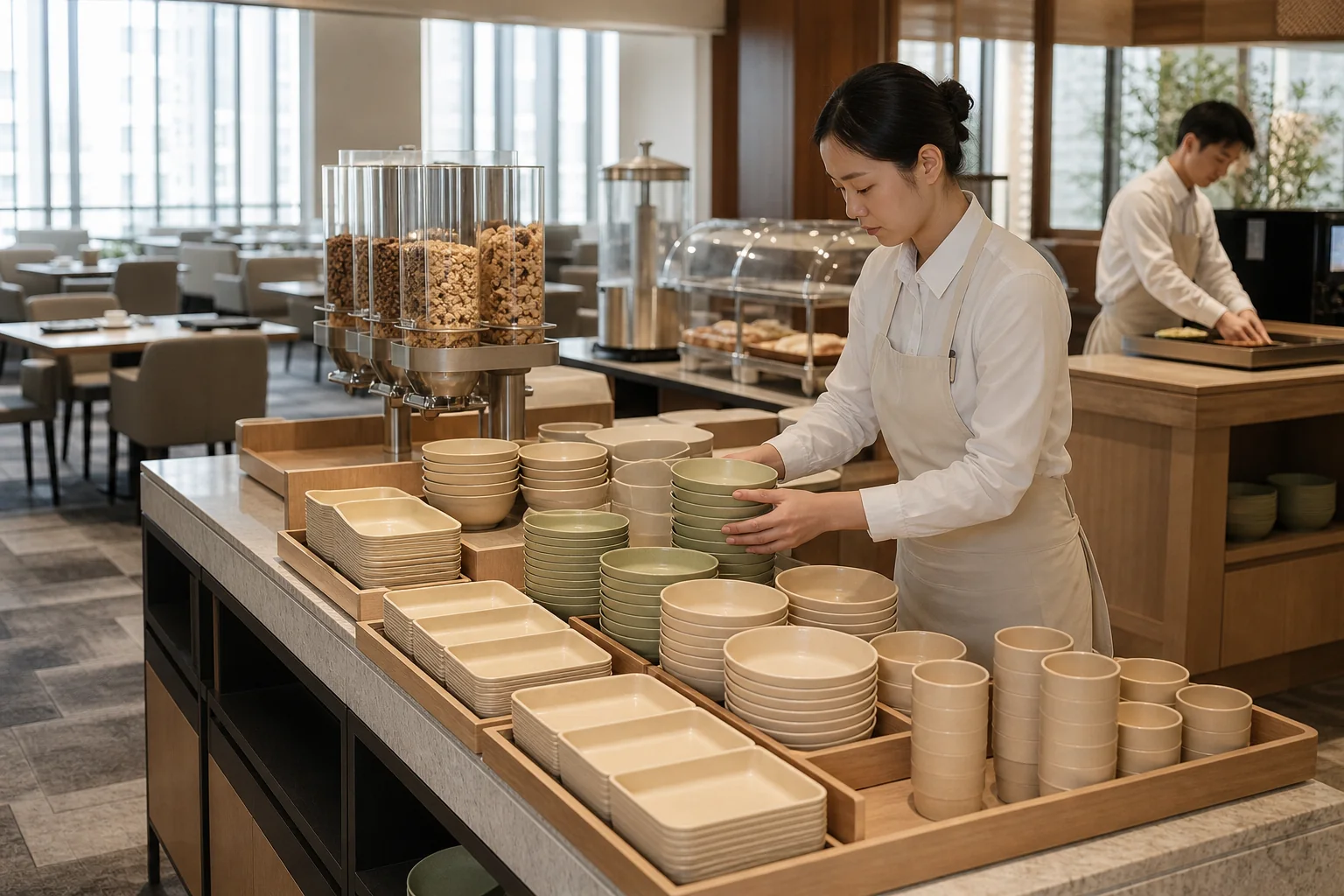
Start with a limited core set rather than replacing every article at once. Side plates, cereal bowls, tumblers for cold beverages, condiment dishes, trays, and selected serving accessories can be piloted as separate use cases. Cups for hot beverages or plates exposed to heated holding areas need especially clear temperature and use validation.
For self-service, rim geometry and stack separation matter. Guests should be able to lift one item without pulling several together, and staff should be able to replenish a stack without excessive noise or instability. A slightly textured matte surface may provide grip, but deep texture can complicate cleaning and visual inspection.
Bowls should balance capacity, footprint, and rack angle. A very deep bowl may trap wash water when nested, while a wide shallow bowl can consume more buffet and storage space. Test the actual rack, not only the catalog dimensions.
Trays and compartment plates can support family, children’s, staff-canteen, or grab-and-go areas, but each compartment should drain and clean effectively. The hotel should confirm whether the product is intended for guest dining, back-of-house portioning, room service, pool areas, or another controlled scenario.
Material Composition Must Match the Destination Market
“Wheat straw tableware” describes a product family, not a universal formulation. Commercial reusable articles can combine processed plant fiber with a polymer matrix and other additives. Buyers should request the actual material declaration, intended-use conditions, color system, manufacturing site, and evidence mapped to the finished article.
For EU projects, the European Commission’s official food-contact materials portal states that kitchenware and tableware are food-contact materials and that applicable framework, good-manufacturing-practice, specific Union, and national requirements must be considered. A hotel group or importer should verify the exact composite under current rules rather than treating a natural-fiber marketing term as authorization.
This distinction matters because the Commission has also published a coordinated action concerning plastic food-contact articles containing certain plant-based additives. That action focused on illegal or misleading products and shows why buyers should obtain market-specific regulatory review for the actual formulation, not extrapolate from the words “bamboo,” “wheat straw,” or “eco.”
North American buyers should likewise review the regulatory basis for the composite, colorants, and intended food-contact conditions. A supplier document is useful only when the product code, formulation, color, test specimen, laboratory method, time, temperature, food simulants, and report date can be connected to the hotel’s planned use.
Commercial Warewashing Is the Central Operational Gate
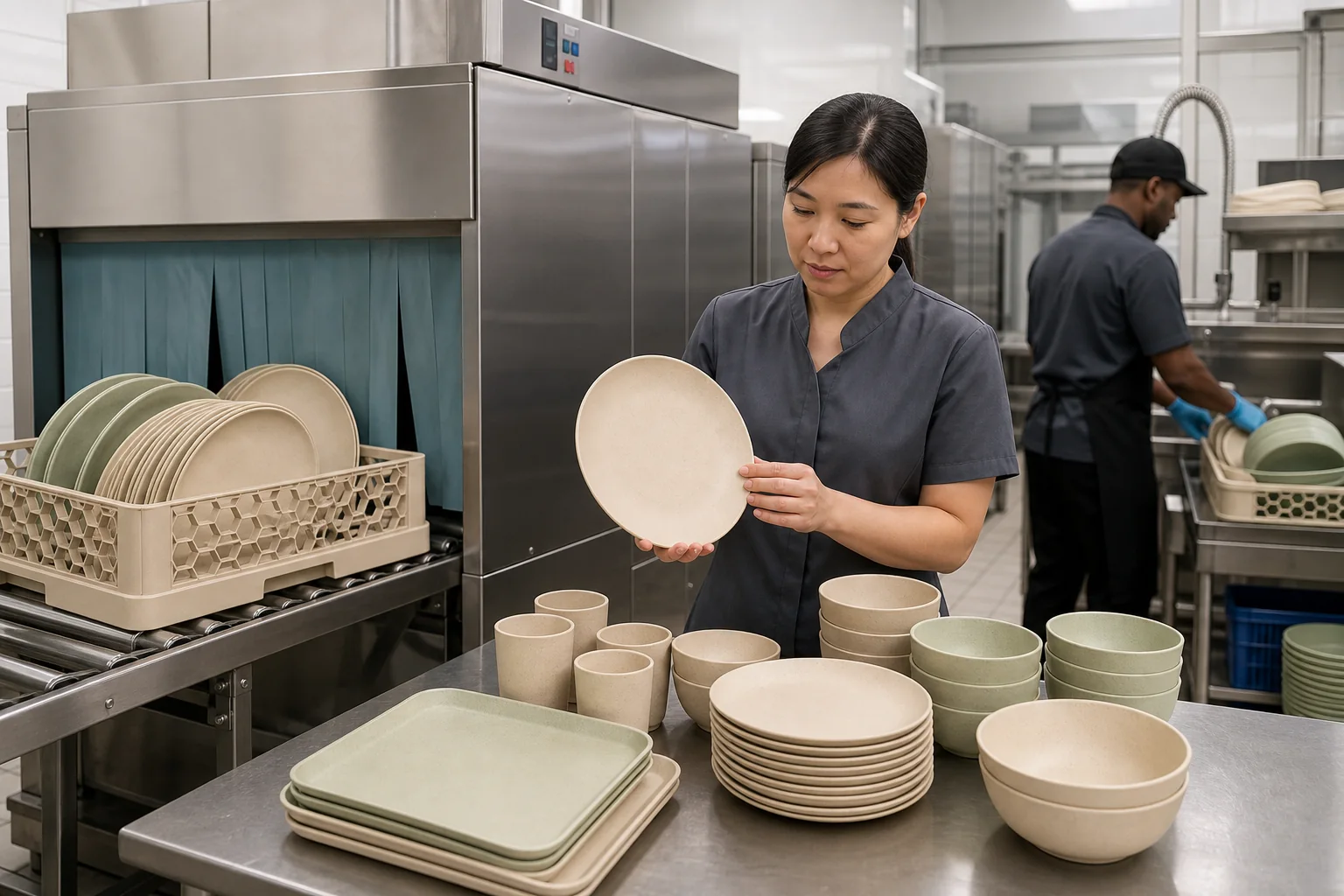
A domestic dishwasher claim does not automatically cover a hotel’s rack conveyor or door-type machine. Commercial programs may combine higher throughput, different detergents, sanitizing conditions, rinse aids, mechanical action, closely packed racks, repeated cycles, and limited cooling time before restacking.
The hotel should document machine type, rack design, wash temperature, final rinse or chemical sanitizing program, detergent and rinse-aid products, cycle time, drying method, and typical cycles per day. The supplier can then assess whether the proposed item has a reasonable test basis for that workflow.
The FDA’s 2022 Food Code is a model used by food-service jurisdictions and addresses equipment, utensils, warewashing, sanitization, drying, and storage. Hotels must follow the rules adopted in their own jurisdiction, but the Food Code demonstrates why “dishwasher safe” is not a complete hygiene plan.
Build a pilot that includes repeated cycles with representative soils. Inspect for warping, surface change, retained odor, discoloration, cracks, roughness, label or decoration damage, trapped water, nesting, and incomplete air drying. Do not towel-dry test pieces if the normal operation requires air drying, because that can hide a drainage problem.
Define the Pilot Cycle Count Without Inventing a Lifetime Claim
A buyer may want a guaranteed number of washes, but that number should not be invented from material reputation or a short sales demonstration. Useful life depends on the product design, actual machine, chemistry, loading, food soil, handling, cooling, storage, and rejection standard.
Instead, define a staged site trial. The first stage checks immediate compatibility and drainage, the second runs repeated cycles over several operating days, and the third monitors real buffet use with staff logging damage and removals. The buyer can then estimate a service-cycle range for its own operation.
Retain an unused control sample and photograph trial pieces under consistent light. Record mass, key dimensions, flatness, surface condition, odor observations, and operational comments at agreed checkpoints. The purpose is to compare change, not to generate a marketing number that the evidence cannot support.
Stain, Odor and Food Trials Should Reflect the Breakfast Menu
Run separate trials for acidic fruit, tomato-based items where served, coffee and tea, strongly colored juices, oily foods, butter, egg, yogurt, and sauces. Contact time, temperature, cleaning delay, and repeated use can all affect the outcome.
A controlled trial should distinguish a removable food film from permanent staining or absorbed odor. Staff should follow the planned scrape, pre-rinse, rack loading, wash, sanitizing, and drying steps, because an unrealistic laboratory cleanup can make a weak operational fit look acceptable.
Visual color also influences perception. Pale natural shades can make staining easier to notice, while darker colors can hide food residue that still requires removal. The hotel should choose colors and inspection lighting that support hygiene verification, not only interior design.
If the breakfast concept includes allergen-managed service, tableware selection does not replace the hotel’s allergen controls. Color-coded items may help identify a workflow, but the operation still needs validated cleaning, separation, labeling, staff training, and jurisdiction-specific procedures.
Measure Fit with Racks, Dispensers, Carts and Storage
Dimensions on a supplier drawing do not reveal every fit issue. Send or measure the hotel’s plate dispensers, dish racks, tray rails, shelving, bus tubs, carts, and storage bins. Confirm the usable internal dimensions, spacing, stack height, and safe load.
Stacking is particularly important for molded composite items. If pieces nest too tightly, staff may use force to separate them; if they stack loosely, tall columns can lean or fall. Heat retained after washing can increase sticking, so evaluate stacks at the actual point when staff handle them.
Calculate storage by component and par level. A hotel operating three turns plus wash and contingency stock needs more than the number of seats. Include items in rooms, at clearing stations, in the machine, awaiting inspection, and temporarily removed from service.
For a multi-property group, standardization can reduce spare inventory, but only if local machines and service formats are compatible. A corporate standard should define approved variations instead of forcing one geometry into every property.
Guest Handling and Inclusive Design Matter
Guests judge weight, balance, rim comfort, grip, temperature feel, appearance, and stability. An item that is very light can be convenient for handling but may move when guests cut food or when airflow reaches an outdoor buffet. A heavy stack can create another manual-handling problem for staff.
Test the plate with the hotel’s cutlery and common portions. Check sliding, scratching, flexing, noise, and whether sauces pool or run. For bowls and cups, evaluate grip with wet hands and the temperature presented to the guest.
Accessibility should be considered during the service trial. Stack height, reach distance, contrast, rim shape, and tray stability can affect older guests, children, and people with limited dexterity. Procurement teams should invite food-and-beverage, safety, and accessibility stakeholders into sample approval.
Branding Should Not Weaken Hygiene or Replenishment
Hotel logos, custom colors, and coordinated palettes can support the guest experience, but decoration must survive the intended cleaning process and remain within the product’s food-contact and use specification. Place decoration where it can be inspected and cleaned, and validate adhesion or wear using the actual process.
Custom color also creates replacement risk. Agree on a physical master, controlled color reference, acceptable natural-fiber variation, repeat-order change notification, and whether old and new batches must be mixed during approval. A shade that looks acceptable alone may be conspicuous when placed beside older stock.
Naike Dinner’s guides to private-label wheat straw dinnerware and custom color matching provide more detail for artwork and shade development. For a hotel project, those decisions should follow the operational pilot, not replace it.
Plan Replacement Inventory Before the First Purchase Order
A full-set purchase can be economical at launch but inefficient if the hotel later needs only bowls or side plates. Ask whether components have separate SKUs, minimum replenishment quantities, packaging units, mold continuity, and retained color standards.
Define an initial spare percentage from pilot loss, breakage, deformation, staining, misplacement, and peak occupancy rather than using a generic number. Monitor removal reasons after launch so the next order reflects actual performance.
For international groups, consider the cost and time to move small replacement quantities. Consolidated orders, regional distributor stock, or standardized components may reduce emergency air freight. The supplier should not promise a lead time or minimum order that has not been documented for the selected SKU and customization.
Change control is equally important. The hotel should be notified before changes to formula, fiber source, color system, manufacturing site, mold, dimensions, surface, decoration, packaging, or intended-use statement. Reapproval depth should depend on the change and risk.
Map Your Hotel Workflow Before Requesting Samples
Send Naike Dinner your breakfast covers, menu, machine type, rack dimensions, product list, target market and branding needs. We can turn those inputs into a clearer sample and documented quotation discussion.
Request a Hotel Project ReviewCompare Materials by Operational Fit, Not Sustainability Slogans
Wheat-straw composite, conventional plastic, melamine, ceramic, glass, stainless steel, and other materials have different strengths, limitations, regulatory profiles, equipment compatibility, breakage behavior, weight, appearance, and end-of-life routes. A hotel should compare the exact articles and claims, not only material names.
Ceramic may offer a familiar premium feel but creates breakage and handling considerations. Metal may be durable in selected applications but can affect temperature feel and presentation. Reusable composites may reduce breakage in certain controlled scenarios, yet they still require verified chemistry, use limits, wash compatibility, and replacement planning.
Environmental claims need defined evidence. “Natural,” “green,” “biodegradable,” and “plastic-free” are not interchangeable, and a wheat-straw composite may contain a polymer matrix. Buyers should request a truthful composition statement and evaluate impacts across sourcing, use, cleaning, lifespan, transport, and disposal.
For a broader material comparison, review Naike Dinner’s wheat straw, PLA and bamboo tableware guide. The hotel decision should remain tied to the property’s local rules, equipment, service cycles, and evidence.
Build a Two-Week Hotel Pilot Before Chain-Wide Rollout
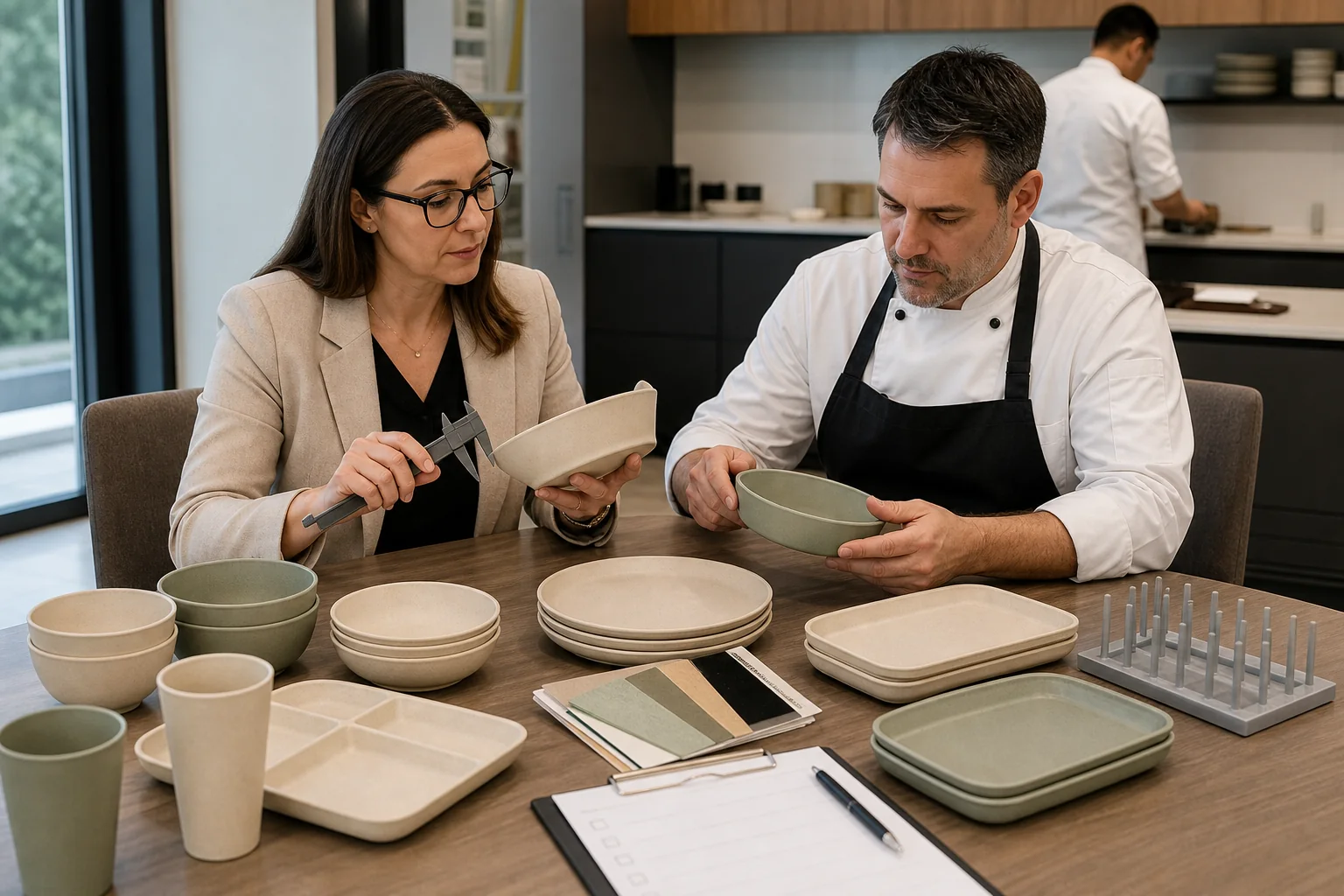
Begin with a documented baseline: product codes, dimensions, weights, photographs, retained controls, food-contact documents, use limits, rack map, and acceptance criteria. Train a small team on loading, drying, inspection, and defect logging.
During the first days, run controlled food and warewashing trials outside peak service. Then introduce a defined quantity into one breakfast area and mark the batch so it can be tracked. Record guest comments, staff handling issues, items removed, wash results, storage time, and replenishment speed.
At the end of the pilot, review the item with procurement, culinary, stewarding, food safety, brand, and finance. Separate product defects from workflow problems and decide whether the solution is approval, specification change, staff instruction, different equipment, a narrower use case, or rejection.
Do not extrapolate a quiet boutique-property pilot to every hotel without checking differences. For a chain rollout, select representative properties with different volume, machines, water conditions, menus, and service formats.
B2B Hotel Breakfast Tableware Buyer Checklist
| Check | Question | Why It Matters |
|---|---|---|
| Use scope | Which foods, temperatures, stations and guest groups will use each item? | Prevents a broad claim from replacing real intended-use conditions. |
| Market evidence | Does documentation match the exact composite, colors and destination? | Natural-fiber wording does not establish food-contact compliance. |
| Warewasher | Has the item passed the property’s actual machine, chemistry and rack? | Domestic dishwasher language may not cover commercial operations. |
| Hygiene | Can staff inspect, sanitize, air-dry and store the item correctly? | Cleanability and drying are operational requirements. |
| Menu trial | Were acidic, oily, colored, hot and cold breakfast foods included? | Representative contact reveals stain, odor and use limitations. |
| Service flow | Do guests and staff separate, carry, clear and restack items safely? | Poor geometry slows the buffet and increases handling risk. |
| Equipment fit | Do items fit racks, dispensers, carts, shelves and bus tubs? | Catalog dimensions cannot replace a physical fit trial. |
| Branding | Are color, logo and decoration included in wash and compliance review? | Customization can change evidence and replacement matching. |
| Replenishment | Can individual SKUs be reordered with controlled revisions? | Hotels lose components at different rates. |
| Business case | Is cost measured per usable service cycle with labor and losses? | Unit price alone can favor a short-lived or inefficient item. |
Hotel Buyer FAQs
Is Wheat Straw Tableware Automatically Suitable for Commercial Dishwashers?
No. Suitability depends on the exact composite, product design, machine, rack, detergent, sanitizing program, cycle, drying, and repetition. Require a documented site pilot and written use limits rather than relying on a generic domestic dishwasher icon.
Can Hotels Serve Hot Breakfast Foods on Wheat Straw Plates?
Only within conditions supported for the exact article. Define food temperature, contact time, holding environment, microwave or heat-lamp exposure, and cleaning process. The hotel should reject unsupported blanket statements and verify intended use with product-specific evidence.
Will Natural Fiber Make Every Batch Look Different?
Controlled natural variation may be visible, but it should not excuse unstable color, contamination, dark clusters, streaking, or mixed components. Approve physical masters and limit samples, define the acceptable range, and require change notification for inputs affecting appearance.
How Should a Hotel Calculate the Initial Order Quantity?
Use seats, peak covers, turns, washing time, storage, items in transit through the operation, contingency stock, pilot loss, and replenishment packaging. Calculate by component because bowls, plates, cups, and trays usually have different usage and loss rates.
Are Wheat Straw Composite Products Biodegradable or Plastic-Free?
Do not assume either claim from the product name. Request the complete material description and evidence for any environmental statement. Many reusable wheat-straw composites use a polymer matrix, so claims must match the exact formulation and destination-market rules.
What Should Hotels Ask Naike Dinner to Include in a Quotation?
Request product codes, dimensions, weights, composition description, intended-use limits, available evidence, color and logo scope, packaging, sample plan, documented price basis, replacement-SKU options, and production timing. Naike Dinner should not invent lifetime, minimum-order, price, or lead-time figures before the project is defined.
Turn the Buffet Workflow into a Procurement Brief
The right hotel breakfast buffet tableware is the set that stays safe, clean, stable, presentable, replaceable, and operationally efficient through the property’s real service cycle. Wheat-straw composite can be evaluated for selected hospitality applications, but the decision belongs to evidence and the site pilot, not to an environmental label alone.
Request Samples Against Your Hotel’s Real Operating Conditions
Share your property type, breakfast volume, menu, commercial warewasher, rack dimensions, destination market, target items, colors, logo needs and replacement plan. Naike Dinner can review the inputs and prepare a documented sample and quotation path for your procurement team.
Open the Inquiry Form Contact Naike DinnerOperational and regulatory note: This article provides general factory-side procurement information, not food-safety, laboratory, regulatory, or legal advice. Hotels, importers and distributors should verify the exact product and use with qualified specialists and the rules adopted in each destination.