
Private Label Wheat Straw Dinnerware: From Logo File to Retail Packaging Approval
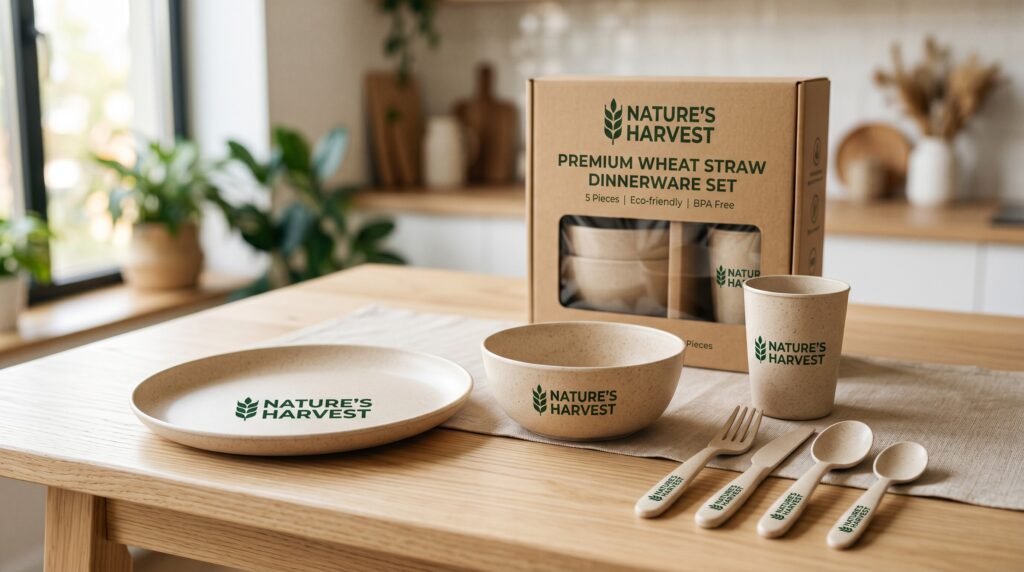
Most first-time private label buyers think the hard part is finding a supplier. It is not. The hard part is the six to eight weeks between sending your logo file and approving the final retail packaging — a stretch where one missing Pantone code, one unapproved font, or one misunderstood packaging spec can add three weeks to your timeline.
Private Label Wheat Straw Dinnerware is not just putting your logo on a plate. It is a structured, multi-stage process that moves from a logo file on your computer to a finished, shelf-ready product in a branded box. Every stage has a decision that can speed things up or slow them down.
At Naike Dinner, we have guided hundreds of private label buyers through this process — Amazon sellers launching their first brand, established distributors expanding into house-label product lines, promotional product companies fulfilling seasonal campaigns, and retail chains developing exclusive tableware collections. The buyers who move fastest are not the ones with the biggest budgets. They are the ones who arrive prepared.
This guide walks through the full Private Label Wheat Straw Dinnerware journey, stage by stage, so you know what to prepare, what to approve, and where the timeline can slip if you are not watching.
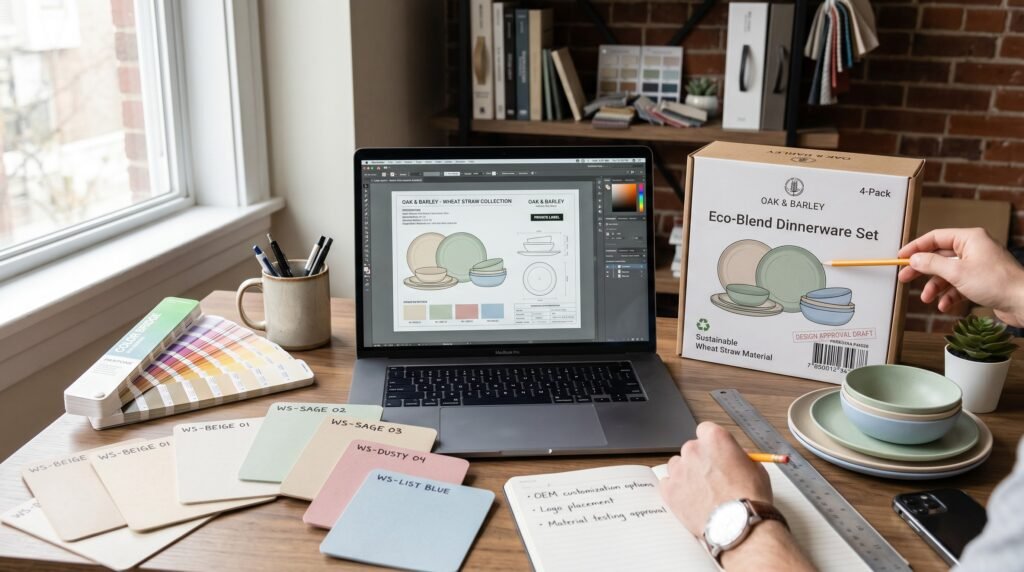
Stage 1: Prepare Your Logo File — The Foundation Everything Else Depends On
The single biggest cause of delay in a Private Label Wheat Straw Dinnerware project is the logo file. Not because buyers send bad logos — because they send logos in formats that cannot be used for production without rework.
What the Factory Actually Needs
Your graphic designer may send you a beautiful PNG with a transparent background, and on a screen, it looks perfect. On a silk screen or a heat-transfer plate, it looks different — because production processes need vector paths, not pixels.
| File Format | Usable for Production? | What You Need to Know |
|---|---|---|
| AI (Adobe Illustrator) | Yes — ideal | Native vector format, fully editable. Send this if you have it. |
| EPS | Yes — ideal | Universal vector format. Works across all design software. |
| CDR (CorelDRAW) | Yes — usable | Common among Chinese factories. If you have this, send it. |
| SVG | Yes — usable | Open vector format. Check that all fonts are outlined. |
| PDF (vector-based) | Yes — if vector | Must be exported with vector data preserved, not rasterized. |
| PNG (high resolution) | Conditional | Needs to be 1200+ DPI at print size. Will require conversion, adding 1–3 days. |
| JPG | No — avoid | Raster format, lossy compression. Cannot be used directly for printing. |
Three Things to Check Before You Send Anything
1. All fonts must be converted to outlines.
If your logo uses a custom font and you send the file without outlining the text, the factory’s computer will substitute a default font — and your logo will look wrong on the proof. Converting to outlines (in Illustrator: Type → Create Outlines) locks the letter shapes as vector paths.
2. Colors must be specified as Pantone codes.
Saying “navy blue” is not enough. One factory’s navy blue is another factory’s royal blue. Pantone codes remove ambiguity. If your brand color is Pantone 289 C, put that in the file name, in the email body, and in the artwork specification sheet. Do not rely on the factory to extract it from the file.
3. Provide a visual reference.
Even with perfect vector files, send a JPG or PNG reference image showing exactly how the logo should look on the product. Mark the position (center, bottom rim, side), the size (in millimeters, not percentages), and the orientation. A quick sketch or annotated photo eliminates most of the back-and-forth that costs days.
Stage 2: Select Your Products — Existing Molds vs. Custom Development
With your logo ready, the next decision in your Private Label Wheat Straw Dinnerware project is which products to brand.
Option A: Use Existing Molds (Faster, Lower Cost)
If you choose products from the supplier’s existing mold library, you skip the tooling stage entirely. Production can begin as soon as the logo proof is approved and the pre-production sample is signed off.
Advantages:
- Zero mold cost
- Timeline: logo proof to first shipment in 4–6 weeks
- Proven product — dimensions, weight, and dishwasher performance are already established
- Easy to order samples before committing
For a full view of available products, our wheat straw dinnerware manufacturer catalog shows existing mold options across plates, bowls, cups, cutlery, and dinnerware sets.
Option B: Develop Custom Molds (Unique Product, Longer Timeline)
If you need a unique shape — a specific plate diameter, a proprietary bowl design, a signature cup handle — you invest in custom mold development. This adds 25–35 working days to the timeline and requires a mold drawing approval stage.
Timeline for custom mold projects:
- Mold drawing and 3D design: 5–7 working days
- Mold drawing approval by buyer: 2–5 working days
- Mold manufacturing: 15–20 working days
- Mold trial and sample production: 3–5 working days
- Total added time: 25–35 working days
Our custom wheat straw tableware page covers the full OEM product development process, including mold design, material specification, and color matching.
Stage 3: Color Matching and Material Specification
Color is where brand consistency lives or dies. A Private Label Wheat Straw Dinnerware product needs to match your brand’s visual identity — not be “close enough.”
The Color Matching Process
Wheat straw composite material has a natural base tone — a warm beige with subtle fiber specks. This affects how colors render on the finished product. A pure white that looks clean on paper can look off-white on wheat straw material. A pastel pink that pops on screen can look muted on the natural fiber surface.
The process:
- You provide a Pantone code or a physical color swatch
- The factory mixes a color masterbatch to match
- A color chip or a small test plaque is molded and sent to you for approval
- You approve the color, or request an adjustment (typically 1–2 rounds)
- The approved color is locked for production
Tip: If color precision is critical for your brand, request a physical color chip by courier rather than approving from a photo. Phone screens, office lighting, and camera white balance all distort color. A 30couriershipmentcanpreventa30couriershipme tcanpreve ta3,000 production mistake.
Material Specification
Beyond color, confirm:
- Binder type: Food-grade PP (recommended for reusable products)
- Wheat straw fiber content: Typically 30–50%
- Surface finish: Matte or glossy
- Dishwasher safety: Confirm temperature tolerance
- Food contact compliance: LFGB for EU, FDA for US
For compliance-specific guidance, our LFGB Testing for Wheat Straw Dinnerware guide covers EU requirements, and our FDA Food Contact Requirements guide covers the U.S. market.
Stage 4: Logo Proof and Pre-Production Sample
This is the stage where a Private Label Wheat Straw Dinnerware project either accelerates or stalls. Getting it right the first time saves 10–14 days.
The Logo Proof (Digital Stage)
Before anything is printed on a physical product, the factory sends you a digital logo proof — a mockup showing your logo placed on the product at the specified size and position.
What to check on the proof:
- Logo size relative to the product surface area
- Positioning — centered, aligned, and not wrapping over curved edges
- Color accuracy — does the proof show the correct Pantone?
- Font integrity — are all characters rendering correctly?
- Print method — is the specified method (silk screen, heat transfer, IML) noted on the proof?
Approve the digital proof quickly — ideally within 24 hours. Every day of delay at this stage pushes the entire timeline.
The Pre-Production Sample (Physical Stage)
After the digital proof is approved, the factory produces one or two physical samples with your logo printed on the actual product. This is your last chance to catch issues before mass production begins.
When the sample arrives, inspect it thoroughly:
- Hold it under different lighting — natural daylight, warm indoor light, fluorescent
- Run a fingernail lightly over the logo to check adhesion
- Wash it in a dishwasher if the product is marketed as dishwasher-safe
- Compare the color against your Pantone swatch or brand reference
- Check for any surface defects, rough edges, or inconsistent color
If anything is not right, this is the moment to say so. Approving a sample you are not happy with because you are behind schedule is the most expensive shortcut in private label manufacturing.
Stage 5: Packaging Design and Approval
Packaging is where your Private Label Wheat Straw Dinnerware brand becomes real to a customer. It is also where the most back-and-forth happens — because packaging involves artwork, text, barcodes, material choices, and structural design all at once.
The Packaging Specification Sheet
Before the factory’s designer begins, provide a packaging specification sheet that covers:
- Box dimensions: Inner box and master carton
- Material: Cardstock weight (typically 300–350gsm for retail boxes), finish (matte, gloss, soft-touch)
- Artwork: Front panel design, back panel information, side panels, inner tray design
- Text content: Brand name, product name, features, care instructions, barcode (UPC/EAN), country of origin, material disclosure, compliance marks (LFGB, FDA, BSCI, recycling symbol)
- Color specification: CMYK or Pantone values for all printed elements
- Special finishes: Spot UV, foil stamping, embossing (adds cost and timeline)
The Packaging Proof Workflow
- Factory designer creates initial packaging artwork based on your specification
- You receive a digital proof (PDF) for review
- Mark corrections directly on the PDF — use comments, not separate emails
- Factory revises and sends revised proof
- You give final approval
- Factory prints one physical packaging sample and sends it for your approval
- You approve the physical sample, or request final adjustments
- Packaging moves to mass production
Timeline reality: A smooth packaging approval takes 5–7 working days from first draft to final approval. If you request significant design changes after the first proof, add 3–5 working days per revision round. Plan for two revision rounds in your timeline.
For a detailed breakdown of packaging costs by tier, our Wheat Straw Tableware Quotation guide covers packaging costs, mold fees, logo printing charges, and freight in full detail.
Stage 6: Production and Quality Control
With all approvals locked — logo proof, pre-production sample, color, packaging — mass production begins. This stage of a Private Label Wheat Straw Dinnerware project is mostly waiting, but it is not hands-off.
What Happens During Production
- Injection molding of the wheat straw composite material into the approved molds
- Cooling, trimming, and surface finishing
- Logo printing on each piece (silk screen, heat transfer, or IML)
- Visual inspection of logo print quality on every piece
- Assembly into retail packaging
- Packing into master cartons
- Palletizing and labeling for export
Quality Control Checkpoints
A serious manufacturer runs QC at multiple points, not just at the end:
| QC Stage | What Is Checked |
|---|---|
| Incoming material | PP resin batch, wheat straw fiber quality, color masterbatch |
| In-process (molding) | Product dimensions, weight, surface finish, color consistency |
| In-process (printing) | Logo position, color accuracy, adhesion, clarity |
| In-process (packaging) | Correct box, correct insert, correct barcode, assembly quality |
| Pre-shipment (final) | AQL sampling per ISO 2859-1, functional testing, carton drop test |
Third-Party Inspection
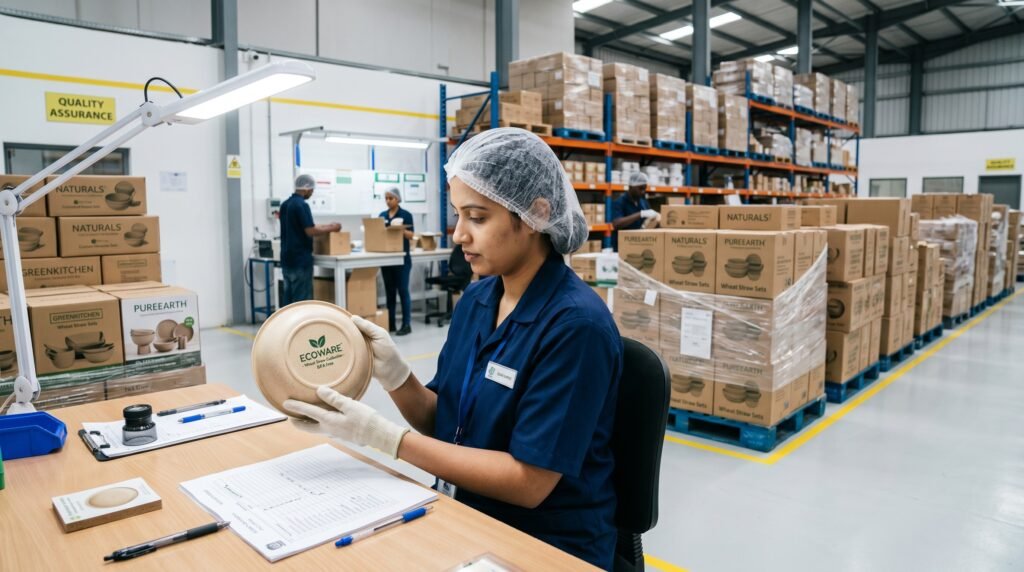
Most private label buyers add an independent third-party inspection before shipment. Agencies like SGS, Bureau Veritas, and Intertek inspect against an AQL (Acceptable Quality Level) standard — typically AQL 2.5 for major defects and AQL 4.0 for minor defects on tableware.
An inspection costs 300–300–500 and takes one day. It is the best money you will spend in the entire process.
Stage 7: Final Approval and Shipment
The last stage of your Private Label Wheat Straw Dinnerware project is shipment approval.
Before the container closes, confirm:
- Pre-shipment inspection report is received and all findings are resolved
- Loading photos show correct carton labels and pallet configuration
- Shipping documents (commercial invoice, packing list, bill of lading) match your order
- Certificates of origin and compliance documents are ready
- Freight forwarder has been notified of the estimated time of arrival
The Complete Private Label Timeline
Here is what a typical Private Label Wheat Straw Dinnerware project timeline looks like, from logo file to container departure, assuming existing molds and a standard packaging specification:
| Stage | Duration | Cumulative |
|---|---|---|
| Logo file preparation and submission | 1–2 days | Day 2 |
| Digital logo proof + approval | 2–3 days | Day 5 |
| Pre-production sample production + courier | 7–10 days | Day 15 |
| Sample review and approval | 2–3 days | Day 18 |
| Packaging design (first draft) | 3–5 days | Day 23 |
| Packaging proof revisions (1–2 rounds) | 4–8 days | Day 31 |
| Packaging physical sample + courier | 7–10 days | Day 41 |
| Mass production | 15–20 days | Day 61 |
| Pre-shipment inspection | 1–2 days | Day 63 |
| Container loading and departure | 2–3 days | Day 66 |
Total: approximately 9–10 weeks from logo file to container departure.
If custom molds are required, add 4–5 weeks to the front end. If packaging is kept simple (e.g., a color sleeve instead of a full retail box), you can trim 1–2 weeks from the packaging stage.
The 5 Most Common Mistakes That Delay Private Label Projects
We see these repeatedly. Every one of them is avoidable.
1. Sending a low-resolution JPG as the logo file.
Result: 3–5 days lost while a designer recreates the logo as a vector. Solution: always send AI, EPS, or CDR files with outlined fonts.
2. Approving a packaging proof without checking the barcode.
Result: 500 retail boxes printed with a barcode that does not scan, or scans to the wrong product. Solution: scan the barcode on the proof with a phone app before approving.
3. Changing the logo design after the pre-production sample is approved.
Result: sample must be remade, adding 10+ days. Solution: finalize the logo design before you send the file — not during the sample stage.
4. Approving the color from a phone photo instead of a physical chip.
Result: production color does not match your brand because the photo white balance was off. Solution: request a physical color chip by courier. It costs $30 and saves thousands.
5. Not specifying the packaging insert design until after the box proof is done.
Result: the insert does not fit the product, and both box and insert need revision. Solution: provide the insert design specification at the same time as the box specification.
How Naike Dinner Manages Private Label Projects
We structure every Private Label Wheat Straw Dinnerware project through a single point of contact who tracks every stage against the agreed timeline. Here is what you can expect:
We ask for your logo file requirements upfront. Before you send anything, we tell you exactly which formats we need, which Pantone codes to provide, and what position and size specifications to include. This eliminates the most common first-week delay.
We send proofs with a checklist. Every digital proof — logo and packaging — comes with a structured checklist of what to verify. You do not need to remember what to look for. It is in the document.
We offer physical samples by courier. Color chips, pre-production samples, and packaging samples are shipped to you by DHL or FedEx. Digital approval is fast, but physical approval is safe. We recommend both.
We run in-process QC, not just final inspection. Our QC team checks logo print quality at the start, middle, and end of the production run — not just during a final AQL sampling. This catches drift early.
We support third-party inspection. If you want SGS, Bureau Veritas, or Intertek to inspect before shipment, we coordinate the scheduling, provide the required sample sizes, and share the inspection report with you the same day.
If you are planning a private label launch — whether it is a single SKU or a full dinnerware collection — and you want a supplier who can walk you through the entire process with a clear timeline and transparent communication, reach out. We can usually return a project plan with stage-by-stage dates within one business day.
For related reading:
👉 Our Custom Wheat Straw Dinnerware for Private Label Brands page covers OEM and ODM project scope in detail.
👉 Our Wheat Straw Tableware Quotation guide explains every cost line from mold to freight so you know what to budget.
👉 Our Composite Tableware Chemical Testing guide covers what compliance documentation your private label products need for EU and US markets.
Ready to Start Your Private Label Wheat Straw Dinnerware Project?
The buyers who launch fastest are not the ones with the biggest orders. They are the ones who arrive with a vector logo file, Pantone codes, and a clear idea of their packaging tier. Everything else, a good supplier can guide you through.
If you have a logo file ready — or even if you do not and you are still in the planning stage — reach out. We will send you a stage-by-stage project timeline with estimated dates, so you know exactly what to expect before you commit anything.
👉 Contact Naike Dinner — Start Your Private Label Project
Discuss Your Project
Tell us about your project.
How to Separate Clean and Used Pieces in an Outdoor Set
A practical buyer workflow for separating clean and used outdoor dinnerware from outbound packing through washing, drying and repacking.
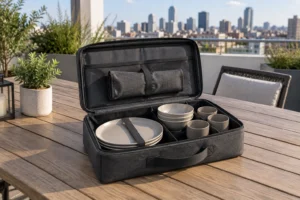
Choose a Carry-Case Opening That Works at the Table
A buyer review sheet for choosing a carry-case opening that keeps camping dinnerware accessible without wasting table space.
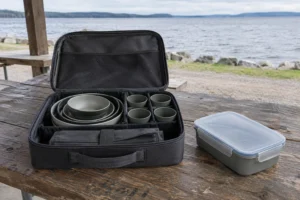
Should the Lunch Box Share the Dinnerware Case?
A buyer matrix for deciding whether a food container should ride inside a camping dinnerware case or remain a separate module.
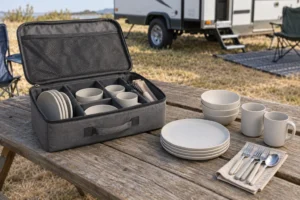
Write a Repeatable Pack-Out Instruction for a Portable Set
A practical numbered pack-out sequence and sign-off worksheet for portable dinnerware sets, with scope, exception and revision controls.
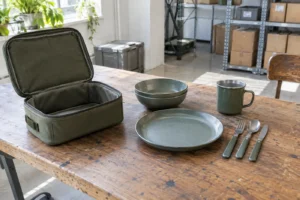
How to Check Fit Between Existing Dinnerware and a New Carry Case
A practical component-to-case drawing checklist for buyers changing the carry case around existing camping plates, bowls, cups and utensils.
How to Build a Core Set Without Bundling Unused Pieces
A buyer-ready base-versus-option worksheet for configuring a camping dinnerware core set without forcing every customer to pay for unused components.