
Wheat Straw Plates Wholesale Guide: Dinner Plates, Kids Plates and Restaurant Use Cases
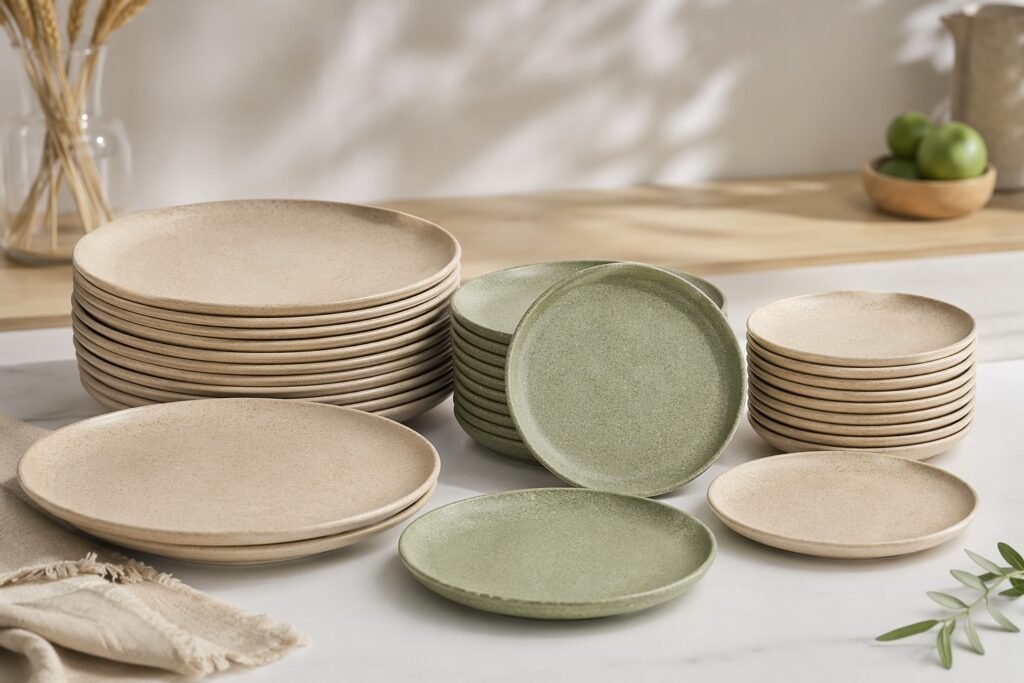
If you are sourcing wheat straw plates wholesale, you are not just buying a stack of plastic discs. You are engineering a product that must survive a toddler’s tantrum, a chef’s plating deadline, and a dishwasher’s 70°C caustic cycle — all while communicating “Eco-Friendly” to a consumer who is increasingly skeptical of greenwashing.
At Naike Dinner, we manufacture plates for three distinct high-volume markets: retail dinnerware sets, children’s feeding products, and commercial food service operations. Each of these markets demands a completely different plate profile, wall thickness, and certification package — yet many B2B buyers approach sourcing with a one-size-fits-all spreadsheet.
This guide is written from the factory floor. I will walk you through the engineering differences between a retail dinner plate and a restaurant plate, the safety and design requirements unique to wheat straw kids plates, and the loading-plan math that determines whether your container of plates arrives at your warehouse with a 30% margin or a 5% loss. If you are a dinner plates supplier evaluating your next order, or a brand owner expanding into eco-tableware, this is your technical playbook.
1. The Plate Production Ecosystem: What Happens at the Factory
Before we talk sizes, let’s look at the physics of a plate. Of all wheat straw tableware categories, the plate is the most demanding injection-molding challenge.
Why Plates Are Harder to Mold Than Bowls
A bowl has a deep cavity. The molten wheat straw composite flows vertically into the mold and cools evenly. A plate is a thin, flat disc. The material must flow radially from a single central injection gate, spreading out to a diameter of 220mm – 280mm while maintaining a uniform wall thickness of 2.0mm – 3.0mm.
The critical failure mode is “Short Shot”: The composite cools and solidifies before it reaches the outer rim, leaving a jagged, incomplete edge. At Naike, we use high-speed injection with a melt temperature precisely controlled at 175°C – 185°C — hot enough to flow, cool enough to avoid fiber charring. For more on the material science, see our Wheat Straw Composite Material Explained guide.
The Mold Design Cost Reality
A plate mold is typically a “Two-Plate Cold Runner” design. For a standard 10-inch dinner plate:
- Mold Steel: P20 or 718H hardened steel, rated for 500,000+ shots.
- Cavities: Typically 2 or 4 cavities per mold (producing 2-4 plates per machine cycle).
- Cycle Time: 25-35 seconds per shot.
- Daily Output per Mold: Approximately 4,000 – 6,000 plates per 24-hour shift.
For buyers developing custom shapes, our Custom Mold Development Guide breaks down the full tooling investment and timeline.
2. Size Matrix: The Standard Wholesale Plate Dimensions
When you order wheat straw plates wholesale, the size specification must be exact. Here is the industry-standard matrix we use for all B2B quotations.
| Plate Type | Diameter | Wall Thickness | Weight | Best For |
|---|---|---|---|---|
| Appetizer / Dessert | 150mm – 180mm (6″ – 7″) | 2.0mm | 80g – 110g | Side dishes, tapas, cake plates. |
| Salad / Lunch | 200mm – 220mm (8″ – 8.5″) | 2.2mm | 120g – 160g | Light meals, salad bars, school cafeterias. |
| Standard Dinner | 250mm – 260mm (10″) | 2.5mm | 180g – 220g | The #1 wholesale SKU. Main courses, everyday dining. |
| Large Dinner / Charger | 280mm – 300mm (11″ – 12″) | 2.8mm | 240g – 300g | Fine dining presentation, steakhouse platters. |
| Kids Divided Plate | 200mm – 220mm (8″ – 8.5″) | 2.2mm | 150g – 180g | Compartment plates for toddler feeding. |
How to Read the Weight Specification
A plate that weighs 20g less than the spec has been “thinned out” by the factory to save material. This is the #1 form of “Silent Cost Reduction” in the wholesale market. Always include a weight tolerance clause in your purchase agreement. Our standard tolerance at Naike Dinner is ± 5 grams for dinner plates and ± 3 grams for kids plates.
Our Wheat Straw Tableware Quotation Breakdown explains how material weight directly impacts your per-unit cost and freight allocation.

3. Kids Plates: The Fastest-Growing Wholesale Segment
Wheat straw kids plates are currently the highest-velocity category in the eco-tableware market. Parents buy them for safety; retailers stock them for margin. But designing a B2B-grade kids plate requires engineering choices that generic dinner plates don’t face.
The Divided Plate Design Standard
A standard kids divided plate has 3-5 compartments:
- Main compartment: 40% of surface area (entrée).
- Side compartment 1: 20% (vegetable).
- Side compartment 2: 20% (fruit or starch).
- Optional small compartment: 10% (dip or sauce).
Wall Height and Spill Guard
Kids plates need higher compartment walls — typically 18mm – 25mm — compared to a flat dinner plate’s 8mm – 12mm rim. This prevents food from sliding into the adjacent compartment, a feature parents actively search for in reviews.
Suction Base Integration
The premium tier of wheat straw kids plates includes a removable silicone suction base that locks the plate to a highchair tray. This requires a two-shot molding process or a mechanical snap-fit design. The suction base must:
- Withstand 5kg of upward pull force.
- Be dishwasher-safe without detaching.
- Use food-grade silicone (LFGB / FDA certified).
For brands targeting the baby and toddler market, see our Kids Tableware Market Guide for the full safety certification requirements.
The BPA-Free Kids Standard
Any dinner plates supplier entering the kids market must provide:
- Third-party BPA-Free certification (not a self-declaration).
- Phthalate-Free test report.
- Heavy metals screening on all pigments and colorants.
- LFGB Sensory Test (EU market) — children are more sensitive to odor/taste migration.
Our BPA-Free and Non-Toxic Verification Guide details every test you need to request from your factory.
4. Restaurant & Commercial-Grade Plates: Engineering for Abuse
Restaurant plates live a hard life. They go from a 180°C plate warmer to a -5°C walk-in freezer. They are stacked 20-high, scraped with metal utensils, and washed in 85°C commercial dishwashers with caustic detergents. A plate that survives 500 cycles in a home dishwasher can fail in 50 cycles in a restaurant.
The Commercial Specification
When bidding on a hospitality contract, your wheat straw plates wholesale must meet these elevated specs:
| Feature | Retail Standard | Commercial Standard |
|---|---|---|
| Wall Thickness | 2.2mm – 2.5mm | 3.0mm – 3.5mm |
| Rim Reinforcement | Standard 0.5mm bead | Full 1.2mm rolled rim |
| Bottom Foot Ring | None or shallow | 3mm raised foot for airflow |
| Thermal Shock Resistance | -10°C to 100°C | -20°C to 130°C |
| Dishwasher Cycles (Rated) | 300+ | 1,000+ |
| Stacking Height | 8 plates stable | 20 plates stable, no lean |
The Cost of Commercial Failure
A major US casual-dining chain tested wheat straw plates in 2024. The initial batch failed after 60 days because the supplier used a standard 2.2mm wall thickness. The plates developed “Stress Crazing” — microscopic cracks radiating from the central injection gate. The chain returned the entire 30,000-unit order.
The supplier lost the contract. The fix was simple: increase wall thickness to 3.2mm and add a 1.2mm rolled rim. The unit cost increased by $0.18, but the plate lasted 18 months instead of 2 months.
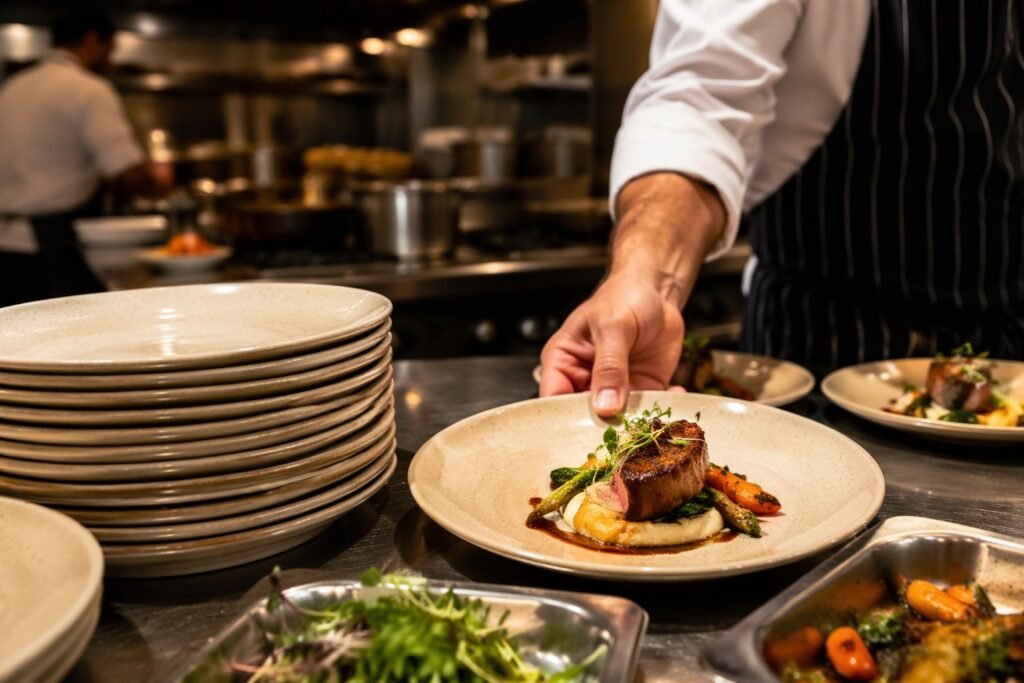
5. Surface Finish: Glossy vs. Matte and the Scratch Reality
The surface finish of wheat straw plates wholesale is a strategic decision, not just an aesthetic one. Here is what I tell every B2B buyer who asks about “glossy vs. matte.”
Glossy (High-Polish Mold Finish)
- Appearance: Mirror-like sheen, similar to ceramic glaze.
- Advantage: Looks premium on the retail shelf. Photographs well for e-commerce.
- Disadvantage: Shows every micro-scratch from cutlery within 2-3 months of use. Restaurant managers hate glossy plates because they look “worn out” too fast.
- Best For: Gift sets, wedding registries, display pieces.
Matte / Satin (EDM Texture Finish, Grain 18-24)
- Appearance: Soft, natural stone-like texture.
- Advantage: Hides 90% of cutlery marks. Maintains its “new” look for 2+ years.
- Disadvantage: Slightly harder to clean if food is baked on (requires a brief soak).
- Best For: Everyday dinnerware, restaurant service, kids plates, school cafeterias.
The “Naike Recommendation”
For 80% of our dinner plates supplier contracts, we recommend a Satin Finish with EDM Grain 21. It provides the best balance of visual appeal, scratch hiding, and cleanability. If the client insists on glossy, we apply a post-molding “Flame Polishing” pass to seal the surface and slightly improve scratch resistance.
6. Container Loading Math: How Many Plates Fit?
Plates are volume-efficient but weight-inefficient. Understanding the loading math is critical to calculating your landed cost.
Standard 40HQ Container Loading
| Plate Type | Nested Height (per plate) | Plates per Carton | Cartons per Pallet | Total per 40HQ |
|---|---|---|---|---|
| 10″ Dinner Plate (2.5mm) | 8mm | 48 (4 stacks of 12) | 24 | ~23,000 plates |
| 8″ Salad Plate (2.2mm) | 7mm | 48 (4 stacks of 12) | 24 | ~28,000 plates |
| Kids Divided Plate | 14mm | 24 (2 stacks of 12) | 24 | ~14,000 plates |
The “Freight Weight” Warning
A container of 23,000 dinner plates at 200g each weighs 4,600 kg of product alone — plus 1,200 kg of packaging. The total is approximately 5,800 kg, safely within the 40HQ payload limit of 26,000 kg. However, if you are shipping a mixed container with heavy items like ceramic mugs or glassware, the plate weight adds up fast. Always request a loading plan from your supplier before confirming the shipping method.
Our Container Loading Plan Guide provides the full calculation methodology.
7. B2B Buyer Checklist: Before You Order Wheat Straw Plates
Print this checklist and require your dinner plates supplier to address every point before you commit to a purchase order.
Material and Construction
- PP-to-Fiber Ratio:Confirmed at 65:35 or 60:40? (Higher fiber = more brittle).
- Wall Thickness:Measured and within tolerance (± 0.2mm) at rim and center?
- Weight Consistency:Spot-checked 10 random plates from production? All within ± 5g?
- Color Match:Delta-E ≤ 3.0 vs. approved Pantone under D65 and TL84 lighting?
- Surface Porosity:Passed the 24-hour soy sauce stain test with zero residue?
Safety and Compliance
- BPA-Free Certificate:From an ISO 17025-accredited lab, dated within 12 months?
- Heavy Metals Screen:Lead, Cadmium, Mercury, Chromium VI — all ND?
- LFGB or FDA Report:Covers the exact SKU and color being ordered?
- Microwave Test:5 cycles at 800W with fatty food — no warping, no odor?
- Dishwasher Test:50 cycles at 70°C — no color fade, no gloss loss?
Logistics and Packaging
- Loading Plan:Provided for your container size? Weight and volume calculated?
- Packaging Drop Test:Retail box passed 1.2m drop on 6 sides and 4 corners?
- Barcode Scan:EAN/UPC verified with a GS1 scanner app on the final proof?
8. Regional Market Preferences: Who Buys What Size
If you are a global dinner plates supplier, your product mix must adapt to regional dining habits. Here is what our export data shows across four key markets.
North America: Bigger is Better
The standard American dinner plate is 10.5″ – 11″ (265mm – 280mm). Portion sizes are larger, and the “charger plate” (a decorative base plate placed under the dinner plate) is still common in fine dining. For Amazon FBA sellers, the 10″ plate is the volume leader, but the 8″ salad/dessert plate is the highest-margin add-on in bundle sets.
European Union: The “Starter-Main-Dessert” Trio
European retailers typically order matched sets of three plate sizes:
- 19cm (7.5″) — Dessert / Bread plate
- 23cm (9″) — Starter / Salad plate
- 27cm (10.6″) — Main course plate
The EU market demands full LFGB compliance and increasingly requires the “Glass and Fork” food-contact symbol molded into the bottom of the plate, not just printed on the packaging.
Middle East: The Sharing Platter Economy
In GCC countries, large communal platters (30cm – 35cm / 12″ – 14″) are in high demand for family-style dining. These oversized plates push the limits of injection molding and require a 3.5mm+ wall thickness to prevent warping. They also typically use bolder, jewel-tone colors rather than the muted Nordic palette popular in Europe.
Japan & SE Asia: Compact and Stackable
Japanese retailers prefer smaller, lighter plates — 15cm – 20cm (6″ – 8″) — that fit compact kitchen storage. Stackability is the #1 purchase driver. Plates with a steep draft angle (7°+) that nest tightly command a premium in this market.
9. Plate Packaging: Protecting Flat Product in Transit
Plates have a large surface area and thin profile, making them uniquely vulnerable to transit damage. Unlike bowls, which can absorb impact through their curved structure, a flat plate transmits shock directly across its surface.
The “Interleaving” Requirement
Every plate in a wholesale carton must be separated by a layer of:
- Acid-free tissue paper (for retail sets) — prevents micro-scratching during vibration.
- 0.5mm PE foam sheet (for e-commerce / FBA) — absorbs impact and passes the ISTA 6 drop test.
- Corrugated divider grid (for commercial bulk) — creates individual cells for each plate.
The “Top-Load” Compression Test
A master carton of plates at the bottom of a pallet must withstand 200kg of vertical compression without collapsing. We test every new carton design by placing a 200kg steel plate on top for 24 hours and measuring the deformation. If the carton compresses by more than 5mm, we increase the flute weight.
For full packaging specifications, see our Retail Packaging for Wheat Straw Dinnerware Sets guide.
10. The “Sectioned Plate” Innovation: What’s Selling in 2026
The fastest-growing niche within wheat straw plates wholesale is the Adult Sectioned Plate — essentially a bento-style dinner plate with 3-4 compartments for portion-controlled meals. This trend is driven by:
- Meal-prep culture: Consumers pre-portion proteins, carbs, and vegetables.
- Weight management programs: Portion-control plates are prescribed by nutritionists.
- Senior living facilities: Sectioned plates help residents with motor difficulties keep food separated.
Engineering Challenge
Adult sectioned plates are larger (280mm+) and have deep dividing walls (15mm – 20mm). The challenge is “Warp at the Weld Line” — where the dividing wall meets the outer rim, the material cools at a different rate, causing a visible distortion. We solve this with a “Hot Runner Valve Gate” system that delivers consistent melt temperature to every corner of the mold.
For brands interested in developing custom sectioned plates, our Private Label Dinnerware Guide walks through the full OEM process.
11. Common Wholesale Plate Defects and How to Spot Them
In our QC bay, we classify plate defects into three categories. Here is what your inspector should flag during a Pre-Shipment Inspection:
Critical Defects (Reject Entire Batch)
- Sharp Flash on Rim: A razor-thin plastic edge that can cut a finger or lip. Caused by worn mold parting lines.
- Fiber Charring: Black or dark-brown burnt spots > 1mm on the eating surface.
- Foreign Material: Embedded metal, wood, or non-food plastic visible in the material.
Major Defects (Sort and Rework)
- Warp > 2mm: Plate wobbles on a flat surface. Caused by uneven cooling or insufficient annealing.
- Color Drift > ΔE 5: Plate color visibly different from the approved Golden Sample.
- Short Shot: Incomplete filling of the mold — a missing section of the rim.
Minor Defects
- Surface Scuffing: Light scratches from handling, removable with a quick polish.
- Slight Gloss Variation: A 10mm patch with a slightly different sheen.
12. Detailed B2B Buyer FAQ: The “Plate Edition”
Q: Can wheat straw plates be used in a microwave with a metal trim or decorative rim? A: Never. Any metallic element — even a thin gold or silver decorative rim — will arc in a microwave and destroy both the plate and the appliance. If your brand aesthetic requires a metallic look, use a “Microwave-Safe Metallic-Effect Pigment” (mica-based, not actual metal), and verify it with a microwave arc test before production.
Q: What is the minimum order quantity (MOQ) for custom plate molds? A: For a new custom plate mold, the typical MOQ is 3,000 – 5,000 units per SKU to amortize the tooling cost. However, if you use an existing mold from our catalog and only customize the color and logo, we can accept orders as low as 500 – 1,000 units. Browse our existing mold catalog to see what is available without tooling investment.
Q: Can I mix different plate sizes in one container? A: Yes, and you absolutely should. A container of only large dinner plates hits the weight limit inefficiently. The ideal mix for a 40HQ is approximately 40% dinner plates, 35% salad/dessert plates, and 25% bowls or cups to balance weight and volume.
Q: The sample plate has a slight “earthy” smell. Is this normal? A: A very faint, neutral “plant-based” scent is normal for wheat straw products straight out of the packaging. It dissipates completely after one wash. However, if the smell is acrid, chemical-like, or intensifies when the plate is heated, that indicates incomplete degassing of the material — a manufacturing defect. Reject the batch and request a hot migration re-test.
Q: Do you offer “Deep Plates” (pasta bowls / rimmed soup plates)? A: Yes. A deep plate has a 30mm – 45mm raised rim on a 220mm – 250mm diameter, combining the wide surface of a plate with the liquid containment of a shallow bowl. These are increasingly popular for “bowl-food” concepts (ramen, pasta, poke). They require a more complex mold with a collapsible core or side-action slide. Contact us for a custom deep plate quotation.
13. Sustainability Claims for Plates: What You Can (and Can’t) Say
As a dinner plates supplier, you have a legal and ethical obligation to make accurate sustainability claims. Here is what our compliance team approves for wheat straw plate marketing:
Approved Claims (with Evidence)
- ✅ “Made with 35% natural wheat straw fiber” — backed by material composition certification.
- ✅ “BPA-Free and Phthalate-Free” — backed by ISO 17025 lab report.
- ✅ “Reduces virgin plastic use by 35% compared to standard PP tableware” — mathematically verifiable.
- ✅ “Dishwasher safe for 300+ cycles” — backed by EN 12875-1 test data.
Claims to Avoid (Risk of Greenwashing)
- ❌ “100% Biodegradable” — wheat straw + PP composite is recyclable, not biodegradable.
- ❌ “Plastic-Free” — the PP binder is a plastic; “Reduced Plastic” is accurate.
- ❌ “Compostable” — only applies to specific PLA or PBAT blends, not standard wheat straw + PP.
- ❌ “Carbon Neutral” — unless you have a certified carbon offset program with audit trail.
For a detailed breakdown of compliant marketing language, see our Lifecycle Claims for Wheat Straw Tableware guide.
14. The ROI of Quality: Why Cheap Plates Cost More
Let’s run the numbers on a typical B2B plate order.
| Scenario | Low-Cost Supplier | Quality Supplier (Naike) |
|---|---|---|
| Unit Price | $0.55 | $0.72 |
| Order Quantity | 20,000 plates | 20,000 plates |
| Total FOB Cost | $11,000 | $14,400 |
| Defect Rate (AQL) | 8% (Major defects) | 1.5% |
| Usable Units | 18,400 | 19,700 |
| Effective Cost per Usable Unit | $0.60 | $0.73 |
| Retail Return Rate | 5% (warping, odor complaints) | 0.5% |
| Cost of Returns (at $4.99 retail) | $4,590 | $490 |
| Brand Reputation Impact | Negative reviews, listing suppression | 4.5+ star average |
The $0.17 difference in unit price disappears when you account for defects, returns, and brand damage. The quality supplier delivers a lower Total Cost of Ownership — the metric that actually matters.
Conclusion: Your Plate Defines Your Brand
In the eco-tableware market, the plate is the hero product. It sits at the center of every dining table, every Instagram post, and every customer review. When you source wheat straw plates wholesale from a manufacturer who understands the engineering behind the aesthetics, you are not just buying inventory — you are building a brand that customers trust and retailers reorder.
At Naike Dinner, we manufacture plates that survive the real world: the toddler’s highchair, the restaurant’s dishwasher, and the customer’s microwave. We provide the material data, the test reports, and the loading plans to back up every specification we quote.
Ready to Get Your Plate Specifications?
Whether you need a standard 10-inch dinner plate, a custom divided kids plate, or a commercial-grade restaurant plate, we can provide the full technical specification and a competitive wholesale quotation within one business day.
👉 Request Plate Specifications & Wholesale Quote
👉 Browse the 2026 Wheat Straw Dinnerware Catalog
👉 Read: Pre-Shipment Inspection Checklist for Tableware Buyers
CONTACT US
Shared Serving Pieces vs Individual Place Settings for Group Camping
A procurement framework for deciding which camping dinnerware components should be issued per person and which should remain shared across a group.
How to Prevent Rattle in a Nested Camping Dinnerware Set
A practical diagnostic for finding and controlling movement, impact and rubbing inside nested camping dinnerware sets without hiding problems behind unsupported claims.
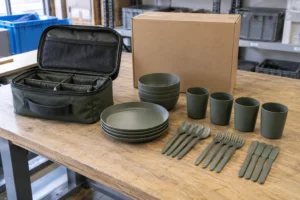
How to Calculate Pack Volume for Camping Tableware
A practical procurement worksheet for measuring the complete camping tableware sales unit, calculating its external cube and separating real pack efficiency from unsupported freight claims.
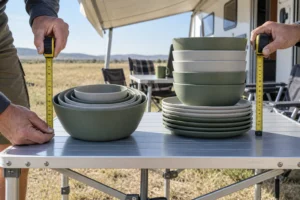
Nesting vs Stacking: How the Two Designs Change Pack-Out
A buyer-focused geometry and pack-out comparison for choosing nested, stacked or hybrid camping dinnerware systems without confusing compact appearance with approved performance.
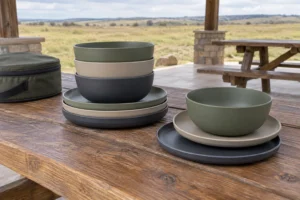
What Makes Camping Dinnerware Truly Stackable?
A procurement acceptance framework for reviewing stack rise, contact interfaces, separation, stability, mixed-component order, drainage and retained pack-out.
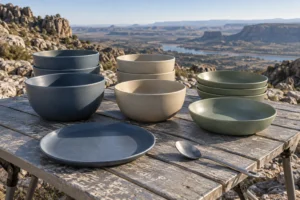
Deep Bowls vs Shallow Bowls for Outdoor Meal Sets
A procurement decision table for selecting deep and shallow camping bowl profiles by meal function, user access, stability, cleaning and packed-set architecture.