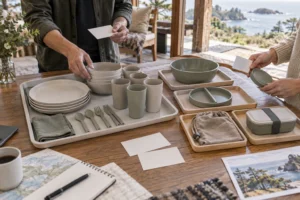
The existing component or new mold decision starts with the buyer brief. Reuse is suitable only when geometry, material, finish, interfaces, intended use and evidence scope already match. A new mold or another development route is needed when a required function depends on changed geometry or a controlled interface. Approve the matrix before requesting drawings, samples or quotations.
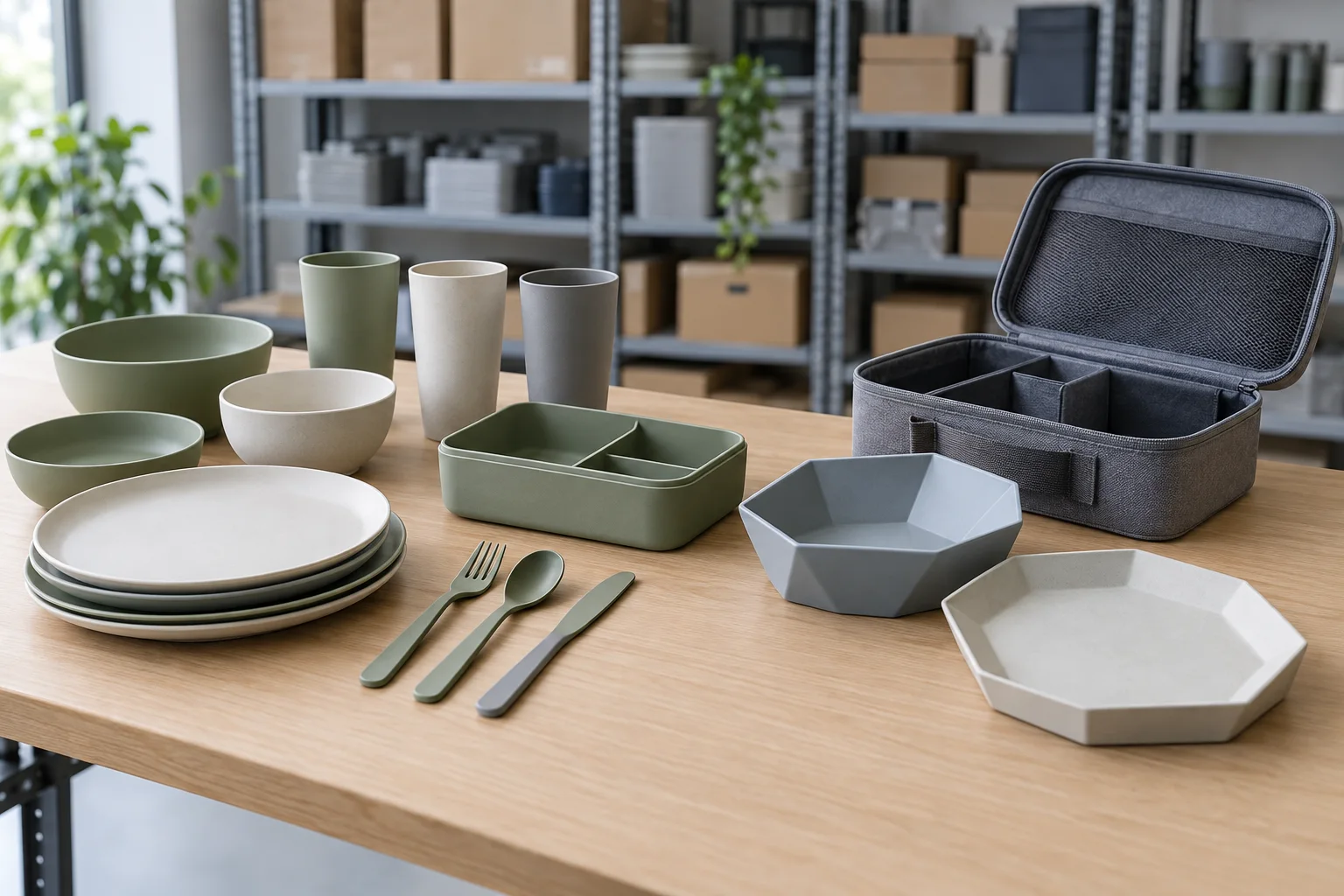
Define the boundary by decisions, not by appearance
“Can we use an existing part?” sounds like a simple cost question, but it is actually a system question. A plate may look close to the target while its rim prevents nesting, its base moves in the proposed carrier, or its available evidence does not cover the intended food, temperature, color or decoration. Conversely, a buyer may assume that an unfamiliar set requires a new mold when the commercial objective can be met by combining existing components with a new insert, case or pack-out. The new mold question should therefore be answered at component level, not from the set silhouette alone.
Start with the actionable brief described in the custom outdoor set brief template. Fix the users, meals, component roles, pack envelope, target markets, intended food-contact conditions, branding and open decisions. Then assess each component separately. The set name is not the decision unit; the plate, bowl, cup, lunch box, cutlery, lid, divider, insert and carrier are.
The decision should produce one of four states: reuse as-is, reuse with packaging or carrier adaptation, supplier-controlled modification requiring written confirmation, or new component development. Do not translate those states into cost, MOQ or timing assumptions. Tool type, ownership, commercial terms, feasibility and schedule must be confirmed in a written quotation for the actual project.

Use the existing component or new mold decision matrix
Complete the matrix with drawings, samples and written supplier responses. “Existing” should identify a specific controlled component and revision, not a generic catalog description. “New” should identify the exact change that creates the need for development.
| Decision field | Evidence that supports reuse | Trigger for new development or tooling review | Buyer approval record |
|---|---|---|---|
| Functional role | The existing part performs the same eating, drinking, serving or storage role under the stated use conditions. | The brief adds a function such as a divider, retention feature, handle, lid interface or controlled nesting relationship. | Role, intended users, foods, temperatures and cleaning method. |
| Geometry and dimensions | Drawing and physical sample meet the approved envelope, grip, capacity role and stack or nest requirement. | Diameter, wall, rim, base, handle, profile or compartment geometry must change. | Revision-controlled drawing plus measured sample review. |
| Component interfaces | The item fits the other approved parts, insert and case without interference or uncontrolled movement. | A mating feature, latch, locating surface, seal, clip, divider or retention point must be created or moved. | Interface map and complete loaded pack-out. |
| Material and finish | Material identity and finish already match the buyer’s documented requirements and evidence request. | A different material, blend, coating, texture or finish is needed to achieve the brief. | Material declaration, sample revision and evidence scope. |
| Color and decoration | An available controlled color and permitted decoration location meet the artwork brief. | The requested color, pigment, ink, adhesive or marking method changes the approved evidence or process. | Color standard, artwork file, location map and signed sample. |
| Evidence and claims | Documentation matches the exact component, material, color, decoration, market and intended use. | The proposed change falls outside the report, declaration or authorization scope. | Evidence-gap list with owner and due decision. |
| Carrier and packaging | An insert or bag change can secure the existing component within the approved outer envelope. | The component itself must change because package adaptation cannot resolve access, clearance, balance or retention. | Loaded case review and pack-out instruction. |
| Commercial control | The supplier identifies the existing component, revision, availability assumptions and exclusions in writing. | Special ownership, exclusivity, tooling, validation, replacement or revision-control terms are required. | Normalized quotation and responsibility register. |
The matrix prevents a false binary choice. A new carrier insert can sometimes accommodate an existing plate without changing the food-contact component. In other cases, changing only the insert would create poor access or uncontrolled contact, so a new geometry may be justified. The decision belongs to the complete system review.
Check interfaces before approving a reused part
A component can pass an isolated visual review and still fail in the set. Map every surface or feature that touches, locates, covers or restrains another part. Include plate-to-plate nesting, bowl-to-plate stacking, cup-to-pocket clearance, lid-to-container fit, cutlery-to-food-contact separation, lunch-box-to-case retention and case closure over the complete load.
Use the component-to-case fit checklist to record clearance, extraction path, loaded closure and movement. Use the modular component interface map when the same part is expected to work across several configurations. Compatibility to be confirmed by project sample and drawing.
Do not infer a dimension from a rendering. Record the drawing revision, measurement method and sample identification. The NIST explanation of measurement traceability is useful for understanding why a value needs an unbroken documented relationship to references; it does not validate any measurement or component shown here.
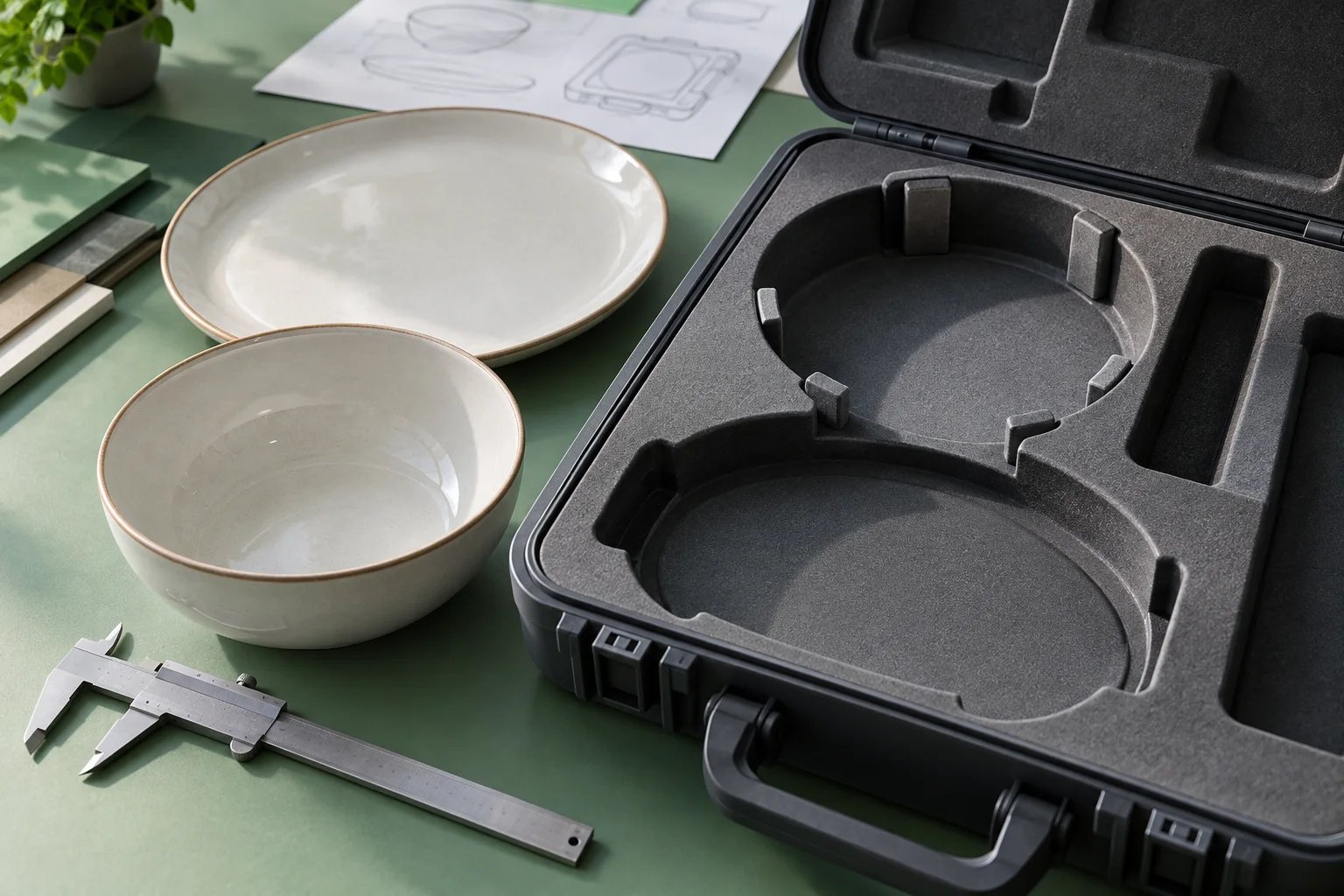
Reuse does not automatically transfer evidence
Food-contact review follows the actual article, substance and conditions of use. The US FDA overview of food-contact substances explains that authorization concerns substances used in food-contact applications. In the European Union, Regulation (EC) No 1935/2004 provides the general framework, while material-specific measures may add requirements. These sources establish review boundaries; they do not certify a supplier, concept image or proposed set.
An existing bowl in a different color, decoration or intended temperature may need a new evidence review even when its mold is unchanged. A new mold made from an already used material still creates a new finished geometry that must be assessed against the intended use and applicable requirements. Separate the new mold decision from the evidence decision; they are related but not interchangeable.
Request a component-level evidence index. Each row should identify the part, material, color, decoration, intended food contact, temperature and cleaning conditions, destination market, document reference, document scope and any gap. Do not use the broad phrase “same material” as a substitute for a matched record.
Apply the matrix to common sourcing scenarios
Existing dinnerware with a new carry case
Reuse may be appropriate when the dinnerware already meets the functional and evidence brief. The development task then shifts to insert geometry, access order, retention, drying and loaded balance. Approve the case against physical components rather than a nominal diameter list.
Existing plate and bowl with a new cup
A cup may require new development because its handle or height controls the entire pack envelope. Before accepting that conclusion, test whether an existing handleless cup, a different pocket position or an adjusted place-setting matrix solves the buyer problem without compromising use.
New visual language across every component
A distinctive rim, asymmetric profile or coordinated locating feature can push several parts toward new geometry. Record which visual features are essential to brand recognition and which can be expressed through controlled color, decoration, bag structure or packaging. Otherwise, aesthetic preference can expand into unnecessary tooling scope.
Retail assortment using a common core
Reusing controlled components across several set sizes can simplify replacement and comparison, but only if interfaces and revision control remain stable. Record the component identifier, permitted configurations and consequences of substitution. A silent supplier replacement can affect fit, evidence, artwork and pack-out even when the retail piece count is unchanged.
Commercial risks at both extremes
Forcing reuse can create a compromised product: poor nesting, excess case volume, awkward grip, visible gaps, unstable retention or an evidence mismatch. Forcing new tooling can create unnecessary development scope, more revisions, more samples and added responsibility questions without improving the buyer’s actual use case.
Other risks include approving a concept before the supplier identifies which components are controlled and available; assuming a mold change alone delivers the required function; mixing tooling ownership with product exclusivity; and accepting a quotation that combines existing and new parts without line-item assumptions. Unknown values should be marked “To be confirmed for the project.”
Do not approve claims such as leakproof, dishwasher-safe, microwave-safe, fire-safe, ultralight or direct-flame suitable from geometry alone. Dinnerware and cookware remain different product roles. This decision matrix covers plates, bowls, cups, cutlery, lunch containers and carriers; it does not establish burner or cookware performance.

B2B Buyer Checklist
| Check | Buyer question | Required record |
|---|---|---|
| Brief | Are users, meals, component roles, pack envelope and target markets fixed? | Approved buyer brief and open-decision list. |
| Existing component identity | Which exact component and revision is being offered? | Drawing, sample ID and supplier confirmation. |
| Geometry | Does the physical sample meet grip, use, nest, stack and case requirements? | Sample review and measured interface map. |
| Evidence | Does documentation match material, color, decoration, market and intended use? | Component evidence index and gap list. |
| Tooling trigger | Which required function cannot be achieved with controlled existing parts or packaging adaptation? | Reuse-versus-tooling matrix with rationale. |
| Commercial scope | Are tooling, samples, validation, ownership, replacement and exclusions separated? | Written line-item quotation and responsibility register. |
| Approval | Can the final choice be traced to the same drawing, sample, BOM and pack-out? | Revision-controlled approval record. |
Buyer FAQs
Does a different color require a new mold?
Not by itself. A new mold is a geometry and tooling decision, while colorant, finish, appearance standard and evidence scope still require review for the actual component and market.
Can an existing component be modified without new tooling?
Sometimes, but the supplier must identify the process, permitted tolerance, tooling implication and evidence impact in writing. Do not assume that a “small” geometry change is commercially or technically minor.
Should the buyer start with a catalog component?
A catalog component can be a useful reference when its controlled drawing, sample, availability and intended-use evidence are available. A catalog photo alone is not enough.
Can a new insert avoid changing the dinnerware mold?
It may, if the insert resolves retention, access, protection and closure without compromising the complete set. Verify with the actual loaded case.
Does owning a mold mean the product is exclusive?
Not automatically. Ownership, use rights, maintenance, storage, revision authority and exclusivity are commercial terms that need explicit written agreement.
When should quotations be compared?
After each supplier prices the same component matrix, existing/new status, sample scope, evidence responsibilities, packaging and exclusions. Different assumptions are not comparable quotations.
Request a reuse-versus-tooling review
Send the intended users, component matrix, drawings or reference samples, pack envelope, target markets, use conditions, branding and packaging brief. Naike Dinner can review which decisions appear compatible with existing components and which require project-specific feasibility, tooling or evidence confirmation.
Contact Naike Dinner with your component matrix or request a written sample and tooling-scope review.