
A replacement piece needs its own SKU when buyers must order, stock, identify, price, trace or approve it independently from the complete set. A camping dinnerware replacement SKU is usually unnecessary for an internal packing spare that never leaves the set program separately. Make the decision from the service route, revision risk and evidence boundary—not from component size alone.
Start with the replacement promise
First define what “replacement” means in the program. It may be a retail spare sold by itself, a service part supplied after damage, a rental-fleet replenishment item, a warranty component, or an internal reserve used only during final assembly. These routes create different identity and recordkeeping needs.
The buyer should also separate an internal SKU from a market identifier. A company can create a camping dinnerware replacement SKU for inventory control without automatically deciding that the item needs a new barcode or GTIN. Barcode allocation follows the applicable channel and the official GS1 General Specifications; the internal SKU decision remains a commercial and operational control.
Use the six-rule replacement SKU decision tree
Walk through the rules in order. A “yes” does not prove that every organization must use the same code structure, but it identifies when a separate record is safer than hiding the component under the master-set SKU. Record the answer, owner and revision rather than relying on a verbal service policy.
| Decision rule | Question | Usually create its own SKU when… | Buyer record |
|---|---|---|---|
| 1. Independent order | Can a customer, distributor or service team request the piece without the complete set? | The item appears on an order, service ticket or replenishment list by itself. | Orderable-part status and channel |
| 2. Separate inventory | Will stock quantity, reorder point or location be managed independently? | The warehouse must count and replenish the component separately. | Stocking location and unit of issue |
| 3. Revision risk | Can an old and new version look similar but fit differently? | Compatibility depends on host-set or interface revision. | Approved host/replacement pairing |
| 4. Evidence boundary | Does the component need its own material, color, use-condition or market evidence? | The replacement may be supplied outside the complete set evidence file. | Evidence index and intended use |
| 5. Commercial treatment | Is the piece quoted, priced, packaged or labeled separately? | The service or retail offer has its own commercial record. | Quotation line and packaging brief |
| 6. Return diagnosis | Must returns or failures be traced to this component? | The team needs component-level cause, revision and disposition data. | Return reason and corrective-action link |
If every answer is “no” and the piece is only an assembly reserve consumed under the master-set record, a separate orderable SKU may add complexity without improving control. Keep it as a controlled BOM line or internal component code. If any answer is “yes,” document why a camping dinnerware replacement SKU is or is not required before launch. The decision record should name the service owner and the evidence used.
Do not let visual similarity replace revision control
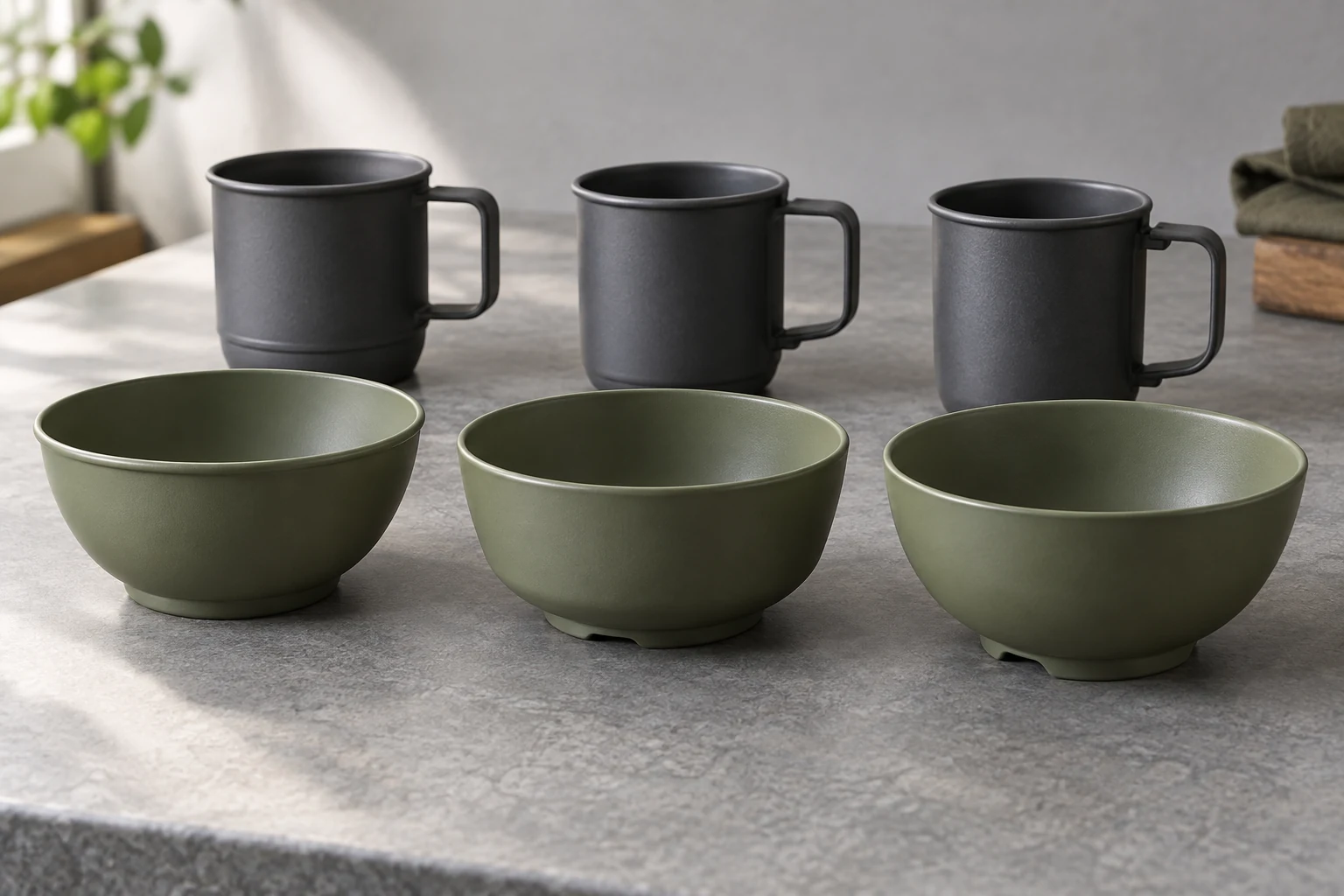
A spare bowl can match the set color and still have a different locating foot, nesting clearance, rim profile or packed height. A cup can share the same nominal capacity while its handle interferes with a divider. Replacement approval therefore needs the same host/component pairing discipline used for cross-size module compatibility.
Where fit can change, the camping dinnerware replacement SKU should identify the component revision or point to a compatibility record that does. Do not promise “fits all versions” because two samples look alike. Compatibility to be confirmed by project sample and drawing.
Choose the right control for each service scenario
Retail and distributor replacement sales
An independently sold plate, bowl, cup, lid or cutlery cassette normally needs a stable order reference, pack description and channel record. The retail team also needs a clear boundary between the replacement item and the complete set. Whether a separate GTIN is required depends on the applicable GS1 and channel rules, not simply on the existence of an internal SKU.
Rental, hospitality and activity fleets
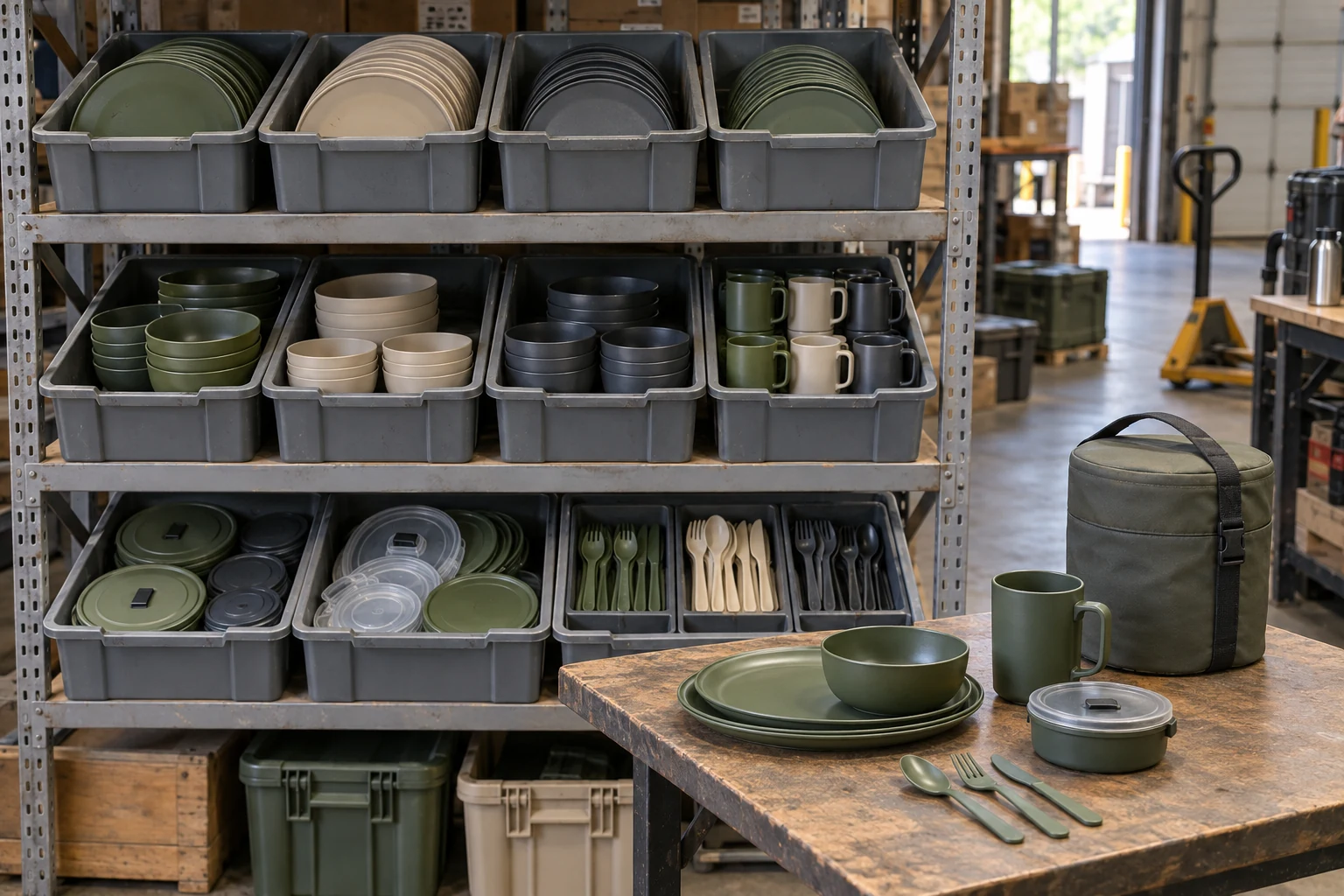
Fleet operators often replenish losses from bulk service stock rather than consumer packs. A separate component SKU can support counts, loss analysis and purchasing even when the item has no consumer-facing barcode. Link the record to the missing-piece audit method so the ordered unit matches the counted unit.
Warranty and after-sales service
If a service agent must diagnose a failed lid, cup or case insert, a separate identity helps prevent the wrong revision from being sent. The service record should capture the master-set identity, component identity, visible failure, requested quantity and compatibility evidence. A photograph alone is useful context but not a substitute for revision confirmation.
Assembly reserves and packing-line spares
An internal reserve may remain a BOM-controlled component when it is never ordered, priced or packaged independently. It still needs a defined part identity and revision, but that identity does not have to become a public replacement offer. Review how the part sits within the core and add-on component architecture.

Keep identification, safety and claims aligned
A replacement component can create a new evidence gap when its material, color, decoration, construction or intended use differs from the approved set. The internal SKU record should point to the actual evidence used for the supplied revision. It should not inherit a complete-set claim automatically.
In the European Union, the General Product Safety Regulation establishes product identification and traceability duties within its scope. The UK government’s product-safety guidance for businesses likewise explains producer and distributor responsibilities. These sources do not decide a company’s SKU format, but they show why product identity, responsible records and supplied revision must remain aligned.
Control the commercial handoff
A buyer-ready replacement record should state the service route, unit of issue, host-set revisions, component revision, color or finish, packaging status, evidence reference and permitted claims. Unknown commercial fields remain “To be confirmed for the project.” Do not invent MOQ, price, stock availability or lead time simply because the component has a SKU.
Before releasing the offer, test the ordering language with someone outside the project team. They should be able to select the correct replacement from the master set, revision and component description without relying on private knowledge. If the choice is ambiguous, the SKU structure or compatibility table is not ready.
B2B Buyer Checklist
Use this checklist to decide whether each camping dinnerware replacement SKU has a clear operational purpose and an evidence boundary that the service team can maintain.
| Check | Question | Why It Matters |
|---|---|---|
| Service route | Who can request the component, through which channel? | Determines whether independent ordering identity is needed. |
| Unit of issue | Is one piece, one pair or one module the replenishment unit? | Prevents count and quotation errors. |
| Host compatibility | Which set and interface revisions accept the replacement? | Stops visually similar but incompatible parts from shipping. |
| Evidence scope | Which material, color and use-condition records cover the component? | Prevents unsupported inheritance from the complete set. |
| Packaging and identifier | Does the channel require separate packaging, labeling or GTIN? | Separates operational SKU needs from market identifiers. |
| Change rule | Which changes create a new SKU or compatibility review? | Keeps service stock aligned with current product revisions. |
Frequently asked procurement questions
1. Does every spare plate or cup need a separate SKU?
No. Create a separate SKU when the item must be ordered, stocked, traced, approved or commercially managed independently. An assembly-only spare can remain a controlled BOM component.
2. Is an internal SKU the same as a GTIN?
No. An SKU is an organization’s internal stock identity. A GTIN is a standardized trade-item identifier governed by GS1 allocation rules and channel requirements.
3. Can several colors share one replacement SKU?
Only if the organization can still supply the promised color or finish without ambiguity and the evidence scope remains correct. Otherwise, each camping dinnerware replacement SKU should preserve the color or finish distinction buyers actually order.
4. What if two revisions are interchangeable?
Record the approved interchangeability evidence and responsible decision. Do not merge revisions solely because they fit one sample.
5. Should replacement packaging match the complete set?
Not necessarily. It should protect the component and carry the information required by the selected channel and market. Structure and artwork are To be confirmed for the project.
6. When should a camping dinnerware replacement SKU be retired?
Retire or supersede it when no supported host revision remains, evidence expires or changes, or the service policy ends. Preserve the cross-reference for historic orders and returns.
Request a replacement-SKU review
Send the master-set component matrix, current SKU list, host and component revisions, service channels, packaging plan, target markets and evidence index. Naike Dinner can use the brief to discuss a camping dinnerware replacement SKU decision tree and the sample or drawing checks still required.
Request a specification review Review core and optional parts
For a written quotation or sample discussion, identify each separately orderable component through the Naike Dinner inquiry page. MOQ, price, tooling and lead time remain To be confirmed for the project.