Description
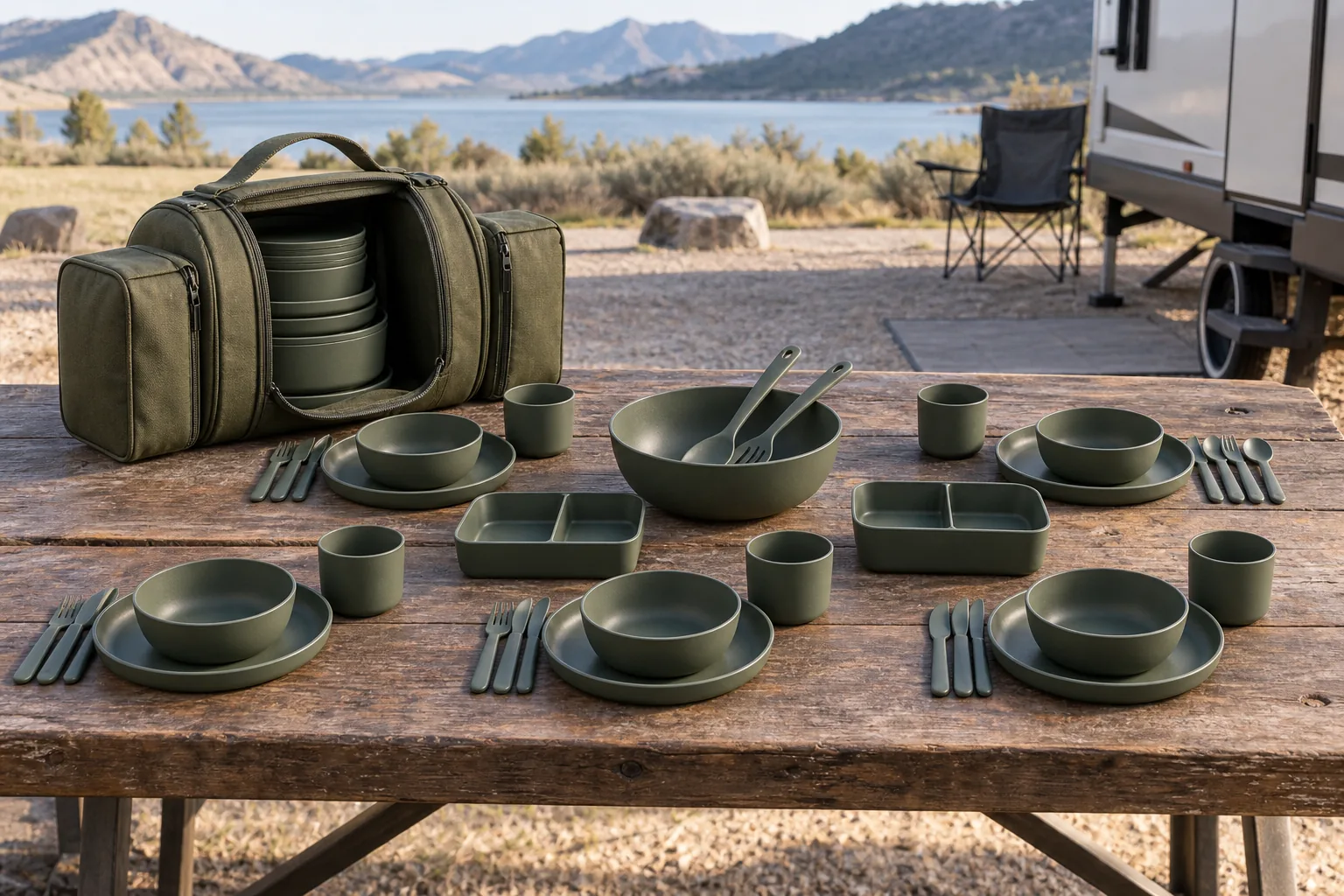
The Saddle-Pocket camping dinnerware set is a configurable six-user concept built around a cylindrical central nesting bay and two structured side pockets. It combines personal plates, bowls, cups and cutlery with divided lunch boxes and shared serving pieces. Final material, dimensions, quantities, colors, compatibility, packaging and performance are confirmed only through the project brief, drawings, samples and applicable evidence.
This page is an application and configuration illustration for B2B development. It does not represent a verified stock SKU, finished customer order, tested product, production claim or certification. Compatibility to be confirmed by project sample and drawing.
PRODUCT PARAMETER
| Product concept | Saddle-Pocket group camping dinnerware set |
|---|---|
| Reference users | Six-user configuration shown; final user count to be confirmed for the project |
| Personal components | Shallow plates, deep bowls, handleless cups and knife-fork-spoon groups; final quantity and geometry to be confirmed |
| Shared components | Serving bowl and serving utensils shown as a reference option |
| Food containers | Two divided lunch-box forms shown; closure, seal and intended-use requirements to be confirmed |
| Carry architecture | Cylindrical soft bag with central padded nesting bay and two structured saddle pockets |
| Material | To be confirmed for the project; every component must be matched to its intended use and evidence scope |
| Color and finish | To be confirmed for the project through controlled color and surface references |
| Size and weight | To be confirmed for the project after component and pack-out approval |
| SKU | To be confirmed for the project; this concept page does not assign a production SKU |
| Logo and artwork | Placement, process, color and approval method to be confirmed for the project |
| Packaging | Carry bag, protection, retail/e-commerce pack and master-carton plan to be confirmed |
| Target markets | Europe, North America, Australia and comparable B2B programs, subject to market-specific review |
| MOQ, price and lead time | Not stated; available only through a project-specific written quotation |
REFERENCE CONFIGURATIONS
Six personal modules
Six repeated plate, bowl, cup and compact cutlery groups support clear user allocation. Exact piece count remains tied to the buyer's menu, channel and pack limits.
Shared-service module
One serving bowl and a dedicated serving pair can be added when the meal plan includes communal food. Dinnerware is not cookware and is not presented for burner or flame use.
Lunch-box module
Two divided rectangular forms illustrate an optional packed-meal or food-organization role. Closure, leak, heat and storage claims require separate project evidence.
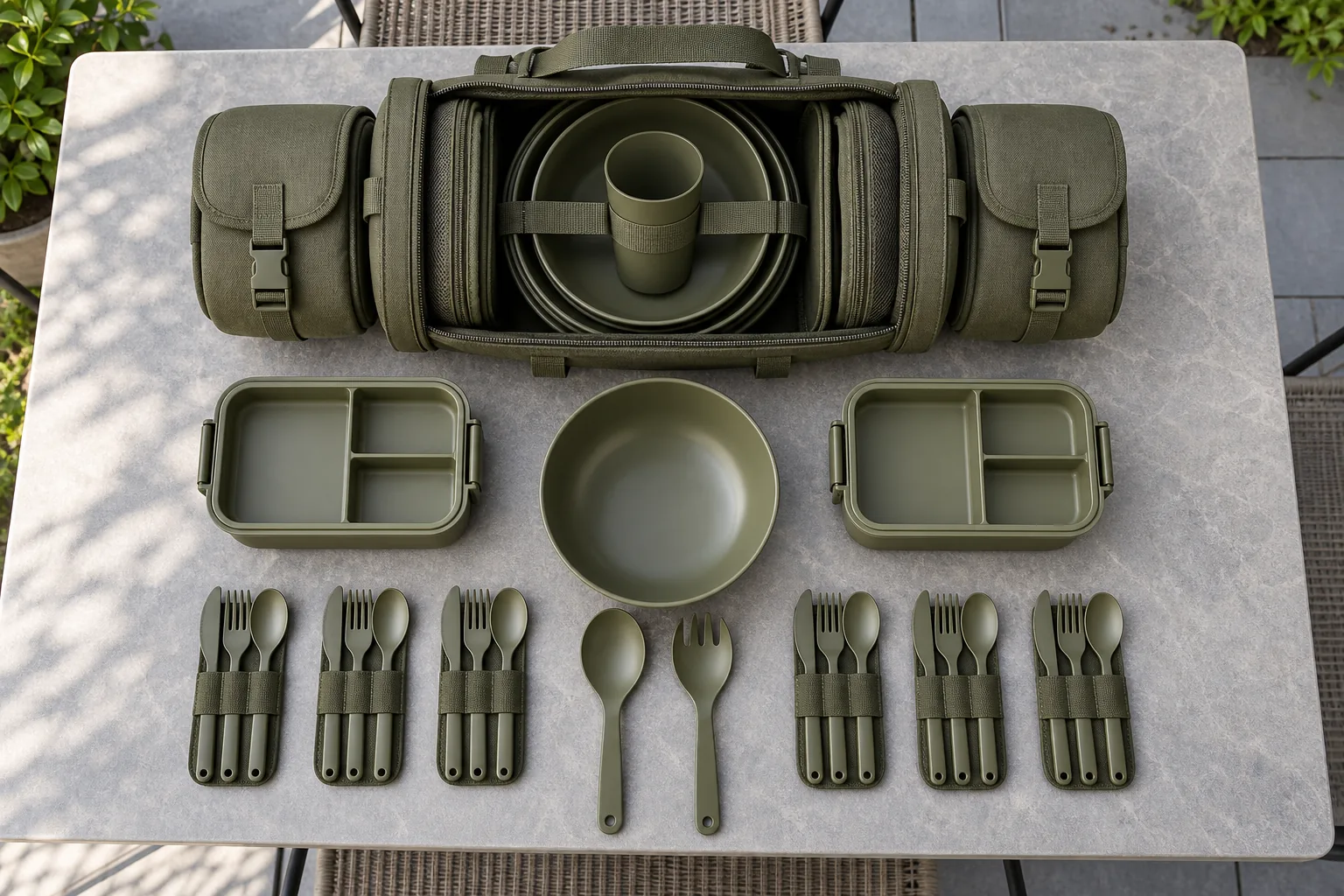
A different way to organize a group set
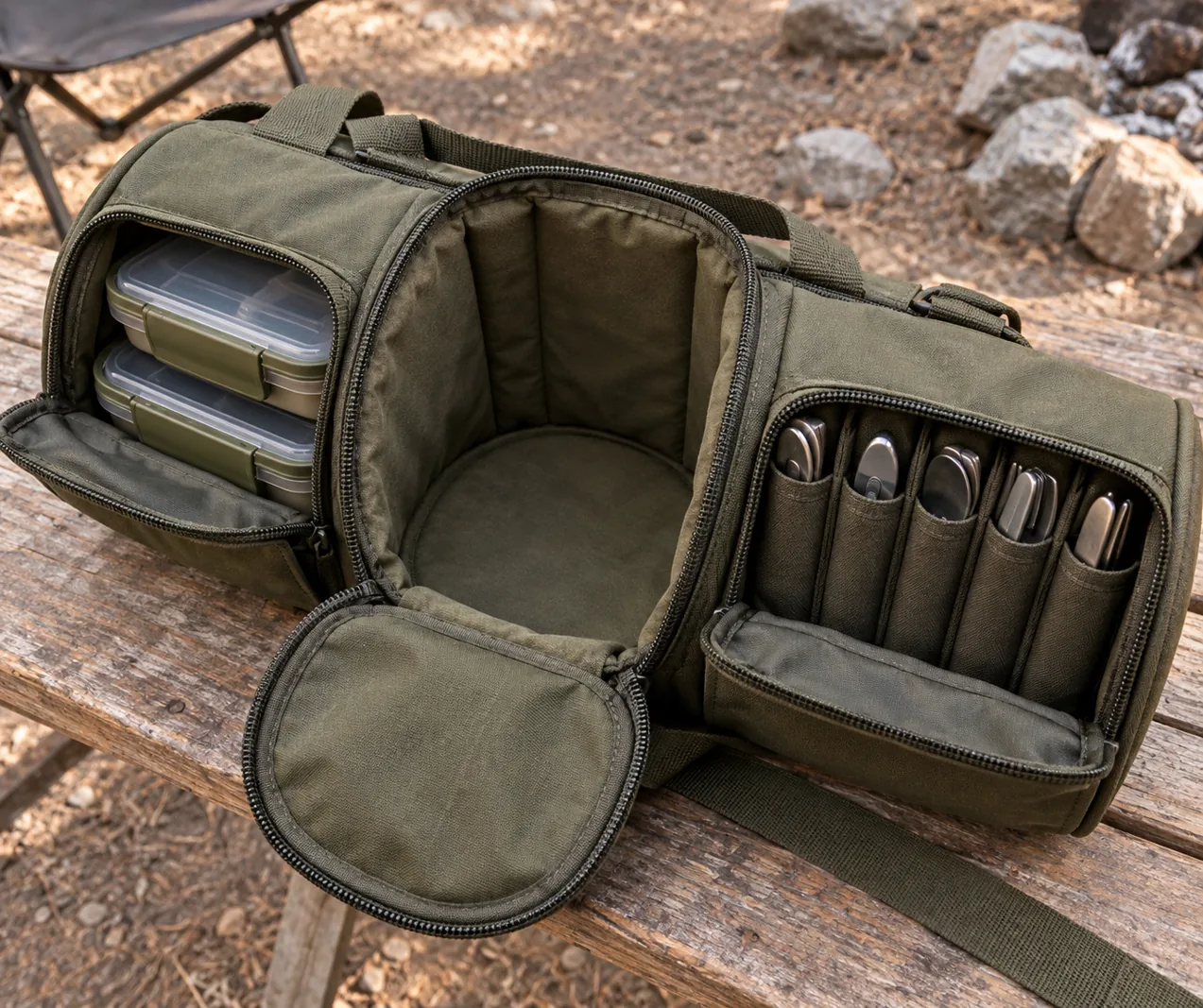
The defining feature is not the olive color or the outdoor background. It is the storage architecture: a padded central bay for the nested circular components, a structured pocket for flat lunch-box forms and a separate pocket with compact cutlery sleeves. The bag opens through several access zones rather than unfolding into wing panels or relying on crossed compression straps.
This concept creates a clear development question for buyers: should repeated personal dinnerware remain in one central nested core while irregular components use the side pockets? The answer depends on actual dimensions, weight distribution, access order and retention. A concept image cannot prove that the final set balances correctly when carried.
The cylindrical body may reduce unused corner space around round plates and bowls, while the saddle pockets can isolate shapes that do not nest. That is an engineering hypothesis to review in CAD and samples, not a quantified packing claim. Final external envelope and carton efficiency remain to be confirmed.
Build the component mix around buyer use
A buyer should begin with the user and meal matrix rather than a target number such as 20 or 24 pieces. Each supported user needs a defined eating surface, vessel, drinkware item and utensil group. Shared pieces should be added only where the approved meal plan gives them a clear role.
The published camping dinnerware component-list guide separates component roles before pack-out. Use that worksheet to decide whether the serving bowl, lunch boxes or extra utensils belong in the base set, an optional module or a channel-specific bundle.
For a compact retail program, the buyer may reduce shared pieces and emphasize repeated place settings. An organized-camp program may value distinct communal components and easy issue counting. A rental fleet may require replacement identifiers and storage positions that reveal missing pieces.
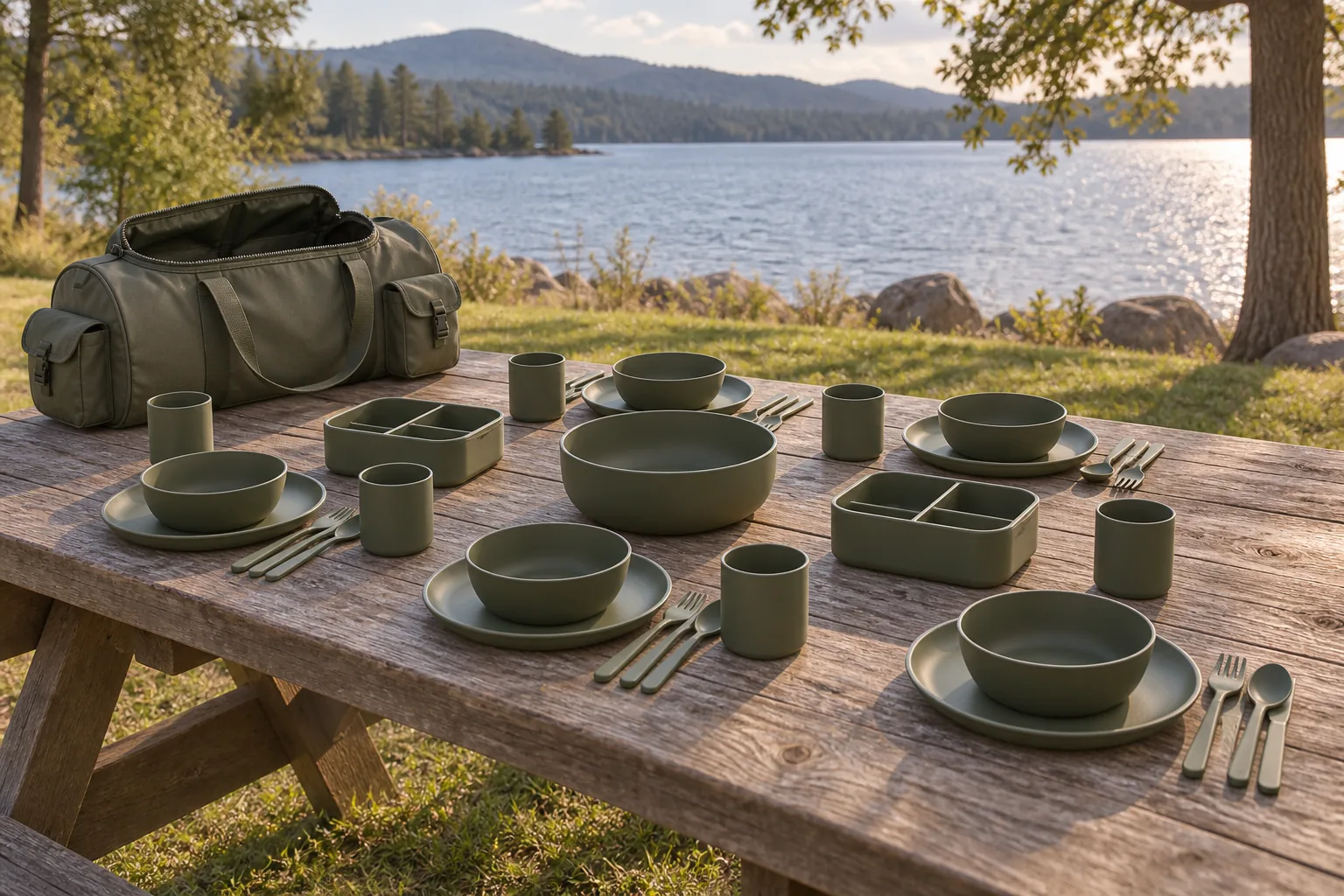
Central nesting bay
The central bay is intended to receive compatible round components in an approved order. Buyers should define the plate rim, bowl foot, cup profile, separators and maximum quantity before the bag dimensions are locked. Compatibility to be confirmed by project sample and drawing.
Nesting needs enough clearance for insertion, release and expected variation, yet not so much movement that pieces strike during carrying. Review the existing nesting versus stacking guide before deciding whether every repeated item belongs in the same core.
A removable padded liner or divider may improve counting and surface separation, but its material, attachment, cleaning and drying requirements must be controlled. Do not describe an unidentified textile or foam as washable, food safe, antibacterial or heat resistant.
Structured saddle pockets
The side pockets create separate homes for non-circular components. One illustrated pocket holds two divided lunch-box forms; the other organizes compact cutlery groups. Their final depth, closure path and reinforcement must be based on real components rather than image proportions.
Review whether loaded pockets make the bag unstable or difficult to carry. The preferred arrangement may change if lunch boxes are heavier than cutlery, if shared utensils are longer, or if the product must stand upright in retail storage. Weight distribution should be checked on the physical sample.
Every pocket adds sewing, hardware and assembly decisions. Ask for a construction drawing that identifies panels, lining, reinforcement, closures and attachment points. This does not imply a confirmed factory process or production capability.
Lunch boxes, serving pieces and boundary control
A divided lunch box is a food container, not automatically a cooking vessel. Do not imply that it is suitable for a microwave, dishwasher, freezer, oven, burner or direct flame unless the exact construction and claim have verified evidence. Unknown use conditions should remain open in the brief.
A shared serving bowl performs a table-service role. It should not be shown or described as cookware without specific verified support. Its size should follow the approved meal quantity and table layout rather than the visual desire for a centerpiece.
If lunch boxes or shared pieces are removed from a channel version, check how the empty pocket is controlled. An unfilled zone may allow movement or collapse. Optional fillers, removable partitions or a different bag size can be explored, but each alternative needs its own configuration review.
Customization and project-development options
Component architecture
Review plate, bowl, cup, cutlery, lunch-box and serving-piece roles as a controlled BOM.
Bag organization
Study central-core diameter, pocket allocation, separators, access order and carry balance.
Color and branding
Approve color references, artwork files, placement and process only after substrate review.
Packaging system
Develop protection, retail presentation, e-commerce handling and carton pack-out from the final configuration.
Existing component availability, new tooling feasibility and any mold-development requirement must be verified for the specific project. This page does not promise tooling, capacity, MOQ, price or lead time.
Logo, color and surface-control workflow
Provide vector artwork, intended placement, maximum print area, color reference and viewing priority. A logo that works on a broad bag panel may not reproduce consistently on a curved cup or textured component. Separate artwork approvals by substrate and process.
Use controlled physical or agreed digital color references for the bag, tableware and printed areas. “Olive” is not an adequate production specification. State whether coordinated components must match exactly or use an approved tonal system.
Decoration can change the compliance evidence needed for a food-contact article. Identify whether artwork is inside, outside, near a rim or on a bag only. Do not infer that one document covers every decorated component.
Material and compliance boundaries
Material selection must be confirmed component by component. A mixed set can include different polymers, metals, textiles, coatings, colorants, adhesives and closure hardware. The buyer should maintain an evidence index that maps each document to the final component and revision.
The European Commission provides primary information on food-contact materials. The U.S. electronic Code of Federal Regulations publishes Title 21 food provisions, and Australia's food regulator publishes food-packaging guidance. These sources help define market review; they do not certify this concept.
Request declarations, test reports or other records only when their scope matches the intended market, material, color, decoration and use condition. Never describe the set as compliant based on an image, a generic material statement or a document for another configuration.
Sample and pack-out approval
Approve the component matrix before sizing the bag. Then review a complete packed sample containing the exact quantities, permanent separators and intended accessories. Photograph the deployed and packed states with a configuration identifier.
Check closure without excessive force, access to first-use items, component movement, surface contact, carry balance and repacking sequence. These observations are buyer-defined acceptance inputs, not universal performance claims. Any formal transport or durability claim needs a separately scoped method.
Use the pack-volume calculation guide to record the final external envelope and compare it with carton planning. Do not add nominal component volumes as though nested parts remain separate.
Choose components as a coordinated system
Plate and bowl relationship
The plate rim, bowl foot and nested clearances should be developed together. A shallow plate may create a compact visual profile, while a deeper bowl can support more meal types; neither choice proves that the pair nests securely. Review the contact map, release path and full stack under expected dimensional variation.
If existing components are proposed, request their controlled drawings and physical samples before the bag is sized. If a new form is considered, define the functional reason, target interface and approval criteria before discussing tooling. A different silhouette alone is not a sufficient engineering brief.
Cup format
The illustrated handleless cup can fit a cylindrical nesting logic, but handle preference, beverage type, grip, rim and storage position remain buyer decisions. A handled cup may improve one use scenario while disrupting the central core. Compare both options in the deployed and packed layouts.
Capacity must not be estimated from an image. State the required use, then confirm nominal and usable capacity through project documents and samples. Any hot-drink or temperature claim requires material-specific evidence and a defined use condition.
Cutlery format
Compact knife, fork and spoon groups are shown in separate sleeves. Final length, edge profile, handle section, material, finish and user suitability remain to be confirmed. The sleeve must retain the approved geometry without exposing working ends or forcing users to drag surfaces against abrasive fabric.
Count every utensil by role. A serving spoon should not silently replace one user's eating spoon, and a knife should not be added merely to increase the headline count. The cutlery matrix should follow the destination market and approved menu.
Develop the bag without hiding construction risk
A cylindrical bag can look efficient around round components, but the actual outcome depends on seam allowances, padding, zipper paths, pocket reinforcement and how the loaded bag is carried. Ask for internal and external drawings after the component stack is frozen. Do not approve capacity based on the empty textile shell.
Review the central bay at three conditions: fully loaded, one personal module missing and shared module removed. If retention changes, define an adjustable or removable solution and confirm it in samples. The goal is a controlled configuration, not a universal promise that the bag works at every fill level.
Inspect the saddle-pocket attachment under normal lifting and placement during sample review. Record observable deformation, interference and access rather than claiming a load rating without a validated method. Hardware, stitch construction and reinforcement are project-confirmation fields.
Drying is part of the use sequence. Consider whether liners, sleeves and pocket corners can be opened, inspected and dried after outdoor use. Do not claim machine washing, antimicrobial performance or water resistance unless the exact materials and construction have supporting evidence.
Plan channel-specific versions without creating uncontrolled variants
An outdoor retailer may want a complete shelf-ready six-user bundle. A DTC program may offer a base set plus selectable lunch-box or serving modules. A rental fleet may favor repeated replaceable personal groups and a visibly separate communal pocket. Define each as a controlled configuration rather than changing pieces informally.
Give every version its own BOM revision, packed-layout drawing, artwork list and evidence index. Shared components should not be assumed common when color, decoration or material changes. A version name is useful only when it maps to exact records.
Packaging should communicate contents accurately. Show the complete included configuration and identify optional modules without implying they are supplied in every set. Retail claims, carton marks and online descriptions must match the approved saleable unit.
For quotation comparison, normalize suppliers against the same component and packaging schedule. Keep MOQ, price and lead time out of the concept page because those values depend on verified components, processes, quantities, artwork and commercial conditions.
Buyer control checklist
| Control | Buyer input | Approval evidence |
|---|---|---|
| Configuration | User count, meal roles and component schedule | Controlled BOM and deployed layout |
| Compatibility | Final geometry and quantities | Drawing review and complete packed sample |
| Bag architecture | Core, pocket and access requirements | Construction drawing and sample inspection |
| Material scope | Intended foods, temperatures and markets | Component-level evidence index |
| Color | Standards and match hierarchy | Approved reference samples |
| Artwork | Vector files and placement map | Substrate-specific artwork approval |
| Packaging | Channel, protection and carton limits | Packed sample and pack-out record |
| Commercial | Forecast and destination | Project-specific written quotation |
Procurement FAQ
Is the Saddle-Pocket camping dinnerware set a current stock SKU?
No verified stock claim is made. It is a development concept that must be reconciled with confirmed components, tooling feasibility, drawings, samples and a written quotation.
Can the six-user configuration be changed?
Yes as a design brief. The final quantity, bag size and retention must be reviewed together, because removing components can create empty space and changing quantities can alter nesting height.
Are the illustrated materials confirmed?
No. Material, grade, color, finish and evidence scope are to be confirmed for the project. Visual appearance is not material identification.
Are the lunch boxes leakproof or microwave safe?
No such claim is made. Closure performance and use-condition claims require exact construction details and scoped validation.
Can a custom logo be added?
Logo placement can be evaluated after the substrate, geometry, artwork and process are reviewed. Feasibility and evidence remain project-specific.
Does Naike Dinner guarantee new mold development?
No. Existing-component use and new-tooling feasibility must be verified for the project before any capability, cost or schedule is stated.
What should a buyer send for a sample review?
Send the user count, component matrix, intended foods, target markets, bag architecture, material preferences, color/artwork files, pack constraints and evidence requirements.
Where are MOQ, price and lead time?
They are intentionally not invented on this page. Request a project-specific written quotation after the configuration and evidence scope are clear.
Develop your Saddle-Pocket group set
Send your user-to-component matrix, serving model, lunch-box requirement, preferred storage architecture, target market, color/artwork brief and packaging constraints. The response should separate verified existing options from items requiring drawings, samples or tooling review.
Request a configuration review Send a sample and quotation briefRELATED SOURCING PATHS
Compare Products and Plan Your Project
Review related product formats, then compare material, set configuration, logo, packaging, testing scope and order quantity with our B2B team.