Description
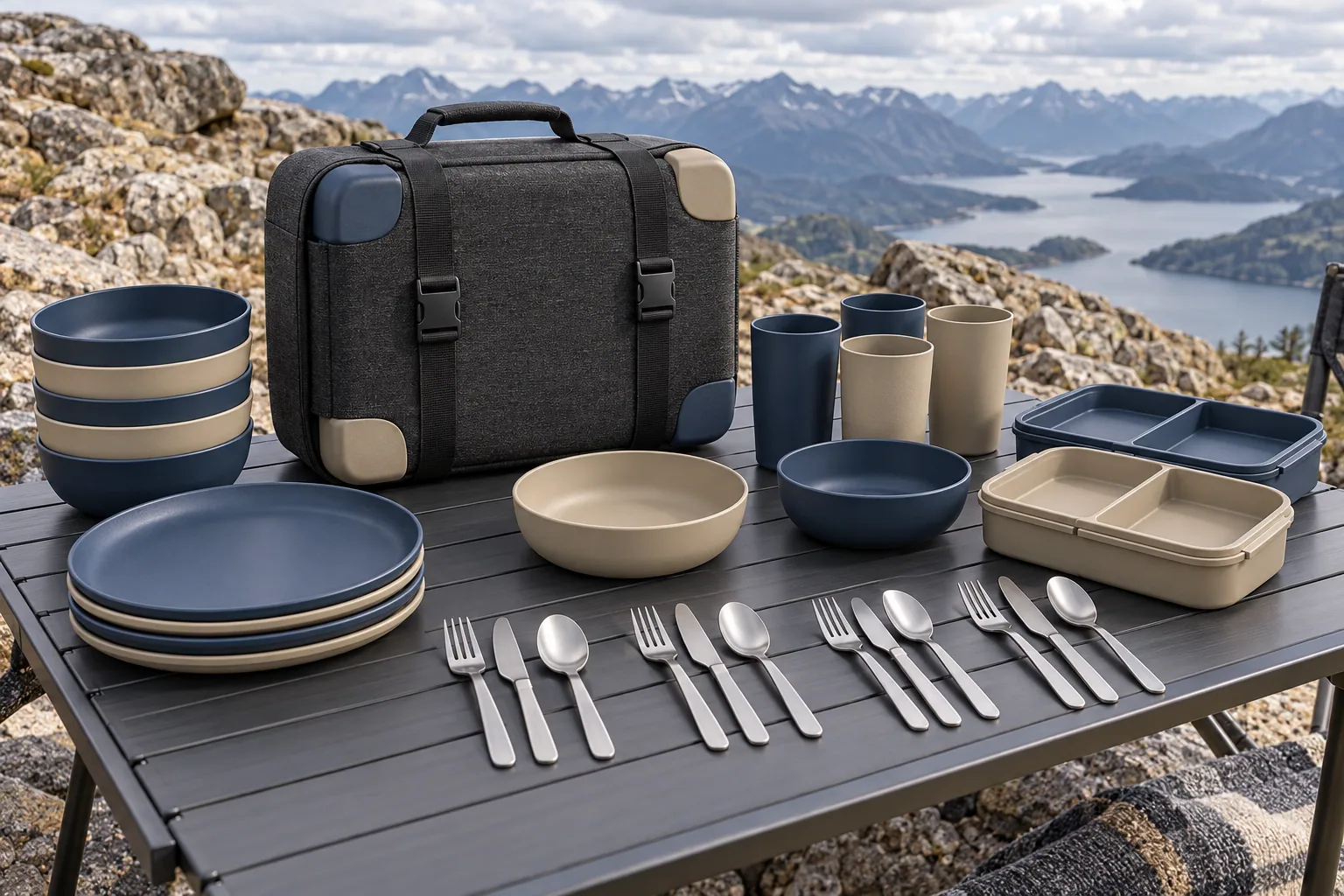
Cross-Strap camping dinnerware set: this configurable family concept uses a protective clamshell case, two removable crossed retention straps and four corner pods to organize plates, bowls, cups, divided lunch boxes and knife-fork-spoon groups. The visual configuration is a development reference, not a stocked-SKU promise. Final parts, dimensions, materials, compatibility, evidence, packaging and commercial terms require project confirmation.
PRODUCT PARAMETER
| Product concept | Cross-Strap compression camping dinnerware set for configurable family and group outdoor programs |
|---|---|
| Reference component roles | Personal plates, bowls, handleless cups and knife-fork-spoon groups; project-selected divided lunch boxes; protective clamshell carry case |
| Material direction | PP-oriented dinnerware concept with separately specified textile shell, structural panels, strap webbing, buckles, corner pods, lining and metal or project-selected utensils |
| Storage architecture | Two-shell case with crossed adjustable restraints, fitted component zones, four protective corner pods and a dedicated lower container area |
| Reference colors | Muted navy, warm sand and charcoal; exact color standards and acceptable variation to be confirmed for the project |
| SKU | To be confirmed for the project |
| Dimensions and weight | To be confirmed for the project after the component matrix and packed sample are approved |
| Packaging | Retail box, e-commerce mailer or project-defined pack; artwork, protection and carton configuration to be confirmed |
| Logo options | Surface-by-surface artwork assessment for case and dinnerware; process and location to be confirmed for the project |
| Destination markets | Europe, North America, Australia and comparable B2B programs subject to final intended-use and evidence review |
| MOQ, price and lead time | To be confirmed for the project; no commercial figure is stated on this page |
REFERENCE CONFIGURATIONS
The Cross-Strap camping dinnerware set is a modular development direction rather than one fixed piece count. Buyers first define users, meal functions and channels, then assign every component to a personal, shared or optional role. The case layout follows the controlled matrix instead of forcing unrelated pieces into an existing shell.
| Program direction | Reference component logic | Case allocation | Buyer approval output |
|---|---|---|---|
| Four-user base set | Equivalent plate, bowl, cup and utensil functions for each user | Matched stacks under cross straps; cups and utensils in fitted zones | User matrix, BOM, drawings and complete packed sample |
| Meal-container bundle | Personal settings plus project-selected divided lunch boxes | Containers occupy the lower fitted zone without loading plate rims | Closure boundary, container scope and packing sequence |
| Rental or guided-use set | Repeated, countable settings with controlled replacements | Visible empty zones support return checks | Service BOM, location map and replenishment record |
| Retail-channel variant | Channel-selected quantities and optional shared serving role | Strap adjustment, pod geometry, insert and carton reviewed together | Exact sales-unit specification and evidence index |
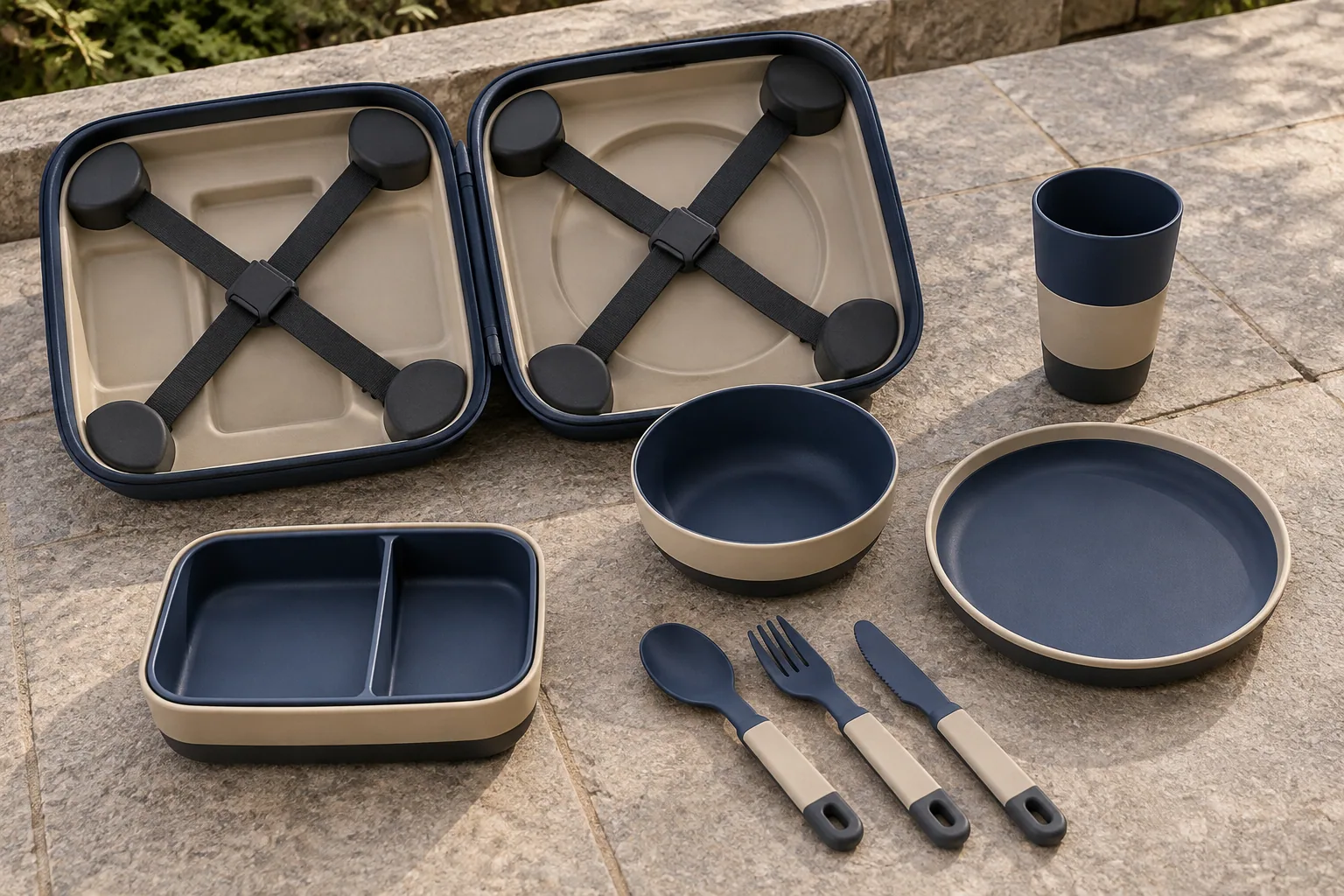
A clamshell case turns restraint into a visible system
The defining architecture is a protective two-shell case with crossed webbing that holds broad components against fitted support zones. Four corner pods buffer the shell geometry and identify a different design language from wing-panel sleeves, vertical racks, radial caddies, drawers and roll-top bags already represented on the site.
Crossed straps can distribute restraint across a plate or container group, provided the load path avoids unsupported rims and decorations. The case also gives buyers a clear surface for evaluating closure, handle reinforcement, hinge behavior and internal allocation as one assembly.
Cross-strap and corner-pod detail
Each strap path needs a defined anchor, adjustment range, buckle location and release direction. Corner pods should support the approved shell and component geometry without becoming decorative shapes that interfere with closure. Their material, attachment, replaceability and cleaning treatment remain project decisions.
The open case should remain stable on a representative outdoor table. Buckles must not fall under food-contact faces, and loose webbing should have a controlled stow position. Compatibility to be confirmed by project sample and drawing.
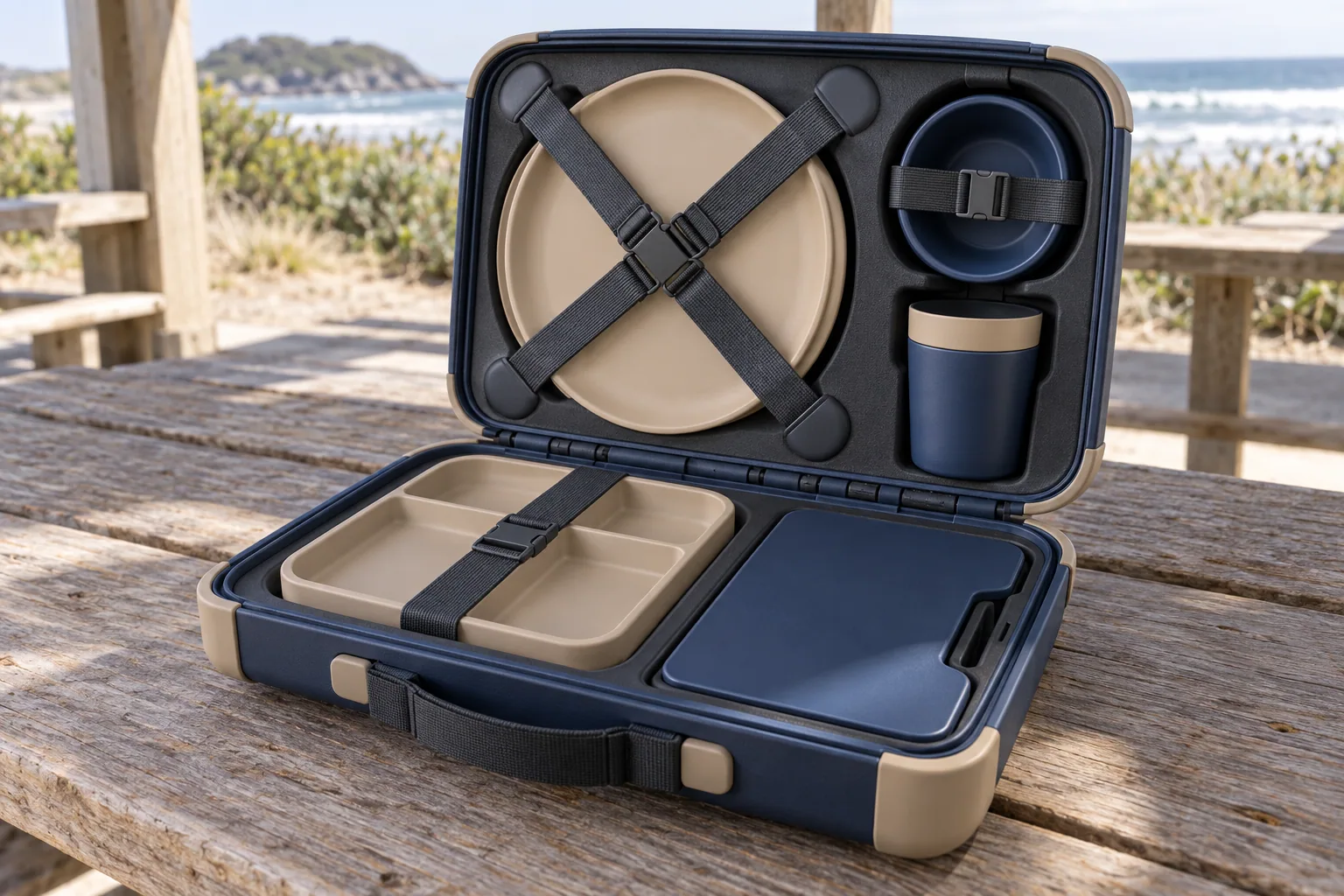
Start with user roles, not a headline piece count
A coherent set begins with meals and users. Define whether every person receives a plate, bowl, cup and three utensils, then identify any shared serving or storage function. Count lids and detachable subparts consistently so marketing language cannot drift away from the physical unit.
Use the camping dinnerware component matrix to remove pieces that lack a clear purpose. If lunch boxes are optional, create a separate configuration instead of photographing them as included while omitting them from the controlled BOM.
After roles are approved, set stack quantities and fitted zones. A change in user count can alter strap adjustment, case height, corner support and carton footprint, so it must be treated as an architecture revision.
Component customization choices
- Plate family
Review eating area, rim, foot and nested interface. - Bowl family
Choose profile and stable stack or nest behavior. - Cup role
Set capacity direction, taper and handle decision. - Lunch boxes
Define compartments, lids and intended foods separately. - Utensil groups
Match length, handle section, finish and retention. - Carry case
Control shell, cross straps, pods, handle and closure. - Color system
Approve molded and textile materials as distinct families. - Artwork
Map logos to suitable surfaces and processes. - Packaging
Reconcile the exact sales unit with channel and carton.
These fields describe what a buyer can specify for evaluation; they do not promise that every geometry or process is available. Existing-component options, new geometry, tooling route, ownership, maintenance, MOQ, price and schedule need written project review.
Control plates as a restrained stack
Plate diameter alone does not define fit. Review rim angle, foot ring, face curvature, edge exposure, separator need and the surface contacted by the cross strap. The complete quantity must seat without rocking or requiring abnormal compression.
Strap pressure should pass through stable support areas rather than a thin outer edge. Check whether removal leaves enough grip area and whether a missing plate releases the remaining group. Any color or decoration located under the webbing needs an abrasion and appearance review appropriate to the final surface.
The plate and bowl size-system worksheet can connect eating function with pack geometry. All numerical dimensions remain to be confirmed for the project.
Control bowls, cups and their nested relationships
Bowls may use progressive nesting, repeated stacking or a project-specific hybrid. Record the full-quantity rise, intended contact points, release path and drainage condition. Avoid using case compression to hide a bowl that has not seated correctly.
Handleless cups can reduce protrusions, but capacity, taper, rim, surface and beverage-use conditions are separate decisions. A cup nested inside a bowl needs deliberate clearance and separation if surfaces could strike or become difficult to dry.
Compare the geometry with the published nesting versus stacking guide. Compatibility to be confirmed by project sample and drawing.
Define divided lunch boxes without overclaiming closures
Divided containers can add meal-preparation value, but they also consume case depth and create additional lids, clips and interfaces. Specify whether the divider is fixed or removable, which foods and temperatures are intended, and how each lid is retained in the packed set.
No leakproof, airtight, insulated, microwave, freezer or dishwasher claim is made by this concept. If any claim is commercially required, agree the method and acceptance criterion for the final material, seal, closure, food type, orientation and use condition.
The fitted lower zone should protect the container without transferring cross-strap load through an unsupported lid. Review access independently so users do not need to remove every place setting to reach one lunch box.
Specify cutlery and small-part retention
Fork, knife and spoon groups should remain countable and should not move against dinnerware or the case wall. The retention design depends on utensil length, working-end width, handle section, finish and whether the set uses individual groups or one shared roll.
Keep knife edges and fork tines away from exposed textile seams and food-contact faces. A pocket, sleeve or fitted insert may be appropriate after the exact utensil pattern is known. The metal appearance in concept images does not establish a grade, finish, corrosion claim or supply commitment.
If accessories are added later, revise the pocket map rather than placing them into unused voids. Every added hard part can change rattle, abrasion, balance and the closure envelope.
Engineer the case as part of the product
The outer shell, structural panels, lining, hinge, zipper, handle, webbing anchors, buckles and corner pods require separate specifications. “Portable bag” is not enough to control assembly. Buyers should define intended carrying orientation, storage position, opening footprint and cleaning approach.
Review the case empty and fully loaded. An empty shell can look precise while the full configuration bulges, twists or loads one hinge. The approved sample should close along its normal path without kneeling, forced compression or removal of permanent components.
Use the pack-volume calculation guide after the component and restraint systems are stable. The measured envelope must include the actual straps, pods, closures and handles in their declared packed positions.
Use cross straps to control movement, not to mask mismatch
Adjustable webbing can manage small configuration differences, but it should not compensate for components that do not fit the case. Define the normal buckle position and confirm that remaining adjustment is available without deforming plates or lids. A visual “tight” appearance is not an acceptance criterion.
Check the set in face-up, edge-up and intended carry orientations. Observe whether the restrained group stays located and whether small parts migrate into a buckle or hinge. The buyer's rattle-control review should name any sound source and corrective action without promising a universally silent set.
After a component change, repeat the assessment. The published guide to stackable camping dinnerware acceptance helps buyers review alignment, release and full-quantity behavior before the case restraint is approved.
Coordinate color across molded and textile families
The navy, warm-sand and charcoal palette shown here is a concept direction. Molded PP, coated metal, woven textile, elastic, buckle resin and printed packaging can reproduce a nominal color differently because their materials and surfaces interact with light in different ways. Approve physical samples by material family.
State the reference, viewing condition and acceptable comparison method. Do not use a screen rendering as final color approval. If texture, gloss or pigment changes, confirm whether food-contact evidence and decoration scope also need revision.
Keep color variants under revision control. A changed pigment or surface is not merely a marketing edit when it affects the final material record or visual matching across the set.
Map logos and decoration surface by surface
Prepare an artwork map for the outer case, optional patch, plates, bowls, cups, lunch boxes and packaging. Each location should identify usable area, curvature, food-contact boundary, likely abrasion, color contrast and the proposed process. Do not assume one decoration method suits every material.
Approve artwork files and decorated samples before releasing sales photography. A logo hidden by a strap or distorted across a curved cup can create avoidable rework. Decoration materials and processes may also change the applicable compliance scope.
This page does not promise embroidery, printing, engraving, in-mold decoration or another method. Feasibility and evidence are to be confirmed after the base material, surface, artwork and intended use are supplied.
Build packaging around the released configuration
Packaging must state the exact included pieces and show the correct cross-strap case. A retail box may emphasize configuration visibility, while an e-commerce mailer may prioritize external protection and efficient cube. Neither direction should imply optional lunch boxes or accessories are included when they are not.
Freeze the packed envelope before releasing a dieline. Changes to stack height, pod thickness, buckle position or container quantity can change the sales-unit dimensions. Update the carton orientation and internal protection whenever the case architecture changes.
For parcel planning, consult current carrier rules for the destination and service. The official UPS package dimension and weight guidance illustrates why a finished outer package must be measured, but it does not provide a quotation or validate this product.
Follow a staged B2B development path
Stage one defines users, meals, channels, component roles, materials, destination markets and required claims. Stage two develops the component and case layout with unresolved interfaces clearly marked. Decorative choices should wait until the functional arrangement is stable.
Stage three reviews the complete sample: distribute all settings, return every part, close the case normally, carry it in the intended orientation and inspect movement. Stage four reconciles BOM, drawings, sample, colors, artwork, instructions, packaging and evidence file.
Only then should the buyer request a documented quotation. The quotation should separate existing components from any new geometry and state what remains to be confirmed. MOQ, price, lead time, tooling and production capacity are not stated on this page.
Check the assembled set, not isolated pieces
An inspection plan should count every component and confirm its assigned zone. Review plate and bowl seating, cup retention, lunch-box lid condition, utensil groups, strap routing, buckles, pod attachment, hinge, zipper and handle. A correct loose bowl does not make an incorrectly assembled set acceptable.
Open and close the case using the released packing instruction. Observe interference, trapped webbing, uncontrolled movement and component surfaces that contact dirty or abrasive materials. Record findings against the exact sample revision and configuration.
Compare product title, photographs, parameter table, artwork and packaging copy with the physical set. Any mismatch should stop release until the responsible record is corrected.
Material and compliance boundaries
A generic material label cannot establish compliance. For EU-bound food-contact items, map final components and intended uses to Regulation (EC) No 1935/2004 and, when applicable to plastics, Commission Regulation (EU) No 10/2011. For United States programs, reconcile substances and intended conditions with the FDA food-contact-substance framework.
Those references do not certify this concept. The evidence file must match final formulation, color, decoration, food type, contact time and temperature. Case textiles, structural panels, webbing, buckles and pods need their own controlled specifications.
This is dinnerware, not cookware. Do not expose plates, bowls, cups, lunch boxes or the case to a burner, stove, campfire or direct flame without product-specific verified evidence.
Buyer control checklist
| Check | Buyer question | Required output |
|---|---|---|
| User matrix | Which function justifies every component? | Meal-to-component allocation |
| Stack geometry | Where do plates, bowls and cups contact? | Interface drawing and full-quantity sample |
| Cross restraints | What load path and adjustment position are approved? | Strap routing and buckle-setting record |
| Corner pods | Do pods support the shell without blocking closure? | Pod drawing and attachment review |
| Containers | Which lunch boxes and lids are included? | Controlled BOM and claim matrix |
| Utensils | Are groups complete, safe and retained? | Utensil specification and pocket map |
| Artwork | Does each decoration suit its final surface? | Artwork map and decorated sample |
| Evidence | Do records match final materials and uses? | Market-specific evidence index |
| Packaging | Does the dieline match the released sales unit? | Packed sample and carton record |
| Revision | Who approves changes across components and case? | Released revision register |
Outdoor application and visual authenticity
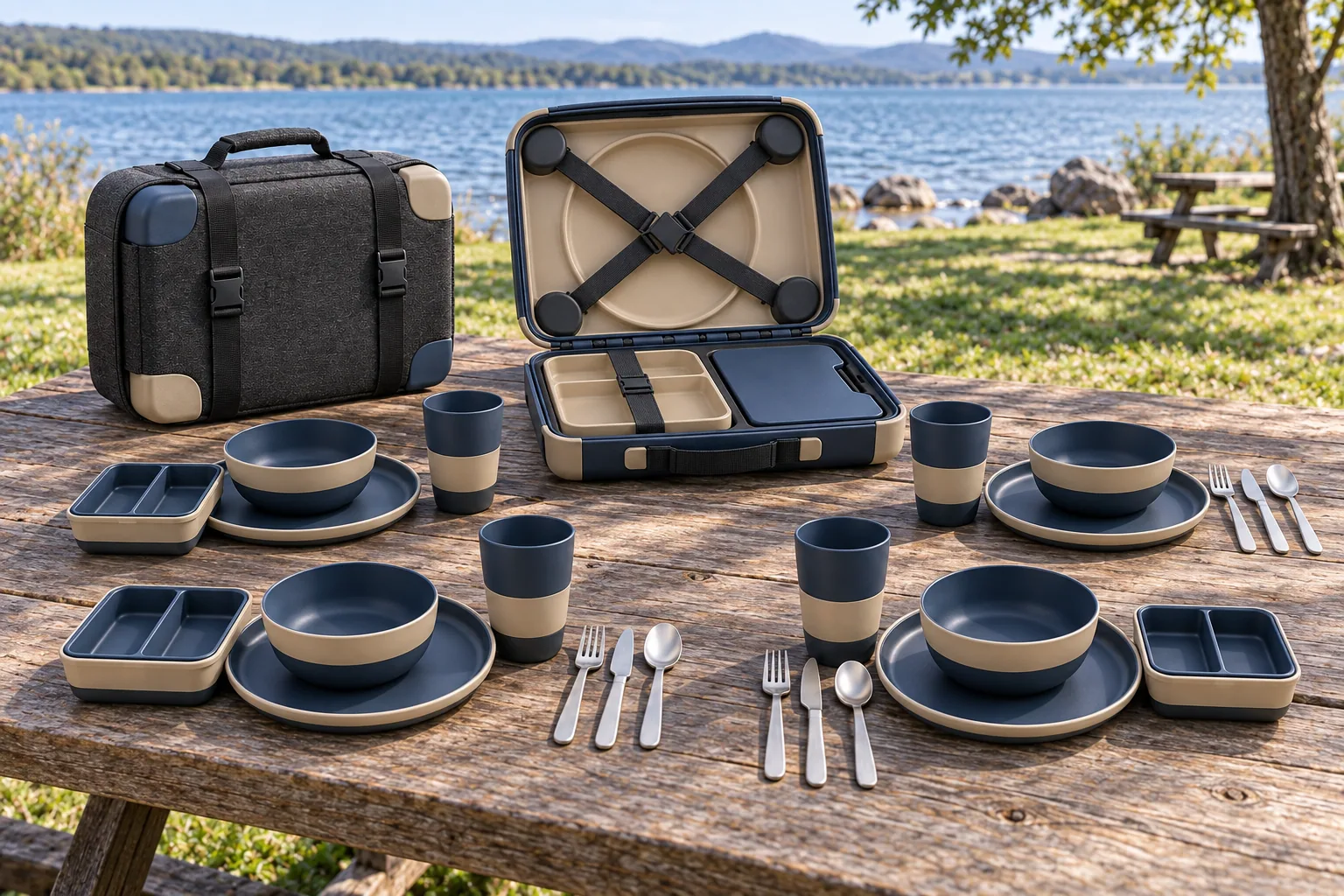
The mountain and lakeside scenes show how the same navy-and-sand component family could be reviewed in outdoor contexts. They are concept/application images, not customer projects, production photographs, laboratory records or evidence of weather performance. Landscape, furniture and surrounding items are not included components.
During a real sample review, place the opened case on the expected table footprint, distribute four coherent settings, access each container and return all parts. Confirm that the cross straps and pods support the released configuration without forcing the closure.
Related procurement resources
Define component roles with the component-list worksheet, compare broad pack geometries using the nesting and stacking guide, and calculate the finished case envelope with the pack-volume worksheet. For a distinctly different organization method, compare the published Wing-Panel family set, which separates plates and utensils into hinged storage wings.
Procurement FAQ
Is the Cross-Strap set a stocked item?
No. It is a configurable product-development concept. Availability, exact parts, dimensions, materials, evidence, packaging and commercial terms are to be confirmed for the project.
Can buyers change the component count?
Alternative matrices can be assessed, but strap setting, support zones, case envelope and carton must be reviewed again. Compatibility to be confirmed by project sample and drawing.
Do the straps guarantee a rattle-free pack?
No universal sound claim is made. The final configuration needs a defined movement review that identifies interfaces, acceptance language and side effects.
Are the lunch boxes leakproof or microwave safe?
No such claim is stated. Intended foods, temperatures, closure, seal, orientation and validation method must be defined for the final project.
Is the clamshell case waterproof?
No waterproof or weather-resistance claim is made. Shell materials, seams, zipper and required performance need a written specification and appropriate evidence.
Can logos appear on both case and dinnerware?
Artwork can be evaluated surface by surface after materials and contact boundaries are fixed. Process feasibility and decorated-sample approval are project-specific.
Can existing parts be combined with a new case?
Potential combinations may be reviewed, but photographs and nominal dimensions do not prove fit. A complete packed sample and controlled drawings govern approval.
What information starts a review?
Send users, meals, component matrix, preferred profiles, case envelope, materials, markets, color direction, artwork, packaging channel and evidence requirements.
Develop your Cross-Strap camping dinnerware set
Prepare a project brief covering users, component roles, proposed plate and bowl profiles, cup and lunch-box functions, utensil direction, cross-strap and pod requirements, case envelope, colors, logos, packaging channel, destination markets and required claims. Identify any fixed dimensions or existing samples separately.
Request a configuration review
Naike Dinner can review the supplied brief and identify which information still needs confirmation. MOQ, price, tooling, lead time, availability, materials, dimensions, compatibility and performance are confirmed only through the final written project process. For a second entry point, send the complete B2B set-development brief here.
RELATED SOURCING PATHS
Compare Products and Plan Your Project
Review related product formats, then compare material, set configuration, logo, packaging, testing scope and order quantity with our B2B team.