Description
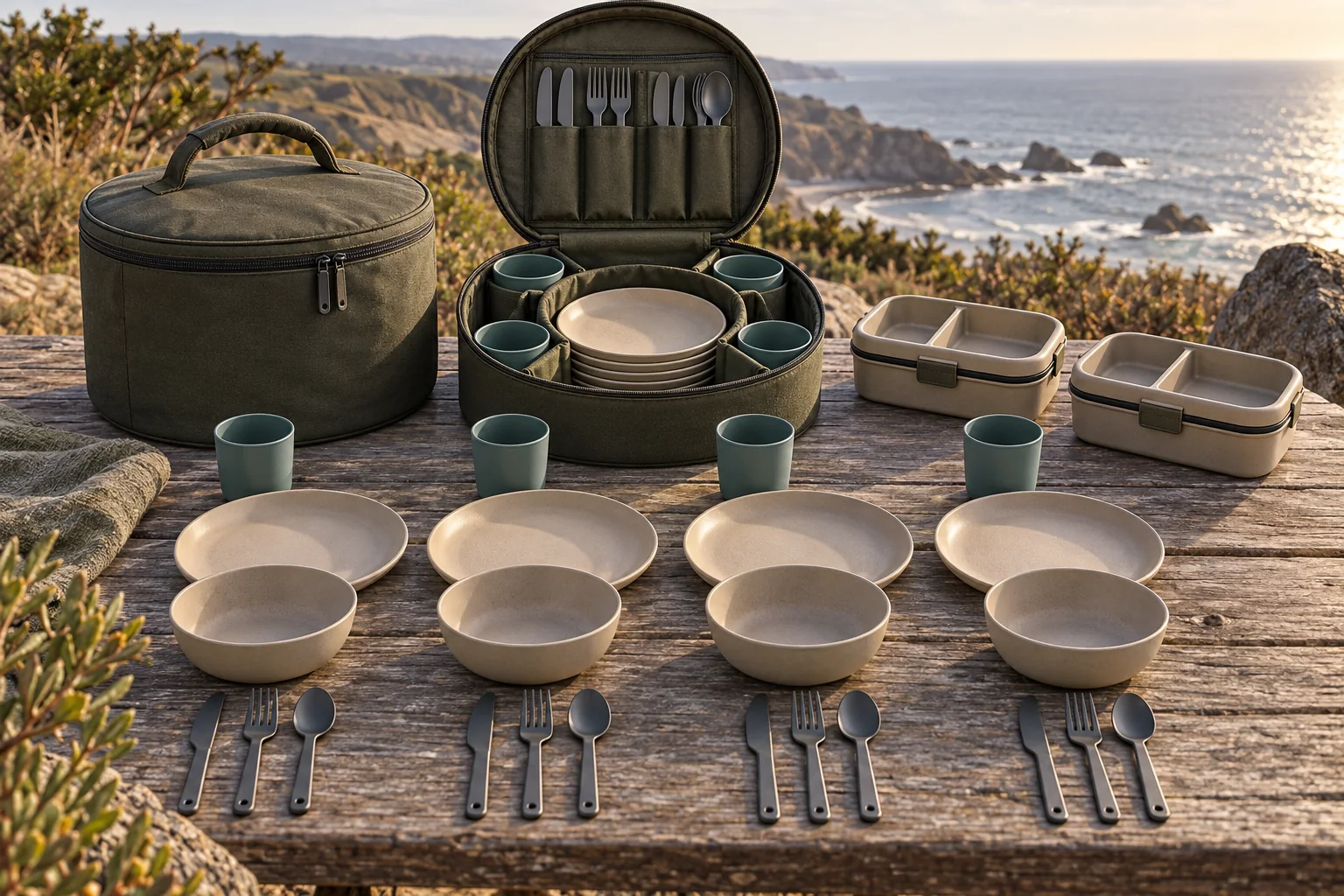
Radial-caddy camping dinnerware set: this configurable four-user concept organizes stackable plates and bowls in a central round well, places four handleless cups in radial textile pockets and secures utensils in the lid. Two divided lunch boxes remain accessible beside the caddy. The project brief must confirm the component list, geometry, material specification, contact interfaces, color references, decoration, pack format and destination-market evidence.
PRODUCT PARAMETER
| Product concept | Radial-caddy family camping dinnerware set for configurable four-user outdoor programs |
|---|---|
| Reference components | Four shallow plates, four bowls, four handleless cups, four knife-fork-spoon groups, two divided lunch boxes, central stack well, four radial cup pockets, lid utensil sleeve and round zip carry caddy |
| Material direction | PP-oriented dinnerware concept with separately controlled textile shell, reinforcement, zipper, dividers, handle and closures; exact formulations to be confirmed for the project |
| Storage architecture | Round semi-rigid top-opening caddy with central plate-and-bowl column and four perimeter cup zones |
| Color direction | Dark olive textile, sand-colored dinnerware, muted teal cups and graphite utensils; production references to be confirmed for the project |
| SKU, dimensions, capacity and weight | To be confirmed for the project |
| Logo and decoration | Location and process subject to final surface, artwork, use condition and feasibility review |
| Packaging | Sales-unit presentation, component restraint and transit carton to be confirmed for the project |
| MOQ, price and lead time | To be confirmed for the project; no universal values are stated |
| Intended markets | Europe, North America, Australia and comparable B2B programs, subject to destination requirements |
REFERENCE CONFIGURATIONS
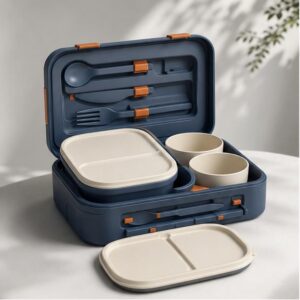
The radial-caddy camping dinnerware set is a product-development framework for buyers who want one compact, visible central stack with task-specific storage around it. The images communicate a possible arrangement; they are not stocked-SKU evidence, production records, test photographs or customer orders.
| Program direction | Central well | Perimeter and lid | Buyer control |
|---|---|---|---|
| Four-user meal set | Four plates and four bowls in controlled stack order | Four cups, four utensil groups and project-selected lunch-box position | User allocation, complete BOM and closed-case drawing |
| Dining-only configuration | Personal plates, bowls and approved shared piece if required | Cups and cutlery with unused zones removed or reassigned | Meal matrix, divider plan and sample fit |
| Rental or guided-use set | Countable stack with component codes | Visible return pockets and replaceable utensil group | Return count, loss plan and service BOM |
| Retail bundle variation | Channel-selected dinnerware quantity | Case finish, lunch-box option, artwork and packaging | Exact sales-unit list and evidence index |
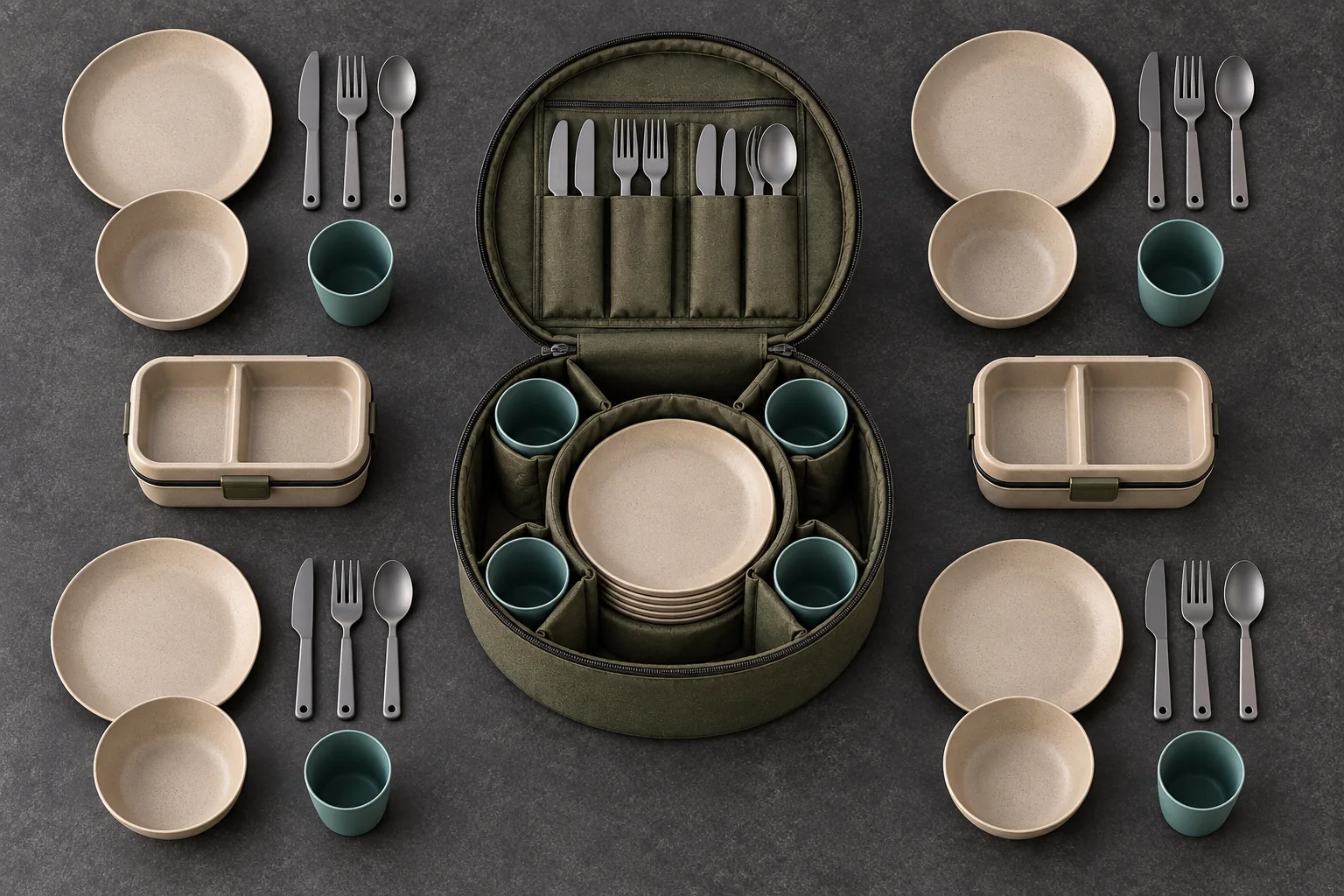
Radial-caddy camping dinnerware set architecture
The round case creates a single visual center rather than a row of separate rectangular modules. Plates and bowls occupy the padded center well. Four cups sit upright in fabric pockets around that well, and the lid sleeve separates cutlery from food-contact dinnerware surfaces.
Two divided lunch boxes can be treated as an optional configuration outside the main column or allocated to a separately controlled sales-unit position. Their exact retention must be resolved in the pack drawing. Compatibility to be confirmed by project sample and drawing.
Central stack well and radial pocket detail
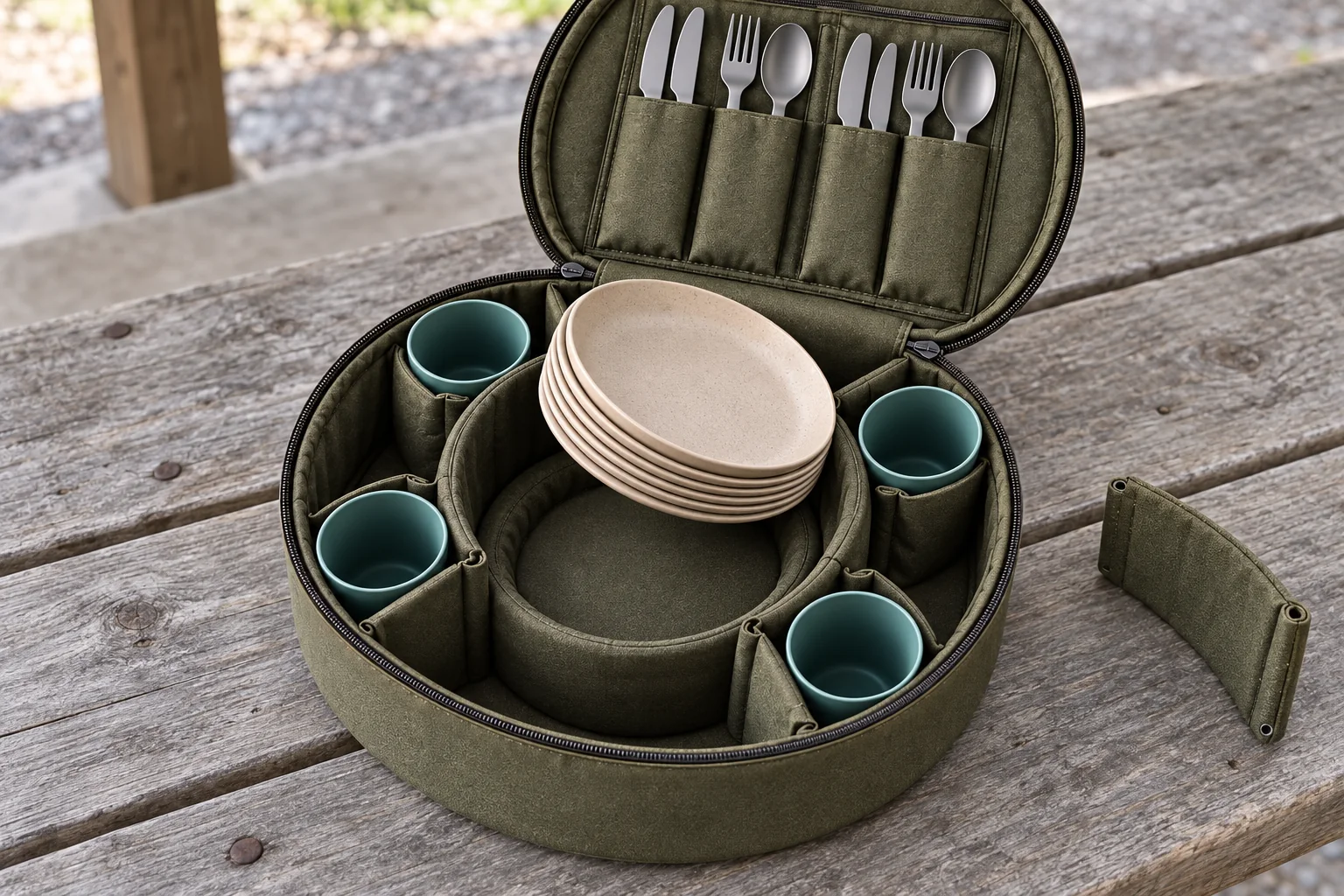
The padded circular well should locate the approved plate-and-bowl stack without forcing the rims. Its inside wall, base pad and removal clearance must match the final quantities and geometry. Four outer pockets should retain cups while leaving enough finger access for ordinary removal.
The radial dividers are functional interfaces, not decoration. They influence cup orientation, load balance, zipper access and the amount of movement around the center stack. Removable divider concepts require a defined attachment method and cleaning instruction before approval.
Assemble the set around user access
Start with the users, meals and distribution sequence. If four users need one plate, bowl, cup and utensil group each, the storage plan should allow those parts to be counted and removed without unloading lunch boxes or unrelated shared pieces. A higher headline piece count is not a substitute for a clear role.
The central stack can be plate-first, bowl-first or separated into subgroups, but the unloading choice affects stability and table setup. Ask an unfamiliar user to open, distribute, collect and repack the set. Record any confusion and update the pack instruction or divider architecture.
Customization choices for B2B buyers
- Component matrix
Select plate, bowl, cup, container and utensil roles. - Stack sequence
Control center-well order, quantities and removal access. - Radial pockets
Review cup zones, dividers and retention around the stack. - Color family
Approve coordinated, user-coded or channel-specific references. - Logo program
Assess decoration on relevant dinnerware and textile surfaces. - New geometry review
Evaluate drawings, interfaces, samples and project feasibility.
Customization can include component selection, stack arrangement, case structure, color direction, artwork and packaging, plus technical evaluation of new geometry. This page does not promise universal tooling or molding capability. Before any new tool is commissioned, the buyer and project team must document feasibility, ownership, maintenance, revision rights, commercial terms and schedule.
Material and compliance boundaries
Material names do not establish food-contact conformity. EU-bound programs can scope final food-contact parts against Regulation (EC) No 1935/2004 and, where applicable to plastics, Commission Regulation (EU) No 10/2011. United States projects should reconcile final substances and intended uses with the FDA framework for food-contact substances.
Those authorities do not certify this concept. Evidence must match final material, color, decoration, food type, contact time and temperature conditions. Textile shells, reinforcement, dividers, zipper, handle and closures need separate specifications and must not be used to imply unsupported dinnerware performance.
Development controls before tooling and artwork
Freeze the component matrix and stack order before the caddy geometry. A change to a bowl foot, plate rim, cup taper or lunch-box closure can alter the center well, pocket positions, zipper clearance, case balance and carton. Unknown data must remain “To be confirmed for the project.”
Request dimensioned drawings for each component and the complete caddy, with sections through the stack contacts, cup pockets and lid sleeve. Approve artwork only after relevant physical surfaces and pack clearances are stable. Scenic images support discussion; controlled drawings and samples determine the project.
Sample approval sequence
- Approve users, meals, component roles and sales-unit count.
- Review proposed dinnerware profiles, cup format and lunch-box function.
- Confirm center-stack order, incremental rise, cup pockets and utensil sleeve.
- Evaluate finger access, repacking, closure and carry balance.
- Approve production-relevant colors and artwork on defined surfaces.
- Reconcile BOM, drawings, golden sample, packaging and evidence index.
Any component or case change after approval should trigger the affected fit, handling, evidence and packaging reviews. An informal substitution must not bypass revision control.
Control stacking and cup-pocket interfaces
The central column needs intended rim-to-base contacts, repeatable incremental height and a reliable separation method. A compact appearance does not prove acceptable release or alignment. Review the complete saleable quantity dry, damp and after the declared washing process.
Each cup pocket is another interface. Check rim clearance, removal grip, divider pressure and whether one missing cup allows others to migrate. The caddy should retain components without using excessive lid compression to hide an unstable stack.
Keep lunch boxes inside the controlled sales unit
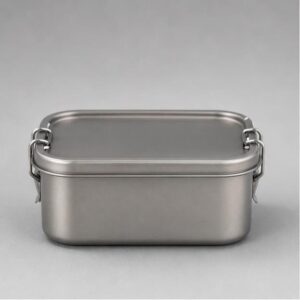
The illustrated lunch boxes express an optional container role, not a confirmed leakproof or insulated claim. If they are included, define their exact packed position, closure type, cleaning boundary and relationship to the round caddy. If they are excluded, artwork and piece-count claims must change accordingly.
Retail and e-commerce programs can require different retention and cartons. Buyers should provide shelf orientation, fulfillment route, handling expectations and labeling needs before packaging is quoted. Props or food shown in application images are not included components.
Buyer control checklist
| Check | Buyer question | Required output |
|---|---|---|
| Meal logic | Which user or shared task justifies every component? | Meal-to-component matrix |
| Center stack | Which exact quantities and revisions form the column? | Stack-order drawing and acceptance record |
| Radial pockets | How are cups located and removed? | Pocket sections and sample observation |
| Utensil sleeve | Are complete groups retained without damaging adjacent pieces? | Lid layout and count check |
| Lunch-box role | Are containers included, optional or separately packed? | Controlled BOM and packaging list |
| Material evidence | Do records match every final food-contact component and use? | Market-specific evidence matrix |
| Decoration | Which surfaces and processes are approved? | Artwork map and decorated sample |
| Change control | Who approves substitutions and geometry revisions? | Signed revision register |
Outdoor application and distribution
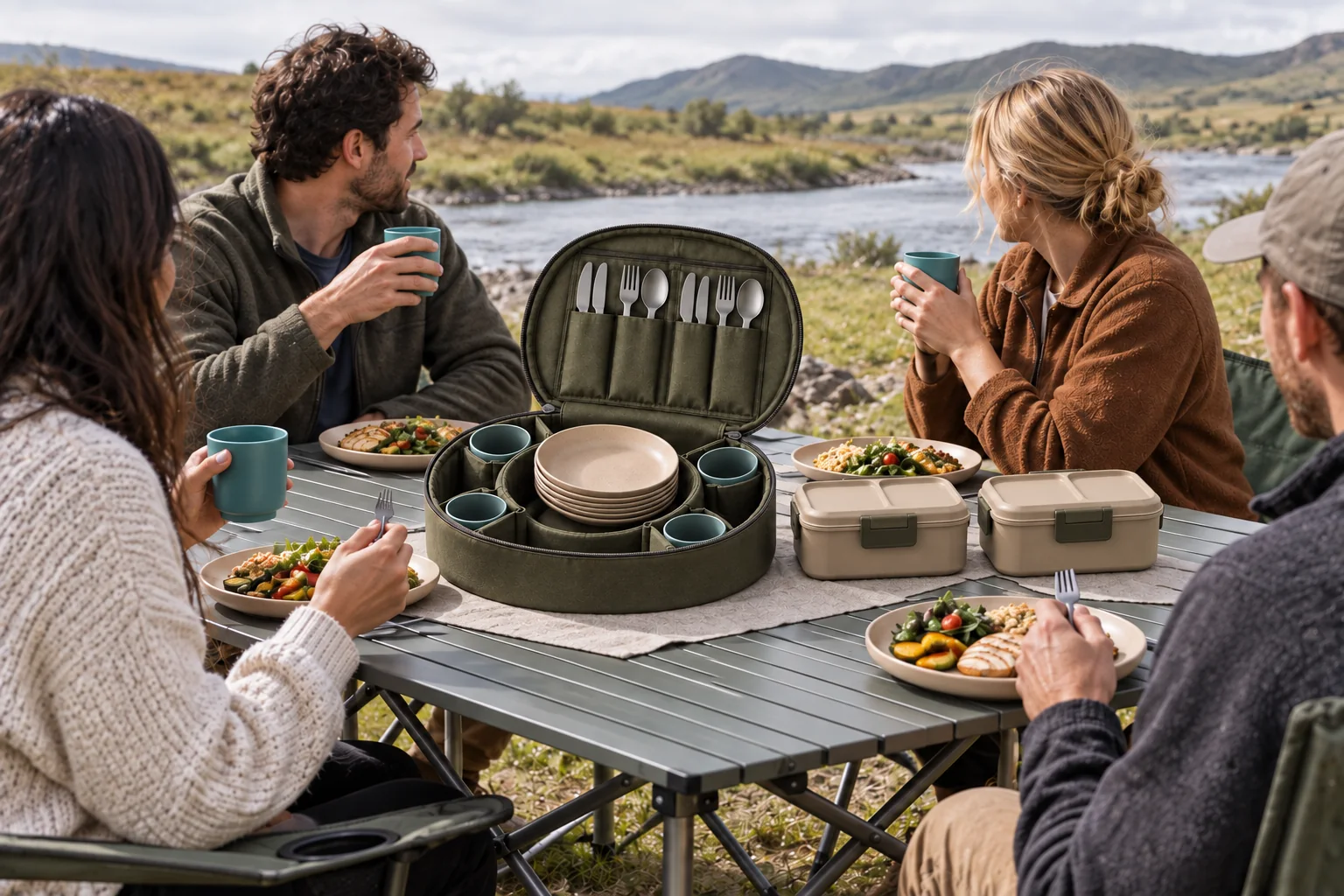
The coastal hero view shows the complete concept for product discussion, while the riverside scene demonstrates four users accessing a central caddy. They are application illustrations, not customer cases or evidence of weather resistance, impact strength, food-contact compliance, leak resistance or any quantified performance.
During sample review, place the caddy on the representative table footprint and distribute the controlled settings. Confirm whether cups and utensils remain accessible, whether the center stack can be served in order and whether every piece returns to a clear position.
Related procurement resources
Define the saleable component roles with the camping dinnerware component matrix, assign quantities using the family set allocation guide, and coordinate profiles through the plate-and-bowl size-system worksheet. Compare the storage direction with the published Twin-Pod camping dinnerware set, which separates two task-based modules rather than using one radial center.
Procurement FAQ
Is the Radial-Caddy set a stocked SKU?
No. It is a configurable product-development concept. Availability, final components, dimensions, materials, evidence, packaging and commercial terms are to be confirmed for the project.
Can the component count change?
Yes, as a project direction, but every count change affects the stack, pockets, case, BOM, artwork and packaging. Compatibility to be confirmed by project sample and drawing.
Are the lunch boxes leakproof?
No leakproof claim is made. Closures, seals, foods, orientations and an agreed method must be defined for the final product if that claim is required.
Is the carry caddy waterproof?
No weather-resistance claim is stated. Shell, reinforcement, zipper and seams need a project specification and matching verification before any claim.
Can buyers use other plate and bowl shapes?
Alternative profiles can be reviewed, but the central well, rise, separation and closure must be redesigned or reconfirmed. Compatibility to be confirmed by project sample and drawing.
Can logos appear on the caddy and components?
Artwork can be assessed surface by surface after materials, colors and processes are defined. Approval should use controlled artwork files and relevant decorated samples.
What information starts a project review?
Send users, meals, component matrix, stack order, cup format, lunch-box role, materials, markets, colors, artwork, packaging channel and evidence needs.
Develop your Radial-Caddy camping dinnerware set
Share the user count, meal map, component list, proposed stack order, cup and lunch-box roles, carry method, material and color direction, destination markets, logo files, packaging channel and evidence needs. Confirmed inputs and unresolved interfaces can then be separated before drawings, samples or a written quotation.
Request a Radial-Caddy configuration review
Attach existing components or sketches through the project inquiry form. MOQ, price, lead time, dimensions and tooling feasibility remain to be confirmed for the project.
RELATED SOURCING PATHS
Compare Products and Plan Your Project
Review related product formats, then compare material, set configuration, logo, packaging, testing scope and order quantity with our B2B team.