Description
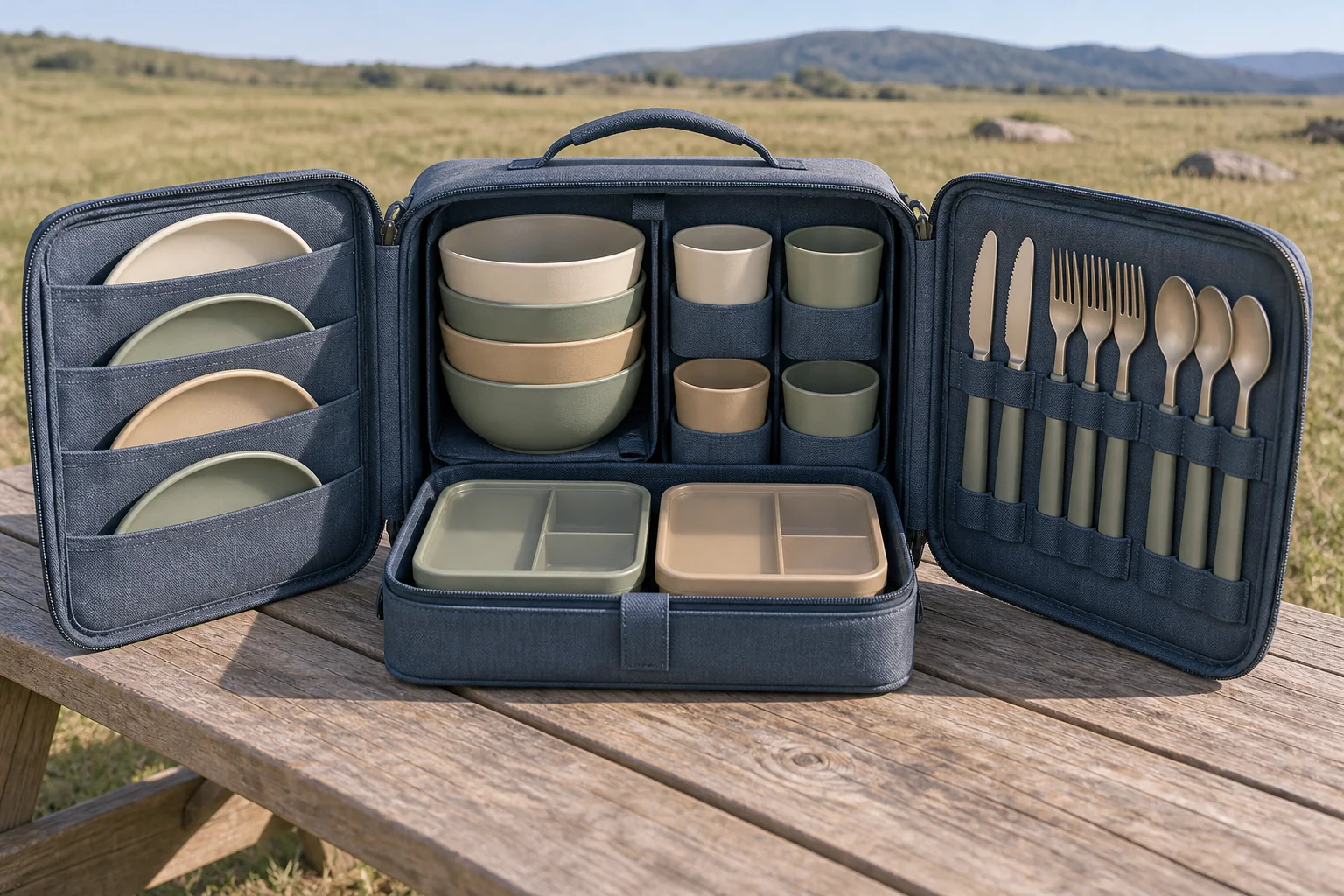
Wing-Panel camping dinnerware set: this configurable family concept opens a soft rectangular case into two storage wings. One wing separates plates in sleeves, the other retains grouped utensils, while the center module organizes nested bowls, handleless cups and divided lunch boxes. Final components, dimensions, materials, compatibility, evidence, packaging and commercial terms remain project-specific.
PRODUCT PARAMETER
| Product concept | Wing-Panel family camping dinnerware set for configurable outdoor dining programs |
|---|---|
| Reference component roles | Personal plates, bowls, handleless cups and grouped knife-fork-spoon sets; project-selected divided lunch boxes; soft carry case with two hinged storage wings |
| Material direction | PP-oriented dinnerware concept with separately controlled textile shell, reinforcement, sleeves, elastic, zipper, handle and removable tray; exact specifications to be confirmed for the project |
| Storage architecture | Book-opening center case with a plate-sleeve wing, utensil-retention wing, central bowl-and-cup module and lower lunch-box tray |
| Color direction | Slate blue case with warm sand and sage components; production color standards to be confirmed for the project |
| SKU, dimensions, capacity and weight | To be confirmed for the project |
| Logo and decoration | Placement and process subject to final surfaces, artwork, food-contact boundary and feasibility review |
| Packaging | Sales-unit presentation, component restraint, instructions and transit carton to be confirmed for the project |
| MOQ, price and lead time | To be confirmed for the project; no universal values are stated |
| Intended markets | Europe, North America, Australia and comparable B2B programs, subject to destination requirements |
REFERENCE CONFIGURATIONS
The Wing-Panel camping dinnerware set is a development concept, not a promise of a stocked SKU. Its defining difference is a center module flanked by two purpose-specific hinged panels. Buyers can review the component family, access order and pack footprint before fixing a BOM.
| Program direction | Component allocation | Wing and center allocation | Buyer approval |
|---|---|---|---|
| Four-user family set | Equivalent plates, bowls, cups and utensil roles with optional lunch boxes | Plates left, utensils right, bowls and cups center, containers below | User matrix, BOM, drawings and full pack sample |
| Meal-prep bundle | Personal settings plus project-selected divided containers | Lower removable tray protects container access from the bowl group | Container scope, closure boundary and pack sequence |
| Rental or guided-use set | Countable repeated pieces with replacement identifiers | Open wings expose missing plates or utensils during return checks | Service BOM and return-count observation |
| Retail-channel variation | Channel-selected quantities and optional shared pieces | Sleeve count, elastic layout, case finish and carton revised together | Exact sales unit, approved sample and evidence index |
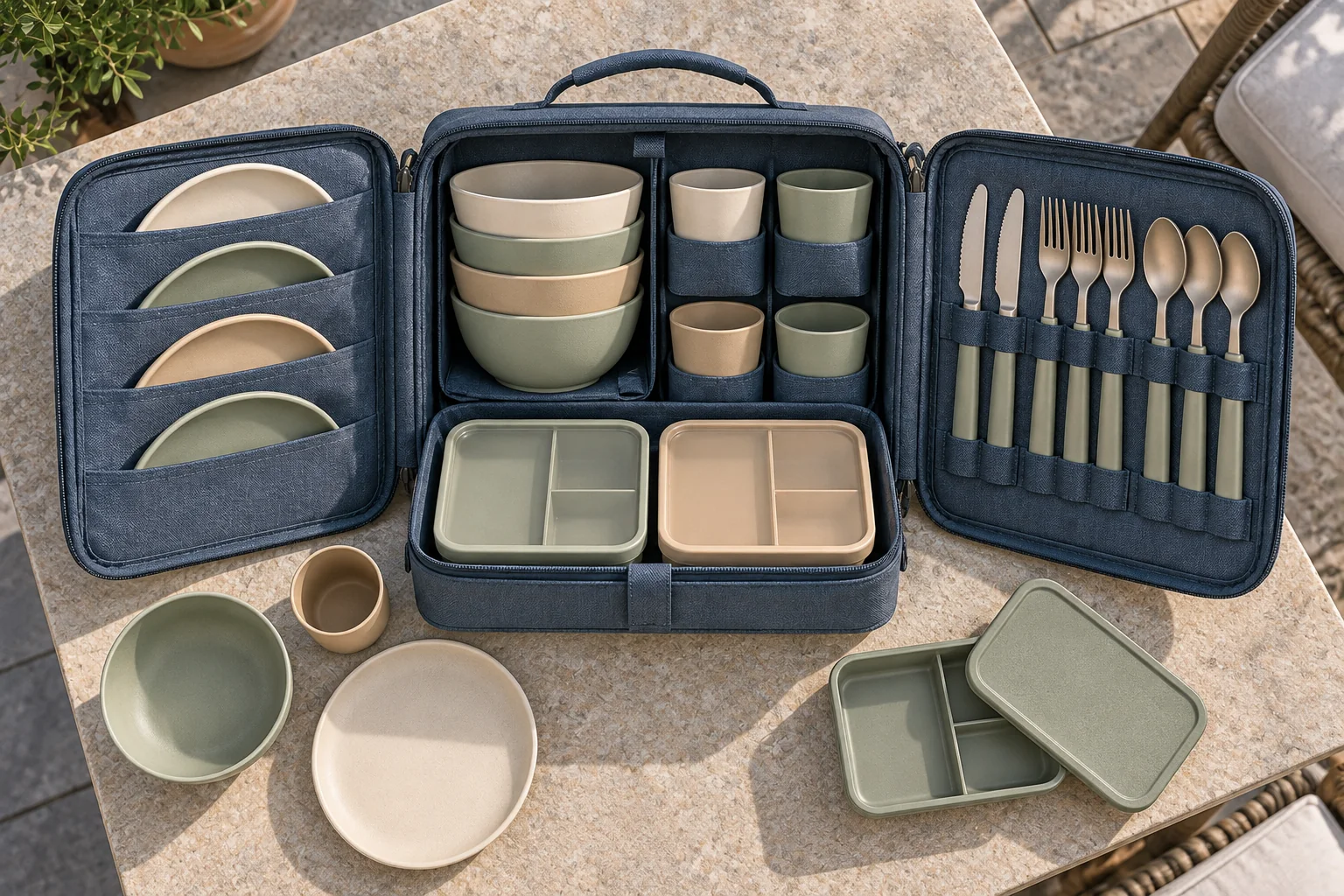
Two wings separate thin and long components
The plate wing gives each approved profile a dedicated fabric sleeve. This can make quantity visible and prevent uncontrolled face-to-face movement, provided sleeve width, depth, padding and lift clearance match the final plate. The opposite wing keeps utensil groups visible under elastic retention instead of mixing them with bowls.
The central body handles deeper pieces. Bowls occupy the main well, cups use fitted pockets and lunch boxes sit in a lower removable tray. This is materially different from radial, drawer, roll-top, twin-pod and vertical bridge-rack concepts already published.
Storage architecture and access detail
Hinged panels must open without pulling the center case out of shape. Review zipper paths, hinge reinforcement, plate load, utensil retention and whether the open wings stay stable on the intended table. The case should not depend on hidden props to remain open.
The removable lower tray separates lunch-box access from bowl-and-cup access, but its rails, lift point and closure clearance depend on final geometry. Compatibility to be confirmed by project sample and drawing.
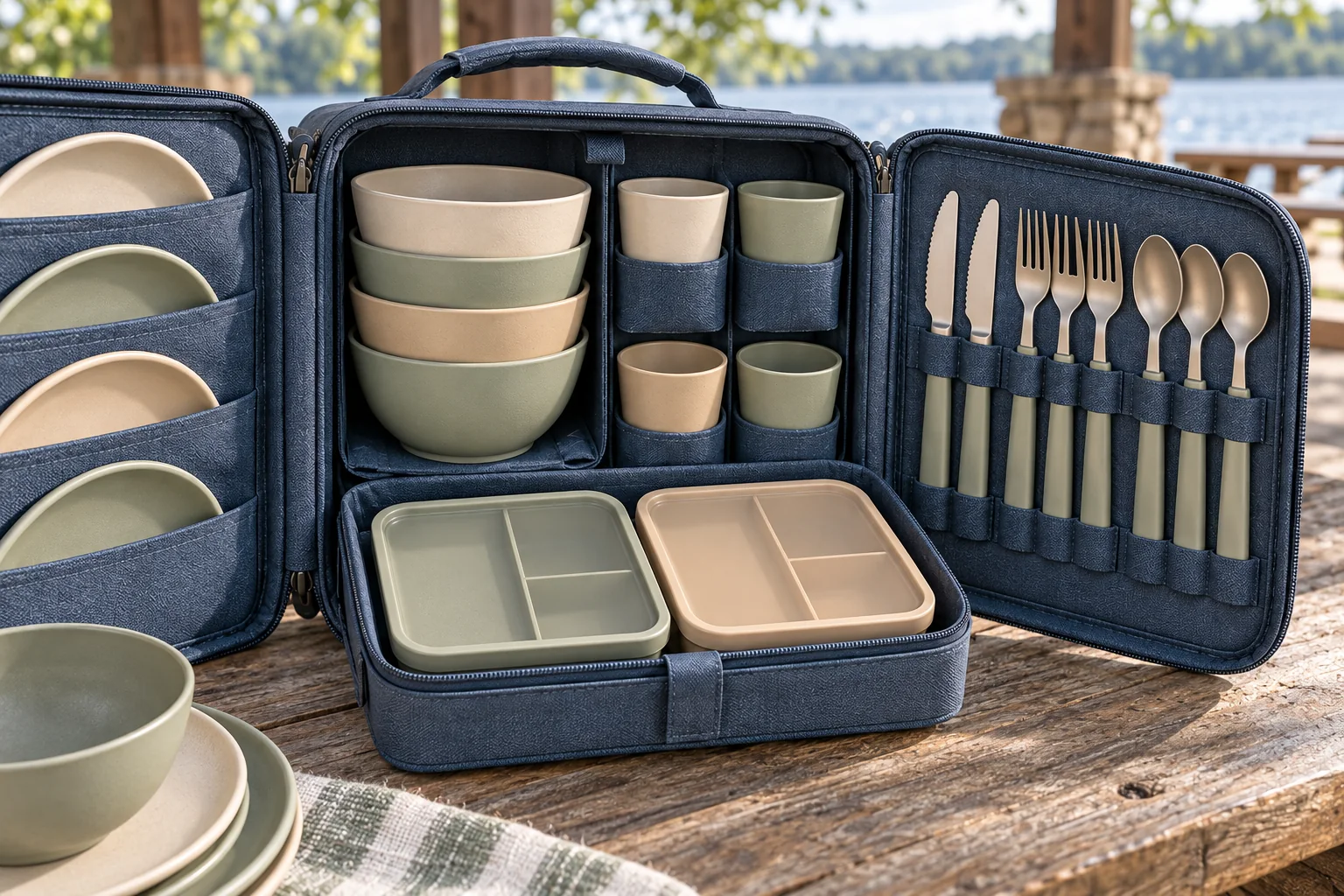
Build the component mix before designing the case
Start with users, meals and required functions. Assign each plate, bowl, cup, lunch box and utensil to a personal or shared role. Use the published camping dinnerware component worksheet to remove pieces that add headline count without a defined task.
Only then set sleeve count, elastic positions, center-well depth and tray allocation. A changed plate rim can affect sleeve spacing; a different bowl taper can change center height; a handled cup can conflict with pockets. The case is an assembled system, not independent styling.
Customization choices for B2B buyers
- Component matrix
Define personal, shared and optional roles. - Plate wing
Set sleeve count, padding, contact and grip. - Utensil wing
Control grouped retention and return visibility. - Center module
Review bowl nesting, cup pockets and lift sequence. - Lower tray
Allocate lunch boxes or another approved module. - Brand system
Coordinate colors, artwork, case and packaging.
Customization can cover component selection, color direction, artwork placement, case construction, retention and packaging, plus evaluation of new geometry. This page does not promise universal tooling or manufacturing capability. Feasibility, ownership, maintenance, revisions, timing and commercial terms require written project review.
Control the plate-sleeve wing
Specify which edge carries the plate and which surfaces must not rub. Sleeve depth must retain the approved plate while leaving enough exposed area for a safe grip. Padding and textile construction should not create lint, trapped moisture or unsupported protective claims.
Test the exact saleable quantity. If one plate is missing, remaining pieces should not migrate freely. Alternative shapes require a fresh review of width, rim, foot, corner radius and extraction path rather than an assumption based on nominal diameter.
The plate and bowl size-system guide helps connect eating area, rim, base and pack interface. Dimensions remain to be confirmed for the project.
Control the utensil wing
Elastic loops should retain the approved handles without contacting sharp working ends in an unsafe way. The layout should make complete groups countable and should not require users to stretch elastic beyond its intended path. Utensil length, handle section and decoration influence the loop design.
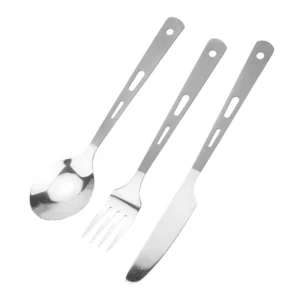
Knives, forks and spoons shown in concept images are role references, not a guaranteed supplied pattern. Final edge geometry, material, finish, cleaning method and evidence must be specified. Any alternative must be checked in the complete wing, not only as a loose sample.
Control bowls, cups and the lower tray
The center well can use repeated stacking, progressive nesting or a controlled hybrid. Record full-quantity height, intended contacts, release and drainage. Review the buyer guide to nesting versus stacking before fixing case depth.
Handleless cups can reduce protrusions, but capacity, taper, rim and intended beverage conditions remain project decisions. Lunch boxes are optional roles; no leakproof, insulated, microwave, freezer or dishwasher claim is made. If included, define closures, seals if any, foods, orientation and validation method.
Translate buyer use cases into reference configurations
A Wing-Panel camping dinnerware set should not start from an arbitrary piece count. Begin with the intended users and meals, then decide which pieces are personal, which are shared and which are optional. A family retail bundle may prioritize equal place settings, while a guided-use program may prioritize fast counting and replacement.
For a personal-setting direction, reserve one sleeve, one bowl position, one cup pocket and one utensil group for each user. Lunch boxes can remain an optional lower module. For a shared-serving direction, one or more center positions may be reassigned after the buyer documents the serving role and confirms that the remaining personal pieces stay equivalent.
The case layout must follow the approved matrix. It is not acceptable to show four plates in photography while quoting three, or to describe lunch boxes that are absent from the controlled BOM. Product title, images, parameter table, instructions, packaging and evidence index should all reconcile to the same released configuration.
When two channel variants are required, identify them separately. The buyer can compare a compact base set with an expanded meal-prep set, but each needs its own packed envelope and artwork record. This prevents optional pieces from being mistaken for included pieces.
Plan the portable case as a product component
The soft case affects access, protection, drying, balance and perceived quality. Specify outer textile, lining, reinforcement, seam direction, zipper path, handle construction, sleeve padding, elastic retention and removable-tray interface separately. A generic “carry bag” description is not enough to control an assembled set.
Review the case in closed, carried and fully open conditions. In the closed condition, no component should prevent normal zipper engagement. In the carried condition, the handle and reinforcement path should support the approved contents without an unsupported load claim. In the open condition, both wings should lie predictably on the representative table.
Cleaning instructions for the case must match its final materials and construction. A removable tray may simplify access, but textile layers and elastic still need an agreed cleaning and drying approach. Do not infer waterproofing, mold resistance or washability from the visual appearance of the concept.
The packed envelope should be measured only after the final components and retention are present. Buyers can use the published stackability acceptance guide to review how retained component geometry affects the closed Wing-Panel camping dinnerware set.
Coordinate colors, logos and packaging
Color approval must cover every visible component and material family. A molded plate, textured bowl, textile panel, elastic loop and printed carton can reproduce the same color reference differently. Approve physical samples under an agreed light source and keep accepted tolerances or visual standards in the project record.
Logo placement should respect usable area, curvature, food-contact boundaries, sleeve coverage and repeated abrasion points. The case may support embroidery, a patch or another reviewed process, while dinnerware may need a different decoration method. No decoration process is promised until the final surface and artwork are assessed.
Packaging should explain the component list without turning optional configurations into a promise. A retail box may need a clear view of the opened wing architecture, while an e-commerce package may prioritize compact protection. The approved images and copy must match the exact sales unit packed inside.
Request packaging dielines only after the case envelope is stable. A change to bowl height, sleeve padding or lunch-box tray can alter the closed pack and carton. Releasing artwork too early creates avoidable revision cost and inconsistent claims.
Use a staged development and approval workflow
Stage one is the buyer brief. Provide user count, meals, personal and shared roles, preferred materials, destination markets, target storage envelope, colors, artwork and sales channel. Identify required claims separately from preferences so the evidence scope can be evaluated.
Stage two is the controlled layout. Review component drawings, the two wing panels, center module, lower tray and closed case as one system. Confirm grip points, contacts, removal order, missing-piece behavior and all unresolved interfaces before commissioning decorative assets.
Stage three is sample review. Examine full-quantity packing, dry and post-cleaning release, table footprint, return sequence, case closure and representative handling. Observations should identify the sample revision and conditions; they must not be converted into broad performance claims that were never tested.
Stage four is reconciliation. Align the final BOM, drawings, approved sample, artwork, component photographs, instructions, packaging and evidence file. Any mismatch should stop release until the responsible party records the correction.
Stage five is written quotation and approval. The quotation should distinguish existing components from new geometry, identify unresolved information and separately confirm quantities, price, MOQ, schedule, packaging and any tooling path. This page does not supply those project-specific commitments.
Inspect the complete assembly, not isolated pieces
Incoming or pre-shipment checks should use the exact saleable quantity. Count plates, bowls, cups, lunch boxes and utensil groups; verify their designated locations; inspect the two wings, hinge reinforcement, zipper route and removable tray. A correct loose component does not compensate for an incorrect assembled pack.
Check that food-contact faces are not exposed to uncontrolled sharp edges or dirty textile surfaces. Observe whether decorations rub against sleeves, whether bowls release without tools and whether cups can be gripped. Record issues against the controlled component and case revisions.
Measure the closed pack without forcing it. Compare observed dimensions with the released packaging record and confirm that the selected master carton still accepts the approved orientation and divider system. Dimensional agreement does not replace distribution testing where the project requires it.
Verify image and copy consistency as part of release. The Wing-Panel camping dinnerware set shown to buyers should have the same major architecture, included roles and color direction as the approved sales unit. Concept images must remain labeled as development illustrations until a real verified product record replaces them.
Material and compliance boundaries
A material name does not establish conformity. For EU-bound projects, map the final food-contact components to Regulation (EC) No 1935/2004 and, where applicable to plastics, Commission Regulation (EU) No 10/2011. For the United States, reconcile substances and intended conditions with the FDA food-contact-substance framework.
Those sources do not certify this concept. Evidence must match final formulation, color, decoration, food type, contact time and temperature. Textile shell, reinforcement, elastic, zipper and tray need their own specifications.
Dinnerware is not cookware. Do not place any component on a burner, stove, campfire or direct flame without product-specific verified evidence.
Buyer control checklist
| Check | Buyer question | Required output |
|---|---|---|
| User roles | Which function justifies every piece? | Meal-to-component matrix |
| Plate wing | How are profiles supported, protected and removed? | Sleeve section and handling record |
| Utensil wing | Are groups complete, visible and securely retained? | Elastic layout and return count |
| Center well | Are bowls stacked or nested and in what order? | Interface drawing and height record |
| Cup pockets | Can cups be retained and gripped? | Pocket drawing and sample observation |
| Lower tray | Which containers are included or optional? | Controlled BOM and pack instruction |
| Evidence | Do records match final food-contact parts and uses? | Destination evidence matrix |
| Artwork | Which surfaces and processes are approved? | Artwork map and decorated sample |
| Revision control | Who approves component, case and carton changes? | Released revision register |
Outdoor application and complete-set access
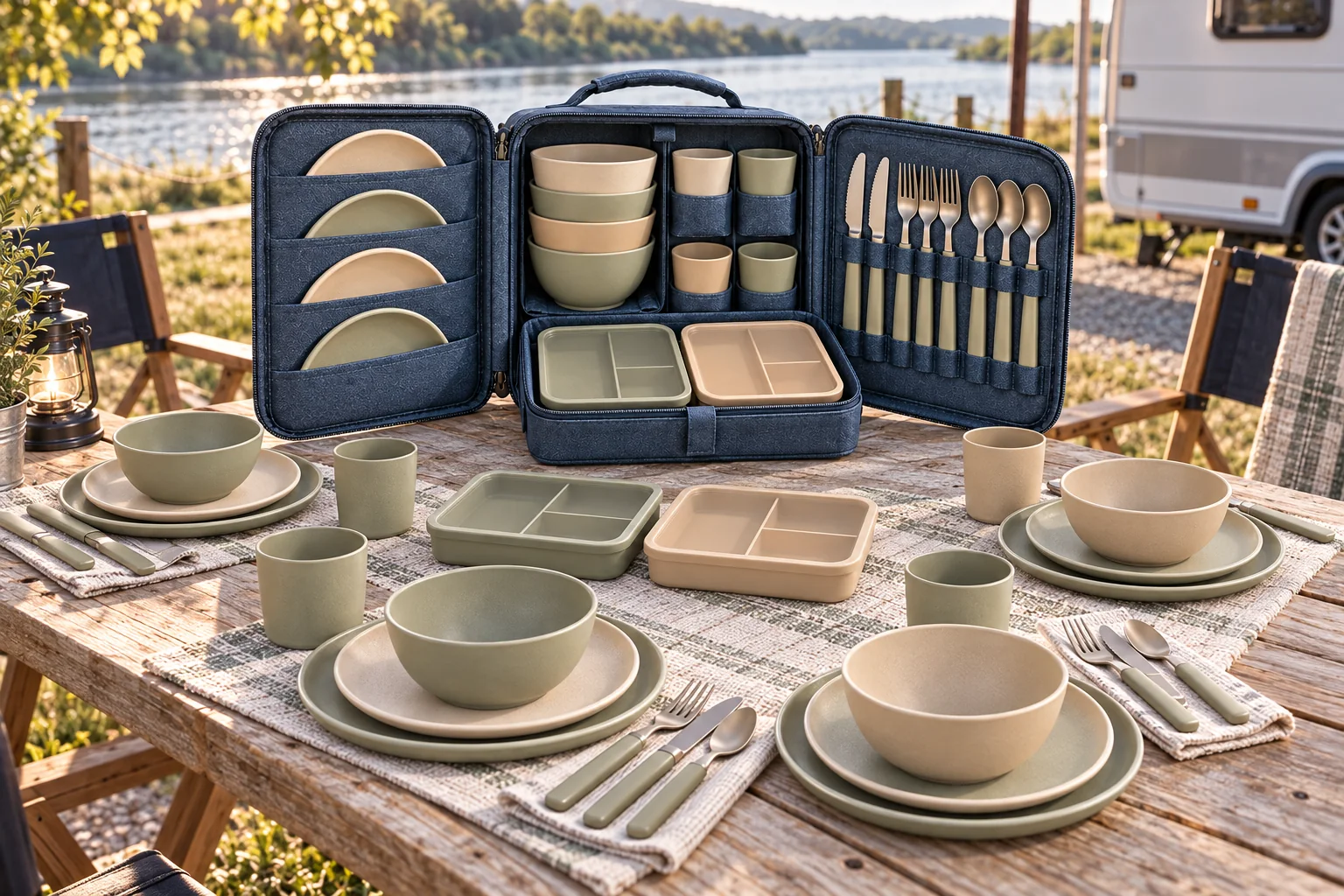
The grassland and riverside scenes show the same Wing-Panel architecture as buyer discussion aids. They are not customer cases, production records or proof of weather, impact, food-contact or cleaning performance. Furniture, vehicles and landscape are not included components.
During sample review, place the case on the representative table footprint. Distribute the settings, access the lunch boxes, return every component and close the case without force. Record any blocked grip, migrating piece or panel instability.
Related procurement resources
Define roles with the component-list worksheet, set user quantities with the family allocation guide, and compare compact geometries with the nesting-versus-stacking worksheet. Compare this two-wing architecture with the published Bridge-Rack set, which uses vertical lanes inside a single top-opening case.
Procurement FAQ
Is this Wing-Panel set a stocked SKU?
No. It is a configurable product-development concept. Availability, components, dimensions, materials, evidence, packaging and commercial terms are to be confirmed for the project.
Can the plate shape or quantity change?
Alternatives can be reviewed, but every sleeve, contact, grip and closed-pack dimension must be reconfirmed. Compatibility to be confirmed by project sample and drawing.
Are the divided lunch boxes leakproof?
No leakproof claim is stated. Closure, seals, foods, orientation and validation method must be defined for the final project if that claim is needed.
Is the soft case waterproof?
No weather-resistance claim is made. Fabric, reinforcement, zipper and seam requirements need a written specification and appropriate validation.
Can buyers mix existing components?
Potential combinations can be evaluated, but nominal sizes and photographs do not establish fit. Compatibility to be confirmed by project sample and drawing.
Can logos be applied to the case and dinnerware?
Artwork can be assessed surface by surface after materials, processes and contact boundaries are defined. Controlled artwork and decorated samples govern approval.
What starts a project review?
Send users, meals, component matrix, proposed profiles, case constraints, materials, markets, colors, artwork, packaging channel and evidence requirements.
Develop your Wing-Panel camping dinnerware set
Share user count, meal roles, proposed component list, plate and bowl profiles, cup format, lunch-box requirement, storage priorities, material and color direction, destination markets, logo files, packaging channel and evidence needs. Confirmed inputs can then be separated from unresolved interfaces before drawings, samples or a written quotation.
Request a Wing-Panel configuration review
Attach component references or sketches through the project inquiry form. Quantities, price, MOQ, schedule, dimensions and any tooling path must be confirmed in writing.
RELATED SOURCING PATHS
Compare Products and Plan Your Project
Review related product formats, then compare material, set configuration, logo, packaging, testing scope and order quantity with our B2B team.