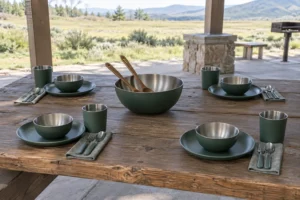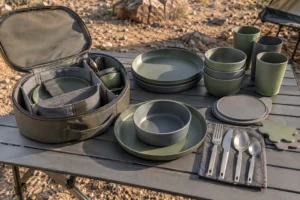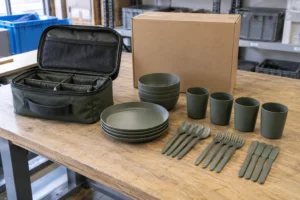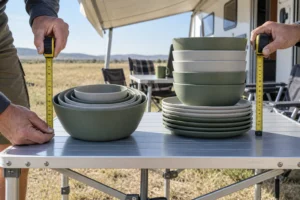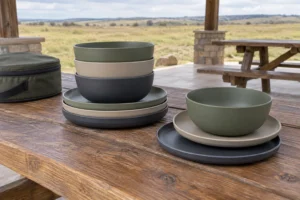
A sound group camping dinnerware configuration gives every user the items needed to eat independently, while sharing only pieces whose use, access and cleaning can be controlled. Start with one plate or bowl, one cup and one eating-utensil set per person. Add serving bowls and serving utensils only for meals that genuinely require transfer from a common container, then validate quantities against the menu, group size and washing plan.
Why shared and individual pieces must be specified separately
“A set for six” is not a complete procurement definition. It may mean six personal place settings, a communal serving kit, or a mixture whose piece count looks generous but cannot support the intended meal. The buyer needs a role for every component before approving the bill of materials.
Individual pieces stay assigned to one user during a meal. Shared pieces move food from a preparation or service container to those individual settings. That distinction affects quantity, pack layout, hygiene instructions, replacement planning and the way a product is presented at retail.
The decision is not that shared pieces are always better or always risky. A large serving bowl can reduce duplicated volume for salad or dry snacks, while individual bowls may be essential for soup or mixed meals. The correct balance follows the menu and service sequence rather than a target piece count.
Use a group camping dinnerware configuration matrix
| Component role | Default allocation | When to add or change it | Buyer evidence |
|---|---|---|---|
| Eating plate | One per user | Add a second form only when courses or food separation justify it | Menu map and sample place setting |
| Personal bowl | One per user when bowl meals are in scope | Remove only if every approved meal can be served on the plate | Intended-food list and capacity review |
| Personal cup | One per user | Specify handle/profile from drink and packing needs | Drink-use statement and nested-set drawing |
| Eating cutlery | One defined set per user | Change utensils by menu, user group and destination expectations | Utensil matrix and retained sample |
| Shared serving bowl | Zero, one or more per meal type | Add for food presented centrally rather than portioned before service | Meal-service storyboard |
| Serving spoon or fork | One dedicated tool per shared food vessel | Add separate tools when foods should not share a utensil | Serving map and cleaning instruction |
| Shared tray or platter | Project-specific | Use when flat presentation or group access matters | Table-layout trial |
| Food container | Project-specific and not automatically dinnerware | Include only when storage/transport is part of the product brief | Container-use boundary and closure review |
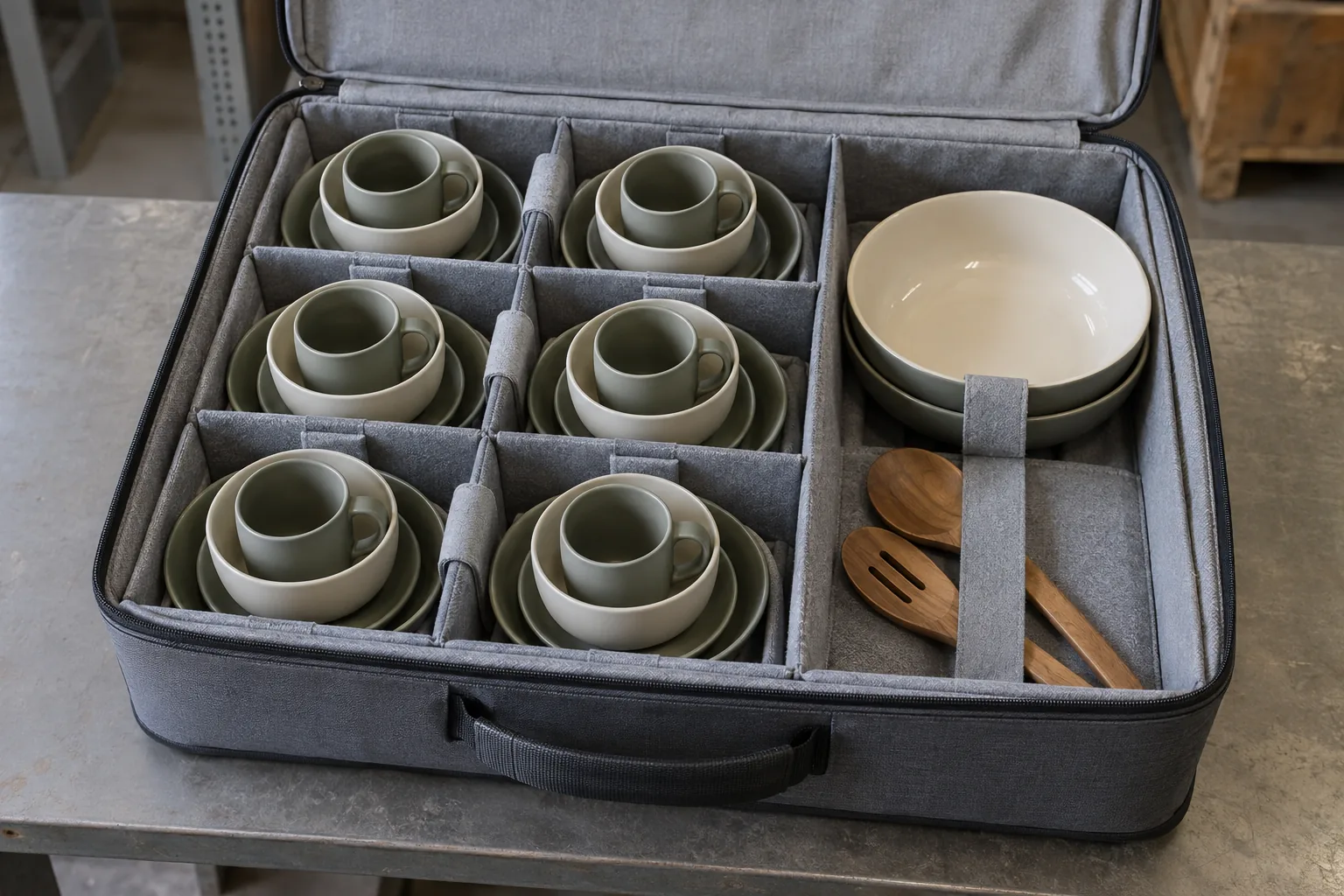
| Carry case | One per saleable set | Divide individual and shared zones when counting or access benefits | Pack-out drawing and packed sample |
This matrix is a starting structure, not a claim that every group needs the same quantities. Convert each row into a controlled requirement: component identifier, user role, quantity, material family, intended food, storage position and cleaning instruction. Mark unknown values “To be confirmed for the project.”
Step 1: define the users, meal occasions and service model
Begin with the maximum supported group size and the smallest configuration the product will be sold as. A six-person retail kit and a six-person rental-fleet module may contain the same eating pieces but use different spares, colors and storage. Do not let the number printed in a concept brief substitute for a user-to-component allocation.
List realistic meal occasions: breakfast, packed lunch, hot evening meal, snacks and drinks. For each occasion, note whether food is portioned before reaching the table, served from a shared vessel, or eaten directly from an approved container. This immediately shows whether a communal bowl or platter performs a real job.
Then define who serves. A family group may pass one bowl around a table, while an organized camp may use a service point where one person portions food. The access pattern changes the necessary number, position and identification of serving utensils.
Step 2: build the individual place setting first
Freeze the minimum viable place setting before discussing shared extras. For many general-purpose programs, that means one plate, one bowl, one cup and a defined cutlery set. The published camping dinnerware component-list guide explains how to give each item a job instead of counting it as decoration.
Test the place setting against the least flexible approved meal. If soup is in scope, a plate cannot replace the bowl merely to reduce pieces. If a fork-only menu is unrealistic for the market, omitting the spoon may shift cost or inconvenience to the user rather than simplifying the set.
Keep variants controlled. A buyer may offer a compact base kit and a more complete configuration, but the relationship between them should be explicit. Reusing the same names for different component lists creates quotation, artwork and replacement errors.

Step 3: add shared pieces only where the menu needs them
Map each shared food to a vessel and transfer tool. A salad may need one bowl and a serving pair; a stew may be portioned from cookware that is outside the dinnerware set; bread may require no dedicated vessel at all. This prevents the common mistake of adding a large bowl because it looks complete in photography.
Keep cookware and dinnerware boundaries visible. A serving bowl is not automatically safe for a burner, stove, campfire or direct flame. Unless a specific item has verified product evidence for that use, describe it only as a food-service component.
When two shared foods are served at once, decide whether they may use the same utensil sequentially or require separate tools. That is a menu and hygiene decision, not a styling preference. Record the intended sequence so the final component count can be defended.
Compare the operational trade-offs
| Decision factor | More individual pieces | More shared pieces | Procurement implication |
|---|---|---|---|
| User independence | High; each person retains a setting | Depends on access to central items | Confirm group behavior and seating layout |
| Menu flexibility | Supports simultaneous personal portions | Efficient for foods served communally | Approve against a menu matrix |
| Piece count | Rises directly with user count | May add fewer but larger items | Compare packed volume, not count alone |
| Cleaning sequence | Many repeated items | Fewer vessels, but high shared-use importance | Define washing and drying responsibility |
| Loss impact | One missing piece affects one setting | One missing server may affect the whole group | Plan critical replacement pieces |
| Pack architecture | Repeated nesting zones | Larger irregular zones may be needed | Review the final case, not isolated parts |
| Retail explanation | Easy to communicate as place settings | Requires clear component and use description | Show exact contents without vague counts |
A shared-heavy set is not necessarily smaller. One large serving bowl can occupy more external envelope than several nested personal bowls. Use the camping tableware pack-volume worksheet to compare the complete packed architecture rather than adding nominal part volumes.
Scenario: family car camping
Family car-camping programs often benefit from complete individual settings plus one or two shared vessels. The family may eat at a picnic table, prepare food nearby and tolerate a larger carry case than a backpacking group. A central bowl can support shared salad, fruit or snacks without pretending to replace personal bowls.
The buyer should test access with the intended table width and seating arrangement. Children may not comfortably reach a central item, and passing a full bowl can create spillage. A smaller pair of shared bowls positioned at opposite ends may work better than one oversized centerpiece.
Color coding can help users return personal components to the same person, but it increases color-control and replacement complexity. If color variants are proposed, define whether they are decoration, user identification or separate sellable SKUs.
Scenario: organized camps and outdoor education
Organized groups need counting, issue and return controls. Repeated personal modules can simplify inventory, while shared pieces should be visibly distinct in shape or storage position. The goal is operational clarity, not an invented claim that one design prevents loss.
Consider separating shared-service items into their own case zone. Staff can check that zone before departure without unpacking every place setting. The final layout should be reviewed with the actual component list and packing sequence.
The U.S. National Park Service summarizes Leave No Trace principles, including planning ahead and properly disposing of waste. This does not certify a tableware set, but it supports requiring a documented washing, drying and waste-handling plan for group use.
Scenario: rental fleets and event programs
Rental fleets face frequent issue cycles, mixed users and missing components. Personal modules make shortages visible, while shared pieces have higher operational criticality because a single missing serving tool can interrupt the meal plan. Specify replacement identifiers and counting positions.
A venue may prefer multiple small serving pieces to reduce carrying distance and queues. A retailer, by contrast, may prioritize a compact complete bundle that is simple to explain. One component architecture should not be assumed to serve both channels without validation.
Keep inspection language factual. Record presence, visible condition, fit and cleanliness according to an approved checklist. Do not claim a generated image or one sample proves fleet durability.
Control hygiene without making unsupported safety claims
Shared utensils should have a defined use and cleaning sequence. The U.S. Food and Drug Administration publishes the 2022 Food Code as a model for safeguarding food in retail and food-service settings. It is not a product certification, yet it is a useful primary reference when a buyer writes operational hygiene requirements.
The U.S. Department of Agriculture also provides official safe food handling guidance. Buyers should separate those handling practices from material-compliance evidence. A food-contact declaration does not define how a group will avoid cross-contact or clean items in the field.
Do not market a shared configuration as “more hygienic” without a scoped basis. Hygiene depends on food, users, hand contact, utensil use, water access, detergent, drying and storage. Write instructions that match the intended scenario and verify any product claim separately.
Pack the system according to access sequence
Items needed at every meal should not be trapped beneath occasional shared components. Map the unpack order: case opening, personal setting issue, shared-service setup, meal use, washing, drying and repacking. A pack that is compact in one direction may be inconvenient if the serving utensils are inaccessible.
Use separate retention zones when they improve counting and prevent uncontrolled contact. The previous guide on preventing rattle in nested dinnerware shows why final quantity and packing sequence matter. Any sleeve, separator or strap must be reviewed with the complete group configuration.
Compatibility to be confirmed by project sample and drawing. That statement is particularly important when individual and shared components come from different existing families. Nominally compatible diameters do not prove stable nesting, closure or release.
Plan replacement logic before approval
Classify components as user-level, group-critical or packaging-only. A personal cup is user-level; a single serving spoon may be group-critical; a divider belongs to the packaging system but can still affect safe retention. This classification helps decide which items need separate identifiers and possible replacement availability.
Do not promise spare-part supply without verified commercial confirmation. Instead, ask whether replacement pieces can be quoted, how revisions will be controlled and whether colors or finishes will remain distinguishable. Record the response in the sourcing file.
Review what happens when the set is incomplete. Can five settings be retained in a six-setting case without uncontrolled movement? Can the shared zone still close when one vessel is removed? These are sample questions, not performance claims.
Convert the decision into an RFQ-ready component schedule
Give each line a stable component ID, description, role, quantity per set, material to be confirmed, color, decoration area, intended food, storage zone and evidence requirement. Distinguish base, optional and replacement components. Avoid using “complete set” as a substitute for the schedule.
Attach a configuration drawing showing all pieces both deployed and packed. If exact dimensions are not verified, leave them as project-confirmation fields rather than estimating from images. Ask suppliers to state assumptions next to their quotation.
Send the meal matrix with the RFQ. This allows the reviewer to identify a component that lacks a job or an intended meal that lacks a vessel. It also provides a rational basis for comparing proposals that use different piece counts.
Run a tabletop approval before locking the packed set
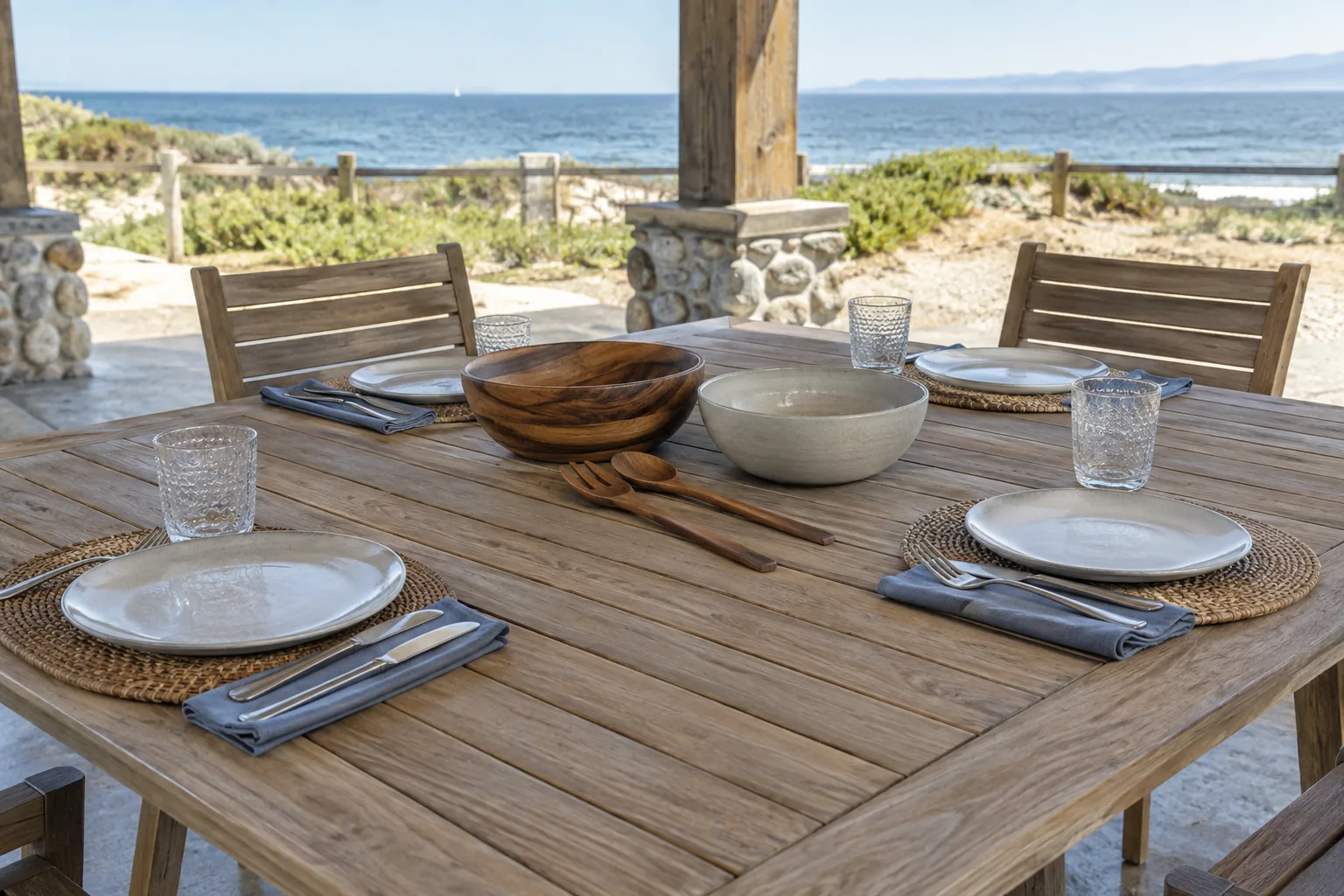
Stage the exact number of users around a representative table or ground-level eating area. Place every individual item at its use position, then add shared vessels one at a time according to the meal sequence. Record reach conflicts, ambiguous ownership, unstable placements and items that remain unused; do not treat a tidy marketing arrangement as an operational trial.
Repeat the review with the most demanding intended meal and the smallest practical surface. A configuration that works on a wide picnic table may fail on a compact folding table. If the program spans several scenarios, state which layout controls approval and which optional component changes are permitted.
After the deployed review, wash or simulate the approved cleaning sequence without making sanitation claims. Count the handling steps, identify parts that trap water, and verify that shared utensils remain identifiable. The purpose is to expose operational complexity before it becomes fixed in the BOM and case architecture.
Control configuration revisions across quotation and sampling
Assign a revision to the component matrix, deployed-layout drawing and packed-layout drawing. When a plate, bowl or container changes, review its effect on personal allocation, shared service, nesting, retention and evidence scope. A supplier quotation should identify the revision used, because a price attached only to a product name cannot be compared reliably.
Record every approved deletion and addition with a reason. “Reduce pieces” is not enough; state whether the change removes an unused meal role, consolidates two valid functions or creates an accepted limitation. This revision trail protects the procurement team from approving a visually similar set whose functional coverage has changed.
Use a configuration code on samples and photographs, but never invent a production SKU for a concept page. The code can remain an internal project reference until the commercial item is formally created. Any dimensions, material grades, color standards or packaging counts that lack verified data should remain “To be confirmed for the project.”
Evaluate the economics without inventing prices
The cost impact of shared versus individual pieces is not determined by count alone. A larger serving vessel may require different tooling, packing protection or carton space, while repeated personal items may benefit from common geometry. Ask for line-level assumptions rather than inferring cost from photographs or material names.
Compare alternatives on a normalized functional basis: users supported, meal roles covered, unique molds or forms, decoration positions, packed envelope, packaging operations and critical replacement items. Keep unit price, MOQ and lead time open until a supplier provides a project-specific written quotation. This preserves commercial truth while still allowing an engineering decision.
If two proposals cover different meals or group sizes, they are not direct substitutes. Normalize the component schedule first, then request revised quotations. A lower headline price for an incomplete configuration can create higher downstream cost through added accessories, repacking or customer returns.
B2B Buyer Checklist
| Check | Question | Why It Matters |
|---|---|---|
| User allocation | Does every supported user receive a complete defined place setting? | Prevents a nominal group count from hiding missing basics |
| Meal coverage | Which approved meal requires each shared component? | Removes decorative or redundant pieces |
| Serving tools | Does every communal vessel have a dedicated transfer tool? | Clarifies service and cleaning |
| Boundary | Are dinnerware, storage containers and cookware clearly separated? | Prevents unsupported heat-use assumptions |
| Access | Can all intended users reach or pass shared items safely? | Connects the configuration to the real table layout |
| Pack-out | Are personal and shared zones stable in the final quantity? | Controls movement and count errors |
| Cleaning | Is the washing, drying and repacking sequence documented? | Prevents the component list from ignoring field operation |
| Replacement | Which pieces are user-level and which are group-critical? | Prioritizes identifiers and replenishment questions |
| Evidence | Are material and claim documents matched to every final component? | A set-level statement may not cover mixed items |
| Approval | Does the retained sample match the controlled BOM and drawing? | Locks the decision before production |
Limitations and commercial risks
A component matrix cannot prove material compliance, durability, dishwasher suitability or field performance. Those questions require product-specific evidence and agreed validation. Do not convert a configuration recommendation into an unsupported claim.
Piece-count marketing can obscure role. A set may reach a larger number by splitting cutlery into separate counted items while omitting a necessary bowl or serving tool. Compare functional modules and the final BOM, not headline numbers.
Shared pieces can create single points of failure. Individual-heavy sets can create excess count, wash load and pack volume. The buyer should document which risk is acceptable for the channel rather than copying a competitor’s assortment.
Material, color, dimensions, packaging and compliance scope remain “To be confirmed for the project” until supported by controlled records. Naike Dinner should only be described as supplying a specific construction or process when verified live company records support that statement.
Sequential buyer FAQs
1. Should every group camping set include a serving bowl?
No. Include one only when the approved meal plan uses a common vessel. If food is portioned directly from a separate preparation container, a serving bowl may add volume without a defined function.
2. How many personal bowls should a six-person set contain?
Six when bowl-based meals are within the intended use and every user needs an independent portion. A different quantity needs a written service rationale and a sample layout review.
3. Can the same spoon be counted as eating and serving cutlery?
Only if its dimensions, access and menu role genuinely support both jobs and the buyer accepts the operational trade-off. Separate roles are usually clearer for group-service planning.
4. Are lunch boxes individual or shared components?
Either is possible. Define whether each user carries a meal, whether containers transport shared food, and whether closures or food-storage claims require separate evidence.
5. Should shared pieces use a different color?
Color differentiation can improve recognition, but it adds color-control and replacement questions. Treat it as a project decision and approve controlled color references.
6. How should buyers compare two different group sets?
Normalize both quotations into the same role-based matrix. Compare users served, meal coverage, critical shared items, pack volume, evidence scope and optional modules before comparing headline piece count.
7. What should be checked on the final sample?
Verify every component against the BOM, deploy the intended meal layout, follow the unpack/repack sequence, inspect retention and confirm that documents match the exact materials and configuration.
Request a configuration and sample review
Prepare the supported group size, meal list, individual place-setting requirement, shared-food vessels, serving utensils, material preferences, target market, pack restrictions, color/artwork needs and required evidence. Include a simple deployed and packed sketch even when final dimensions remain open.
Contact Naike Dinner for a component-matrix review and ask for a written response that separates verified existing options from project-specific development. Compatibility to be confirmed by project sample and drawing.
For a documented quotation, send the controlled user-to-component schedule, destination market, packaging brief and claim/evidence checklist. This gives both buyer and supplier a defensible basis for refining the group camping dinnerware configuration.