Description
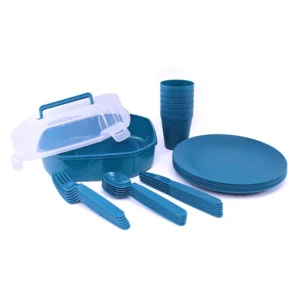
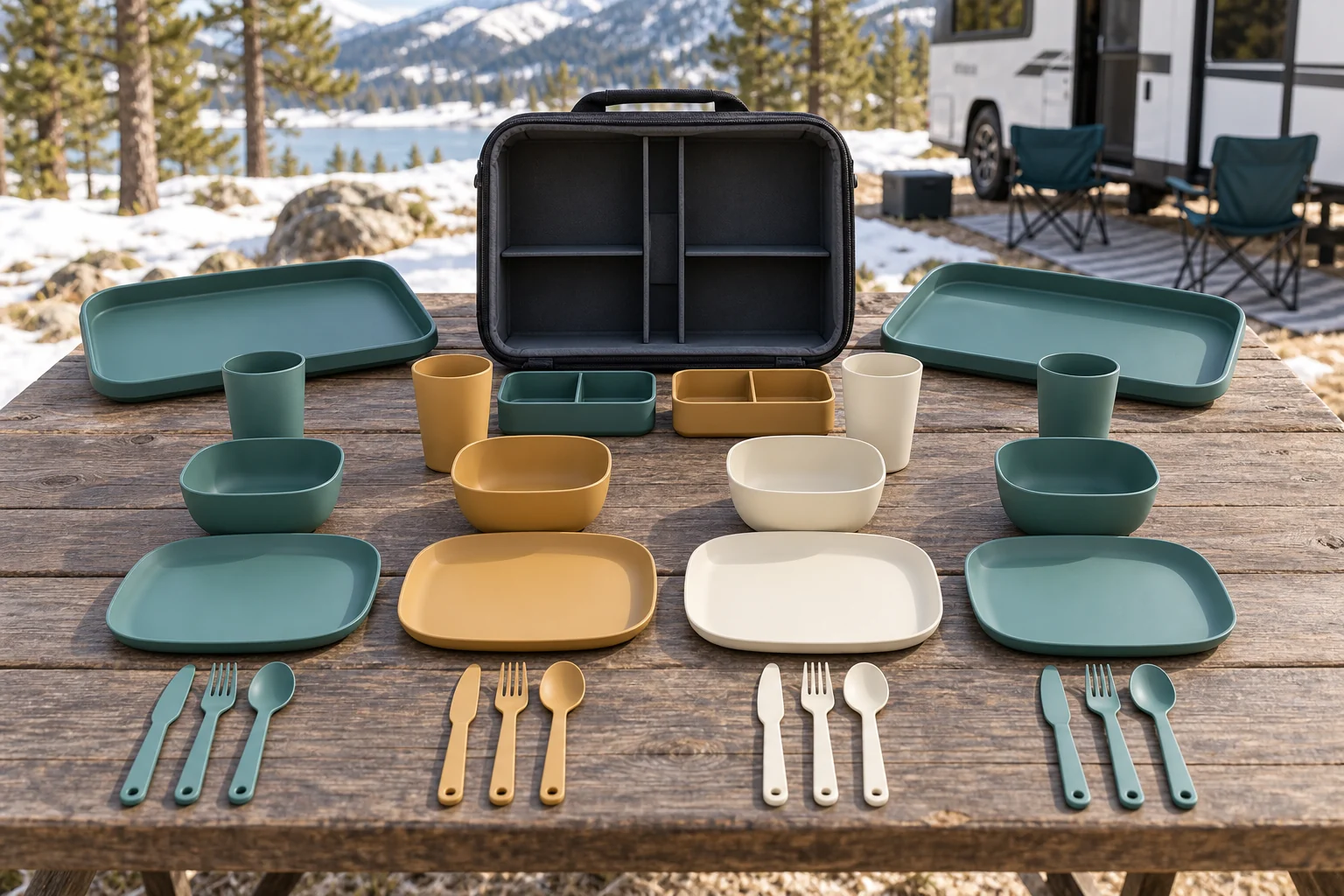
Flip-tray camping dinnerware set: this configurable family concept turns two rigid lid panels into shallow serving trays while a removable divider and slim utensil cassette organize four place settings, two divided lunch boxes and a woven carry case. Final quantities, dimensions, materials, interfaces, artwork, packaging and destination-market evidence are to be confirmed for the project.
PRODUCT PARAMETER
| Product concept | Flip-tray family camping dinnerware set for configurable four-user programs |
|---|---|
| Reference components | Four rounded-square plates, four nesting bowls, four tapered cups, four knife-fork-spoon groups, two divided lunch boxes, two removable shallow trays, utensil cassette, divider frame and rigid carry case |
| Material direction | PP-oriented dinnerware concept with separately specified case textile, reinforcement, zipper and retention parts; exact formulations to be confirmed for the project |
| Storage architecture | Rectangular top-opening case with two removable tray panels, divider frame and dedicated utensil cassette |
| Color direction | Charcoal case with warm grey, muted blue and sand component groups; production colors to be confirmed for the project |
| SKU, dimensions, capacity and weight | To be confirmed for the project |
| Logo and decoration | Position and process subject to final component surface, artwork and feasibility review |
| Packaging | Retail presentation and transit pack to be confirmed for the project |
| MOQ, price and lead time | To be confirmed for the project; no universal values are stated |
| Markets | Europe, North America, Australia and comparable B2B programs, subject to destination requirements |
REFERENCE CONFIGURATIONS
The flip-tray camping dinnerware set is a product-development direction for buyers who want one carry unit to support transport, inventory control and table service. The illustrated arrangement communicates a configurable design brief; it must not be read as current stock, an actual buyer order, a production-site record or validation of the final interfaces.
| Program direction | Personal components | Shared/storage components | Buyer control |
|---|---|---|---|
| Four-user dining set | Plate, bowl, cup and selected utensil group per user | Two trays, divider, cassette and case | Meal matrix, piece-count rule and packed drawing |
| Meal-prep and dining set | Four coordinated settings | Two divided lunch boxes and removable trays | Food task, lid boundary and cleaning review |
| Guided-use or rental set | Color-grouped place settings | Countable cassette zones and replacement codes | Return count, loss plan and service pack |
| Retail assortment version | Channel-selected component mix | Case finish, insert, artwork and carton | Shelf story, evidence file and sample approval |
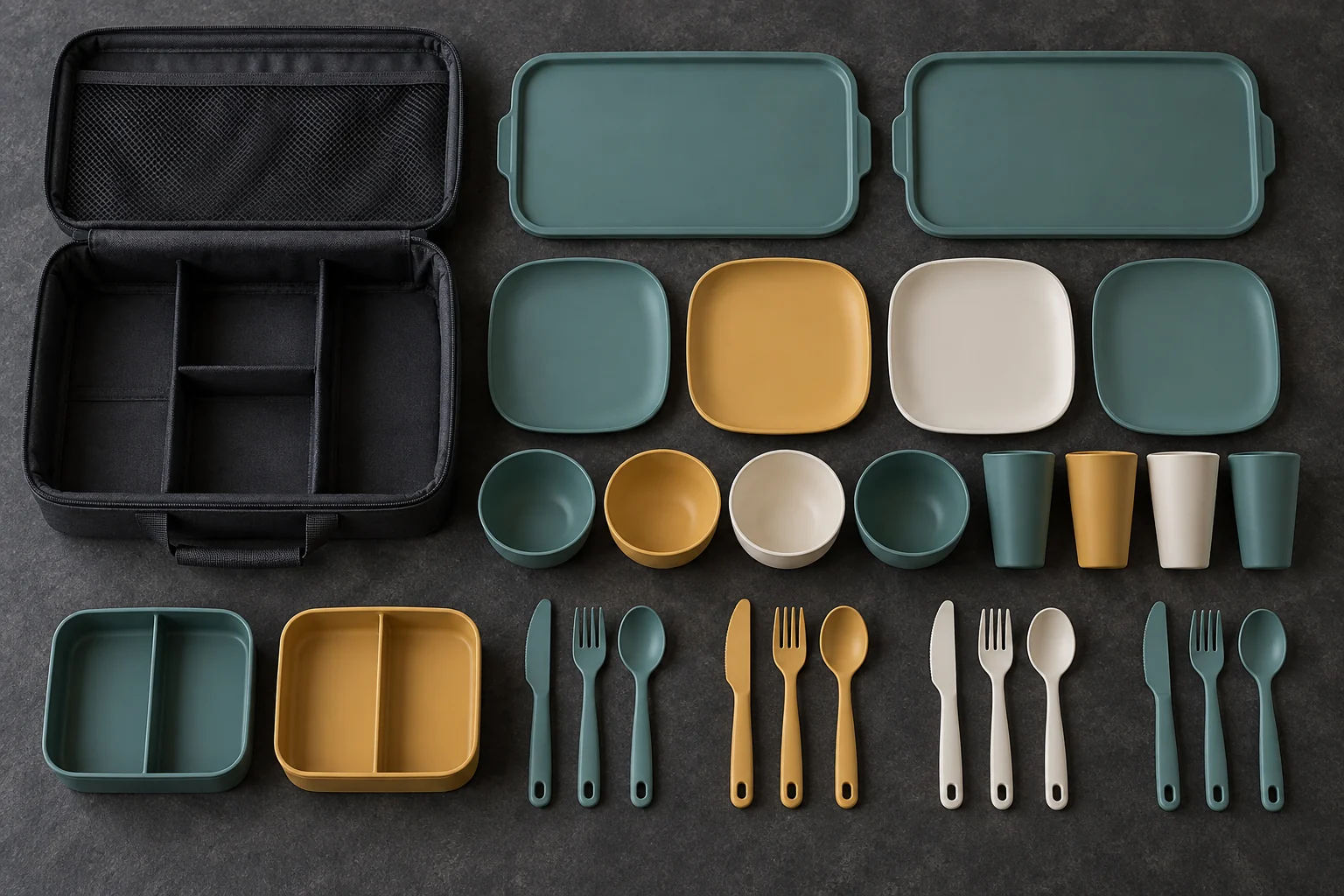
Flip-tray camping dinnerware set architecture
The defining feature is not the component count alone. Two rigid panels sit inside the case lid and can be removed as shallow serving trays, while the lower case holds a divider frame, nested food-contact pieces and a separate cassette for four complete utensil groups. This creates a visibly different pack-out from a drawstring nest, book-opening case or drawer case.
The trays must be treated as their own components in the BOM. Their intended food-contact status, edge profile, removal tabs and packed restraint need project-specific review. Compatibility to be confirmed by project sample and drawing.
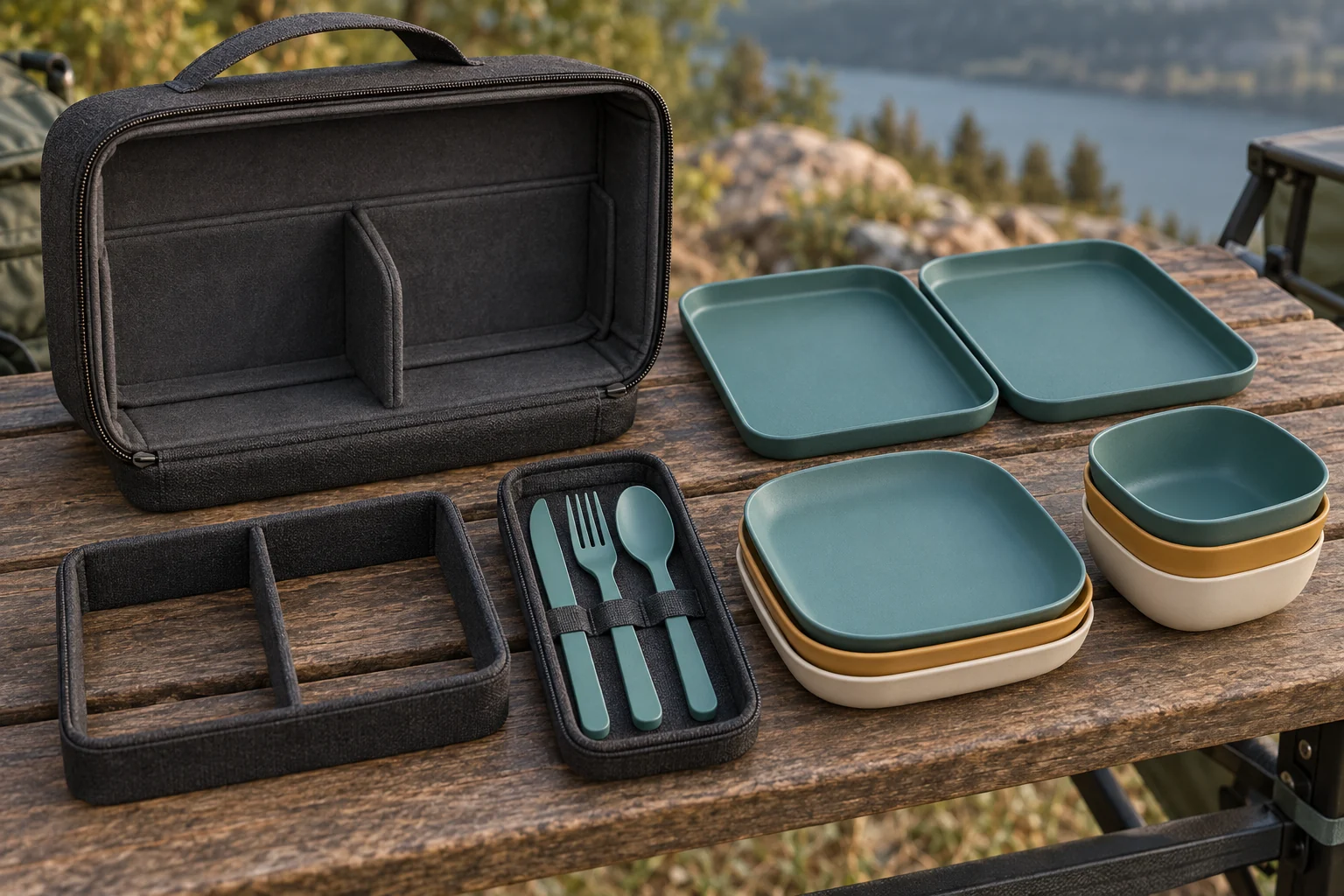
Storage, divider and utensil-cassette detail
A removable divider can separate the lunch-box group from the plate-and-bowl nest, while the cassette keeps knives, forks and spoons in countable positions. The organization supports buyer review and repeatable repacking; it does not prove impact resistance, leak resistance, waterproofing or durability.
Review the case upright, flat, open and closed. Confirm zipper clearance, panel retention, utensil edge protection and the effect of a wet component on textile parts. Any venting, lining or cleaning instruction must follow the approved construction.
Build a component combination from meal tasks
Start with who eats, what is served and whether the lunch boxes carry food, organize ingredients or act as shared containers. Then assign one plate, bowl, cup and utensil group to each user. Add trays and divided containers only when they have a documented role; accessories should never be inserted merely to raise the advertised piece count.
A buyer may request fewer personal pieces with more shared serving functions, or a full four-user allocation with two meal-storage containers. Each version needs an approved component matrix, drawing revision, pack order and commercial counting rule. Replacement pieces should be identified separately from the shipped set.
Customization for a distinct B2B program
- Component family
Select plate, bowl, cup, container and utensil roles from the meal matrix. - Tray function
Define food-contact, serving or organization use before design approval. - Case structure
Review divider, cassette, lid retention, handle and zipper interfaces. - Color system
Approve coordinated, user-coded or channel-specific references. - Logo placement
Evaluate artwork on final surfaces and production samples. - Packaging program
Align component images and claims with the exact shipped BOM.
Customization can include component selection, color direction, artwork, packaging and an assessment of new geometry. This page does not confirm universal molding capability or finished tooling. Any new-mold request requires written technical and commercial evaluation before commitment.
Material and compliance boundaries
A material name does not prove food-contact suitability. European Union projects can scope evidence against Regulation (EC) No 1935/2004 and, where applicable to plastic components, Commission Regulation (EU) No 10/2011. United States programs should reconcile the final construction and intended use with the FDA framework for food-contact substances.
These sources do not certify this concept. Evidence must match the final resin, color, decoration, food type, time and temperature conditions. Textile, reinforcement, zipper and retention parts require separate specifications and must not be used to imply unsupported dinnerware performance.
Development controls before artwork or tooling
Freeze the component matrix and packed stack before approving the case cavities or artwork. A change to a bowl foot, cup rim, lunch-box latch or utensil handle can alter tray clearance, divider position and case closure. Record all assumptions and mark unknown fields “To be confirmed for the project.”
For new geometry, request dimensioned drawings, interface sections, material direction and a staged sample plan. Scenic images communicate product intent but do not approve tooling. The final drawing, BOM, evidence matrix and representative sample must govern the project.
Sample approval sequence
- Approve the user, meal and component matrix.
- Review reference shapes and the intended tray functions.
- Check nesting, dividers, cassette access and case closure.
- Confirm color references and artwork on relevant samples.
- Reconcile the complete pack-out with packaging and evidence files.
- Sign the BOM, drawings, pack sequence and golden-sample status.
If a component changes after approval, repeat affected fit, use, evidence and packaging checks. A verbal substitution is not adequate revision control.
Control every component-to-case interface
The case creates multiple interfaces: tray to lid pocket, divider to sidewall, utensil cassette to closure envelope, lunch-box lid to neighboring pieces and nested rims to one another. A successful fit at one location does not prove that the fully loaded system closes or reopens consistently.
Create an interface register beside the BOM. Identify both component codes, intended relationship, control drawing and sample observation for each contact. Compatibility to be confirmed by project sample and drawing. Unknown clearances or retention values must remain project questions rather than invented specifications.
Align packaging with the approved configuration
The main image can show all components outside the case, while the shipped product arrives nested and restrained. Packaging needs to reconcile those views with the exact component count and an approved pack diagram. Do not show accessories or scenery as included product when they are not in the BOM.
Retail display, e-commerce transit and rental return programs create different packaging requirements. Buyers should state channel, handling, carton and labeling needs before packaging is quoted. If a component revision changes the packed envelope, update artwork, insert and transport review together.
Buyer control checklist
| Check | Buyer question | Required output |
|---|---|---|
| Component logic | Which meal task justifies every item? | User-to-component matrix |
| Tray boundary | Are the removable panels food-contact serving trays or organization panels? | Declared use and material evidence scope |
| Storage interfaces | How are dividers, cassette and nested pieces located? | Section drawings and packed sample |
| Counting rule | How are paired and shared parts counted? | Approved BOM and sales-unit list |
| Artwork | Which final surfaces can accept the selected process? | Artwork map and decorated sample |
| Evidence | Do records match every final food-contact component and use? | Market-specific evidence matrix |
| Packaging | Does the carton show and protect the exact approved set? | Pack diagram, artwork and transit plan |
| Change control | Who approves substitutions or geometry revisions? | Revision and approval record |
Outdoor application and buyer review
The snow-edge caravan setting shows the complete concept near a controlled camp table, while the outdoor event scene demonstrates a different group-use context. These are physically plausible application illustrations, not customer cases or evidence of temperature, impact, cleaning or food-contact performance.
During sample review, recreate the buyer’s actual table footprint, serving sequence and pack order. Confirm whether both removable trays are needed at once, whether users can access their utensils without emptying the case and whether wet items have a defined return workflow.

Related procurement resources
Use the camping dinnerware component matrix to justify the set contents, compare family allocation logic in the family camping set piece-count guide, and review counting risks in the 20-piece versus 24-piece comparison. Published product references such as the book-case camping dinnerware set illustrate a materially different storage architecture.
Procurement FAQ
Is this a stocked flip-tray camping dinnerware set?
No. It is a configurable product-development concept. Availability, final components, materials, dimensions, packaging and commercial terms are to be confirmed for the project.
Can both lid panels be used for serving food?
That use must be declared and reviewed against final material, construction and evidence. The concept image alone does not establish food-contact suitability.
Can buyers change the four-user component mix?
Yes, a project can evaluate another allocation based on users and meals. Every version requires its own BOM, pack drawing, compatibility review and quotation.
Are the lunch boxes proven leakproof?
No leak-resistance claim is made. Closure, seals, intended foods and test methods must be defined and verified for the final product if such a claim is required.
Can a custom logo be added?
Logo position and process can be assessed after the component surface, color, artwork and use conditions are defined. Approval should use the relevant decorated sample.
Does the case prove impact or weather resistance?
No. The visual shows an organizational case concept. Construction, lining, closures and any performance claim require an agreed specification and evidence.
What should a buyer send for review?
Send the user count, meal tasks, desired components, material direction, target markets, carry method, artwork, packaging channel and any existing drawings or samples.
Develop your flip-tray camping dinnerware set
Share the intended users, meal matrix, component list, tray role, case direction, material preferences, destination markets, logo files, packaging channel and evidence needs. We will separate confirmed inputs from open project questions before a sample, drawing or written quotation review.
Request a configuration review
For drawings or a component matrix, use the project inquiry form. MOQ, price, lead time and tooling feasibility remain to be confirmed for the project.
RELATED SOURCING PATHS
Compare Products and Plan Your Project
Review related product formats, then compare material, set configuration, logo, packaging, testing scope and order quantity with our B2B team.