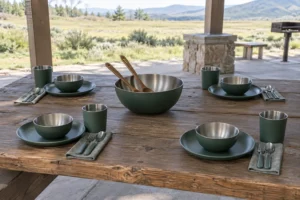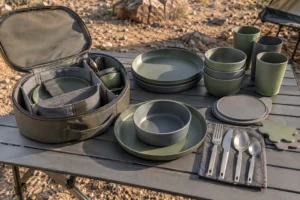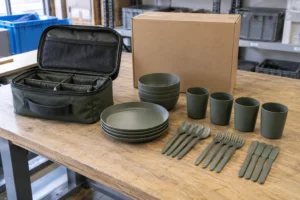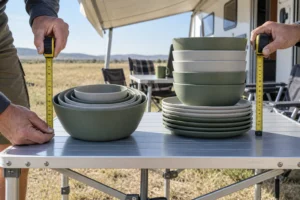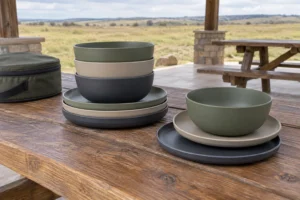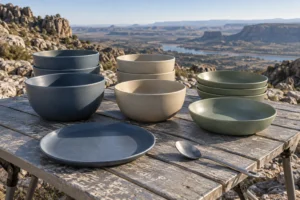
Lightweight and ultralight camping tableware are not defined by one universal mass cutoff. For buyers, lightweight means a complete, durable eating system whose mass is reduced without sacrificing agreed functions; ultralight means a more aggressively minimized system that may remove pieces, shrink capacity, or accept tighter durability and comfort tradeoffs. Specify both by measured component and packed-system mass, not by marketing labels.
What lightweight and ultralight should mean in a B2B specification
Outdoor brands often use lightweight and ultralight as merchandising language, but neither word gives a factory a complete engineering target. A sourcing brief needs a measurable mass boundary, a named component list and a use scenario. Without those three items, suppliers can reduce the apparent number simply by omitting a bowl, weighing without packaging or comparing different capacities.
A lightweight tableware program normally protects a complete eating experience while reducing avoidable mass. It may retain a full-size plate, a stable bowl, a comfortable cup and practical cutlery because the intended user values repeated use and familiar handling. An ultralight program begins with a stricter carrying limit and challenges every function, sometimes combining plate and bowl roles or removing duplicate utensils.
These descriptions are procurement definitions for this article, not universal industry standards. The buyer should write its own approved thresholds in grams and state whether the number applies to one piece, one place setting, the consumer set or the fully packed retail unit. The U.S. National Institute of Standards and Technology guidance on SI mass units supports consistent use of grams and kilograms when recording and communicating mass.
Lightweight vs ultralight camping tableware decision table
| Decision factor | Lightweight direction | Ultralight direction | Evidence to request |
|---|---|---|---|
| Primary objective | Reduce mass while retaining a familiar complete setting | Minimize carried system mass around essential eating functions | Approved use brief and component matrix |
| Component count | Often plate, bowl, cup and practical cutlery | May combine functions or omit nonessential pieces | Line-by-line bill of materials |
| Capacity and geometry | Comfort and meal flexibility receive more weight | Compact volume and minimum sufficient capacity dominate | Controlled drawings and measured samples |
| Material strategy | Several verified material systems can qualify | Thin sections or lower-density systems may be explored | Finished-item construction and evidence scope |
| Handling | Full grip surfaces and stability are normally retained | Smaller handles, rims or bases may create tradeoffs | Wet-hand, glove and loaded-use trials |
| Durability margin | Usually balanced with repeated family or retail use | Must be explicitly assessed against aggressive mass reduction | Product-specific test method and acceptance criteria |
| Packaging | Protective structure can remain substantial | Packaging mass and volume become part of the optimization | Packed sample, carton drawing and measured mass |
| Best-fit channel | Car camping, RV, family, rental and broad outdoor retail | Backpacking, individual issue and weight-led specialist programs | Channel brief and user research |
The table does not declare one direction superior. A well-designed lightweight family set may create more value than an ultralight set that cannot support the buyer’s menu or replacement promise. Equally, a disciplined ultralight individual kit may be the correct solution where every carried gram competes with water, shelter and safety equipment.
Start with a defensible measurement boundary
Mass data is only comparable when every quotation uses the same boundary. Define whether utensils, lids, storage pouches, bands, cases, printed sleeves and retail cartons are included. State the sample revision, color, material and measurement condition because moisture, accessories and later design changes can alter the recorded result.
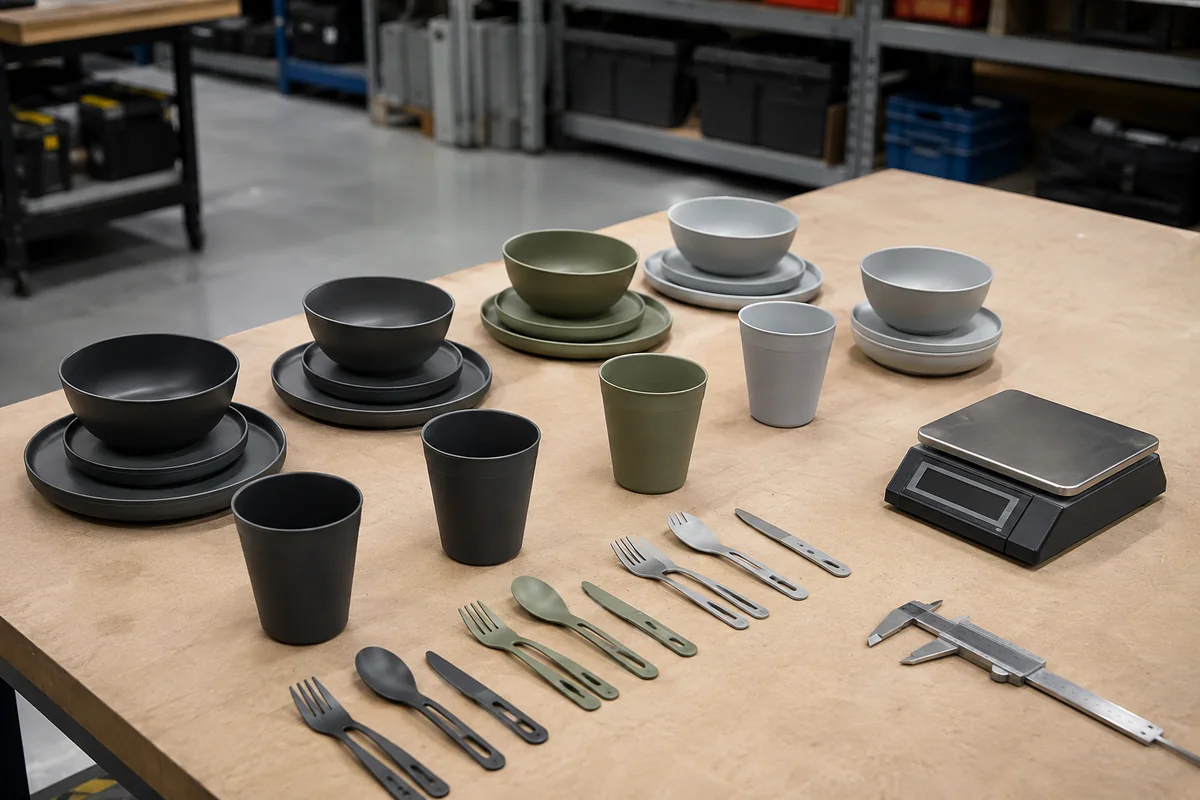
Record at least four levels: individual component mass, complete eating-setting mass, consumer pack mass and shipping-unit mass. Component data reveals where reduction is possible, while packed-system data shows what the customer actually carries or the retailer actually ships. The published Camping Dinnerware Weight Guide for Product Buyers provides a companion workflow for setting those boundaries.
Use calibrated equipment appropriate to the tolerance and document the method. Do not copy a value from a generated image, competitor listing or material datasheet and present it as finished-product mass. This article intentionally gives no invented Naike Dinner weight, because production values must come from the exact approved sample and configuration.
Compare equal functions before comparing grams
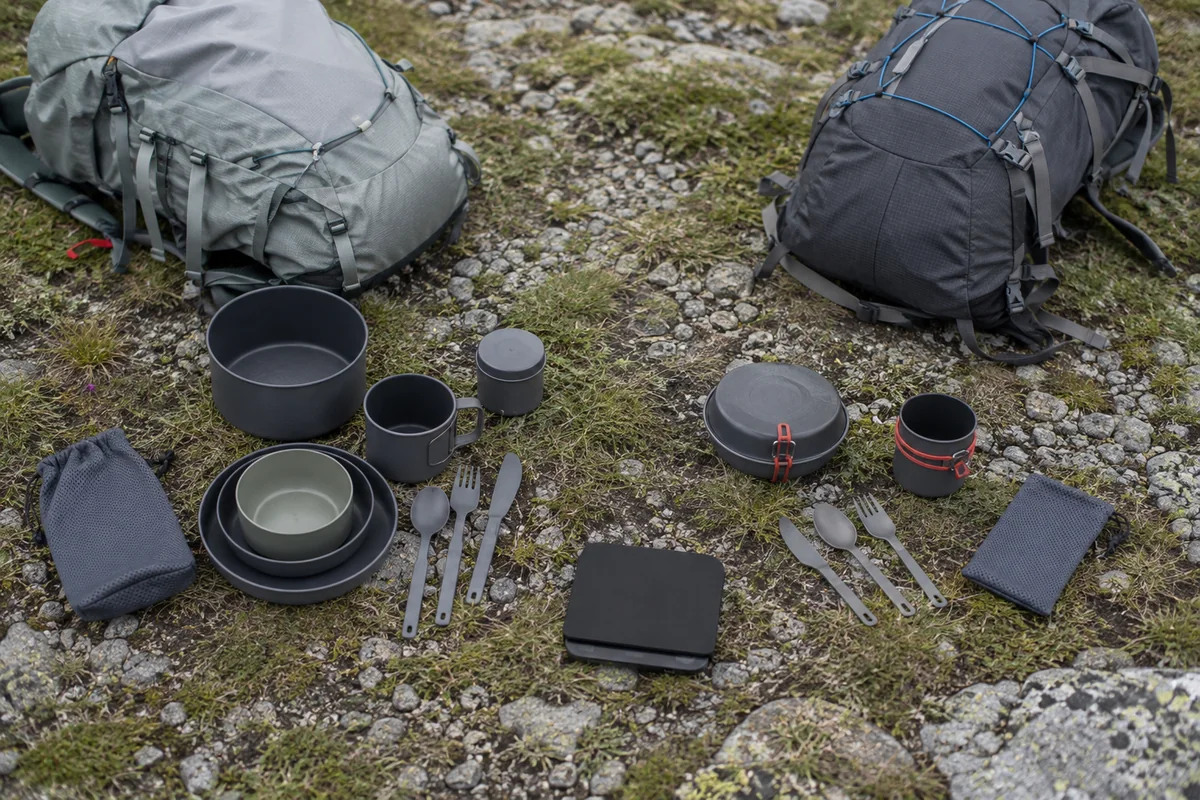
A common sourcing error is comparing a four-piece lightweight setting with a two-piece ultralight bundle. The second is predictably lighter, but the result says more about missing functions than design efficiency. Create a functional-equivalence matrix that identifies eating surface, deep-food vessel, drinking vessel, cutting or scooping tools, storage and any shared pieces.
Run the intended menu through both configurations. A deep plate may replace a plate and bowl for some meals, but it may be awkward for beverages or high-volume soup. A spoon-fork combination can reduce piece count, yet the buyer must test whether it performs acceptably for the target food, hand size and retail promise.
The same rule applies to user count. A one-person set and a four-person set cannot be compared by total mass without dividing by equivalent personal functions and separating shared components. See the live One-Person vs Four-Person Camping Dinnerware Sets analysis for allocation, replacement and simultaneous-service questions.
Material choice matters, but geometry controls the result
Titanium, stainless steel, aluminum, enamel-coated steel, silicone, polypropylene, copolyester and plant-fiber composites can all appear in outdoor programs. A material name alone does not establish the mass of a finished plate or cup. Diameter, depth, wall distribution, ribs, foot rings, handles, rolled edges, coatings and closures can outweigh a simple density comparison.
Thin metal can reduce mass, but the buyer must evaluate edge safety, local deformation, heat transfer, noise and surface behavior. Lower-density polymers can support quiet handling and color control, yet the finished geometry, temperature scope and food-contact formulation still require verification. Flexible materials may pack compactly but need enough structure to remain stable when loaded.
Plant-fiber appearance does not prove a low-mass, biodegradable or compostable outcome. The polymer matrix, fiber content, section thickness and complete article determine performance and claims. Naike Dinner’s verified live scope is strongest in reusable plant-fiber composite and related tableware; neutral discussion of other materials does not claim that every option is currently manufactured or supplied.
For a focused metal example, the live article Is Aluminum Camping Dinnerware Safe? explains why material identity, surface condition and intended food-contact use must be separated from general outdoor appearance. Apply the same evidence discipline to every candidate construction.
Food-contact evidence cannot be traded away for lower mass
Reducing mass never removes the supplier’s obligation to support the intended food-contact use. The U.S. FDA explains that food-contact substances are evaluated for their intended conditions of use, and authorization depends on the substance and application. Buyers should consult the FDA’s food-contact substance and packaging guidance and request documentation tied to the finished material system.
For the European market, the European Commission’s food-contact materials overview explains the framework and material-specific measures. The relevant evidence must match the finished item, formulation, color, food type, contact time, temperature and repeated-use conditions. A declaration for a thicker or differently colored article should not be assumed to cover an ultralight redesign without a documented technical basis.
Ask whether aggressive wall reduction changes foreseeable use, deformation or exposure conditions. Do not infer that a product remains suitable for hot food, dishwashing or acidic foods merely because the base resin or alloy name is unchanged. Any revised construction needs a controlled drawing, sample and evidence review before claims are approved.
Comfort, stability and heat are part of the weight budget
A very light plate that tips when food is cut, flexes during carrying or becomes uncomfortable to hold can fail the user scenario. Base width, rim shape and center of gravity influence real stability. Evaluate the item empty and loaded on picnic tables, uneven ground and the surfaces identified in the brief.
Metal cups and bowls can transfer heat rapidly to fingers or lips depending on construction and contents. Handles, rolled rims, double-wall designs or sleeves may improve handling but add mass and complexity. The buyer must decide whether the comfort gain is essential, optional or outside the target use.
Grip trials should include wet hands and, where relevant, gloves. Thin rims may save material but can feel sharp even when they pass a basic visual inspection. Define an edge and handling acceptance criterion that a supplier and inspector can repeat rather than using subjective words such as premium or comfortable.
Durability: avoid the false choice between heavy and fragile
Lower mass does not automatically mean poor durability, just as higher mass does not prove strength. Material condition, forming, molding, transitions, ribs and stress concentrations determine how a product responds. Use product-specific tests that reflect transport, nesting, washing and repeated meal service, then agree acceptance criteria before production.
Inspect likely failure points: cup handles, utensil necks, thin bowl bases, plate rims, hinge features, clips and storage closures. A reduction that is harmless in the center of a plate may be risky at a sharp transition or attachment. Retain approved samples and document any change in wall section, material supplier, pigment, coating or process.
Service strategy also matters. Broad retail and rental programs may benefit from replaceable components and a modest durability margin. A specialist ultralight program may accept a narrower use range, but the limitation must be communicated honestly and supported by the product brief rather than hidden behind a weight headline.
Use scenarios that favor lightweight tableware
Family car camping
Vehicle-supported trips reduce the pressure to minimize every gram. Families often gain more from stable portions, color allocation, easy washing and a storage system that makes missing pieces visible. A complete lightweight configuration can reduce carrying burden without sacrificing bowls, cups or child-appropriate handling.
RV and caravan programs
Compact nesting and quiet storage can matter more than absolute minimum mass. Buyers should measure cabinet space, rattling, access and drying behavior. A slightly heavier but stable, replaceable system may create a stronger daily-use offer.
Rental fleets, camps and group issue
Operators need fast counting, sanitation, clear condition checks and component replacement. Extremely thin or specialized pieces may increase loss or inspection time. Evaluate total operating cost and service workflow, not only the mass printed on a retail page.
General outdoor retail
A lightweight assortment can reach customers who camp, picnic, travel by vehicle and use products at home. The buyer can offer familiar shapes and explain the mass benefit without forcing every shopper into specialist ultralight tradeoffs. Packaging should state exactly what is included and how mass was measured.
Use scenarios that may justify ultralight tableware
Backpacking and fast-moving individual travel
When all equipment is carried over distance, system mass has a direct place in the purchase decision. A combined vessel, compact cup and limited cutlery may be appropriate if the meal plan supports them. Test pack access, nesting, cleanup and portion suitability on a realistic route simulation.
Personal issue kits
Organizations may need a minimal, individually assigned eating solution that fits a defined pouch or compartment. The specification should still cover identification, cleaning, drying and replacement. Low mass does not excuse incomplete item tracking or unsupported food-contact claims.
Specialist merchandising tiers
An outdoor brand can maintain separate lightweight and ultralight tiers. The commercial distinction should be based on declared system boundaries and intended users, not cosmetic colors. Publish measured production-intent values only after the final configuration and packaging are controlled.
Limitations and risks buyers should control
The first risk is an undefined label. “Ultralight” without grams, component scope and tolerance cannot be inspected. Require the quotation, sample record, packaging and product page to use the same measurement boundary.
The second risk is function removal disguised as engineering improvement. A smaller piece count may be appropriate, but it must be transparent. Compare equal functions and state any combined role, shared component or omitted feature.
The third risk is overstating material performance. Thin walls, coatings and flexible constructions need finished-item evidence and realistic handling checks. Do not promise unbreakable, heatproof, flame-safe, dishwasher-safe or stain-proof performance unless the exact product and conditions support the claim.
The fourth risk is confusing dinnerware with cookware. A metal bowl photographed near a stove is not automatically suitable for direct flame, burner or campfire use. Keep cookware components, heating tests and warnings separate from plates, cups and serving vessels.
The fifth risk is uncontrolled compatibility. Components from different families may look stackable yet bind, scratch or rattle after transport. Use the statement “Compatibility to be confirmed by project sample and drawing” until the complete assembly is approved.
The sixth risk is a mass value that changes after artwork or packaging approval. Printing, sleeves, pouches, dividers and replacement parts affect the consumer system. Run the final measurement after all commercial elements are locked and keep the revision in the specification file.
Procurement workflow for a defendable low-mass program
1. Define the user and meal
State whether the program serves a solo backpacker, couple, family, rental fleet or general retail customer. List the typical food, drink, serving temperature, trip duration, cleaning method and carrying conditions. This prevents a mass target from overriding the actual eating task.
2. Lock the functional baseline
Create a component matrix showing personal, shared and optional functions. Decide whether a deep plate can replace two vessels and whether combined cutlery is acceptable. Record rejected alternatives so later quotations do not silently remove required pieces.
3. Set measurable mass boundaries
Define target and tolerance in grams for each component and complete system. State whether storage and retail packaging are included. Unknown figures remain “To be confirmed for the project” until measured on controlled samples.
4. Review construction and compliance scope
Request material, color, finish, drawing and intended-use information for every item. Map declarations and tests to the finished configuration and destination market. Do not treat a generic material statement as approval of the full set.
5. Test complete samples
Run meal, grip, stability, nesting, washing, drying, packing and transport checks. Weigh the same samples under the agreed boundary and record equipment, units and revision. Photograph pack-out order for quality and packaging teams.
6. Approve change control
Require written review for changes in material, wall distribution, pigment, coating, supplier, tooling, artwork, accessories or packaging. A small change can affect mass, evidence scope or fit. Recalculate and remeasure whenever the approved boundary changes.
Build a commercial assortment without confusing the two tiers
A brand can offer lightweight and ultralight products in the same range when the distinction is visible in function, specification and intended user. Start with a shared vocabulary: name the number of users, the included meal functions and the exact weighing boundary. Then explain why the ultralight version is different, such as a combined vessel, reduced capacity or simplified storage, instead of relying on darker colors or technical-looking photography.
Shared components can reduce development complexity, but they also create a substitution risk. If the same cup or utensil appears in both tiers, give it a stable item identifier and control its material, color, dimensions and mass. Where a thinner or smaller variant is introduced, treat it as a separate controlled component rather than allowing packing teams to choose whichever version is available.
Retail packaging should display the exact component matrix and distinguish net product mass from packed carry mass. Online product pages should use the same definitions and revision-controlled values. If the number is still based on an engineering sample, label it appropriately and replace it only after production-intent verification; never present a concept target as a guaranteed shipment value.
Sample requests should mirror the commercial decision. Ask for one complete lightweight set and one complete ultralight set in their proposed storage formats, not a collection of unrelated loose parts. Run the same meal and cleaning sequence, record observations and obtain a documented quotation that identifies open values as “To be confirmed for the project.”
For private-label programs, logo placement and color can change the design or evidence scope even when they add little mass. Review artwork areas, printing or engraving processes, color masters and packaging together with the weight target. A buyer seeking new-mold development should provide the functional baseline and target envelope first, then request a feasibility assessment rather than assuming that a thinner wall or altered rim is available.
Finally, train sales and customer-service teams on limitations. An ultralight dinnerware item is not cookware unless verified for direct heat, and a lightweight claim does not prove impact resistance or environmental benefit. Clear boundaries protect the brand from overpromising and help the supplier maintain the approved configuration throughout sampling, production and replenishment.
B2B Buyer Checklist
| Check | Question | Why It Matters |
|---|---|---|
| Definition | What do lightweight and ultralight mean in grams for this project? | Turns marketing language into an inspectable requirement. |
| Boundary | Which components, storage items and packaging are included? | Prevents unequal comparisons. |
| Function | Do both candidates complete the same meal tasks? | Separates genuine optimization from missing pieces. |
| Sample | Was mass measured on the final material, color and revision? | Connects the claim to the ordered article. |
| Evidence | Does documentation cover every finished food-contact component? | Protects destination-market compliance review. |
| Handling | Are grip, stability, edges and heat behavior acceptable? | Prevents low mass from undermining real use. |
| Compatibility | Has the full nested assembly passed sample and drawing review? | Reduces binding, scratching and rattling. |
| Change control | Will material, geometry or packaging changes trigger reapproval? | Keeps the measured claim valid through production. |
Buyer FAQs
1. Is there an official weight limit for ultralight camping tableware?
No universal limit applies across all products and set sizes. Define a project-specific gram target, component boundary and tolerance, then compare equal functions.
2. Is titanium always the lightest choice?
No. Finished mass depends on geometry, thickness, size, handles, coatings and included pieces. Material name alone cannot replace a measured production-intent sample.
3. Can plastic or plant-fiber composite tableware be ultralight?
Potentially, depending on the verified formulation and geometry. Buyers must review stability, intended-use conditions, food-contact evidence and finished mass without making unsupported environmental claims.
4. Should packaging count toward the published weight?
State the boundary explicitly. For a carried kit, include the pouch, band or case the user must carry; retail and shipping packaging can be reported separately.
5. Does a lighter wall reduce durability?
It can change stiffness or local strength, but the outcome depends on material and geometry. Verify the exact construction with relevant sample tests and acceptance criteria.
6. Can dinnerware be used on a camp stove?
Not unless that exact item is designed and verified as cookware for the specified heat source. Keep direct-flame claims separate from ordinary plates, bowls and cups.
7. Can Naike Dinner assemble custom low-mass sets?
Project options must be checked against verified current components, material scope and compatibility. Send the target functions and mass boundary for a documented feasibility review.
8. What should an RFQ include?
Include market, users, meal scenario, component matrix, gram targets, measurement boundary, material direction, colors, logo, packaging, evidence needs and sample plan.
Specify the System, Not Just the Label
Share your complete component matrix, user scenario, packed boundary and target mass. Naike Dinner can separate confirmed tableware options from compatibility, material, tooling and evidence questions before quotation.
Review the published camping dinnerware set direction, then request a lightweight vs ultralight specification review. For a side-by-side supplier discussion, send both proposed bills of materials.