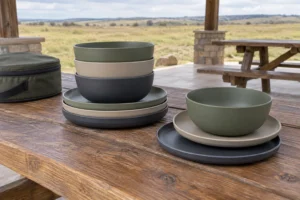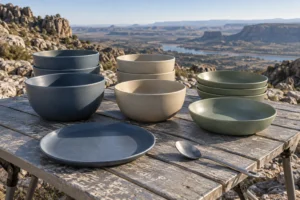
Anodized aluminum camping tableware is aluminum dinnerware whose surface has been electrochemically converted into a controlled aluminum-oxide layer. The treatment can change surface hardness, appearance, corrosion behavior and dye acceptance, but it does not prove food-contact compliance, care performance or suitability for direct flame. B2B buyers must verify the alloy, anodizing specification, sealed condition, color system and intended use for the exact article.
What does anodized aluminum actually mean?
Anodizing is an electrolytic oxidation process in which the aluminum article acts as the anode. Instead of adding a separate sheet of paint, the process converts the metal’s outer surface into an oxide layer that is integrated with the underlying aluminum. The Aluminum Anodizers Council’s process overview explains the electrochemical conversion and the porous structure that can accept coloring and sealing, illustrating why the process must be stated rather than inferred from color.
That definition matters because buyers often treat “anodized aluminum” as one uniform material. In commercial sourcing, two plates can both carry that description while differing in alloy, thickness, forming method, surface preparation, anodizing route, color, sealing and final inspection. The phrase identifies a process family; it does not establish that two offers are equivalent.
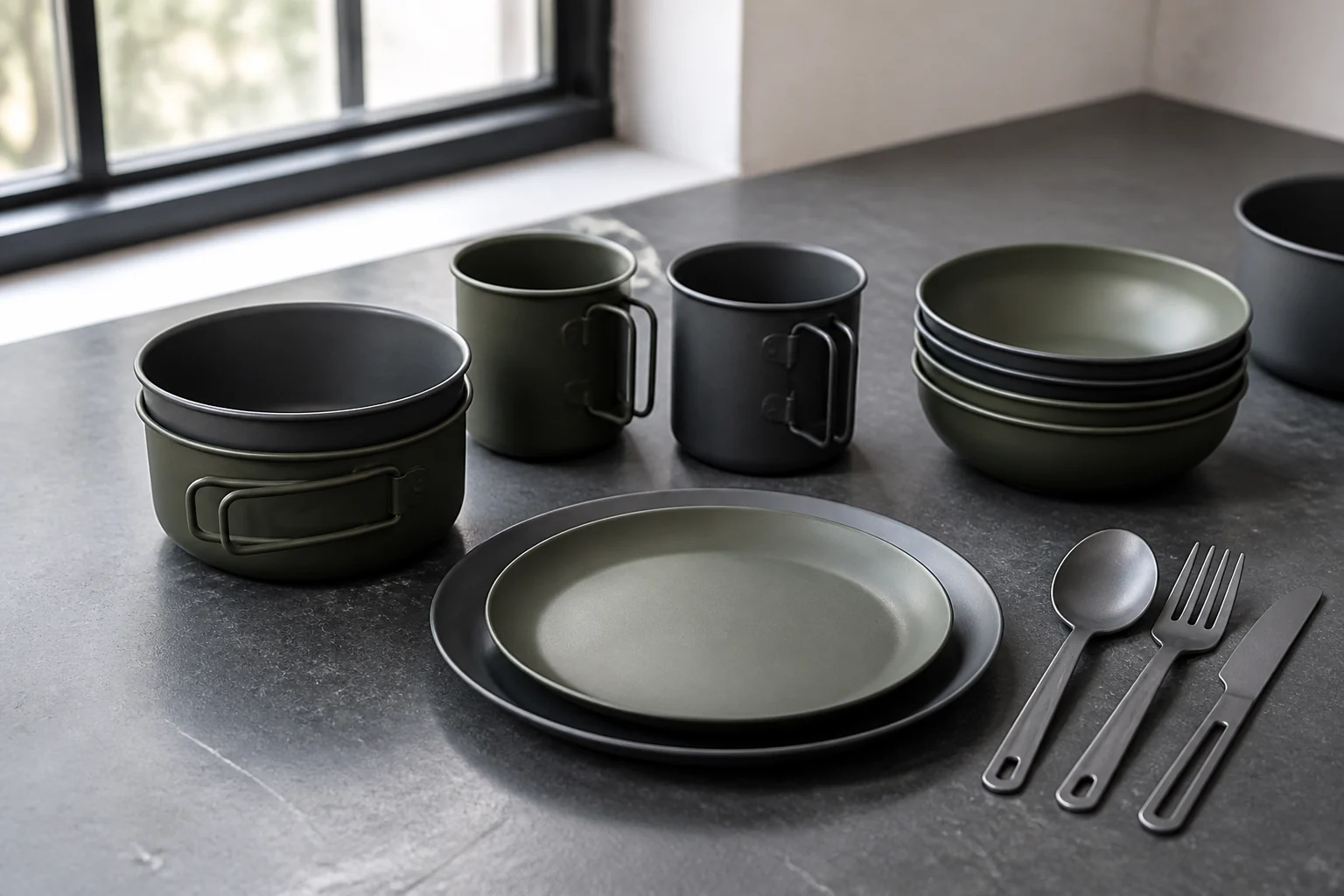
For camping tableware, the term usually applies to lightweight plates, bowls, mugs, cups, utensils or nested eating components. A bowl with folding handles can visually resemble cookware, but appearance does not authorize stove or campfire use. Unless the supplier provides product-specific evidence for heating, describe and evaluate it as dinnerware only.
Anodized surface, organic coating and bare metal are different systems
A bare aluminum surface naturally forms an oxide film in air, but a controlled anodizing process is designed to create a more deliberately specified surface. A painted, lacquered or non-stick article uses an applied organic coating system instead. Those systems have different evidence needs, damage modes and repair expectations, so a quotation should never collapse them into a single word such as “coated.”
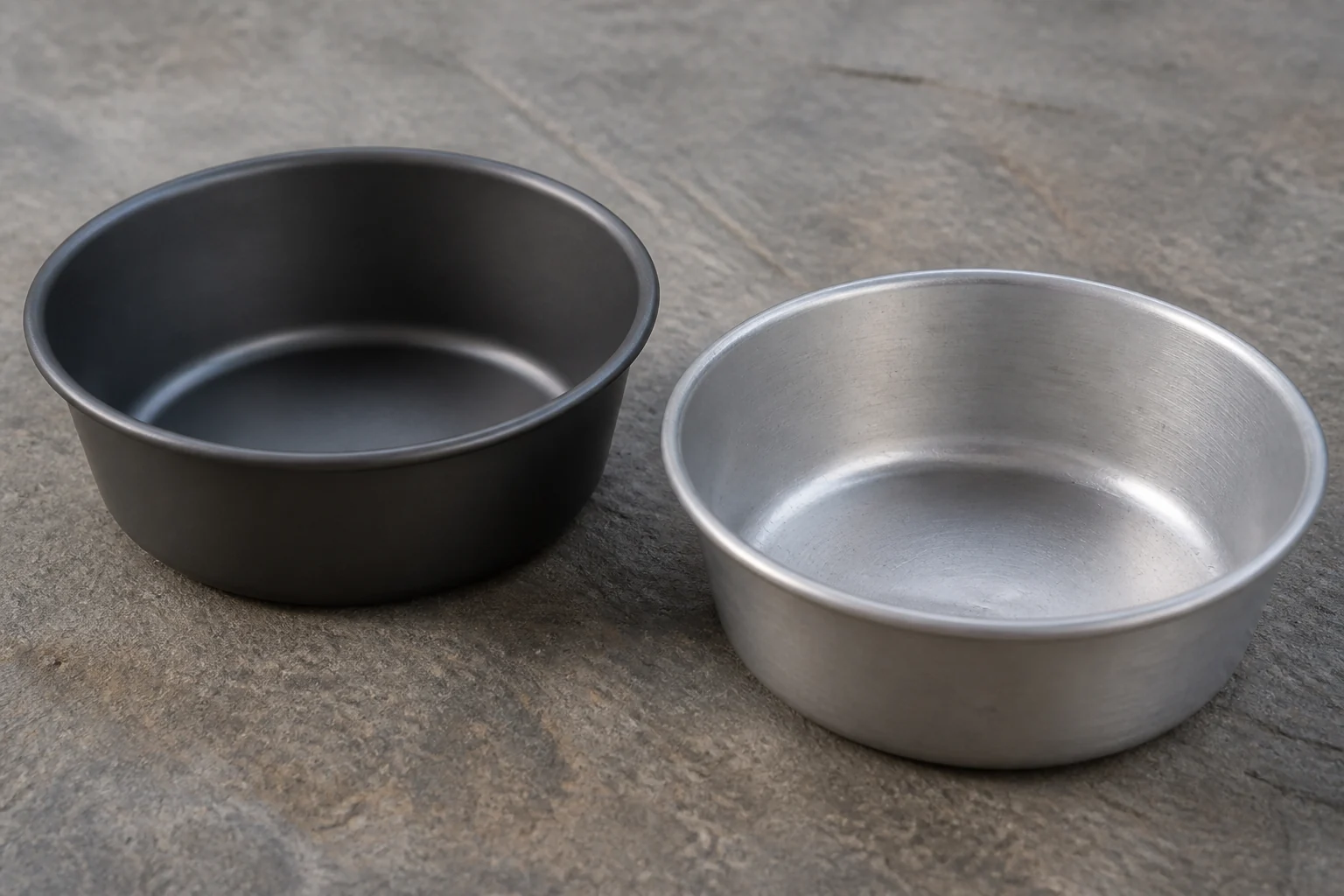
Color is also not proof of process. Dark gray, black or colored aluminum may be anodized, painted, powder coated or treated by another route. Ask the supplier to name the finish, provide the applicable specification and identify every food-contact layer instead of identifying the construction from photographs.
Decision table: how the surface systems differ
| Buyer question | Bare aluminum | Anodized aluminum | Applied organic coating |
|---|---|---|---|
| What is the surface? | Base metal with its naturally formed oxide film | Electrochemically converted oxide layer integrated with the aluminum surface | A separate resin, paint, lacquer or non-stick layer applied over the substrate |
| What must be specified? | Alloy, temper, gauge, finish and use conditions | Alloy, pretreatment, anodizing specification, appearance, sealing and use conditions | Substrate, coating chemistry, application, cure, thickness and use conditions |
| What can photos prove? | General appearance and visible forming quality only | General color and appearance only; not process identity or performance | General color and visible coverage only; not chemistry or adhesion |
| Typical damage concern | Denting, scratching, staining or surface change | Abrasion, color variation, localized wear, poor sealing or damage at formed edges | Scratching, chipping, peeling, blistering or cure-related defects |
| Food-contact conclusion | Requires finished-article evidence for the target market and use | Requires finished-article evidence for the target market and use | Requires evidence for all relevant food-contact layers and the finished article |
| Direct-flame conclusion | Not established by the material name | Not established by anodizing | Not established by the coating name |
The practical message is simple: a surface label should open the specification discussion, not close it. If a supplier cannot distinguish the substrate from the surface treatment, the buyer does not yet have enough information for an approval sample or a market claim.
Which data and evidence should a buyer request?
Start with a construction declaration. It should identify the aluminum alloy or alloy family, material gauge, manufacturing route, food-contact surfaces and any non-metal parts such as silicone grips, plastic lids, rivets, inks or decorative elements. A complete declaration lets a laboratory and compliance reviewer understand what the finished article actually contains.
Next, request an anodizing specification that is meaningful to the intended product. A process specification can define coating types, classes or test characteristics, but the reference by itself is not a food-contact approval. The buyer should ask which characteristics were ordered, which were measured, where they were measured and whether the report applies to the exact construction and color under review.
For EU projects, Regulation (EC) No 1935/2004 sets the general principle that food-contact materials must not transfer constituents to food in quantities that could endanger health, unacceptably change the food’s composition or deteriorate its organoleptic properties. The regulation also covers traceability and truthful presentation. Read the official EUR-Lex text of Regulation 1935/2004 rather than relying on a generic “EU approved” phrase.
Metals require a material-specific evidence strategy. The European Commission’s official food-contact materials overview confirms that metal kitchenware and tableware fall within the framework and that, where no specific Union measure exists, national provisions can also matter. A buyer should work with the destination market’s legal framework and a competent laboratory to define simulants, contact time, temperature, repeated-use cycles and analytical scope for the actual product.
Evidence must match the finished article
A certificate for raw aluminum sheet does not automatically cover a formed, colored and sealed bowl. Forming can expose edges, welding or riveting can introduce other metals, coloring can add substances and cleaning can alter the surface. The finished article should therefore be assessed as a system, not as a single material name.
Report identity is equally important. Match model code, drawing revision, dimensions, color, substrate, finish, sampling date and laboratory name to the approval sample. If a report covers a product family, ask for the written grouping rationale and confirm that the selected worst case represents the ordered range.
Do not infer compliance from a logo shown in a catalog. Request the complete, legible report or declaration, confirm its scope and verify that the issuing body and method are appropriate. “FDA,” “LFGB,” “food grade” or “BPA free” is not a substitute for a market-specific evidence package.
Need a specification review before sampling?
Share the target market, article type, intended foods, contact time, cleaning method, color direction and required evidence. Naike Dinner can review the project brief and clarify what must be confirmed before a product is represented as available.
Request a documented project reviewWhat performance differences are relevant in outdoor use?
An anodized surface is often selected to obtain a controlled appearance and to change surface behavior compared with unfinished aluminum. However, buyers should not convert general material expectations into fixed product claims. Performance depends on the alloy, process controls, geometry, surface condition, thickness, sealing, food chemistry, cleaning and actual duration of use.
Weight is primarily governed by article dimensions, gauge and design, not anodizing alone. A lightweight plate can be convenient for backpacking but may deform more easily than a heavier design. A reinforced rim or deeper form can improve handling, yet it may affect nesting height, tooling, packing density and cleaning access.
Surface hardness is another frequently oversimplified point. An anodic oxide layer may offer different abrasion behavior from bare aluminum, but sharp metal utensils, sand, aggressive scouring and repeated stacking can still mark a surface. A procurement specification should define acceptable cosmetic change after a realistic care protocol instead of promising “scratch proof.”
Thermal conductivity remains a property of the aluminum system. Thin tableware can feel hot or cold quickly, and dark surfaces exposed to sun may heat faster than buyers expect. Handle shape, rim geometry and intended beverage temperature therefore deserve evaluation during sampling even when the article is not cookware.
Color consistency needs an agreed viewing method
Anodized color can vary with alloy, pretreatment, surface texture, process conditions, dye system, sealing and viewing angle. Establish an approved master sample, a defined light source and a practical tolerance before production. Digital renderings and Pantone references can communicate direction, but they do not replace an approved physical metal finish.
For mixed sets, evaluate components together. A plate, deep bowl and cup may be formed from different gauges or suppliers, producing a visible shade or gloss difference even when the nominal color name is the same. Buyers should decide whether a coordinated family needs a close match or an intentionally varied tonal system.
Where does anodized aluminum camping tableware fit?
It can fit outdoor retail assortments that value low carried weight, compact nesting and a technical metal appearance. Common programs may include a plate, bowl, cup and utensil set for hiking, campground meals, picnic kits, caravan storage or event rental. Each use case changes the important checks: backpacking emphasizes mass and nesting, while family camping may prioritize hand comfort, stability and easy sorting.
For coastal or humid scenarios, buyers should define exposure, cleaning and storage conditions rather than using a broad “corrosion resistant” promise. Salt, trapped moisture, dissimilar-metal contact and residues can create conditions very different from a short studio demonstration. A care statement should tell users to clean and dry the articles according to the validated instructions.
Retailers also need a clear product boundary. If the kit is intended only for eating and serving, packaging should not show it on a burner or in a campfire. If a separate saucepan is included, document that item independently so users can distinguish cookware from dinnerware.
Limitations and risks buyers should not ignore
The first risk is an undefined finish. “Hard anodized,” “military grade,” “premium oxide” and similar phrases can be marketing shorthand unless tied to a recognized specification and measurable requirements. Ask for the actual process designation and acceptance criteria.
The second risk is assuming that the surface layer eliminates all metal-release considerations. Food-contact suitability depends on the whole article and foreseeable use, including acidic or salty foods, temperature, duration and repeated cleaning. The correct framework evaluates constituent transfer and market rules, not merely the nominal alloy name.
The third risk is using dinnerware as cookware. Direct flame can create localized heating, distort thin forms, damage non-metal attachments or exceed the validated use condition. Unless a specific article has been designed, tested and documented for stove or flame exposure, label it as dinnerware and keep it off heat sources.
The fourth risk is aggressive care. Steel wool, sharp nesting contact, alkaline cleaners or unsuitable dishwasher conditions may change appearance or accelerate wear. Use instructions should reflect actual validation, and buyers should test repeated cleaning with the intended detergent, water quality, temperature and stacking method.
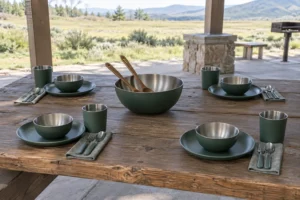
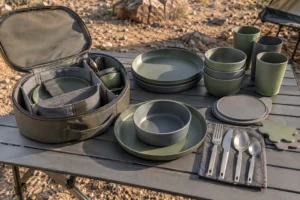
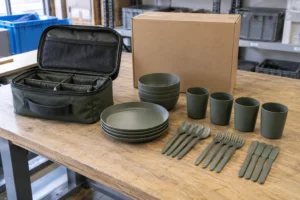
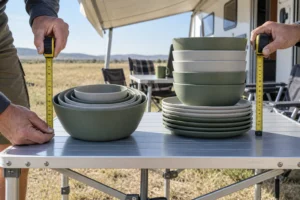
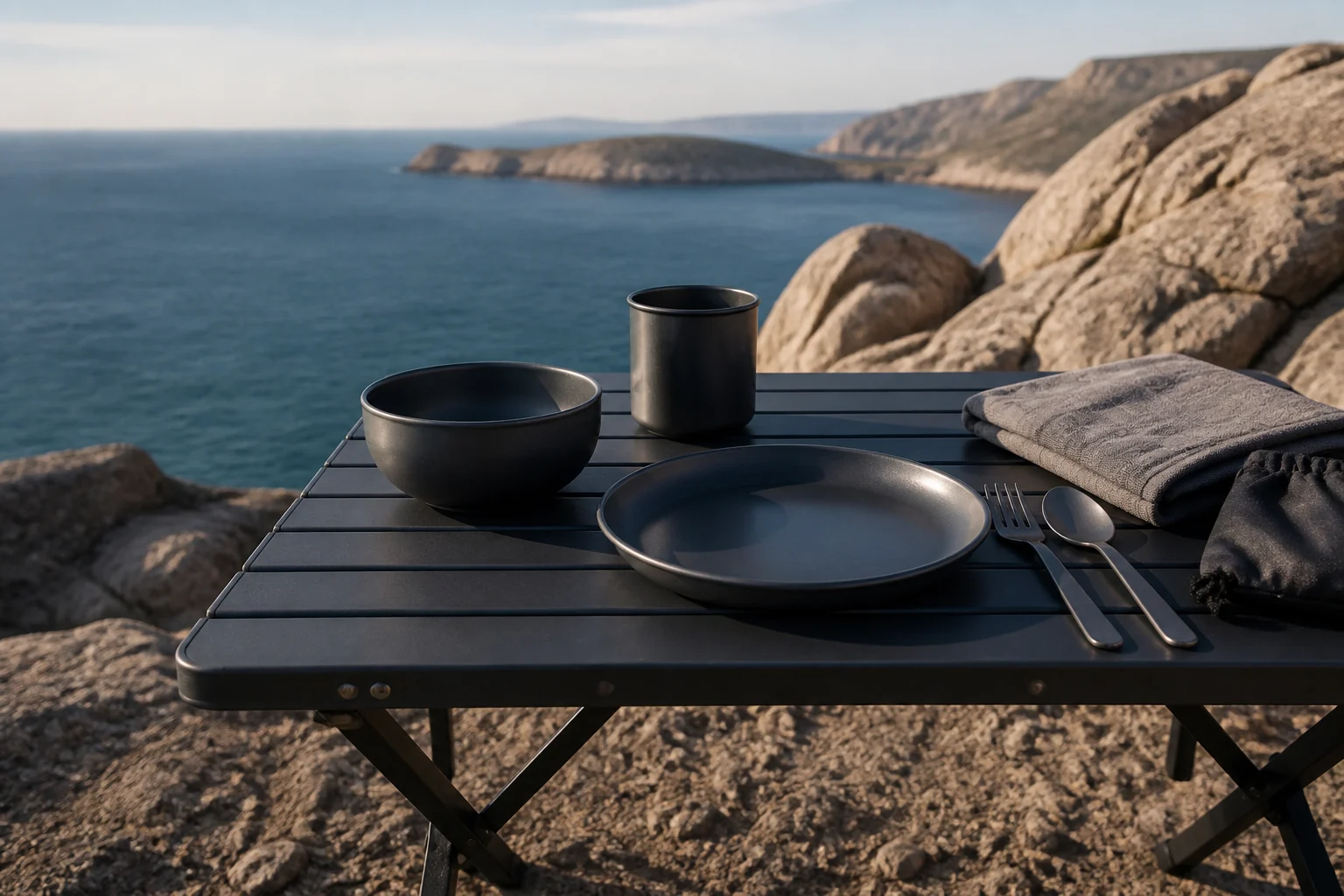
The fifth risk is interpreting a generated application image as product evidence. The images in this article are clearly labeled illustrations used to explain procurement situations. Product approval must rely on samples, drawings, supplier records and relevant tests—not on an editorial scene.
Seams, edges and attachments deserve extra attention
Inspect rolled rims for sharpness, cracking, uneven finish and trapped residue. If handles, rivets or mixed metals are present, confirm material identity, galvanic compatibility, cleaning access and mechanical security. A visually attractive face surface does not compensate for an unsafe edge or loose attachment.
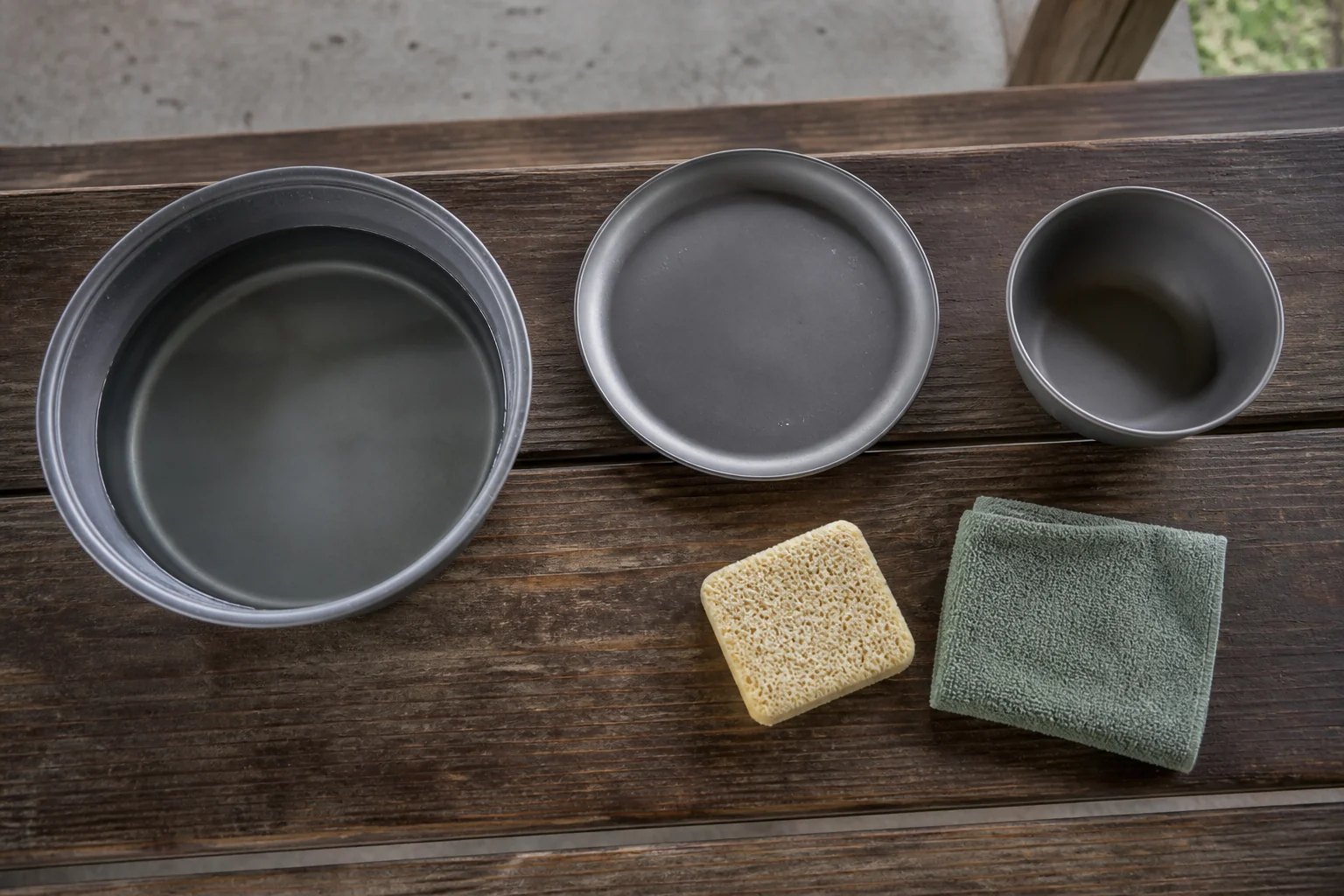
Nested products should be checked for metal-on-metal abrasion. Measure how easily users separate the pieces and whether transport vibration produces rings or bright contact marks. A fabric pouch, paper separator or redesigned stacking feature may help, but any packaging addition should be validated for moisture retention and logistics.
A practical B2B procurement workflow
First, define the user and scenario. State whether the product is for backpackers, family campers, caravan users, outdoor caterers or retail gift sets. Add the expected foods, beverage temperatures, cleaning method, pack configuration and destination market.
Second, lock the construction. Provide a drawing for each component with dimensions, gauge, mass target, rim, foot, handle or attachment details and nesting order. Identify the alloy, anodizing requirement, color and permitted variation rather than approving a product from a beauty image.
Third, build a verification matrix. Link every claim to a document, inspection or test: alloy identity to material records, geometry to drawing inspection, surface specification to process records, food-contact claims to relevant finished-article evidence, and use instructions to validation. Separate mandatory legal checks from voluntary appearance or durability targets.
Fourth, approve samples in stages. A visual sample can establish form and color direction, but a pre-production sample should represent the intended construction and process. Keep signed reference samples and high-resolution records of acceptable rims, finish, nesting and packaging.
Fifth, define production inspection. Sampling should cover dimensions, mass, deformity, sharp edges, finish consistency, contamination, attachments, nesting and packaging. If the program includes multiple colors or sizes, state how the inspection lot and worst cases are selected.
Finally, control change. Require notification before any alloy, gauge, supplier, pretreatment, anodizing chemistry, dye, seal, attachment, packaging or manufacturing-location change. A technically similar substitution can invalidate earlier evidence or change appearance, so approval must be revision-specific.
Commercial teams should also separate the evidence file from the marketing file. The evidence file holds drawings, material declarations, reports, inspection criteria, sample approvals and revision history. The marketing file translates only the supported conclusions into product-page language, packaging instructions and sales training; unsupported adjectives should be removed before publication.
For a multi-component mess kit, assign each component its own specification line and then add a set-level assembly sheet. The sheet should show which plate nests into which bowl, how utensils are retained, whether surfaces touch during transport and how the packed set is oriented. This reduces the risk that individually acceptable parts create abrasion, rattling, trapped moisture or inefficient cartons when combined.
Packaging trials should reflect the real route to market. An e-commerce parcel, retail shelf box and wholesale master carton expose the surface to different vibration, pressure and handling. Inspect samples after the intended transport simulation and record any rub marks, dents, pouch transfer or color change against the agreed cosmetic limit rather than relying on an undisturbed display sample.
When a buyer wants several sizes or colors, do not assume one sample represents every variant. Large, deeply formed or dark-colored articles may present different manufacturing and inspection challenges from a small shallow plate. Ask the supplier and laboratory to justify the selected worst case, and keep the justification with the technical file so later assortments can be reviewed consistently.
B2B buyer checklist
| Check | Question | Why It Matters |
|---|---|---|
| Product boundary | Is each component dinnerware, drinkware, cutlery or verified cookware? | Prevents misleading flame or stove claims. |
| Base material | Which aluminum alloy, temper and gauge apply to each component? | Controls forming, mass, appearance and evidence scope. |
| Surface process | Which anodizing specification, pretreatment, color and sealing requirements apply? | Turns a marketing term into an auditable specification. |
| Food contact | Which market, foods, times, temperatures and repeated-use conditions were assessed? | Aligns evidence with foreseeable use. |
| Mixed materials | Are rivets, handles, lids, inks, pouches or other parts fully declared? | These parts can create separate safety and durability questions. |
| Appearance | Is there a physical master sample and a defined viewing method? | Reduces disputes over shade, gloss and texture. |
| Care | Which detergents, tools, dishwasher cycles and drying conditions are validated? | Prevents unverified durability promises. |
| Traceability | Can the supplier link the finished lot to material and process records? | Supports investigations and market documentation. |
| Change control | Which changes require written buyer approval? | Protects the validity of samples and reports. |
Frequently asked buyer questions
1. Is anodized aluminum the same as hard-anodized aluminum?
No. “Anodized” covers a family of electrochemical surface treatments, while “hard anodized” usually implies a more specific process or performance intention. Do not accept the phrase without the applicable standard, ordered characteristics, inspection method and finished-article evidence.
2. Does anodizing make camping tableware food safe?
Not by itself. Food-contact suitability is a conclusion about the finished article under defined conditions and destination-market requirements. Review the substrate, anodized surface, colors, sealing, attachments, manufacturing controls and relevant migration or release evidence together.
3. Can anodized aluminum plates go on a camp stove?
Only if the exact article is designed and verified for that use. A plate or bowl should otherwise be treated as dinnerware, even if it is made from metal or has handles. Keep it away from burners, flames and campfires unless product-specific instructions explicitly permit heating.
4. Will an anodized surface never scratch?
No surface should be marketed as impossible to scratch without strong, defined evidence. Utensils, sand, abrasive cleaners and nesting contact can create wear. Buyers should define an inspection method and acceptable cosmetic change after a realistic care and transport protocol.
5. How should buyers approve anodized color?
Use a physical master sample produced on the intended alloy and finish, viewed under an agreed light source. Define acceptable shade, gloss and texture variation, then retain reference samples. A screen image or Pantone direction alone cannot represent the optical behavior of anodized metal.
6. What should be included in a quotation request?
Include component drawings, alloy and gauge requirements, surface specification, color direction, nesting plan, target market, intended food and beverage conditions, care method, packaging, evidence list and inspection criteria. Ask the supplier to mark every unconfirmed item clearly rather than filling gaps with assumptions.
Procurement conclusion
Anodized aluminum camping tableware can support a lightweight, compact and visually technical outdoor assortment, but the word “anodized” is not a safety certificate or complete quality standard. The strongest sourcing brief connects the intended use to the alloy, geometry, surface specification, finished-article evidence, care instructions and change controls.
Naike Dinner’s live site currently provides buyer education across outdoor material choices; this article does not claim a specific anodized aluminum product is available. For a real project, submit your component plan and evidence requirements so availability and capability can be confirmed before samples or claims are discussed. You may also review our aluminum camping dinnerware safety guide, compare titanium and aluminum camping cookware, or browse the Outdoor Materials & Performance archive.
Request an anodized aluminum tableware specification review
Send your target market, product drawings, user scenario, finish direction, evidence list, cleaning conditions and packaging plan. We will identify which points require confirmation and whether the requested capability can be supported—without inventing product availability, MOQ, price or test results.
Request a project reviewExplore outdoor tableware guidance