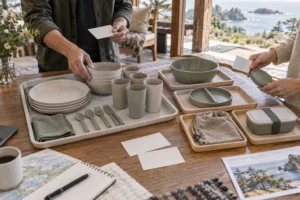
What is a camping mess kit? It is a compact, portable set for serving and eating meals outdoors. It normally combines reusable dinnerware, drinking ware, utensils and a way to nest, carry or store them. Some products also include cookware, but that is optional rather than universal. For buyers, the correct definition depends on the user, trip style, meal plan and whether cooking is inside the product scope.
What Is a Camping Mess Kit in Practical Terms?
The practical meaning is an outdoor meal system that travels as one organized unit. Its essential job is to give the user a surface or vessel from which to eat, a cup or mug when required, utensils, and a compact way to keep those pieces together. A one-person backpacking kit and a four-person car-camping set can both be called mess kits even though their contents and priorities are very different.
When a retail buyer asks “what is a camping mess kit,” the most accurate answer is therefore functional, not based on a universal piece count. The kit must organize the meal tools its named user needs, and its instructions must define where serving ends and cooking begins.
The term does not describe one regulated bill of materials or one internationally fixed component list. Retailers use it for minimalist plate-and-cutlery bundles, military-style nested metal pieces, family dinnerware sets, and cook-and-eat systems that include a pot or pan. A responsible supplier therefore confirms what a proposed set does instead of assuming that the market name proves its function.
For a B2B buyer, the useful definition has three parts: user, task and boundary. The user may be a solo hiker, a family at a campground, an RV customer, a glamping guest or a rental fleet. The task may be eating a prepared meal, reheating food, or cooking from raw ingredients, while the boundary states which of those tasks the product is actually designed and documented to perform.
| Functional layer | Typical components | Usually core or optional? | Buyer decision |
|---|---|---|---|
| Eating | Plate, divided plate, bowl or bowl-plate | Core | Match shape and capacity to the intended menu. |
| Drinking | Cup, mug or tumbler | Common but not universal | Define fill volume, lid need and hot/cold use. |
| Utensils | Fork, spoon, knife, spork or chopsticks | Core in a complete personal kit | Define eating function, adult/child use and storage. |
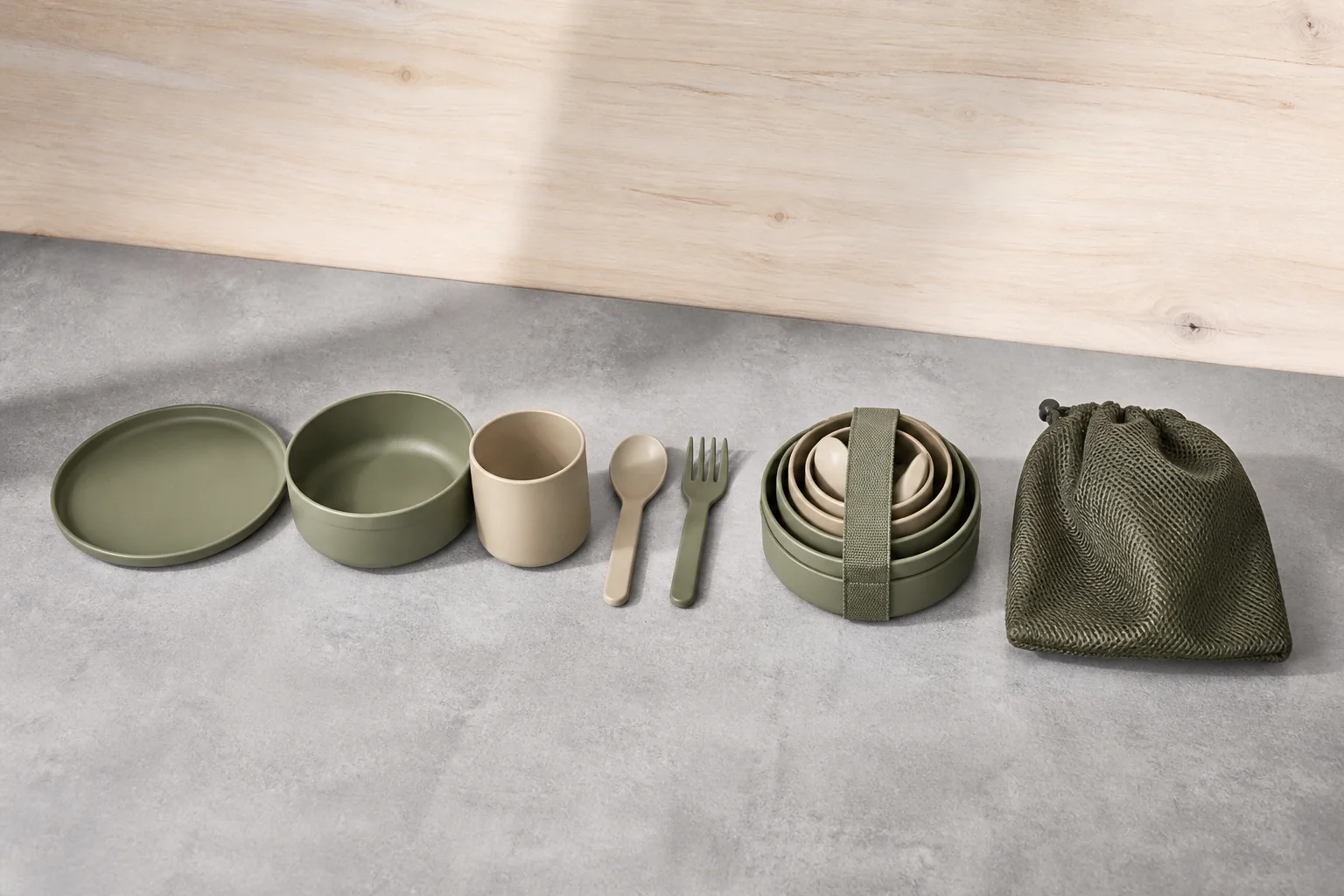
| Organization | Pouch, strap, lidded box, nesting shell or mesh bag | Core to the “kit” concept | Set packed dimensions, drainage and piece-retention needs. |
| Cooking | Pot, pan, kettle, handle or stove-compatible vessel | Optional | State heat source and validate the exact product; never infer flame safety. |
| Accessories | Cutting board, condiment cup, cleaning cloth or opener | Optional | Add only when it improves the target scenario without creating clutter. |
A Mess Kit Is Not Automatically a Cookware Set
This is the most important boundary in the category. Dinnerware is designed primarily to hold, serve and eat food; cookware is designed to receive cooking heat. A plate, bowl or cup made for meal service must not be placed over a flame, on a burner or against a hot stove merely because it was sold in a camping assortment.
Some traditional metal mess kits combine a pan or pot with a lid that doubles as a plate. Other modern kits deliberately separate cooking equipment from lightweight reusable dinnerware. Both architectures can be valid, but the listing, packaging and instructions must identify which components are cookware and which are only for serving or eating.
This distinction matters especially when buyers evaluate wheat-straw composite products. Naike Dinner’s reusable wheat-straw composite tableware can be considered for plates, bowls, cups, cutlery and storage-oriented set components when the specific SKU and intended food-contact conditions are verified. It should not be represented as open-flame cookware unless product-specific evidence explicitly supports that claim.
Mess kit, cookset, dinnerware set and picnic set
A cookset centers on preparing food and usually contains pots, pans, lids, handles or kettles. A camping dinnerware set centers on serving and eating. “Mess kit” is the broader retail term that may cover one or both functions, while a picnic set often emphasizes group service, transport cases and front-country use rather than nesting for a backpack.
The names can overlap in search results, which makes the technical description more important than the category label. Buyers should compare the component schedule and marked uses, not just the hero image. If a set combines different materials, each component needs its own material identity, care instruction and applicable evidence.
Why One Definition Cannot Fit Every Camper
Trip style changes the product. A backpacker carries every gram and may accept one bowl that also functions as a plate. A car camper may prefer full-size plates, stable cups and separate bowls because packed mass matters less. An RV user may value cabinet efficiency, quiet stacking and repeated washing more than trail weight.
Meal format also changes the kit. Freeze-dried meals may require only a long spoon and mug, whereas grilled food needs a plate with enough cutting stability. Soup, cereal and noodles benefit from a deeper bowl; shared dishes require serving utensils; children may need smaller proportions and secure grips.
Finally, sales channel changes the acceptable complexity. A promotional kit must communicate its value quickly and preserve logo visibility. A specialty outdoor retailer may accept more variants and technical detail. A campsite rental or glamping operator needs replacement logic, easy inventory counts and cleaning procedures that staff can repeat.
The Four Functional Layers of a Well-Defined Kit
1. The eating layer
The eating vessel should match the actual menu rather than an abstract “outdoor” aesthetic. A shallow plate is familiar but handles liquid poorly. A deep plate or bowl-plate can cover pasta, curry, cereal and snacks, while a divided plate separates foods but consumes more packed volume and can be harder to nest efficiently.
Buyers should specify useful dimensions and nominal capacity alongside tolerances, not rely on photos. Rim shape affects gripping and spill control. Base geometry affects stability on picnic tables and uneven ground, and surface finish affects both visual positioning and how readily food residue can be removed.
2. The drinking layer
A cup adds convenience but also creates claim risk. “Suitable for hot drinks” is not the same as “insulated,” “boil-safe” or “stove-safe.” Define the intended beverage, contact time, temperature conditions and lid arrangement, then request evidence that matches the exact cup material and construction.
Handles occupy space and can interrupt nesting; handle-free tumblers pack well but may be less comfortable with warm contents. A lid can reduce splashes in an RV or at a campsite, yet a friction lid should not be described as leakproof unless the complete assembly has been tested under a stated method.
3. The utensil layer
One multi-tool saves pieces, but it may perform each task less comfortably than separate utensils. A spork works for many ready-to-eat meals but is not an automatic replacement for a knife. Compact utensils must still provide adequate reach, grip and stiffness for the menu and intended user.
Storage is part of the utensil decision. Loose pieces can rattle, become contaminated or disappear in a pack. Clips, sleeves and dedicated cavities improve organization, but they should be designed so users can clean and dry the contact areas rather than trap residue or water.
4. The organization layer
A collection of outdoor plates is not a coherent kit until the pieces travel together predictably. Nesting reduces volume; a strap or case prevents separation; a breathable pouch can help manage drying after cleaning. The chosen solution must also survive shelf presentation, consumer unpacking and repeated field use.
Ask for both unpacked and packed dimensions. A supplier may describe each component accurately while leaving the assembled volume unclear. Buyers should also define the acceptable rattle, the order in which pieces nest, whether damp items may be packed, and how the user can confirm that every piece is present.
How Camping Scenario Changes the Specification

| Scenario | Primary priority | Likely architecture | Common specification trap |
|---|---|---|---|
| Solo backpacking | Low mass and small packed volume | One bowl-plate, cup and compact utensil | Calling a serving vessel cookware without heat-source validation. |
| Family car camping | Complete place settings and usability | Repeated color-coded sets with full-size pieces | Ignoring storage volume, piece counts and replacements. |
| RV and caravan | Cabinet efficiency, low rattle and repeat washing | Nesting stacks with retention and stable bases | Using “dishwasher safe” without SKU-specific conditions. |
| Glamping and hospitality | Presentation, cleaning workflow and inventory control | Coordinated service set with replaceable components | Choosing a consumer pack that is slow for staff to count and reset. |
| Outdoor retail | Clear shelf story and variant discipline | Good-better-best configurations with visible component schedule | Creating too many near-identical SKUs. |
| Promotional or gift program | Brand visibility and predictable landed presentation | Compact branded set with controlled packaging | Approving artwork before confirming printable areas and pack-out. |
Which Materials Can Appear in a Camping Mess Kit?
Camping kits are sold in stainless steel, titanium, aluminum, silicone, conventional polymers, fiber-filled polymer composites and mixed-material constructions. No material is best in isolation. The decision depends on whether the component cooks or only serves food, the weight target, impact behavior, cleaning conditions, feel, price position and destination-market obligations.
Titanium and stainless steel are often considered when heat-capable cookware or a premium outdoor identity is central. Aluminum may reduce mass in cookware but requires construction- and coating-specific review. Flexible silicone can collapse for storage, while reusable molded tableware can offer color, shape and branding flexibility for front-country and family sets.
Wheat-straw composite tableware is a molded composite, not compressed raw straw. Its exact formulation and finished-product performance matter. Buyers can read Naike Dinner’s wheat-straw composite material guide and should request documentation tied to the selected SKU, color and intended contact conditions instead of extrapolating from another product.
Use a component-by-component material map
A mixed kit may intentionally use one material for plates, another for utensils and a textile for the pouch. That can improve function, but it also multiplies the evidence, labeling, odor, color and recycling questions. Record the material of every sellable and removable part, including lids, seals, coatings, printed areas and accessories.
Do not treat a generic material statement as a finished-kit approval. Food-contact support must be relevant to the exact component and market, and performance claims must reflect the complete construction. Naike Dinner’s guide to verifying tableware claims explains how buyers can connect a report, sample and commercial SKU.
Food Safety in the Field Is a System, Not a Material Slogan
The U.S. Food and Drug Administration explains that pathogens can spread through utensils and food-preparation surfaces, and it emphasizes cleaning hands, utensils and surfaces. That guidance shows why a mess kit specification should consider cleanable geometry and operating instructions, not just the moment food is served. See the official FDA utensil and surface cleaning guidance.
Safe water is another boundary. The U.S. Centers for Disease Control and Prevention notes that water encountered while hiking or camping may not be safe and describes treatment options. A reusable kit does not make untreated water safe; the operating instructions should keep product cleaning advice consistent with the user’s water context. Refer to the CDC water-treatment guidance for camping.
The U.S. National Park Service also emphasizes campsite food handling and cleanup, including keeping food attended and cleaning dishes and preparation areas to protect people and wildlife. Site-specific rules can vary, so brands should not print one universal wastewater practice as if it overrides local requirements. The NPS Cooking in Camp guidance is a useful starting point.
These authorities do not define a commercial mess kit or certify any Naike Dinner product. They provide operational evidence for why secure storage, cleanable geometry, safe water, separation and clear instructions belong in a buyer’s brief. Product compliance remains a separate SKU- and market-specific exercise.
Need a component schedule before requesting quotes?
Send Naike Dinner the target camper, number of users, meal types, sales market, preferred materials and packaging concept. We can turn the idea into a comparison-ready component and evidence checklist without assuming cookware claims.
Request a mess kit range reviewNesting Is More Than Making Pieces Fit
Efficient nesting begins with dimensional relationships. Rim diameter, wall angle, base ring and handle geometry determine whether parts stack smoothly or wedge together. A stack that looks compact in a rendering may be difficult to separate after temperature changes, load or repeated use.
Prototype the full color and component combination, not isolated pieces. Confirm removal sequence with dry and slightly damp products. Check whether utensils scratch visible surfaces, whether lids deform the stack, and whether the retaining strap stays tensioned across production tolerances.
Packed efficiency should be measured using the sellable configuration. Carton utilization, retail box structure and protective materials can erase the volume saved by nesting. For larger programs, connect unit pack dimensions to master-carton assumptions early; our container loading guide for dinnerware sets explains the broader logistics relationship.
What Should a Brand Put in the Product Brief?
Begin with the intended user and environment: adult or child, solo or group, backpacking or front-country, personal ownership or fleet use. Add the meals and beverages the set should handle, cleaning resources likely to be available, expected storage space and any prohibited uses that need to be communicated.
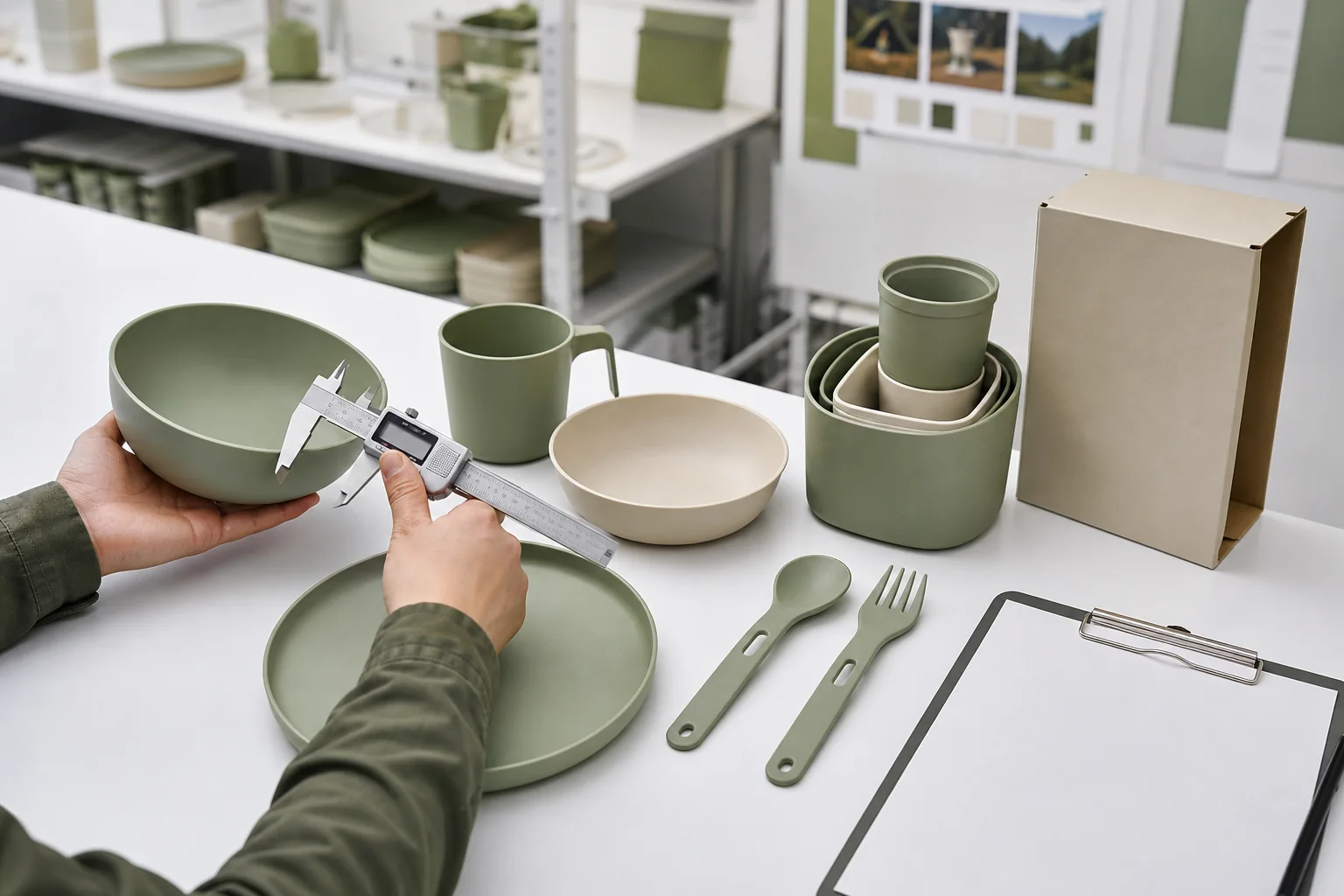
Next create a component schedule with item name, quantity, material, color, dimensions, nominal capacity, weight target and functional notes. If cooking is in scope, separate cookware lines from dinnerware lines and state the heat source. If cooking is out of scope, say so plainly to prevent an attractive camping image from implying flame compatibility.
Define the market and evidence plan before artwork. Food-contact requirements, language, importer details, product identifiers, packaging claims and user instructions depend on where and how the set will be sold. Ask suppliers to identify which evidence exists, which testing remains project-specific and which statements cannot be supported.
Finally, describe the commercial presentation: retail box, sleeve, pouch, barcode, color coding, insert, master carton and replacement strategy. The retail packaging guide for wheat-straw dinnerware sets covers packaging decisions that also apply to camping assortments.
A clear brief also answers the consumer-facing question “what is a camping mess kit” in one sentence that matches the actual pack. That sentence should identify the user count, included eating components and whether any verified cookware is present.
How to Evaluate Samples Without Inventing a Universal Test
There is no single pass/fail test that proves every camping mess kit is suitable for every trip. Build a use-based evaluation. Count the pieces, assemble and disassemble the stack, serve the intended foods, carry the packed kit, clean it using the expected method, and inspect every contact and retention point.
Record objective observations: actual mass, packed dimensions, useful capacity, missing parts, rocking, sharp edges, staining, odor, visible damage and fit after defined conditioning. Where a performance claim is important, agree on a repeatable method and acceptance criteria before testing. Never convert one informal field trial into a universal durability claim.
Use controlled samples. The artwork, material, color, dimensions and pack-out approved by the buyer should be traceable to the production specification. Naike Dinner’s custom tableware sample-approval guide describes how to prevent a good prototype from becoming an ambiguous production reference.
Camping Mess Kit B2B Buyer Checklist
| Check | Question | Why It Matters |
|---|---|---|
| Definition | Is this an eating set, a cooking set or a clearly separated combination? | Prevents unsupported heat-use assumptions. |
| User | Who carries and uses the kit, and for how many people? | Determines size, piece count, mass and ergonomics. |
| Menu | Which foods and beverages must each component hold? | Connects shape, capacity and utensils to real use. |
| Materials | Is every component, coating, lid and accessory identified? | Enables accurate claims and evidence mapping. |
| Heat boundary | Which pieces, if any, are validated for a named heat source? | Separates cookware from serving ware. |
| Pack-out | What are the complete nested dimensions and retention method? | Controls portability, shelf fit and logistics. |
| Cleaning | How will users wash, drain and dry the set in the target scenario? | Influences geometry, pouch choice and instructions. |
| Evidence | Does documentation identify the exact SKU and intended conditions? | Prevents generic reports from supporting the wrong product. |
| Branding | Where is the artwork applied and what process is proposed? | Affects appearance, durability and food-contact review. |
| Replacement | Can lost or damaged pieces be replenished consistently? | Supports fleets, hospitality and long-running retail ranges. |
Common Buying Mistakes
Buying a lifestyle image instead of a specification
A photograph can show the intended mood but rarely proves capacities, materials or uses. Request a numbered component schedule and dimensioned information. Align every accessory visible in marketing with what is actually included, or clearly mark props as excluded.
Using “eco-friendly” as the complete material description
Environmental language does not identify a material or end-of-life pathway. State the actual material, avoid unsupported biodegradation or compostability implications, and keep claims narrow enough to verify. Reusability is a use model, not proof of a specific environmental outcome in every scenario.
Assuming outdoor means extreme-performance
A camping context does not automatically prove open-flame resistance, freeze performance, impact resistance or long-term UV stability. Each claim needs a defined component, method and boundary. If the evidence is not available, omit the claim or commission appropriate project testing.
Adding components until value becomes clutter
More pieces can increase the perceived count while making the kit heavier, harder to explain and easier to lose. Start with the minimum complete meal system for the target user. Add accessories only when research or channel needs show that they solve a repeatable problem.
Camping Mess Kit Questions Buyers Ask Next
1. Is a camping mess kit the same as camping cookware?
No. A mess kit is a portable outdoor meal set, while cookware is designed to receive cooking heat. A mess kit may include cookware, but many contain only plates, bowls, cups, utensils and storage. Read the component uses and heat-source evidence rather than assuming from the name.
2. Does every camping mess kit include a pot or pan?
No. Pots and pans are optional. A front-country family set may pair with cookware the camper already owns, while a compact backpacking product may integrate cooking and eating functions. Buyers should state whether cookware is included, excluded or sourced as a separate module.
3. How many pieces should a one-person mess kit contain?
There is no universal number. A minimal set might use one bowl-plate, one drinking vessel, one utensil and one retention item, while a more complete place setting separates plate, bowl, cup and cutlery. Menu coverage and packed volume are better decision criteria than a high piece count.
4. Can wheat-straw tableware be used in a camping mess kit?
It can be evaluated for reusable serving and eating components when the exact formulation, SKU, food-contact conditions and destination-market evidence are appropriate. Do not infer open-flame or stove use. A supplier should map every claim to the finished product and intended conditions.
5. What is the difference between a mess kit and a picnic set?
A mess kit usually emphasizes a compact personal or small-group meal system and often nests. A picnic set may emphasize group service, a transport case, full-size cutlery and front-country presentation. Retail language overlaps, so component schedules and use scenarios remain the reliable comparison.
6. What should buyers confirm before requesting a quotation?
Confirm target user, user count, exact pieces, materials, colors, dimensions, capacity, packed size, cookware boundary, target market, branding, packaging, evidence needs and sample plan. A quotation based on those inputs is more comparable than one based only on the phrase “custom camping mess kit.”
From Category Name to a Saleable Outdoor Range
A camping mess kit is best understood as a portable, organized meal system—not a guaranteed cookware bundle and not a fixed piece count. Its value comes from matching the right eating, drinking, utensil and storage functions to a defined camper and trip. The strongest product briefs make every component and claim visible before price discussions begin.
In short, “what is a camping mess kit” is a product-definition question with a use-based answer: it is the organized set a camper uses to serve, eat, drink and carry meal tools, with cooking included only when named components are designed and validated for it.
Naike Dinner can help outdoor brands, retailers, RV channels, promotional buyers and hospitality programs evaluate reusable wheat-straw composite dinnerware components within that boundary. We will not invent flame-use claims, certifications, capacities, minimum quantities or performance results. The first useful step is a documented range brief and controlled sample plan.
Build a camping mess kit brief buyers can compare
Share the intended camper, place-setting count, meals, target market, preferred components, material direction, branding and packaging. Naike Dinner can return a project review that separates confirmed options, evidence questions and sample decisions before you request a documented quotation.
Request a project reviewRequest controlled samples