How to Maximize Container Loading Volume When Importing Bulk Dinnerware Set
International freight costs have become one of the biggest concerns for importers, wholesalers, retailers, and private-label brands.
When purchasing bulk dinnerware sets from overseas suppliers, many buyers focus heavily on product pricing but overlook a critical factor that directly impacts their total landed cost:
Container loading efficiency.
In many cases, improving container utilization by just 10%–15% can save thousands of dollars per shipment.
So How to Maximize Container Loading Volume When Importing Bulk Dinnerware Set?
In this guide, we’ll share practical strategies used by experienced manufacturers and importers to reduce freight costs and improve shipping efficiency.
Why Container Loading Efficiency Matters
Ocean freight costs are often calculated based on:
- Container quantity
- Cubic volume (CBM)
- Shipping routes
- Fuel surcharges
- Port handling fees
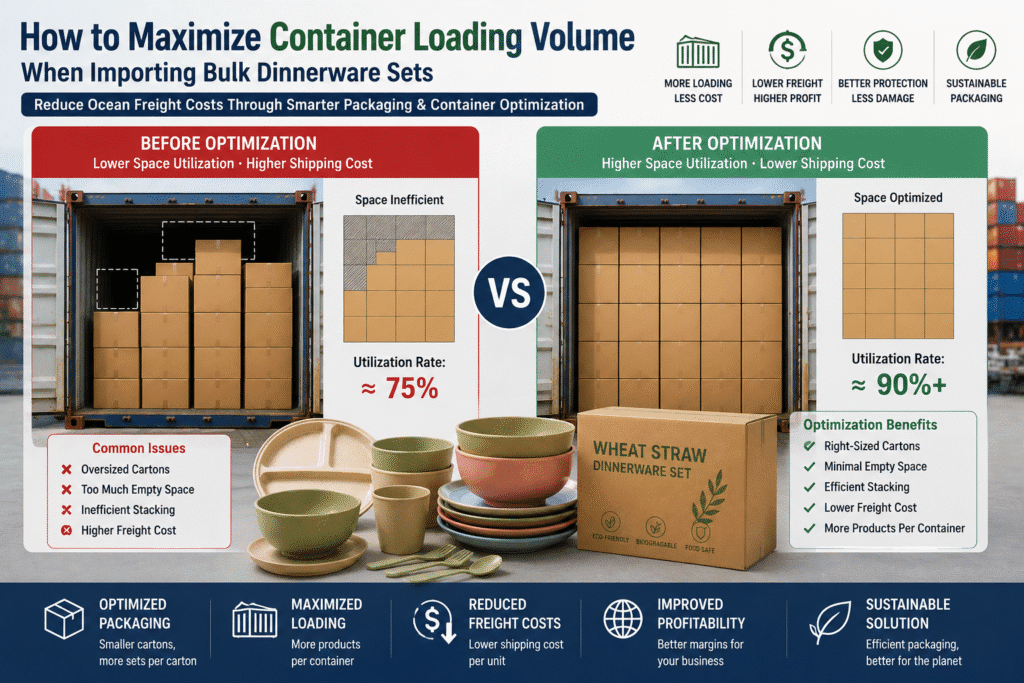
If your products occupy unnecessary space due to inefficient packaging, you’re effectively paying to ship air.How to Maximize Container Loading Volume When Importing Bulk Dinnerware Set.
For example:
| Scenario | Container Capacity Utilization |
|---|---|
| Traditional Packaging | 75% |
| Optimized Packaging | 90%+ |
That difference can translate into:
- Fewer containers required
- Lower freight costs per unit
- Improved profit margins
- Better inventory planning
For high-volume importers, these savings quickly add up.
Understanding Container Capacity
Before discussing optimization strategies, it’s helpful to understand common container sizes.And How to Maximize Container Loading Volume When Importing Bulk Dinnerware Set.
20FT Container
Approximate Capacity:
- 28–33 CBM
- Suitable for smaller orders
40FT Container
Approximate Capacity:
- 58–68 CBM
- Most commonly used for dinnerware exports
40HQ Container
Approximate Capacity:
- 68–76 CBM
- Additional height provides more loading opportunities
For official container specifications, refer to the standards published by the World Shipping Council
And How to Maximize Container Loading Volume When Importing Bulk Dinnerware Set?
Strategy 1: Optimize Product Nesting Design
One of the most effective ways to increase loading volume begins at the product design stage.
Traditional Design
Many dinnerware products have:
- Deep profiles
- Large rims
- Poor stackability
This creates wasted space inside cartons.
Optimized Design
Well-designed products allow:
- Bowls to nest deeper
- Plates to stack tighter
- Cups to fit efficiently together
Benefits include:
✔ Smaller cartons
✔ Lower packaging costs
✔ Increased container quantity
For OEM projects, many experienced buyers discuss container loading requirements during the product development phase.
Strategy 2: Reduce Empty Space Inside Cartons
Many suppliers use oversized cartons simply because they are easier to source.
Unfortunately, oversized cartons create:
- Dead space
- Higher freight costs
- Reduced container efficiency
Professional packaging engineers typically:
- Measure actual product dimensions
- Design custom carton sizes
- Minimize internal void space
Even reducing 1–2 cm per carton can significantly improve loading efficiency when shipping thousands of units.
Strategy 3: Use Multi-Layer Packaging Configurations
Instead of placing products in single-layer packaging arrangements, consider:
Standard Packaging
- 12 sets per carton
Optimized Packaging
- 16–20 sets per carton
through improved divider systems and stacking methods.
This often increases loading volume without sacrificing protection.
Strategy 4: Replace Bulky Protective Materials
Many factories still use:
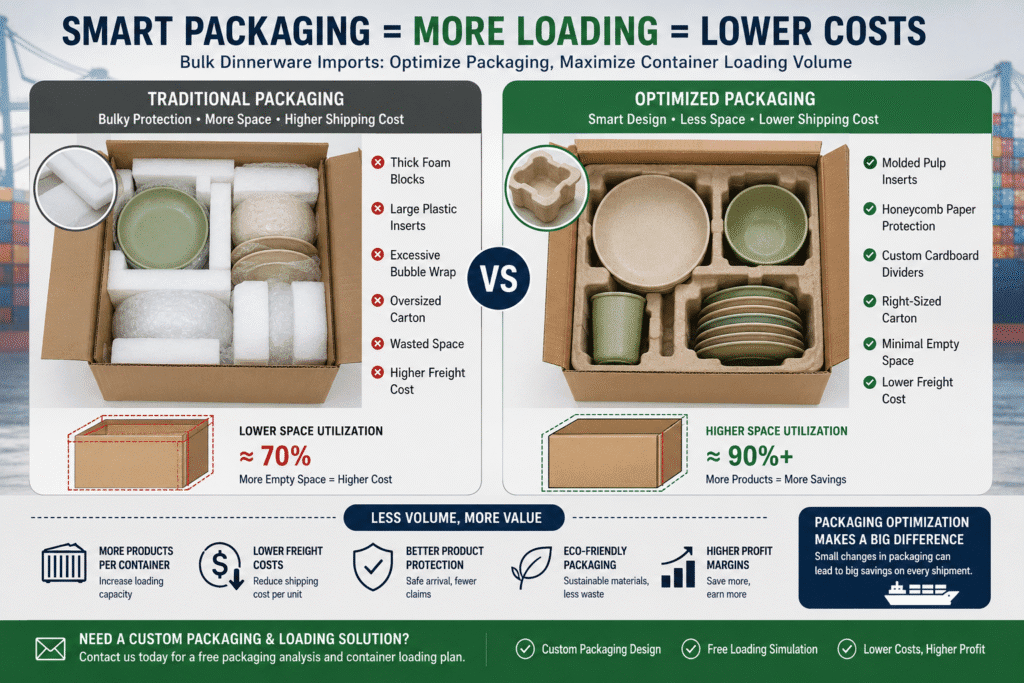
❌ Thick foam blocks
❌ Excessive bubble wrap
❌ Large plastic inserts
Modern alternatives include:
✅ Molded pulp inserts
✅ Honeycomb paper protection
✅ Customized cardboard dividers
These solutions provide protection while occupying less space.
Additional information about sustainable packaging can be found at the Forest Stewardship Council (FSC)
Strategy 5: Customize Master Carton Dimensions
Many buyers don’t realize that carton dimensions directly affect container loading patterns.
A carton that appears efficient individually may waste significant space when stacked inside a container.
How to Maximize Container Loading Volume When Importing Bulk Dinnerware Set?
Experienced manufacturers often conduct:
- Pallet simulations
- Container loading calculations
- Carton dimension testing
before mass production begins.
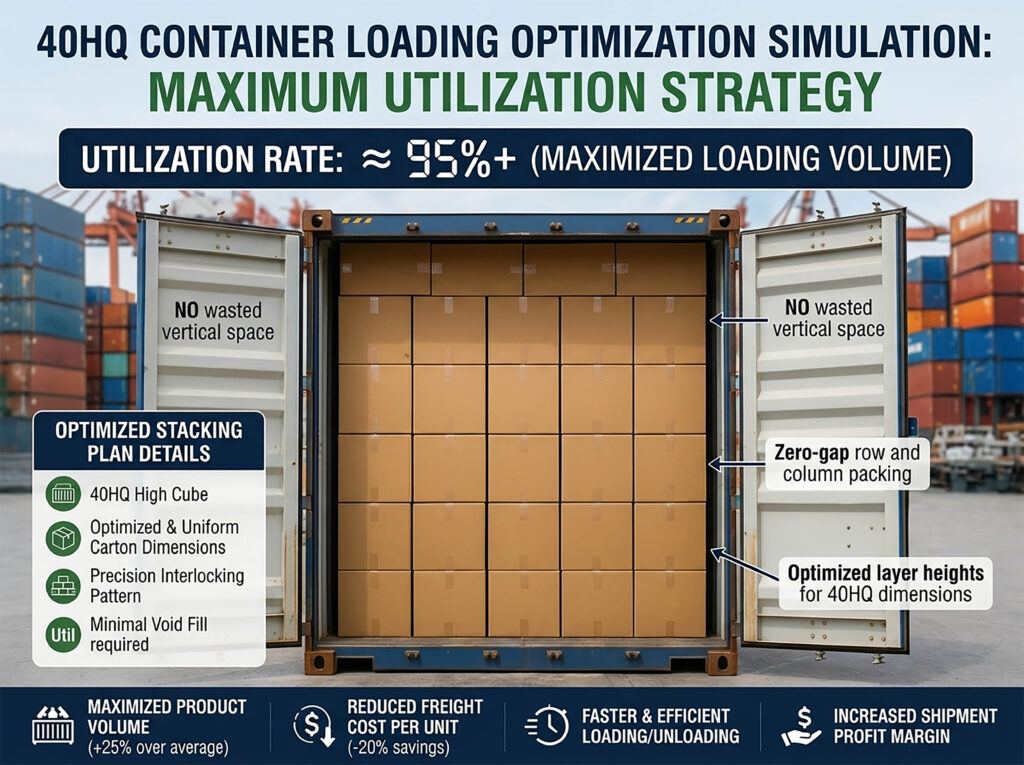
The goal is to create carton sizes that fit container dimensions with minimal unused space.
Strategy 6: Evaluate Knock-Down or Modular Designs
For certain product categories, knock-down designs can dramatically increase loading capacity.
Examples include:
- Modular lunch boxes
- Stackable storage containers
- Multi-piece dinnerware sets
Benefits:
- Reduced shipping volume
- Lower freight cost per unit
- Improved warehouse efficiency
Although not suitable for every product, modular solutions can provide substantial savings for large-volume buyers.
Strategy 7: Utilize Professional Container Loading Planning
Many importers simply ask:
“How to Maximize Container Loading Volume When Importing Bulk Dinnerware Set?”
“How many cartons fit into a container?”
The better question is:
“What’s the most efficient loading configuration?”
Professional loading plans consider:
- Carton orientation
- Weight distribution
- Container dimensions
- Product protection
Some manufacturers use digital loading software to simulate different configurations before shipment.
For international shipping best practices, importers can review guidance from the International Chamber of Shipping (ICS).
Common Mistakes That Increase Freight Costs
Overpackaging
Too much protection often means:
- Higher material costs
- Larger carton sizes
- Lower container utilization
Ignoring Container Calculations
Many buyers approve packaging without reviewing:
- CBM per carton
- Cartons per container
- Freight cost impact
Using Standard Cartons for Every Product
Different products require different carton strategies.
A one-size-fits-all approach often leads to wasted space.
Real Example: How Packaging Optimization Reduced Costs
One of our customers importing eco-friendly dinnerware sets for a retail chain wanted to reduce shipping expenses without changing the product itself.
After reviewing the packaging design, we:
- Reduced carton height by 15%
- Improved bowl nesting depth
- Redesigned internal dividers
- Optimized pallet layout
Results:
✔ Approximately 18% more units per container
✔ Lower freight cost per set
✔ Reduced warehouse storage costs
✔ Improved profitability
The customer achieved savings without compromising product protection.
Why Smart Importers Discuss Packaging Before Production
Many buyers negotiate product pricing extensively but never discuss packaging optimization.
However, packaging affects:
- Freight cost
- Warehouse cost
- Inventory turnover
- Sustainability goals
- Retail presentation
A supplier that understands both manufacturing and logistics can often create more value than a supplier offering only a lower unit price.
How We Help Customers Maximize Container Loading Efficiency
As a manufacturer specializing in eco-friendly dinnerware and OEM projects, we help customers optimize shipments through:
Product Design Review
Improving stackability and nesting performance.
Custom Packaging Engineering
Reducing carton volume while maintaining protection.
Container Loading Simulation
Calculating the most efficient loading patterns.
Sustainable Packaging Solutions
Reducing waste while improving shipping efficiency.
OEM & ODM Support
Helping brands balance appearance, protection, and freight savings.
Frequently Asked Questions
Does higher loading volume increase breakage risk?
Not when packaging is properly engineered.
Optimized loading should improve efficiency without compromising product safety.
Is custom carton design worth the investment?
For large-volume shipments, the freight savings often exceed the additional packaging development cost.
Can loading optimization reduce container quantity?
Yes.
Many customers discover they can ship more products using the same container capacity, reducing overall logistics expenses.
Looking to Reduce Shipping Costs on Your Next Dinnerware Import Project?
If you’re sourcing:
- Wheat Straw Dinnerware Sets
- Wheat Straw Plates
- Wheat Straw Bowls
- Eco-Friendly Tableware
- Private Label Dinnerware Collections
our packaging and logistics team can help you identify opportunities to:
✅ Increase units per container
✅ Reduce ocean freight costs
✅ Improve packaging efficiency
✅ Lower total landed costs
✅ Maintain product safety during transportation
Contact us today for a FREE container loading analysis and packaging optimization proposal.
Our team can calculate how many additional units you may be able to fit into a 20FT, 40FT, or 40HQ container—and how much money you could save on every shipment.
CONTACT US
How to Maximize Container Loading Volume When Importing Bulk Dinnerware Set
How to Maximize Container Loading Volume When Importing Bulk Dinnerware Set International freight costs have become one of the biggest concerns for importers, wholesalers, retailers,
Understand MOQ in Eco-Tableware Manufacturing: How Factories Calculate Production Runs
Understand MOQ in Eco-Tableware Manufacturing: How Factories Calculate Production Runs If you’re sourcing eco-friendly dinnerware for the first time, one question usually comes up very
Pantone Color Matching for Wheat Straw Products: How We Ensure Brand Consistency
Pantone Color Matching for Wheat Straw Product: How We Ensure Brand Consistency When launching a custom eco-friendly product line, color is often one of the
Sustainable Packaging Options for Bulk Eco-Friendly Dinnerware Imports
Sustainable Packaging Options for Bulk Eco-Friendly Dinnerware Imports As global consumers become increasingly environmentally conscious, sustainability is no longer limited to the products themselves. Buyers
How to Custom Wheat Straw Dinnerware Mold
How to Custom Wheat Straw Dinnerware Mold: Timelines and Cost Guide Launching a successful eco-friendly tableware product is no longer just about choosing existing designs
Why Biodegradable Wheat Straw Composite is the Future of Sustainable Foodservice
Why Biodegradable Wheat Straw Composite is the Future of Sustainable Foodservice The global foodservice industry is going through a major transformation. From restaurants and cafés