
How to Read a Wheat Straw Tableware Quotation: Mold,Packaging,Logo and Freight Costs Explained
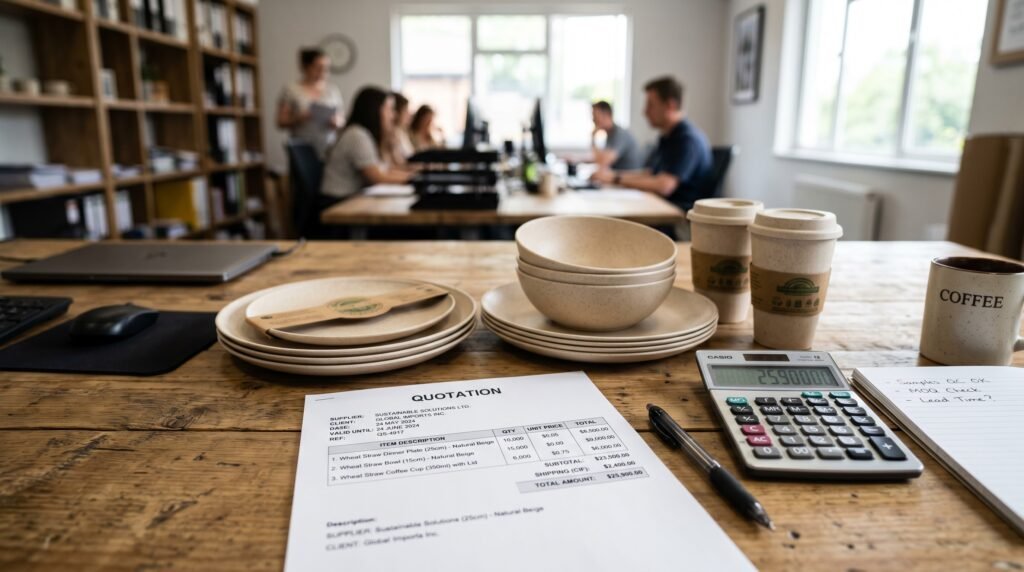
If you have sourced wheat straw dinnerware from China for more than one order, you have probably had this experience: two suppliers quote the same product at prices that are $0.30 apart, and neither quotation explains why.
A Wheat Straw Tableware Quotation is not just a unit price in an email. It is a document that tells you — or hides from you — where your money is actually going. Mold fees that look like one-time charges but renew every year. Packaging that gets quoted at retail-box pricing but shipped as bulk. Logo printing that is listed as “included” until you ask for a second color. Freight that is estimated low to make the total look competitive, then adjusted upward when the container is already on the water.
At Naike Dinner, we quote for B2B buyers every day — importers, distributors, private-label brands, Amazon sellers, hospitality groups, and promotional product companies. We see the same quotation misunderstandings cost buyers real money, repeatedly.
This guide walks through the four cost categories that make or break a Wheat Straw Tableware Quotation: mold, packaging, logo printing, and freight. By the end, you will know what every line item should look like, which questions expose gaps, and how to compare quotations on total landed cost — not just the unit price at the top of the page.
Why a Wheat Straw Tableware Quotation Needs to Be Read Line by Line
Most first-time buyers focus on one number: the unit price per piece. A supplier quotes 0.85 for a wheat straw plate, and the buyer compares it against another supplier quoting 0.92. The $0.85 looks better. The order gets placed.
Six weeks later, the actual cost per piece — after mold amortization, packaging upgrades, logo setup charges, and freight adjustment — comes out to $1.38.
That gap is not a supplier being dishonest. It is a buyer reading a Wheat Straw Tableware Quotation without understanding which costs are fixed, which are variable, which are one-time, and which will reappear on every order.
A complete quotation should break down into four clearly separated sections. If a supplier sends you a one-line email with only a unit price and a total, you do not have a quotation — you have a conversation starter. Ask for the full breakdown before you compare anything.
Mold Costs: The Biggest One-Time Item Most Buyers Misunderstand
Mold cost is the most misunderstood line in any Wheat Straw Tableware Quotation. It is also the one where suppliers have the widest range of quoting practices — some amortize it into the unit price, some charge it separately, and some do not mention it at all until the purchase order is being finalized.
What You Are Actually Paying For
Wheat straw dinnerware is injection-molded. Every unique shape — a specific plate diameter, a bowl depth, a cup handle design — requires its own steel mold. A mold is a precision-machined tool that can produce hundreds of thousands of units before it needs refurbishment or replacement.
For comparison, if you are also sourcing standard wheat straw dinnerware sets, our wheat straw dinnerware manufacturer catalog shows existing mold options that can reduce your upfront tooling investment.
Typical Mold Cost Ranges
| Product Type | Mold Complexity | Approximate Mold Cost (USD) |
|---|---|---|
| Simple round plate (single cavity) | Low | 800–800–1,500 |
| Bowl with curved walls | Medium | 1,200–1,200–2,000 |
| Cup with handle | Medium-High | 1,500–1,500–2,500 |
| Multi-compartment tray (e.g., kids’ divided plate) | High | 2,000–2,000–3,500 |
| Cutlery set (fork, spoon, knife — 3 molds) | Medium (×3) | 800–800–1,200 per mold |
| Complex design with textured surface | High | 2,500–2,500–4,000 |
Three Questions That Expose Mold Cost Gaps
1. “Is the mold fee one-time, or does it renew annually?”
Some suppliers quote a mold fee that covers the initial mold production but not ongoing maintenance. After 300,000–500,000 shots, a mold may need refurbishment — polishing, re-cutting worn edges, replacing ejector pins — and some suppliers charge a “mold maintenance fee” that can be 20–30% of the original mold cost. Ask whether the quoted mold fee includes maintenance for a specified number of cycles.
2. “If I place a repeat order within 12 months, do I pay the mold fee again?”
A legitimate manufacturer does not charge the mold fee twice for the same customer within a reasonable period. The mold sits in the factory, assigned to your account. If the quotation lists mold cost as a per-order line item rather than a one-time charge, clarify this before signing.
3. “Is the mold fee refundable or amortized into the unit price after a certain order volume?”
Many factories offer mold fee amortization: if you order 50,000 units or more, the mold cost is absorbed into the unit price over the production run, and you do not pay it as a separate line item. If a supplier does not offer this, ask why.
The Mold Ownership Question
This one catches a lot of first-time buyers off guard: you paid for the mold, but do you own it?
In most Chinese manufacturing arrangements, the buyer pays for the mold but the factory retains physical possession. The mold stays on the factory floor, loaded into their injection-molding machines. If you switch suppliers, you may need to pay a mold transfer fee — or discover that the factory considers the mold their property because it was designed for their specific machine configuration.
Clarify mold ownership in writing before paying. A standard clause: “Mold remains the property of the buyer. Upon request, supplier shall release the mold for transfer to an alternate facility within 30 days, with buyer responsible for packing and shipping costs only.”
Packaging Costs: Where Quotations Hide the Biggest Markup
Packaging is the line item that changes a Wheat Straw Tableware Quotation more than any other variable — and it is often quoted in the vaguest possible terms. “Standard packaging included” can mean anything from a polybag in a brown carton to a full-color retail box with a barcode sticker.
Packaging Tiers and Their Real Costs
| Packaging Level | What It Includes | Approximate Cost Impact (vs bulk) | Best For |
|---|---|---|---|
| Bulk / Industrial | Polybag + plain brown master carton | Baseline | Wholesale distribution, food service, restaurant supply |
| Color Sleeve / Belly Band | Product in polybag + printed paper sleeve + branded carton | +0.08–0.08–0.20 per unit | Retail shelves, discount chains |
| Retail Box (Full Color) | Individual printed box, die-cut insert, barcode, product info | +0.25–0.25–0.60 per unit | Amazon FBA, premium retail, gift sets |
| Gift Set Packaging | Multi-piece set in printed gift box with foam or molded-pulp insert, ribbon/sleeve, hang tag | +0.80–0.80–2.00 per set | Holiday promotions, corporate gifting, premium brands |
| Display Ready / PDQ Tray | Retail shelf-ready display tray, shrink-wrapped, pre-loaded | +0.30–0.30–0.70 per unit | Supermarkets, big-box retail |
If you are developing private-label products, our custom wheat straw tableware page covers how packaging, color, and logo interact in the OEM process.
The Questions to Ask About Packaging
1. “Is the quoted packaging cost per unit or per carton?”
Some quotations list packaging as a per-carton charge but describe it alongside per-unit prices. A 1.50colorboxsoundsreasonable—untilyourealizeitis1.50colorboxsou dsreasonable—u tilyourealizeitis1.50 per box for a dinnerware set, not per piece. Read the unit carefully.
2. “Does the packaging cost include the inner carton and the master carton, or just the retail box?”
If you are importing for retail, you need three layers: the individual product packaging (retail box or sleeve), the inner carton (typically 6–12 units), and the master shipping carton (typically 24–48 units). A quotation that only covers the retail box is missing two cost layers.
3. “Will the packaging artwork design be charged separately?”
Some suppliers include basic graphic design for packaging in the quotation; others charge 50–50–150 per design file. Clarify this before you send artwork specifications.
4. “Is there a minimum order quantity for custom packaging?”
Custom-printed boxes typically require a minimum print run — often 3,000–5,000 units per design. If your order is smaller than the print-run minimum, you may pay a surcharge or need to switch to a more flexible packaging method like color sleeves.
Logo Printing Costs: Free Is Never Actually Free
Logo printing is the most common “included” item in a Wheat Straw Tableware Quotation that turns out to cost money once you specify what you actually want.
Logo Printing Methods and Their Real Costs
| Printing Method | Durability | Cost per Unit (approx.) | Setup / Screen Fee | Best For |
|---|---|---|---|---|
| Silk Screen (1 color) | Good — 2–3 years of dishwasher use | 0.03–0.03–0.08 | 30–30–60 per screen | Most common B2B method; single-color logos, simple designs |
| Silk Screen (2–3 colors) | Good | 0.08–0.08–0.20 | 30–30–60 per screen per color | Multi-color brand logos |
| Heat Transfer | Moderate — 1–2 years | 0.05–0.05–0.12 | 80–80–150 per transfer plate | Detailed or photographic designs, gradients |
| In-Mold Labeling (IML) | Excellent — permanent, cannot scratch off | 0.15–0.15–0.40 | 500–500–1,500 per label mold | Premium brands, baby products, long-term OEM programs |
| Laser Engraving | Excellent — permanent | 0.08–0.08–0.20 | Minimal setup fee | Minimalist branding, no-color designs |
| Pad Printing | Good — suitable for curved surfaces | 0.04–0.04–0.10 | 40–40–80 per cliché plate | Cups, curved bowls, irregular surfaces |
What “Logo Printing Included” Usually Means
When a supplier says logo printing is included, the safe assumption is: one-color silk screen, one position, using the supplier’s standard ink, with no setup fee amortized into the first order.
If you need two colors, a second printing position (e.g., logo on the bottom of the plate plus a brand name on the rim), a specific Pantone color match, or food-contact-certified ink — any of these can add cost.
Ask the supplier to specify in the quotation:
- Number of colors
- Printing position(s) on the product
- Setup/screen fee (one-time or per-order)
- Whether screens are stored for future orders or remade each time
- Minimum quantity for custom logo printing
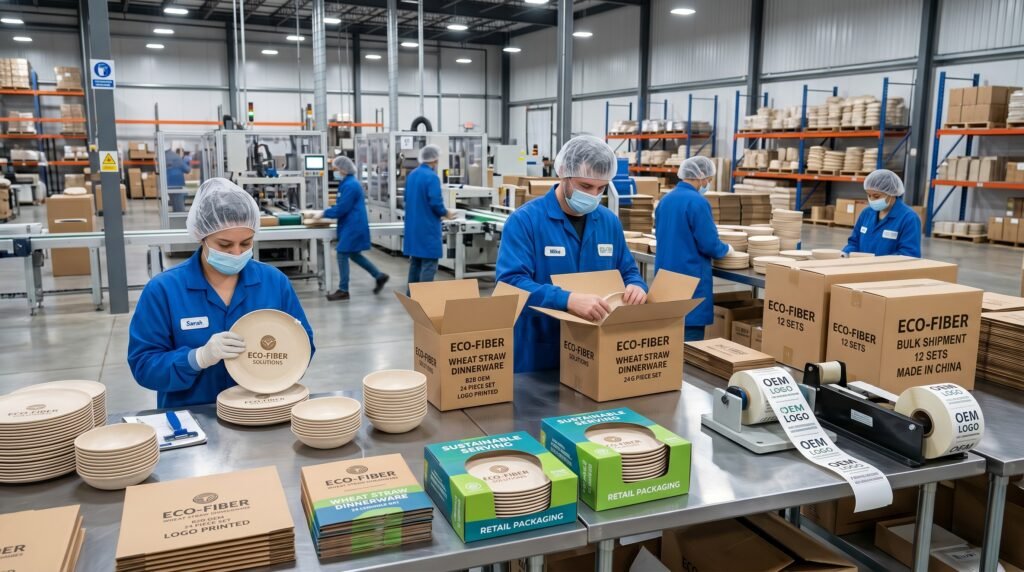
Freight Costs: The 30% of Your Quotation You Cannot Afford to Guess
Freight is the largest variable cost in any Wheat Straw Tableware Quotation, and it is the one most suppliers quote without enough detail. A two-word line — “FOB Xiamen” or “CIF Hamburg” — is not a freight quotation. It is a starting point.
FOB vs. CIF vs. DDP: Know Who Pays for What
| Term | What the Supplier Pays | What You Pay | When Risk Transfers |
|---|---|---|---|
| FOB (Free On Board) | Factory-to-port transport, export customs clearance, loading onto vessel | Ocean freight, insurance, destination port charges, import duties, inland delivery | When goods cross the ship’s rail at origin port |
| CIF (Cost, Insurance, Freight) | Everything in FOB + ocean freight + marine insurance | Destination port charges, import duties, inland delivery | Same as FOB — risk still transfers at origin port |
| DDP (Delivered Duty Paid) | Everything — door-to-door including import duties and taxes | Nothing except receiving the goods | When goods arrive at your warehouse |
Most first-time importers start with CIF because it feels simpler — the supplier handles the ocean leg. But CIF has a hidden problem: you do not control the freight forwarder. The supplier chooses the shipping line, the consolidation schedule, and the destination agent. If the container sits at the destination port for two weeks racking up demurrage charges, those are your costs — even under CIF, because risk transferred to you at the origin port.
Why Freight Estimates Are Always “Estimates”
Ocean freight rates move constantly. A quotation from January and a quotation from March for the same route can differ by 800–800–1,500 per 20-foot container. A supplier who quotes a fixed freight number without an expiry date is guessing.
A usable freight line in a quotation should include:
- Origin port and destination port
- Container size (20GP, 40GP, or 40HQ)
- Estimated transit time
- Whether the rate includes BAF (Bunker Adjustment Factor) and other surcharges
- Rate validity period (typically 14–30 days)
- Whether the quotation assumes FCL (Full Container Load) or LCL (Less than Container Load)
Container Loading: How Many Units Fit?
Wheat straw dinnerware is relatively lightweight but bulky. Understanding how many units fit per container directly affects your per-unit freight cost.
| Container Type | Approximate Capacity (Wheat Straw Dinnerware) | Best For |
|---|---|---|
| 20GP | 8,000 – 12,000 units (mixed sets) | Trial orders, first-time importers |
| 40GP | 18,000 – 26,000 units | Regular restocking orders |
| 40HQ | 22,000 – 30,000 units | High-volume importers, multi-SKU orders |
Actual capacity depends on product dimensions, packaging bulk, and palletization. Ask the supplier to provide a loading plan with the quotation — not just a total container count, but a per-SKU breakdown.
For first-time importers, our How to Import Wheat Straw Tableware from China guide covers the full shipping and customs process step by step.
The Hidden Costs Most Quotations Leave Out
Beyond the four main categories, several costs often do not appear in a Wheat Straw Tableware Quotation but will hit your invoice before the goods arrive.
Sample Costs
Production samples are not free. Expect to pay:
- Pre-production sample: 50–50–150 per SKU (including courier shipping)
- Shipping sample by express: 30–30–80 via DHL/FedEx/UPS
- Sample mold (if applicable): Less than full production mold, typically 300–300–800
A supplier who offers completely free samples, including international courier, is either building sample cost into the unit price or sending you a stock sample that may not match your custom specification.
Third-Party Inspection
A pre-shipment inspection by SGS, Bureau Veritas, Intertek, or a similar agency typically costs 300–300–500 per inspector-day. Most importers budget one inspector-day per container. Some suppliers include basic inspection in the quotation; most do not. Ask explicitly.
Certifications and Testing
If you need LFGB, FDA, or REACH test reports for your market, confirm whether the supplier has existing valid reports or whether new testing is required. Fresh third-party LFGB testing typically costs 500–500–1,200 per SKU.
For EU buyers, we covered testing requirements in detail in our LFGB Testing for Wheat Straw Dinnerware guide. For the U.S. market, our FDA Food Contact Requirements guide covers the separate testing framework.
Payment Terms and Currency
Some suppliers quote in RMB and convert to USD at their own rate — which may be 1–2% less favorable than the mid-market rate. Ask whether the quotation currency is fixed for the order duration or subject to exchange rate adjustment.
7 Questions That Turn a One-Line Quote Into a Real Quotation
If a supplier sends you a quotation that is essentially a unit price and a total, reply with these seven questions. A serious manufacturer will answer all of them within one business day.
Mold: “Is the mold fee one-time or recurring? Does it include maintenance, and how many shots is it rated for? Who owns the mold after payment?”
Packaging: “What packaging tier is quoted — bulk, color sleeve, or retail box? Does it cover inner carton, master carton, and palletization?”
Logo: “How many colors, what printing method, and is the screen/setup fee included or separate?”
Freight: “Is this FOB or CIF? Which port pair, and how long is the ocean freight rate valid? What surcharges are included?”
Container plan: “How many units per container at this packaging spec? Can you provide a loading plan?”
Samples: “What is the cost for a production sample including courier to [your country]? Is the sample cost deductible from the bulk order?”
Hidden items: “Are there any additional charges not listed — inspection fee, documentation fee, bank transfer fee, palletizing charge, barcode/label cost?”
How to Compare Two Quotations Properly
When you have two Wheat Straw Tableware Quotations side by side, do not compare unit prices. Build a simple landed-cost comparison.
| Cost Category | Supplier A | Supplier B |
|---|---|---|
| Unit price (per piece) | $____ | $____ |
| Mold fee (amortized over first order) | $____ | $____ |
| Packaging (per unit) | $____ | $____ |
| Logo printing (setup + per-unit) | $____ | $____ |
| Samples (including courier) | $____ | $____ |
| Freight (to destination port) | $____ | $____ |
| Inspection (third-party, estimated) | $____ | $____ |
| Testing / certification (if new) | $____ | $____ |
| Total landed cost per unit | $____ | $____ |
| Order quantity | ____ units | ____ units |
Only after filling in every row can you make a meaningful comparison. In our experience, the supplier with the lower unit price is not always the supplier with the lower landed cost — packaging, freight efficiency, and amortization structures often reverse the ranking.
How Naike Dinner Structures Quotations
We believe a Wheat Straw Tableware Quotation should eliminate surprises, not create them. Here is what you can expect when you request a quotation from us:
Mold costs are transparent. We quote mold fees as one-time charges with maintenance included for the rated mold life. Existing molds from our catalog carry zero mold cost for new customers.
Packaging is quoted by tier. You tell us your sales channel — bulk wholesale, Amazon FBA, retail shelf, or gift market — and we quote the packaging spec that matches. Every quotation includes all three packaging layers if applicable.
Logo printing is specified to the detail. Color count, printing method, position, screen fee, and per-unit cost are listed separately. No “logo included” without the fine print.
Freight is quoted with an expiry date and full terms. We provide FOB and CIF options with the origin-destination port pair, estimated transit time, surcharge breakdown, and a 14-day rate validity window. We can also work with your own freight forwarder under FOB terms.
Samples are quoted at cost. Production samples with courier shipping to your country — cost declared upfront, deductible from the bulk order if your sample order converts to production within 60 days.
If you are evaluating suppliers and want to benchmark our quotation against what you are seeing elsewhere, or if you have a specific product specification you would like us to price, our team can usually return a detailed quotation within one to two business days.
For related reading, our Composite Tableware Chemical Testing guide covers what your quotation should include for compliance support, and our Custom Wheat Straw Dinnerware for Private Label Brands page covers OEM/ODM project planning.
Ready to Get a Transparent Wheat Straw Tableware Quotation?
A good quotation does not just tell you the price. It tells you what you are paying for, what is included, what is not, and what will change between quotation and delivery.
If you are comparing suppliers, finalizing product specifications, or ready to request pricing for your next project, reach out. We will send you a detailed quotation that answers all seven questions above — without you having to ask.
👉 Request a Wheat Straw Tableware Quotation from Naike Dinner
👉 Browse Existing Wheat Straw Dinnerware Molds (No Mold Fee)
👉 Read: LFGB Testing for Wheat Straw Dinnerware — EU Buyer’s Guide
👉 Read: How to Import Wheat Straw Tableware from China — Complete Guide
CONTACT US
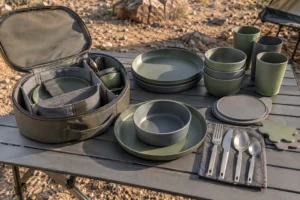
Shared Serving Pieces vs Individual Place Settings for Group Camping
A procurement framework for deciding which camping dinnerware components should be issued per person and which should remain shared across a group.
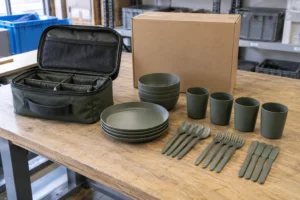
How to Prevent Rattle in a Nested Camping Dinnerware Set
A practical diagnostic for finding and controlling movement, impact and rubbing inside nested camping dinnerware sets without hiding problems behind unsupported claims.
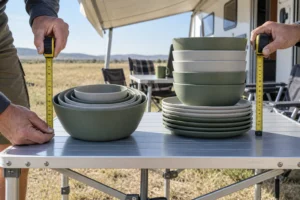
How to Calculate Pack Volume for Camping Tableware
A practical procurement worksheet for measuring the complete camping tableware sales unit, calculating its external cube and separating real pack efficiency from unsupported freight claims.
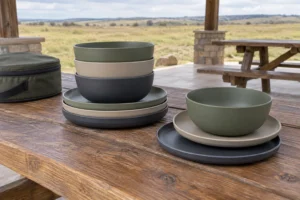
Nesting vs Stacking: How the Two Designs Change Pack-Out
A buyer-focused geometry and pack-out comparison for choosing nested, stacked or hybrid camping dinnerware systems without confusing compact appearance with approved performance.
What Makes Camping Dinnerware Truly Stackable?
A procurement acceptance framework for reviewing stack rise, contact interfaces, separation, stability, mixed-component order, drainage and retained pack-out.
Deep Bowls vs Shallow Bowls for Outdoor Meal Sets
A procurement decision table for selecting deep and shallow camping bowl profiles by meal function, user access, stability, cleaning and packed-set architecture.