
Bulk Wheat Straw Dinnerware Order: 30 Supplier Questions

The bulk order is where B2B tableware relationships succeed or fail.
A single missed specification on a 20,000-unit order is not a minor correction. It is a full container of product that cannot be sold.
In 15 years of manufacturing wheat straw dinnerware, I have watched buyers lose money on every category of mistake covered in this guide.
Some ordered the wrong material ratio. Some accepted test reports that did not cover their specific SKU. Some signed contracts without mold ownership clauses.
Every one of those mistakes was avoidable with the right questions asked before the order was placed.
This guide compiles the 30 questions every B2B buyer should ask before placing a bulk wheat straw dinnerware order.
They are organized into six categories: material, compliance, production, quality control, logistics, and commercial terms.
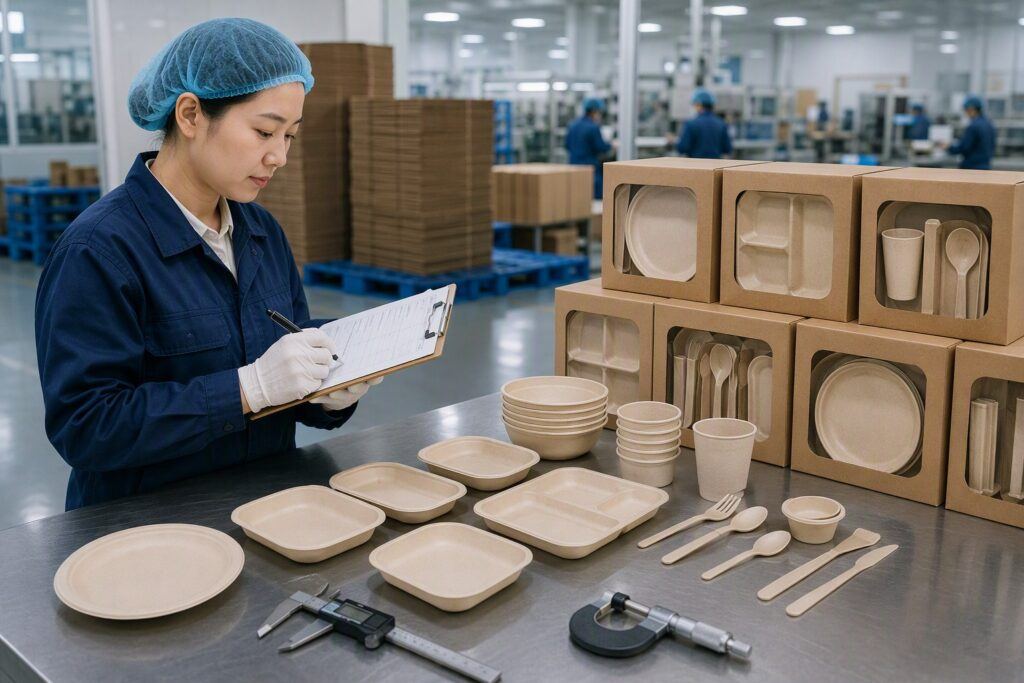
Material Questions (Questions 1-5)
Question 1: What is the exact PP-to-wheat-fiber ratio?
The ratio determines durability, heat resistance, and food safety.
Standard professional products use 60-70% food-grade PP and 30-40% wheat straw fiber.
A higher fiber content (50%+) looks “more natural” but becomes brittle and porous.
A lower fiber content means the product is essentially plastic with a wheat-straw label.
Ask for the ratio in writing and verify it with a material composition test.
Question 2: Is the PP resin 100% virgin food-grade?
Recycled or industrial-grade PP can contain unknown contaminants.
For food contact products, only virgin food-grade PP is acceptable.
Ask for the Certificate of Analysis (COA) from the PP resin supplier.
The COA should show the batch number matching your production dates.
Question 3: Where is the wheat straw fiber sourced?
Wheat straw is an agricultural byproduct with varying quality across regions.
The fiber source affects color consistency and material stability.
Ask for the sourcing declaration and verify the fiber has been properly cleaned and dried.
Question 4: What is the fiber grind size?
The grind size determines the surface texture and appearance.
100-200 mesh produces a smooth, premium surface with subtle fiber specks.
Coarser grinds produce a rougher, more rustic look.
Specify the grind size you expect and verify it on the pre-production sample.
Question 5: Can you provide a material composition certificate?
This document states the exact percentages of every component.
It is the foundation document for all other compliance claims.
Without it, every safety claim on your packaging is unsubstantiated.
Our BPA-free verification guide explains the full documentation hierarchy.
Compliance Questions (Questions 6-10)
Question 6: Which lab performed the test reports, and are they ISO 17025-accredited?
Only ISO 17025-accredited laboratories produce test reports accepted by customs and retailers.
Request the lab name and the accreditation number.
Verify the accreditation on the lab’s official registry.
Question 7: Do the test reports cover this exact SKU and color?
A report for a beige dinner plate does not cover a sage green dinner plate.
Each color uses different pigments with different migration profiles.
Each SKU has different surface area and volume ratios.
Verify the report’s sample description matches your exact product.
Question 8: Are the test reports current (within 12 months)?
Material formulations and pigment sources change over time.
Retail buyers and customs authorities expect current documentation.
Reports older than 12 months are effectively expired.
Question 9: Do you have LFGB sensory test reports (odor and taste)?
Chemical migration tests prove safety. Sensory tests prove consumers will accept the product.
LFGB sensory testing is required for the European market.
Without it, your product may fail German and Nordic retail requirements.
Question 10: Do you maintain BSCI and ISO 9001 certifications?
BSCI demonstrates social compliance — worker safety and fair labor practices.
ISO 9001 demonstrates a functioning quality management system.
European retail chains require both for supplier onboarding.
Verify the certificate numbers on the official registries. Our verification guide explains how to validate certificate claims.
Production Questions (Questions 11-15)
Question 11: What is your monthly production capacity for wheat straw dinnerware?
Capacity determines whether your order can be produced within your timeline.
A factory at 60% capacity can absorb your order quickly.
A factory at 90% capacity may extend your lead time by weeks.
Ask for current capacity utilization, not theoretical maximum capacity.
Question 12: How many injection molding machines are dedicated to food-contact products?
Food-contact production should be separated from industrial production.
Cross-contamination between product streams is a food safety risk.
A dedicated food-contact production zone indicates a professional operation.
Question 13: What is your mold maintenance schedule?
Molds need polishing every 300,000-500,000 shots.
Worn molds produce rough edges, dimensional drift, and flash.
Ask for the maintenance log and the shot count of the mold for your product.
Question 14: Do you anneal products after molding?
Annealing relieves internal stress and prevents delayed cracking.
A factory that skips annealing produces plates that fail after weeks of use.
Ask for the annealing process documentation.
Question 15: What is your in-house QC staffing per shift?
QC staffing reveals the factory’s commitment to quality.
Professional factories maintain at least 2 dedicated QC staff per shift.
A factory with no dedicated QC staff is a factory producing by hope.
For the production standards we apply, our custom dinnerware sets page documents our in-process QC checkpoints.
Quality Control Questions (Questions 16-20)
Question 16: What AQL sampling standard do you use?
AQL (Acceptable Quality Level) sampling defines the defect tolerance.
For dinnerware, we recommend AQL 2.5 for major defects and 4.0 for minor defects.
Children’s products should use stricter levels, particularly for sharp edges.
Question 17: Can I hire an independent third-party inspector?
Professional factories welcome independent inspection.
They should coordinate the inspector’s visit, provide samples, and share the report.
A factory that resists third-party inspection is hiding something.
Question 18: What happens if the inspection fails?
The contract should specify: rework at the supplier’s cost, re-inspection, and a clear failure remedy.
If the supplier has no defined failure process, you have no recourse.
Question 19: Do you provide batch-level test reports, or only annual reports?
Annual reports document the material. Batch-level reports document your specific production.
For food-contact products, batch-level verification is the professional standard.
Ask for the batch documentation that will accompany your shipment.
Question 20: How do you handle defective units after shipment?
The replacement policy should cover defects discovered after arrival.
Clarify: who pays for replacement shipping, and what is the response time?
A clear post-shipment defect policy protects your retail relationships.
Our quality issues diagnostic guide explains how to verify and resolve common defect claims.
Logistics Questions (Questions 21-25)
Question 21: Can you provide a container loading plan before the order?
The loading plan shows carton dimensions, pallets per container, and utilization percentage.
Utilization above 90% indicates efficient packaging design.
Ask for the plan before confirming the order, not after production.
Question 22: What is the lead time in working days, from which trigger?
Clarify the starting point: deposit receipt, sample approval, or order confirmation.
Specify working days, not calendar days.
Get the lead time in writing on the Proforma Invoice.
Question 23: What are the exact payment terms?
Standard terms are 30% deposit and 70% against a copy of the bill of lading.
Confirm the deposit trigger, the balance trigger, and the payment method.
Never accept 100% upfront payment for a first order.
Our payment terms and lead time guide covers the full negotiation framework.
Question 24: Do you support FOB, CIF, and DDP shipping terms?
Different terms allocate freight and risk differently.
FOB transfers risk at the origin port. CIF includes freight and insurance. DDP includes delivery and duties.
Choose the term that matches your logistics capability and risk tolerance.
Question 25: What is your packaging drop-test standard?
Export cartons must survive a 1.2-meter drop test on six sides and four corners.
Retail packaging must pass ISTA standards for the shipping environment.
Ask for the drop-test report and the carton compression rating.
Commercial Questions (Questions 26-30)
Question 26: What is the MOQ per SKU and per color?
MOQ defines your minimum financial commitment.
Standard MOQ is 500-1,000 units per SKU; custom colors may require more.
Understand the MOQ for each combination before planning your order.
Question 27: What is included in the unit price?
Clarify whether the price includes packaging, logo printing, and testing.
Some suppliers quote a base price and add every service separately.
Request a fully itemized quotation showing product, packaging, and logistics costs separately.
Question 28: Do you own the mold if I commission custom tooling?
Mold ownership determines your product’s long-term value.
The contract must state the mold belongs to you and transfers on request.
Our OEM vs ODM guide covers the mold ownership clauses in detail.
Question 29: Can I have a pre-production sample before mass production?
Never skip the pre-production sample stage.
The sample verifies material, color, dimensions, and logo quality.
Approve the sample in writing before production begins.
Question 30: What references can you provide from similar bulk orders?
References validate the supplier’s track record.
Ask for contact details of buyers who placed similar-sized orders.
Call at least one reference to verify the supplier’s reliability.

How to Use This Bulk Wheat Straw Dinnerware Order Checklist
The 30 questions work best as a structured inquiry document.
Send them to the supplier in writing before the first quotation.
A professional supplier will answer all 30 questions clearly and quickly.
A supplier who deflects, delays, or gives vague answers is signaling problems.
Scoring the Supplier Checklist
Score each answer from 1 to 5. Total score out of 150.
A score above 120 indicates a professional supplier worth shortlisting.
A score below 90 indicates significant risk.
Use the score to compare suppliers objectively instead of comparing only prices.
The Contract Link
Every answer should be reflected in the written contract.
A verbal answer that is not in the contract does not exist.
Request that the critical specifications — material ratio, test report currency, lead time, mold ownership — be written into the Proforma Invoice or sales contract.
Our import compliance guide explains how to verify supplier claims beyond the questionnaire.
Real-World Failures: When Buyers Skipped the Questions
Every question in this checklist exists because a buyer skipped it and paid the price. These are real failure patterns from the tableware industry.
The Test Report Mismatch
A European distributor ordered 15,000 wheat straw bowls for the German retail market.
The supplier provided a test report — but it covered a beige dinner plate, not the sage green bowls ordered.
The shipment was cleared by customs but rejected during the retailer’s random compliance audit.
The distributor paid €32,000 in returned shipping, restocking, and brand-damage costs.
The BPA-free verification guide would have prevented this with a 5-minute report description check.
The Material Ratio Shortcut
An Amazon seller ordered 20,000 “eco plates” at an attractive unit price.
The factory had quietly increased the fiber content to 55% to reduce material cost.
The plates passed initial inspection but became brittle after three months of customer use.
The listing collapsed under a wave of 1-star reviews about cracking.
The quality issues diagnostic guide covers how to verify the PP ratio before production.
The Mold Ownership Dispute
A brand commissioned a custom plate mold at a cost of $3,200.
The contract did not specify mold ownership.
Two years later, when the brand moved to a new supplier, the factory refused to release the mold without a $1,500 fee.
The brand’s proprietary design — and its $3,200 investment — was held hostage.
The mold ownership clause in Question 28 exists because of stories exactly like this.
The Lead Time Miscalculation
A seasonal buyer ordered holiday inventory in October, expecting a 25-working-day lead time.
The factory was at 95% capacity for the holiday rush.
The order shipped in 40 working days — two weeks after the client’s product launch window.
The payment terms and lead time guide explains the peak-season calendar that prevents this mistake.
The Checklist as a Negotiation Tool
Beyond filtering suppliers, the 30 questions strengthen your negotiation position.
Signaling Professionalism
A buyer who sends a structured 30-question inquiry signals serious intent.
Suppliers prioritize professional buyers over casual inquiries.
You receive better pricing and faster responses because the supplier knows you are ready to commit.
Creating Documentation Leverage
Every answer you receive in writing becomes negotiation leverage.
If the supplier claims a 25-day lead time in writing, you can hold them to it.
If they claim virgin food-grade PP, you can request the COA to verify.
Written answers convert vague promises into enforceable commitments.
Identifying Negotiable Areas
The 30 questions reveal which areas the supplier is flexible on.
A supplier who easily accepts your AQL standard is confident in their quality.
A supplier who hesitates on mold ownership may be protecting something.
Use the answers to focus your negotiation energy on the highest-risk items.
B2B Buyer Checklist: Bulk Wheat Straw Dinnerware Order Preparation
Before you send your inquiry, complete this preparation checklist.
| Check | Preparation Item |
|---|---|
| ☐ | Product specifications defined — SKU list, colors, quantities, packaging tier |
| ☐ | Target markets identified — EU, US, or multi-market (determines compliance needs) |
| ☐ | Test report requirements listed — which certifications your retail partners require |
| ☐ | Shipping terms chosen — FOB, CIF, or DDP based on your logistics capability |
| ☐ | Budget range set — total landed cost target per set |
| ☐ | Timeline confirmed — required delivery date, working backward from production |
| ☐ | Mold strategy decided — ODM catalog products or custom OEM tooling |
| ☐ | All 30 questions prepared — formatted as a single inquiry document |
B2B Buyer FAQ: Bulk Orders
Should I send all 30 questions at once or in stages?
Send all 30 at once. A single comprehensive inquiry signals a professional buyer and filters out unqualified suppliers.
Suppliers who cannot answer a structured questionnaire are not equipped for serious bulk orders.
How many suppliers should I evaluate with this checklist?
Three is the ideal number. One excellent candidate, one comparison candidate, and one alternative.
Evaluating more than three creates analysis paralysis.
Can I negotiate on the answers?
Yes, but prioritize. The non-negotiables are: material ratio, virgin food-grade PP, current test reports, and mold ownership.
Flexible items include: MOQ, packaging tier, and minor lead time adjustments.
What if a supplier cannot answer all 30 questions?
Ask for the missing answers in writing with a deadline.
A supplier who cannot produce documentation for critical items is a risk.
Consider whether the missing answers are deal-breakers for your market.
How long should a professional supplier take to answer?
A well-prepared supplier answers a structured inquiry within 2-3 business days.
Longer delays suggest disorganization or over-commitment.
Should I share the checklist with the supplier before requesting a quote?
Yes. Sending the questions in advance lets the supplier prepare accurate answers and documentation.
It also filters out suppliers who are not equipped for structured B2B procurement.
A supplier who reacts negatively to professional questions is not a partner for serious orders.
What is the most common question buyers forget?
Question 17 — the right to independent third-party inspection — is the most frequently skipped.
Buyers assume they can always inspect, but the contract must reserve that right explicitly.
Without it, a supplier can refuse inspection access and you have no contractual recourse.
How do the 30 questions differ for first-time versus repeat orders?
For first orders, all 30 questions apply with full weight.
For repeat orders, focus on the items that can change: test report currency, material ratio, lead time, and pricing.
Renew the critical documentation annually even for established suppliers.
Can the checklist be used for products other than wheat straw?
Yes, with minor adjustments.
The material questions (1-5) are wheat-straw-specific. The compliance, quality, logistics, and commercial questions apply to any bulk tableware import.
Adapt the material section for the specific product you are sourcing.
What should I do if the supplier’s answers are inconsistent between documents?
Inconsistency is a red flag requiring resolution before the order.
Ask for the conflicting information to be reconciled in writing.
If the discrepancy involves safety or material claims, consider whether the supplier is qualified at all.
Consistency across documents is the baseline expectation of a professional operation.
Should the 30 questions be part of the formal purchase contract?
The critical answers should be written directly into the Proforma Invoice or sales contract.
Material ratio, test report currency, lead time, mold ownership, and the inspection right are the five clauses that must appear in writing.
Attach the full questionnaire as an appendix and reference it in the contract.
This makes every answer contractually binding rather than a courtesy.
What is the single best predictor of a reliable bulk wheat straw dinnerware supplier?
Documentation quality. A supplier who maintains current, specific, verifiable documentation across every category is a supplier with institutional discipline.
Price competitiveness and salesmanship are poor predictors.
A supplier who can produce the right document on demand, without excuses, is the supplier who will deliver your order correctly.
Our factory quality system is what an on-site audit verifies — documentation, records, and traceability.
Conclusion: Your Bulk Wheat Straw Dinnerware Order Starts With Questions
A bulk wheat straw dinnerware order is a significant financial commitment that deserves the same rigor as any major procurement decision.
The 30 questions in this guide cover the six dimensions where bulk orders fail: material, compliance, production, quality control, logistics, and commercial terms.
These six dimensions correspond exactly to the stages of the order lifecycle, from the first material decision to the final commercial agreement.
A professional supplier checklist process transforms you from a passive price-taker into an informed buyer.
The checklist also creates the documentation trail you need if anything goes wrong after the order ships.
Every question answered in writing is a specification locked into your contract.
Every vague answer is a risk you can eliminate before committing capital.
The supplier who answers all 30 questions clearly is a supplier worth building a long-term relationship with.
The supplier who cannot answer them is a supplier you should walk away from — no matter how attractive the price looks.
Ready to Place Your Bulk Order Confidently?
Use this checklist as your inquiry document. We welcome every question on this list — and we will answer all 30 in writing within two business days.
Send Your Bulk Order Inquiry with the 30-Question Checklist
Browse the Wheat Straw Dinnerware Catalog
CONTACT US
Can Wheat Straw Tableware Go in the Freezer?
Can wheat straw tableware go in the freezer? This evidence-led B2B guide explains frozen-storage conditions, material variables, freeze-thaw testing, compliance documents and the questions buyers should ask before approving a freezer-safe claim.

EU GPSR Wheat Straw Tableware: A Traceability Guide
A factory-side guide to GPSR traceability, technical documentation, responsible-person information, online listings and corrective-action planning for EU wheat straw tableware programs.

Does Wheat Straw Tableware Contain Gluten?
A factory-insider guide for B2B buyers evaluating wheat straw material sources, gluten-related claims, testing scope, food-contact compliance and supplier controls.
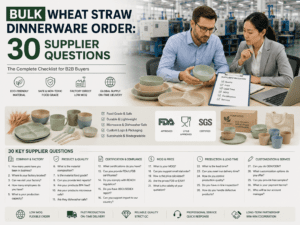
Bulk Wheat Straw Dinnerware Order: 30 Supplier Questions
Ask these 30 bulk wheat straw dinnerware order questions before you sign. Avoid costly mistakes with our supplier checklist. Send your inquiry with confidence now.
Complete Wheat Straw Dinnerware Product Line: Build Guide
Build a complete wheat straw dinnerware product line with plates, bowls, cups and cutlery. Learn assortment strategy, SKU planning and margin optimization. Get your line quote.
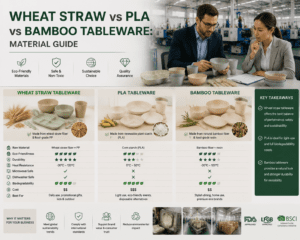
Wheat Straw vs PLA vs Bamboo Tableware: Material Guide
Compare wheat straw vs PLA vs bamboo tableware for B2B sourcing. Learn heat resistance, cost, and safety differences. Get material recommendations now.