Understand MOQ in Eco-Tableware Manufacturing: How Factories Calculate Production Runs
If you’re sourcing eco-friendly dinnerware for the first time, one question usually comes up very early in the conversation:
“What is your MOQ?”
Many buyers are surprised when different factories provide completely different MOQ requirements for what appears to be the same product.
Some suppliers quote 500 pieces.
Others require 3,000 pieces.
And for custom products, the MOQ may be even higher.
So why does this happen?
More importantly, how do factories actually calculate production runs and determine MOQ requirements?
In this article, we’ll break down the logic behind MOQ in eco-tableware manufacturing and explain how buyers can reduce costs, improve sourcing efficiency, and find the right production solution for their business.
Whether you’re an Amazon seller, distributor, retailer, startup brand, or importer, understanding MOQ can help you make smarter purchasing decisions and avoid unnecessary misunderstandings during supplier negotiations.
What Does MOQ Mean?
MOQ stands for Minimum Order Quantity.
Simply put, it is the smallest quantity a manufacturer can economically produce while maintaining production efficiency and reasonable costs.
MOQ is not an arbitrary number.
Instead, it is calculated based on several manufacturing factors, including:
- Raw material procurement
- Machine setup costs
- Production efficiency
- Packaging requirements
- Labor costs
- Quality control expenses
- Shipping and logistics considerations
Understanding these factors helps buyers negotiate more effectively and identify opportunities for lower-volume production.
Why Factories Can’t Always Produce Small Quantities
One of the most common misconceptions among new buyers is:
“If the product already exists, why can’t the factory just make 100 pieces for me?”
The answer lies in production economics.
Before manufacturing begins, factories must invest time and resources into:
- Material preparation
- Machine setup
- Color matching
- Quality inspection
- Packaging preparation
- Production scheduling
Whether producing 100 pieces or 10,000 pieces, many of these setup costs remain almost identical.
For this reason, factories establish MOQs to ensure production remains commercially viable.
MOQ in Eco-Tableware Manufacturing
1. Raw Material Consumption
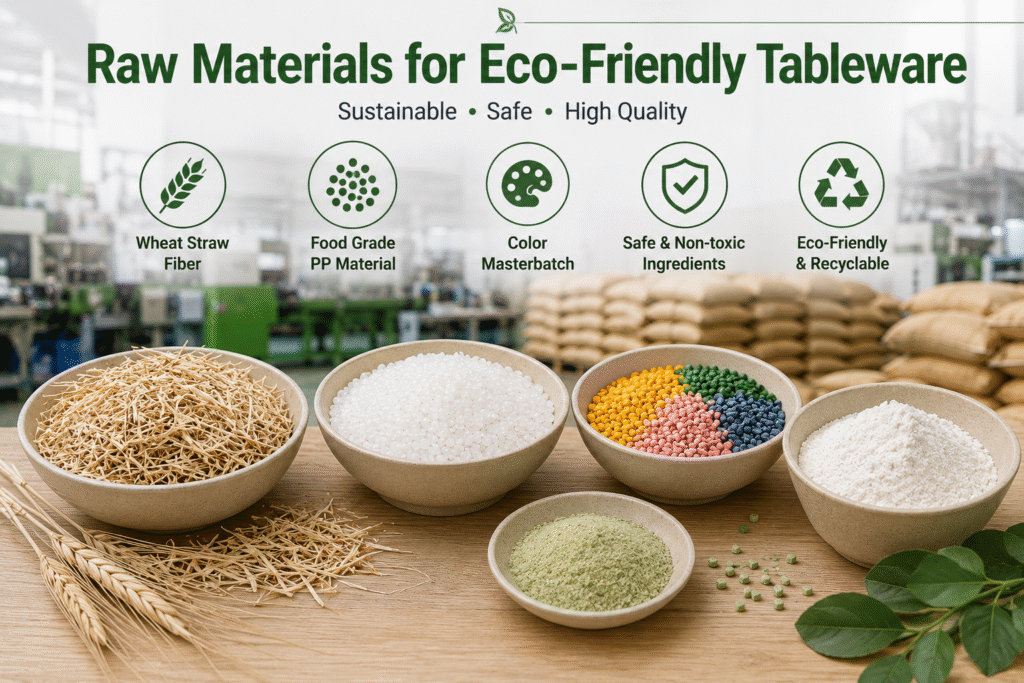
For wheat straw dinnerware manufacturing, raw materials are usually purchased in batches.
Factories often purchase:
- Wheat straw fiber
- Food-grade PP materials
- Color masterbatch
- Packaging materials
Suppliers frequently impose their own minimum purchase quantities.
As a result, the factory’s MOQ is often influenced by upstream material suppliers.
2. Production Machine Efficiency
Injection molding machines and production equipment operate most efficiently during continuous production runs.
Short production runs create:
- Increased machine downtime
- Higher setup costs
- Lower productivity
This directly impacts manufacturing costs.
For example:
| Production Quantity | Cost Efficiency |
|---|---|
| 500 pcs | Low |
| 2,000 pcs | Medium |
| 5,000+ pcs | High |
This is one reason factories often encourage buyers to consolidate orders.
3. Custom Colors and Branding
Custom requirements significantly affect MOQ.
Examples include:
- Custom Pantone colors
- Logo printing
- Custom packaging
- Retail gift boxes
- Barcode labels
Each customization requires additional setup work and materials.
As a result, custom projects generally have higher MOQ requirements than stock products.
If you’re considering a custom product line, you may also find this guide useful:
👉 How to Custom Design a Wheat Straw Dinnerware Mold: Timelines and Cost Guide
4. Packaging Requirements
Many buyers underestimate the impact of packaging on MOQ.
Packaging materials often have their own minimum production quantities.
Examples include:
- Custom retail boxes
- Printed cartons
- Instruction manuals
- Stickers
- Hang tags
A packaging supplier may require 1,000 or 2,000 units per print run, even if the dinnerware order itself is smaller.
This becomes a key factor in MOQ calculations.
Why Some Factories Offer Lower MOQ
Not all factories operate the same way.
Experienced manufacturers with larger production capacity often have greater flexibility.
This may be possible because they:
- Run multiple projects simultaneously
- Share material inventories
- Maintain stock packaging
- Produce common product designs year-round
As a result, they can sometimes support lower MOQ projects for new customers.
This is particularly valuable for:
- Amazon FBA sellers
- New eCommerce brands
- Kickstarter projects
- Market testing programs
- Promotional campaigns
How Buyers Can Reduce MOQ Requirements
The good news is that MOQ is often negotiable.
Here are several practical ways buyers can lower MOQ barriers.
Choose Existing Molds
Using existing molds eliminates tooling costs and reduces production complexity.
This often results in lower MOQ requirements.
You can explore our available wheat straw product collection here:
Use Standard Colors
Custom colors typically require separate material preparation.
Choosing standard factory colors can help reduce MOQ.
Popular options include:
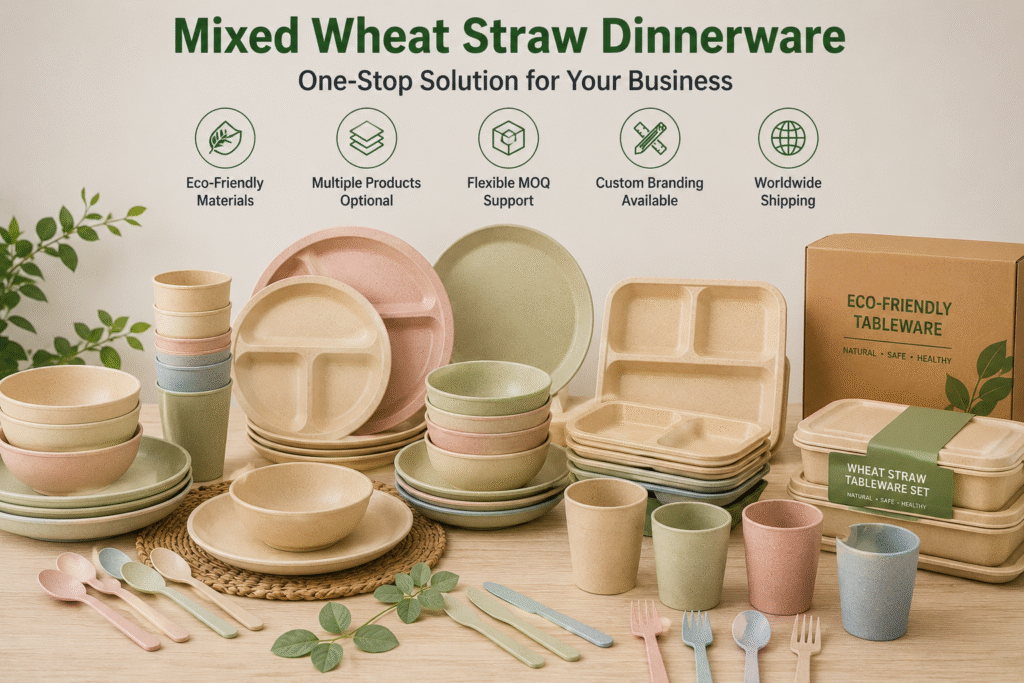
- Beige
- Cream White
- Light Green
- Gray
- Pastel Blue
These colors are often already in production.
Simplify Packaging
Custom packaging frequently drives MOQ higher.
Using standard export packaging initially can significantly lower startup costs.
Once sales increase, buyers can upgrade to fully customized retail packaging.
Combine Multiple Products
Some factories allow buyers to mix different products within one order.
For example:
Combining products may help meet overall production requirements without purchasing excessive quantities of a single SKU.

MOQ vs. Total Cost: What Buyers Should Really Focus On
Many buyers focus exclusively on MOQ.
However, MOQ is only one part of the equation.
A lower MOQ does not always mean lower overall costs.
Sometimes:
- Unit price increases significantly
- Shipping becomes less efficient
- Packaging costs rise
- Product margins decrease
The smarter question is often:
“What order quantity gives me the best balance between risk and profitability?”
Experienced suppliers can help calculate this based on your target market and sales strategy.
How We Help New Buyers Start With Confidence
At Naike Eco Technology, we understand that not every customer is ready for container-load orders.
Many successful long-term customers started with small test orders.
That’s why we offer:
✔ Existing mold options
✔ Flexible MOQ solutions
✔ OEM & ODM services
✔ Custom packaging support
✔ Product development consultation
✔ Sample evaluation programs
✔ Export experience to 50+ countries
Whether you’re launching a new Amazon brand, entering a retail chain, or developing a private label collection, our team can recommend the most cost-effective production strategy.
Why Transparent MOQ Communication Matters
A professional supplier should explain MOQ clearly rather than simply providing a number.
Understanding the reasons behind MOQ helps buyers:
- Plan inventory more accurately
- Control sourcing costs
- Reduce purchasing risks
- Improve product launch strategies
The best supplier relationships are built on transparency and collaboration—not just pricing.
Ready to Discuss Your Project?
If you’re sourcing eco-friendly dinnerware and want to better understand your production options, our team is here to help.
Whether you need:
- Stock products
- Private label customization
- Custom packaging
- OEM manufacturing
- Mold development
- Low MOQ solutions
We’ll help you identify the most efficient and cost-effective approach for your business.
👉 Contact Us Today for Product Catalogs, MOQ Consultation & Free Quotation
You can also browse our latest eco-friendly product range here:
Naike Eco-Friendly Dinnerware Collection
Conclusion
MOQ is one of the most misunderstood aspects of eco-tableware manufacturing.
Rather than viewing MOQ as a barrier, buyers should understand it as a reflection of production economics and supply chain efficiency.
By understanding how factories calculate production runs, businesses can make better sourcing decisions, reduce costs, and establish stronger supplier relationships.
For growing brands, retailers, and importers, the right supplier won’t simply quote an MOQ—they’ll help you find the most practical path to market success.
CONTACT US

Understand MOQ in Eco-Tableware Manufacturing: How Factories Calculate Production Runs
Understand MOQ in Eco-Tableware Manufacturing: How Factories Calculate Production Runs If you’re sourcing eco-friendly dinnerware for the first time, one question usually comes up very

Pantone Color Matching for Wheat Straw Products: How We Ensure Brand Consistency
Pantone Color Matching for Wheat Straw Product: How We Ensure Brand Consistency When launching a custom eco-friendly product line, color is often one of the

Sustainable Packaging Options for Bulk Eco-Friendly Dinnerware Imports
Sustainable Packaging Options for Bulk Eco-Friendly Dinnerware Imports As global consumers become increasingly environmentally conscious, sustainability is no longer limited to the products themselves. Buyers

How to Custom Wheat Straw Dinnerware Mold
How to Custom Wheat Straw Dinnerware Mold: Timelines and Cost Guide Launching a successful eco-friendly tableware product is no longer just about choosing existing designs

Why Biodegradable Wheat Straw Composite is the Future of Sustainable Foodservice
Why Biodegradable Wheat Straw Composite is the Future of Sustainable Foodservice The global foodservice industry is going through a major transformation. From restaurants and cafés

How Wheat Straw Dinnerware Trend To Helps Retailers Capitalize
How Wheat Straw Dinnerware Trend To Helps Retailers Capitalize on the Plastic-Free The global shift toward sustainable living is no longer just a consumer preference