
Pre-Shipment Inspection Checklist for Wheat Straw Dinnerware Buyers: Ensuring Quality Before Loading

If you are sourcing wheat straw dinnerware from overseas, there is one moment that defines whether you are a professional importer or a gambler: the pre-shipment inspection. I have spent years on the factory floor and in the export office, and I can tell you with certainty that a supplier’s “self-inspection report” is not a valid QC document. It is a marketing tool.
A pre-shipment inspection (PSI) is the final technical gate before your container is loaded. For wheat straw composite products—which combine natural fibers with PP binders—standard plastic inspection protocols are not enough. You need a material-specific checklist that accounts for fiber charring, color shift, nesting integrity, and odor migration.
At Naike Dinner, we encourage and coordinate third-party PSIs for every bulk order because we know that a failed inspection costs us a small delay (rework), but a missed defect costs you a destroyed brand reputation. This guide provides the comprehensive, factory-tested checklist you need to protect your shipment.
1. The Economics of a Pre-Shipment Inspection: An ROI Calculation
Before diving into the checklist, let’s examine why spending 300−300−500 on a professional pre-shipment inspection is the highest-ROI activity in your procurement cycle.
Scenario: A 40HQ Container of Wheat Straw Bowls
- Order Value: $45,000
- Profit Margin: 25% ($11,250 expected profit)
Without a 3rd-Party Inspection:
- Risk: 5% of products have a “Major Defect” (color mismatch, unstable logo).
- Consequence: A retail chain rejects the shipment or demands a 15% discount.
- Loss: $6,750.
With a 3rd-Party Inspection:
- Cost: $450 (for one inspector-day).
- Result: Catches the defect before loading. Factory reworks 5% of the order.
- ROI: A 450investmentprotects450investme tprotects6,750 in potential losses. That’s a 1,400% ROI.
Furthermore, an independent PSI report from SGS, Bureau Veritas, or QIMA is a legal asset. If a dispute arises, you have an ISO 17025-accredited document to support your case.
2. What to Look for in a Wheat Straw-Specific Inspection
General tableware inspections check for cracks and dimensions. A wheat straw dinnerware QC must go four layers deeper. Here is what your inspector must verify, and here is what I check when I observe the inspection at our factory.
A. The Visual Inspection (AQL Sampling)
Sampling must follow the ISO 2859-1 (ANSI/ASQ Z1.4) standard. For a standard B2B order, we recommend:
- Level: General Inspection Level II.
- AQL (Acceptable Quality Limit):
- Critical Defects (Safety): 0 (Zero tolerance) — e.g., sharp edges from flash, heavy metal contamination risk.
- Major Defects (Function): 2.5 — e.g., logo peeling, size deviation >2mm, color drift.
- Minor Defects (Aesthetics): 4.0 — e.g., slight surface scuff, minor fiber clumping.
B. The “Wheat Straw Defect” Categories
Standard injection molding defects like “short shots” (incomplete filling) apply, but we also add:
Fiber Charring (Critical): Small black or dark-brown spots that look like dirt.
- Cause: Injection barrel temperature too high (>200°C), literally burning the wheat fibers.
- Standard: No charred spots larger than 0.5mm on the eating surface.
Surface Porosity (Major): A “rough” or sandpaper-like feel.
- Cause: Low PP binder ratio, poor compounding.
- Test: A simple “Drop Test” with water droplets. If the surface absorbs water, it will absorb food and bacteria, making it impossible to clean and a micro-organism risk.
Color Metamerism (Major): The color looks different under the inspection light vs. the office light.
- Protocol: Inspect the same piece under D65 (Daylight) and TL84 (Retail Light) in a light box. If the color shifts visibly, the masterbatch is not stable.
3. Factory Floor QC: The 6-Spot “Problem Area” Check
Before starting the formal AQL sampling, the inspector should walk the factory floor to check for systemic problems that the sample might miss.
①. The “Cooling Zone” Check
Post-molding, wheat straw tableware cools on a rack.
- The Red Flag: Parts stacked too hot. If the operator stacks plates directly out of the mold (125°C), they will fuse together. This creates “Welding Marks” on the bottom of the plate.
- Protocol: Use a thermal gun to verify the surface temperature of the top and bottom plates in a stack. There must be a 50°C drop before nesting.
②. Siloing the Trim-Waste (Regrind Leak)
- High-Risk Area: Low-quality factories throw “Sprue and Runner” (excess plastic from the molding process) into a dirty bin on the floor. This contaminated waste is then ground up and mixed back into the fresh wheat straw material.
- Inspector Action: Inspect the regrind bins. If you see dust, leaves, or non-white plastic mixed in, the factory is contaminating the food-grade stream.
③. The “Warehouse Aging” Audit
If your order was produced in batches over several weeks, the inspector must check the “Oldest Stock” cartons first. Wheat straw composite, if not properly stabilized, will slowly release moisture over 6 weeks, causing “Internal Stress Cracks” in the warehouse. Inspect at least 5 cartons from Batch #1 to ensure no delayed cracking.
④. Print-Wear Check (The “Dishcloth” Simulation)
Logos that look perfect on the shelf can fail in the kitchen.
- Accelerated Test: Take a piece of the production welding fabric used on the table of the printing station. Rub it vigorously in a circular motion over the logo for 30 seconds. If the ink smudges or flakes, the curing temperature for the ink dryer was too low during that shift.
⑤. Fiber-Cross Contamination Audit
Our wheat straw uses a specific PP binder. If the same injection machine was used for a different color (or worse, an industrial part) just hours before your run, the first 10 minutes of your production will be contaminated.
- The “Non-Purge” Risk: Check the trash bin near the injection machine for the first “purge cookies” (lumps of plastic from cleaning the barrel). Their color must be the exact color of your product. If they are a foreign mixed color, they didn’t purge the machine correctly.
⑥. Odor Migration Spot-Test
We perform this in our lab, but an inspector can do a rough version.
- Test: Fill a bowl with boiling water (95°C), place a lid on it, and let it sit for 10 minutes. Open the lid and take a deep breath. Any “plastic musty” or “burnt cereal” smell signals that the volatiles are migrating—a likely failure under the European LFGB Sensory Test.
4. The Essential Pre-Shipment Inspection Checklist (Print This)
Here is the comprehensive checklist we provide to all our B2B clients. It is written in inspector-friendly language, referencing our private QC manuals.
①. Quantity Verification
- Total Cartons:Count all master cartons. Match against the packing list.
- Assortment:If the order includes multiple SKUs (S, M, L bowls), verify the carton distribution matches the PO.
②. Workmanship (Visual Inspection)
- Surface Quality:Free from cracks, warping, chips, and burrs on parting lines.
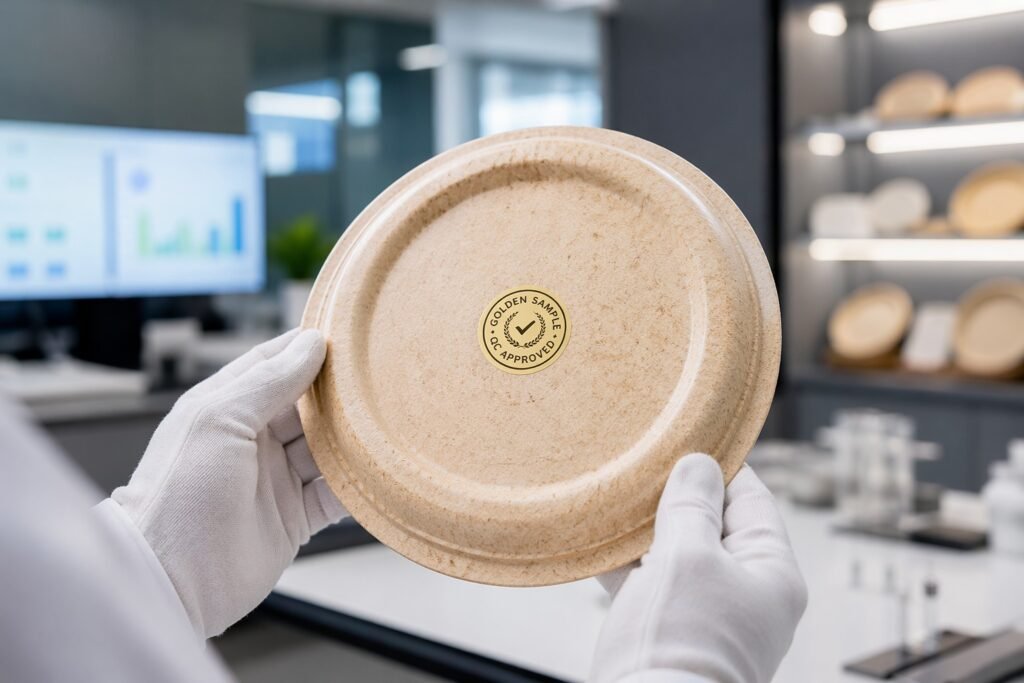
- Texture Consistency:Use the “Golden Sample” as the visual reference. No “pin-holes” or major fiber clusters.
- Gloss/Matte Level:Consistent across the table surface. No shiny “hot spots.”
③. Color Verification
- Pantone Match:Compare 5 random samples against the approved Pantone Color Chip. Acceptable tolerance:Delta-E (ΔE) ≤ 3.0.
- Lightfastness:If possible, briefly check color consistency under a UV lamp to simulate retail shelf-life.
④. Dimension & Weight Verification
- Diameter/Height:Use a calibrated digital caliper. Compare against the approved sample or tech spec. Tolerance: +/- 1.5mm.
- Individual Weight:Random sample of 20 pieces. Tolerance: +/- 5 grams of the confirmed PPS weight. A -10g difference indicates the factory thinned the material.
⑤. Functional Tests
- Microwave Safety:Place 2 random items in a microwave with 100ml of water for 2 minutes. The item must not warp, melt, or emit a “burnt” acidic odor.
- Stackability:Stack 8 plates or bowls. They must sit flush without wobbling or “locking” together.
- Logo Adhesion:Apply 3M 600 high-tack tape to the printed logo, press firmly, and rip off rapidly. No logo transfer is allowed. (SeePrivate Label Guide).
⑥. Packaging & Marking
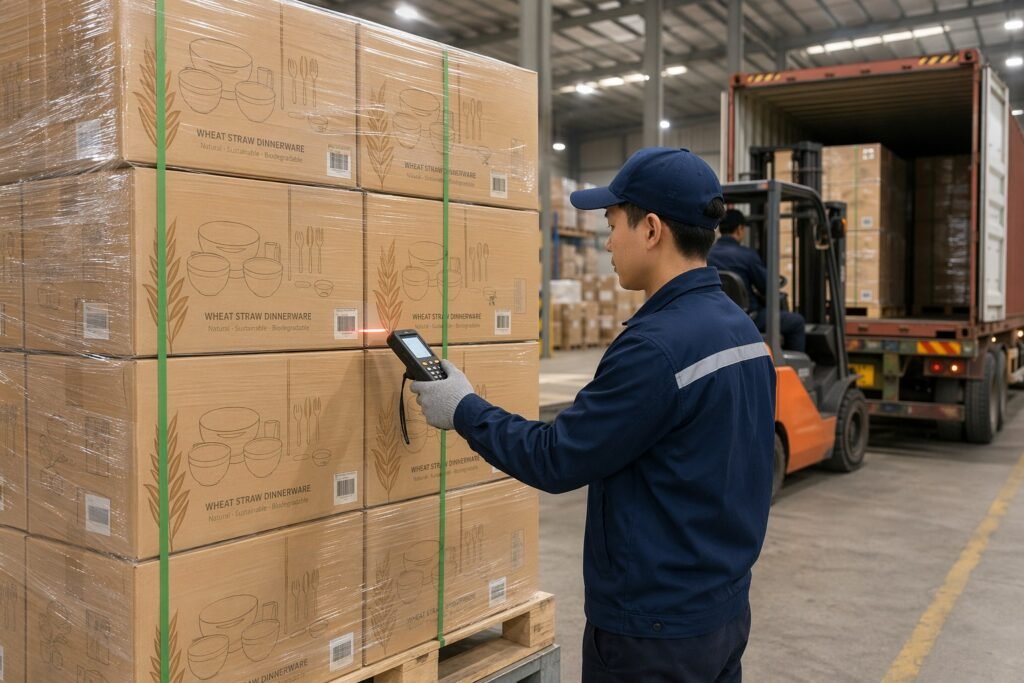
- Barcode Scan:Use a mobile scanner to check the EAN/UPC on the retail box. It must scan first time and return the correct product code.
- Box Strength:Perform a 90cm “Drop Test” on a packed retail box. The box must not burst open at the corners. (SeeTableware Quotation Guide).
- Shipping Marks:Master cartons must show “Made in China,” batch number, and handling marks (“Fragile,” “Keep Dry”).
⑦. Chemical Safety & Documentation
- Material Traceability:Verify that the batch number on the product matches the COA (Certificate of Analysis) for the PP resin.
- Test Report Validity:Confirm that the latestLFGB or FDA test reportcovers the specific color SKU being shipped. A report for a “Beige” plate does not cover a “Navy Blue” plate if the pigment changed.
5. Defect Classification: Pass or Fail?
Understanding the difference between a “minor blemish” and a “critical failure” prevents unnecessary re-negotiation and delays.
| Defect Class | Description | Wheat Straw Example |
|---|---|---|
| Critical | Renders the product unsafe or illegal. | Sharp edge (flash) on the rim; fiber charring >0.5mm; heavy metal positive test. |
| Major | Affects function or saleability. | Logo peeling off; severe color drift (ΔE > 5); packaging missing barcodes. |
| Minor | Aesthetic issue not affecting use. | Slight surface scuff; minor fiber specks visible; 1mm scratch on the underside. |
Pass/Fail Rule: If the number of “Major Defects” in your sample exceeds the AQL 2.5 limit, the order is held. The factory must re-sort, rework, and submit for a re-inspection before loading.
6. The Container Loading Supervision: Don’t Walk Away After PSI
A classic scam is the “Good Sample, Bad Load.” The inspection passes during the day, but the factory loads rejected cartons at night.
Container Loading Protocol
- Seal Integrity: Your inspector should select a specific high-security bolt seal and record the number.
- Carton Spot-Check: As the container is loaded, the inspector randomly opens 3-5 cartons from the middle of the pallet to verify they match the approved samples.
- Blocking and Bracing: The inspector must verify that “Air Bags” (dunnage) are placed correctly to prevent carton movement during the 30-day ocean transit.
- Final Photo: A time-stamped photo of the closed container with the seal affixed.
For more detailed logistics advice, see our Importing Guide for Wheat Straw Tableware.
7. The “Golden Sample” and the Reference Standard
We briefly touched on this in our Sample Approval Guide, but it is the most critical element of a PSI. You cannot inspect “quality”; you can only inspect conformity to an approved reference standard.
Before the inspector arrives, you must have signed and sealed “Sealed Samples” at the factory. At Naike Dinner, we keep three:
- Buyer’s Master (Your Office).
- Factory QC Master (Production Floor).
- Inspector’s Reference (Sealed Bag).
The inspector opens the sealed bag at the start of the inspection. They do not ask the factory for “a sample to compare to.” They use the pre-agreed, un-tampered standard.
8. Comparative Analysis: In-House vs. Third-Party Inspection
Some buyers ask, “Why can’t I trust the factory’s own QC report?” Here’s the factual comparison.
| Feature | Factory Self-Inspection | Professional 3rd-Party (SGS/BV) |
|---|---|---|
| Scope | Often limited to “Visual Checks” and weight. | Technical: ΔE Colorimetry, Drop Tests, Barcode scanning. |
| Cost | “Free” (hidden in unit price). | 400−400−600 per Inspector-Day. |
| Autonomy | Incentivized to “Pass” the order to speed shipment. | Incentivized to “Find Defects” to justify their value. |
| Documentation | Simple PDF scan. | ISO 17025-accredited detailed report with traceable photos. |
| Legal Standing | No legal weight in disputes. | Accepted by banks for Letter of Credit (L/C) and by courts. |
Moreover, a factory self-inspection cannot substitute for independent oversight during wheat straw dinnerware QC because the inspector has no knowledge of the sealed “Golden Sample.” The inspector walks onto the factory floor with a sealed bag containing the agreed reference. For a deeper look at how we secure this reference, see our Sample Approval Guide.
9. The “QC Hold” Crisis: What to Do If the Batch Fails
If your inspector calls and says “FAIL,” you have three immediate options. Here’s how we, as a manufacturer, prefer to handle it.
Scenario 1: “Isolated Major Defects” (Minor Color Drift on 5% of pieces)
- Action: “Sort and Re-submit.” The factory pays for a team of sorters to check 100% of the production. The inspector can return 24 hours later to audit the “Sorted” batch.
- Risk: Adds 1-2 days to the shipment schedule.
Scenario 2: “Systemic Manufacturing Defect” (Homogeneous Charring across all samples)
- Action: “Rework or Scrap.” The batch is sent back through a grinding and re-molding process (if the material allows it), or the batch is scrapped.
- Cost: This is where your contract terms matter. Our B2B contract states the factory is responsible for all rework costs if the “Approved Golden Sample” was not reproduced accurately.
Scenario 3: “Failed Packaging Drop-Test” (Barcode placement error)
- Action: “Repacking.” The factory hires a local team to open all cartons and re-stick the correct barcode labels.
- Naike Protocol: We use a “Double-Verification” system now—once on the box proof, and once on the final carton sample—to avoid this entirely because the repacking cost is 10x higher than the QC cost.
10. The “Remote Inspection” Option for Small Orders
If a full SGS visit is too expensive for a small trial order (< $10,000), modern technology offers an alternative.
The “Video-Assisted QC” Protocol
We have implemented this for several Amazon FBA sellers:
- The factory sets up a “QC Room” with a calibrated light box, digital microscope, and scale.
- The inspector (maybe you) observes a live video feed.
- A factory worker picks random samples live, scans the barcode, puts them under the microscope, and performs the Drop Test in real time.
The Limitation: This lacks the “Walkaround” audit (you can’t check the dirty regrind bins remotely). But for a small batch, it’s a solid 80% quality gate.
11. Technical Deep-Dive: Warp-Detection With A Laser Grid
One specific defect unique to wheat straw dinnerware QC is “In-Mold Stress Warp.” Plant fibers orient themselves along the plastic flow, and if the injection gate is positioned incorrectly, the material cools unevenly, causing the plate to twist like a potato chip.
The Inspection Protocol
Your inspector should use a Laser Grid Projector or a calibrated flatness gauge.
- Method: Place the plate face-down on a granite surface plate. Shine a laser grid over it. Measure the maximum gap between the plate rim and the surface table.
- Tolerance: For a standard dinner plate (250mm dia), the warp must be < 1.5mm. If a single plate has >3.0mm of warp, it will spin on the restaurant table and wobble dangerously in the microwave.
12. Auditing a PSI Agency: Questions to Ask
Not all inspection agencies are equal. When hiring SGS, TÜV, Bureau Veritas, or a smaller firm, ask these questions:
- “Does your inspector have experience with plant-fiber composites?”(Cost:400−400−600 per Man-Day).
- “Can you provide a spectrophotometer to measure color ΔE on-site?”(Avoids subjective “it looks okay” judgments).
- “Will the inspector stay for Container Loading Supervision, or only the PSI?”(Separate service).
- “What is your reporting time?”(We require reports within 12 hours to allow for rapid decision-making).
: Questions to Ask
Not all inspection agencies are equal. When hiring SGS, TÜV, Bureau Veritas, or a smaller firm, ask these questions:
- “Does your inspector have experience with plant-fiber composites?”(Cost:400−400−600 per Man-Day).
- “Can you provide a spectrophotometer to measure color ΔE on-site?”(Avoids subjective “it looks okay” judgments).
- “Will the inspector stay for Container Loading Supervision, or only the PSI?”(Separate service).
- “What is your reporting time?”(We require reports within 12 hours to allow for rapid decision-making).
Conclusion: The Smart Importer’s Non-Negotiable
In the high-stakes world of B2B importing, a pre-shipment inspection is not a “nice to have”—it is the ultimate insurance policy. For wheat straw dinnerware QC, the specific risks of fiber charring, color metamerism, and PP matrix failure demand a technical, data-driven inspection process that goes far beyond a simple visual check.
At Naike Dinner, we partner with the world’s top inspection agencies to make this process seamless. We don’t hide from the light; we hold up our production to it. When you order from us, you receive not just a shipment, but a certified, independent report that guarantees your goods meet every specification.
Ready to Lock Your Quality Assurance?
Protect your investment and your brand with a verified quality checkpoint. We are ready to coordinate your inspection and provide the sealed reference samples needed to guarantee conformity.
👉 Request a Pre-Shipment Inspection Checklist & Consultation
👉 Download the 2026 Wheat Straw Dinnerware Catalog
👉 Read: FDA and LFGB Food Safety Testing Guide for Tableware
CONTACT US

Shared Serving Pieces vs Individual Place Settings for Group Camping
A procurement framework for deciding which camping dinnerware components should be issued per person and which should remain shared across a group.
How to Prevent Rattle in a Nested Camping Dinnerware Set
A practical diagnostic for finding and controlling movement, impact and rubbing inside nested camping dinnerware sets without hiding problems behind unsupported claims.
How to Calculate Pack Volume for Camping Tableware
A practical procurement worksheet for measuring the complete camping tableware sales unit, calculating its external cube and separating real pack efficiency from unsupported freight claims.
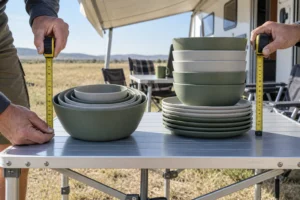
Nesting vs Stacking: How the Two Designs Change Pack-Out
A buyer-focused geometry and pack-out comparison for choosing nested, stacked or hybrid camping dinnerware systems without confusing compact appearance with approved performance.

What Makes Camping Dinnerware Truly Stackable?
A procurement acceptance framework for reviewing stack rise, contact interfaces, separation, stability, mixed-component order, drainage and retained pack-out.

Deep Bowls vs Shallow Bowls for Outdoor Meal Sets
A procurement decision table for selecting deep and shallow camping bowl profiles by meal function, user access, stability, cleaning and packed-set architecture.
One Response