
One add-on module can work across several camping-set sizes only when every size shares a controlled interface, clearance envelope, retention method and revision rule. Similar appearance is not proof of compatibility. Use a modular camping set compatibility matrix to approve each module and host set as a defined pairing, then record fit, access, closure and packed-movement results.
Answer the compatibility question at the interface
The commercial idea is attractive: one condiment pod, serving container, cutlery cassette or lunch-box module can extend a two-person, four-person and family set without creating a different accessory for every configuration. The engineering question is narrower. Does the same module connect to each host set without changing the intended pack-out, damaging adjacent pieces or creating an unapproved claim?
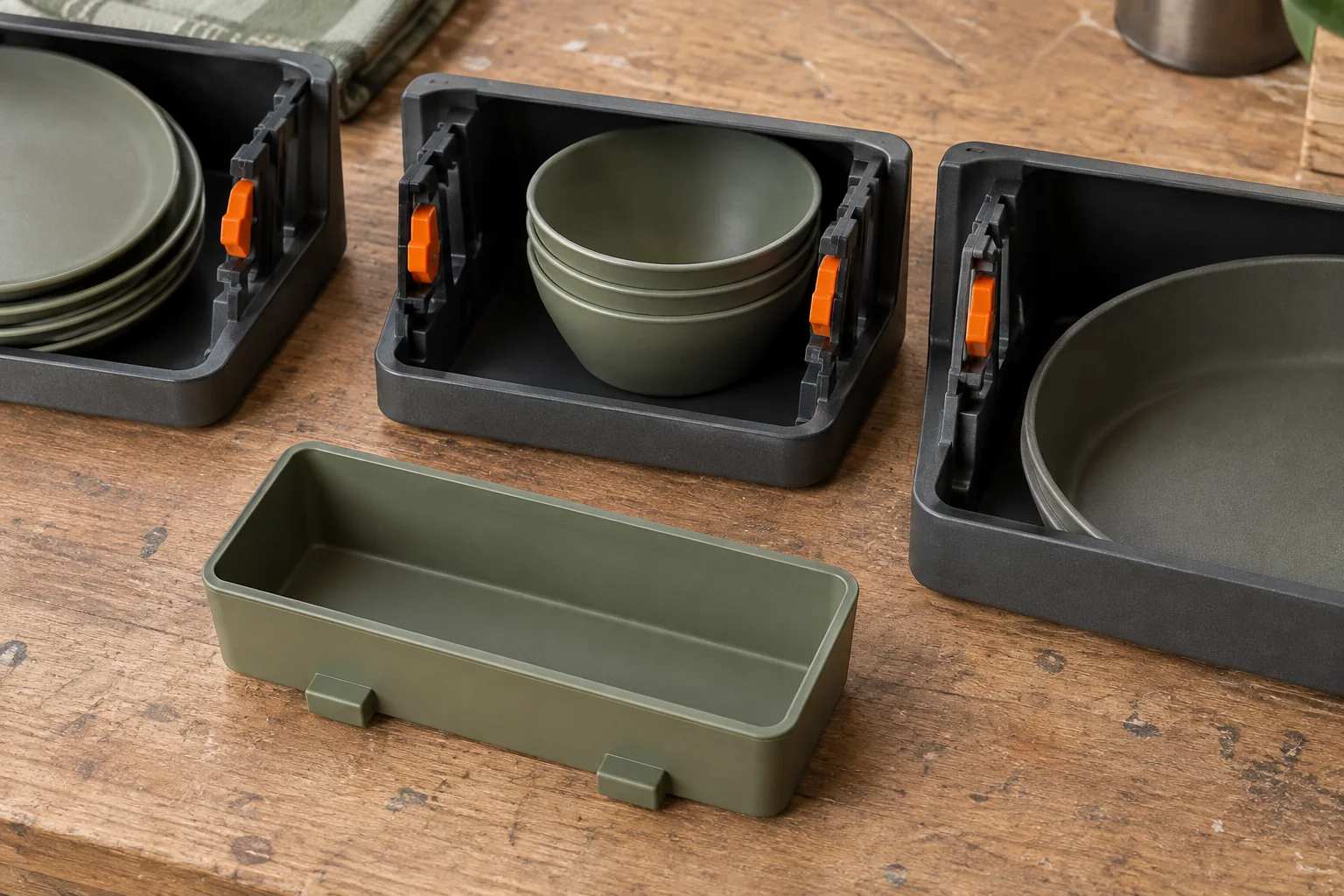
Begin with the interface rather than the module name. Define the locating surfaces, rail or pocket position, locking direction, allowable movement, hand-access space and the volume that must remain clear around the module. A shared component list does not create modular camping set compatibility unless those interface conditions are common and revision-controlled.
| Interface field | What must stay common | What may vary by set size | Approval evidence |
|---|---|---|---|
| Locating geometry | Datums, rail spacing, tab direction and seating depth | Number or position of unused rail locations | Drawing comparison and sample fit |
| Clearance envelope | Module body, lid movement and removal path | Open space around the approved envelope | Closed-case and access observation |
| Retention | Approved latch, strap, pocket or friction feature | Secondary divider layout outside the interface | Pack, move, reopen and inspect |
| Adjacent components | No rim, utensil or food-contact surface interference | Plate, bowl and cup quantities | Loaded configuration review |
| Revision identity | Module and host-interface revision pairing | Commercial set name and user count | Released compatibility matrix |
Build a cross-size interface compatibility matrix
The modular camping set compatibility matrix should list actual host configurations, not broad families such as “all camping sets.” Give each row a host-set revision and each column a module revision. A cell is approved only after the buyer has the defined evidence for that pairing. Blank, untested and failed cells must remain visibly different from approved cells.
This modular camping set compatibility approach prevents a common sourcing error: approving the module in the largest case, then assuming smaller cases are automatically compatible because they use related plates and bowls. Smaller sets may have different lid arcs, divider positions, compression loads or removal angles. The published guide on checking dinnerware and carry-case fit provides the companion drawing inputs.
Buyer-ready compatibility matrix
| Host set / revision | Interface status | Loaded-fit result | Access and closure | Buyer disposition |
|---|---|---|---|---|
| Compact set / current revision | Drawing match to be confirmed | Module must not displace core pieces | Remove without unloading the whole set | Approve, revise or hold |
| Four-place set / current revision | Drawing match to be confirmed | Check adjacent plate, bowl and cup clearances | Case closes without forcing | Approve, revise or hold |
| Family set / current revision | Drawing match to be confirmed | Check movement when the case is fully loaded | Module remains reachable in the intended sequence | Approve, revise or hold |
| Future host revision | Not inherited automatically | Repeat the affected checks | Confirm unchanged user access | New matrix revision required |
Compatibility to be confirmed by project sample and drawing. The table is a decision template, not a claim that any illustrated module or current Naike Dinner product already fits several host sets.
Separate common interface from common appearance
Matching color, material or exterior outline can support a coordinated assortment, but it does not control fit. Two containers with the same outer width may use different feet, lid overhangs or latch paths. Conversely, differently sized containers can share a controlled underside interface. The buyer should specify which surfaces govern modular camping set compatibility and which surfaces may change.
A useful interface drawing identifies primary locating points, retention features and keep-clear zones. It also states the orientation in which the module is inserted and removed. Without these items, modular camping set compatibility relies on visual judgment rather than a repeatable product/entity definition.
Run the trial with every host fully loaded
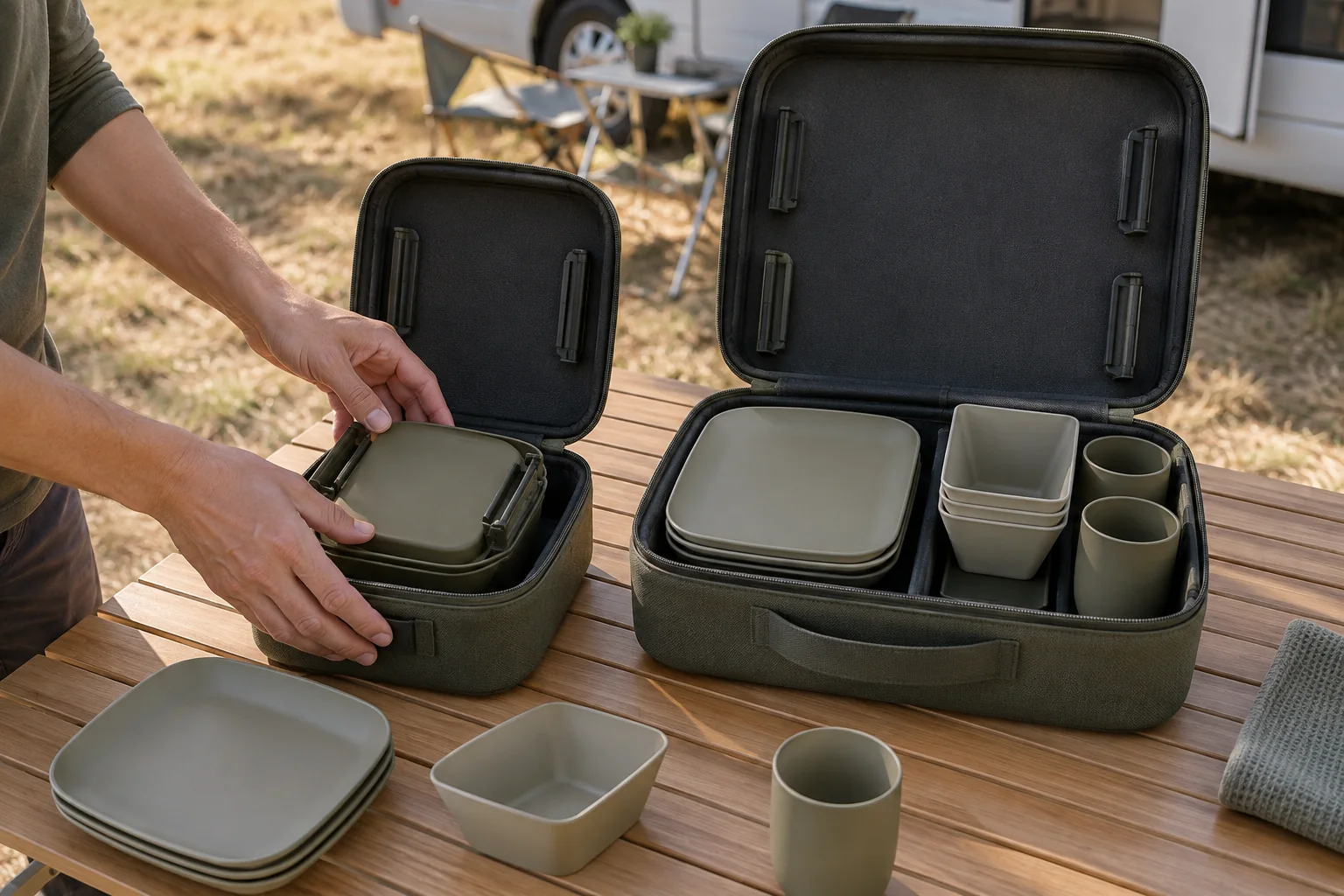
An empty case can hide interference. Review modular camping set compatibility with the intended plates, bowls, cups, utensils, lids and dividers installed in each set size. Observe seating, removal, closure, pressure on rims, contact with food-contact surfaces and movement after the case is handled in the normal orientation.
Record results as observations, not marketing adjectives. “Case closed without forcing,” “module removed without unloading plates” and “no visible contact with cup rims after the defined handling cycle” are scoped observations. They are not universal performance claims. Define the handling sequence, sample revision and acceptance boundary before the trial.
For pack-sequence control, use the published portable-set pack-out instruction framework. For deciding which components deserve stable interfaces, review which camping dinnerware parts should be modular.
Know when one module should not span all sizes
A shared module may be the wrong decision when the compact set sacrifices core pieces, when the family set leaves the module uncontrolled, or when removal requires users to disturb clean dinnerware. A module also should not cross host sizes if the interface change would create ambiguous revision pairings or if the smaller case needs a different lid, latch or use condition.
Do not force modular camping set compatibility simply to reduce SKU count. The business benefit must be weighed against case volume, assembly complexity, return errors and the cost of compatibility failures. A two-size family with one dedicated compact module and one shared medium/large module may be clearer than a nominally universal accessory.
Keep food-contact and use-condition evidence separate
Mechanical fit does not establish food-contact suitability, temperature limits, cleaning suitability or leak resistance. Those questions belong to the final material, construction, colorant, intended food and conditions of use. The FDA food-type and condition-of-use framework and the European Commission food-contact materials overview illustrate why evidence must be tied to the actual product and market.
Outdoor handling can add cleaning and contamination risks that are not solved by a common rail. The USDA FSIS camping food-safety guidance is useful context, but it does not approve a module interface. Keep mechanical compatibility, food-contact documentation and field-handling instructions as separate approval lines.
B2B Buyer Checklist
| Check | Question | Why It Matters |
|---|---|---|
| Host definition | Is every set size identified by released configuration and revision? | Prevents compatibility from being assigned to an undefined family. |
| Interface datums | Are locating, retention and keep-clear features controlled? | Turns visual similarity into a repeatable fit requirement. |
| Loaded trial | Was the module reviewed with every intended component installed? | Finds interference hidden by an empty case. |
| User access | Can the module be inserted and removed in the intended sequence? | Fit alone does not prove practical use. |
| Revision rule | Which interface changes require reapproval? | Stops old evidence from following a changed host or module. |
| Evidence boundary | Are mechanical fit and food-contact claims documented separately? | A compatible interface does not prove other performance. |
Frequently asked procurement questions
1. Can one successful sample prove compatibility with the whole range?
No. Approve each host-set revision and module revision pairing, or document why evidence legitimately applies to an unchanged shared interface.
2. Should every set size use the same cavity around the module?
The controlled interface and keep-clear envelope should be common where compatibility is intended. Extra space outside that envelope may vary if retention and movement remain acceptable.
3. Is a rail system required?
No. A pocket, strap, keyed base, divider bay or other retention method can work. What matters is a defined, testable interface.
4. How should failed pairings appear in the matrix?
Mark them as failed or not approved with the reason and revision. Do not leave a failed result indistinguishable from an untested cell.
5. Does sharing one module reduce tooling or MOQ?
Potentially, but tooling, MOQ, price and lead time are To be confirmed for the project. Interface reuse does not prove a commercial outcome.
6. When must compatibility be reviewed again?
Reassess when locating geometry, retention, adjacent components, case closure, module lid, material behavior or the intended pack sequence changes.
Request a cross-size compatibility review
Send the host-set component matrices, case drawings, module drawing, revision list, pack sequence and target markets. Naike Dinner can use the brief to discuss a modular camping set compatibility matrix, sample needs and an existing-component or project-specific development route without assuming unverified fit.
Request a specification review Review core and add-on planning
For a written quotation, include the intended user counts, materials, artwork, packaging and evidence requirements through the Naike Dinner inquiry page.