Description
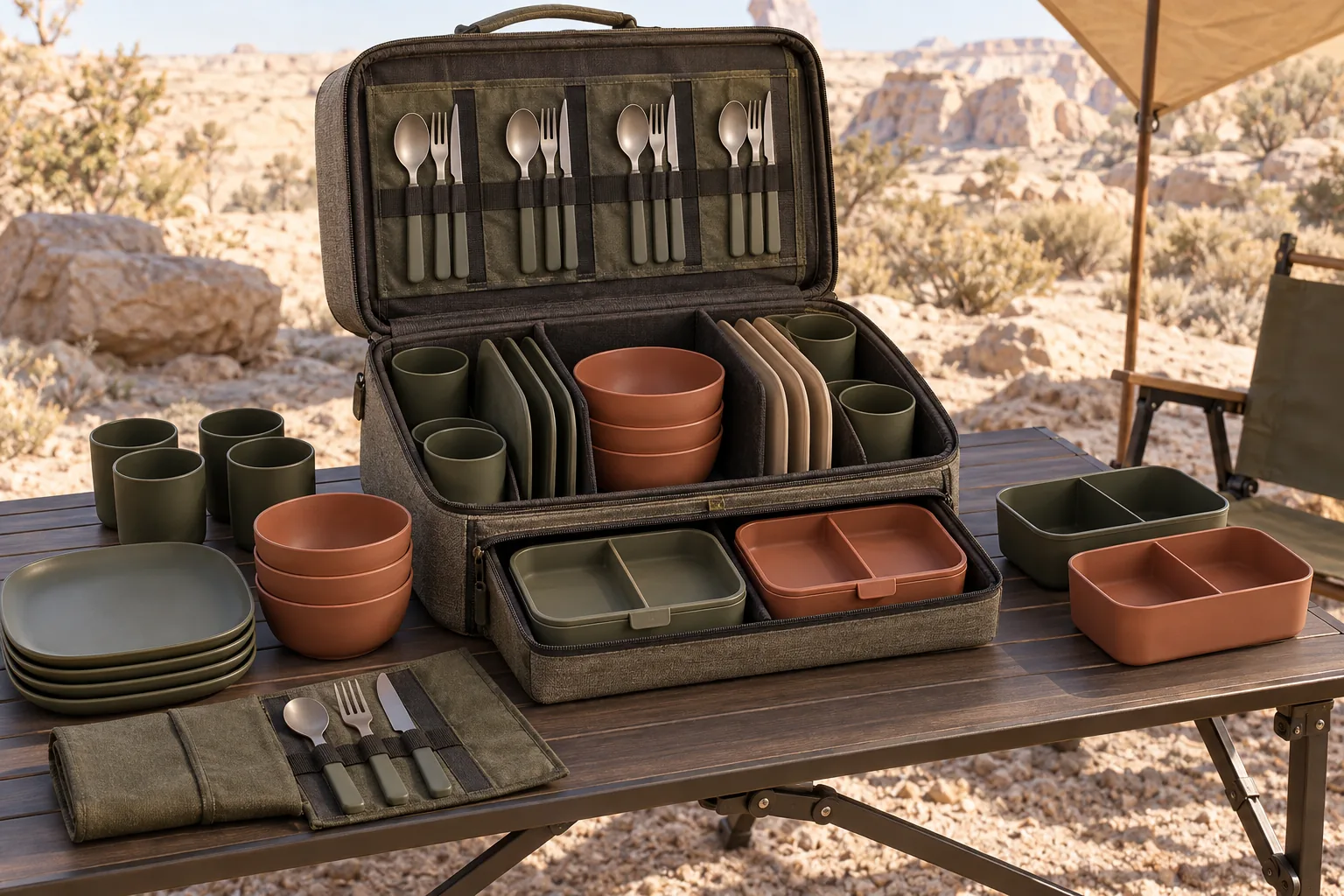
Bridge-Rack camping dinnerware set: this configurable four-user concept uses a soft rectangular carry case with vertical plate lanes, a central bowl well, separated cup pockets, a lower lunch-box compartment and lid-mounted utensil groups. Buyers can develop a sales unit around user roles and pack access; final components, geometry, materials, dimensions, evidence and commercial terms remain project-specific.
PRODUCT PARAMETER
| Product concept | Bridge-Rack family camping dinnerware set for configurable four-user outdoor programs |
|---|---|
| Reference component roles | Personal plates, bowls, handleless cups and knife-fork-spoon groups; project-selected divided lunch boxes; soft carry case with plate lanes, bowl well, cup pockets and lid retention |
| Material direction | PP-oriented dinnerware concept with separately controlled textile shell, reinforcement, dividers, zipper, handle, elastic and closures; exact specifications to be confirmed for the project |
| Storage architecture | Rectangular top-opening soft case with side-by-side vertical plate racks, central nested-bowl zone, corner cup pockets and a lower front compartment |
| Color direction | Muted olive, sand, terracotta and charcoal concept palette; production color references to be confirmed for the project |
| SKU, dimensions, capacity and weight | To be confirmed for the project |
| Logo and decoration | Placement and process subject to final surfaces, artwork, use conditions and feasibility review |
| Packaging | Sales-unit presentation, component restraint and transit carton to be confirmed for the project |
| MOQ, price and lead time | To be confirmed for the project; no universal values are stated |
| Intended markets | Europe, North America, Australia and comparable B2B programs, subject to destination requirements |
REFERENCE CONFIGURATIONS
The Bridge-Rack camping dinnerware set is a development framework rather than a promise of a stocked SKU. Its central idea is to separate thin vertical components from deeper nested pieces so buyers can control access, count and pack movement. Images are concept and application illustrations, not production records, test evidence or customer orders.
| Program direction | Dinnerware allocation | Case allocation | Buyer approval |
|---|---|---|---|
| Four-user family set | Equivalent personal plate, bowl, cup and utensil roles with optional shared pieces | Vertical plate lanes, center bowl well, corner cup pockets and lid-mounted flatware | User matrix, controlled BOM and closed-case drawing |
| Meal-prep bundle | Personal settings plus project-selected divided food containers | Lower front compartment reserved for containers without blocking dinnerware access | Container role, closure boundary and pack sequence |
| Rental or guided-use set | Countable equivalent components with replacement identifiers | Visible lanes and pockets that show missing pieces | Return-count method and service BOM |
| Retail-channel variation | Channel-selected quantities and optional container or shared-serving roles | Case finish, handle, artwork, instruction and carton revised to match | Exact sales-unit list, approved sample and evidence index |
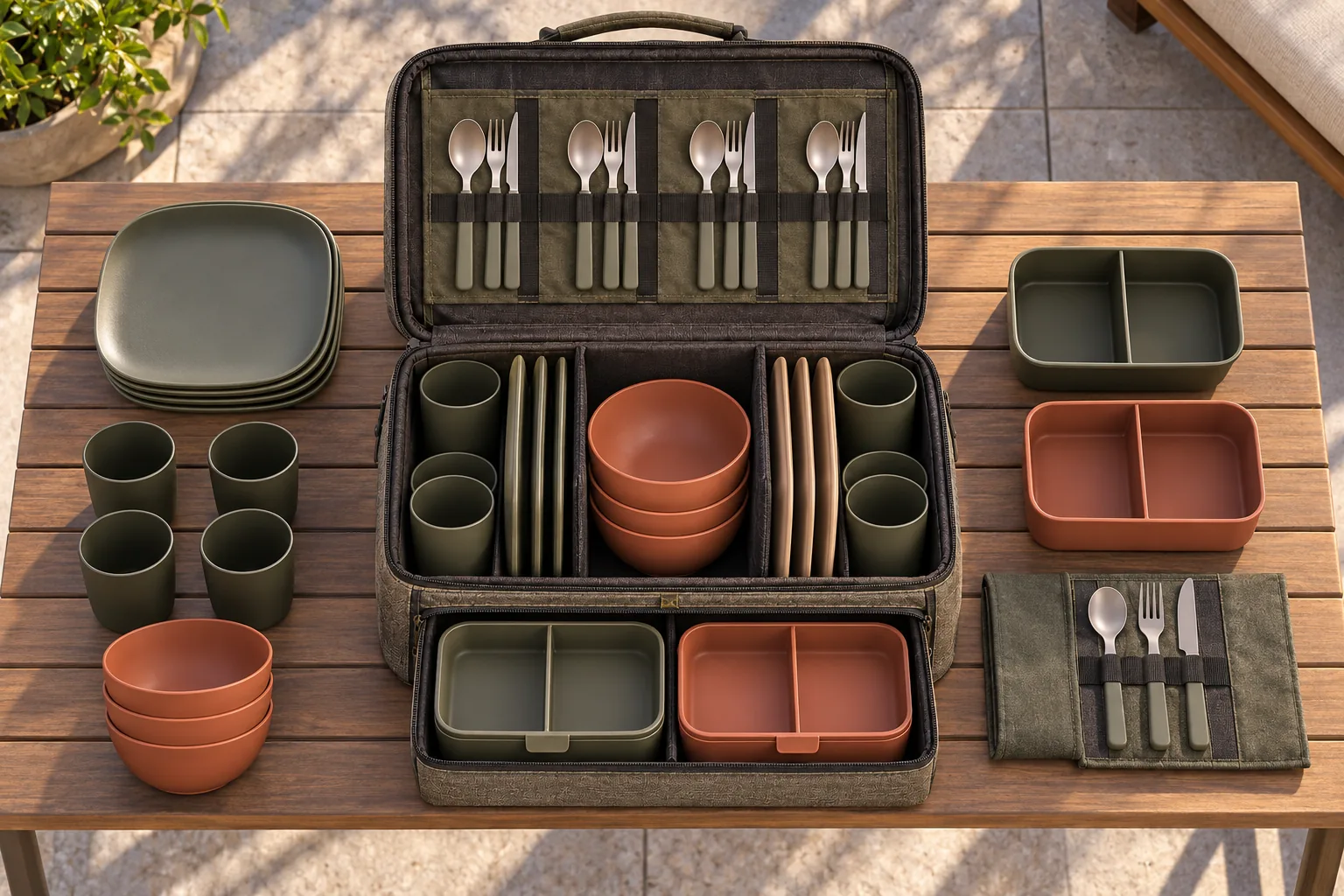
A bridge layout separates thin and deep components
The rectangular case divides the set by geometry. Curved-rectangle plates stand in padded vertical lanes so a buyer can count them without lifting the bowl group. Bowls occupy a deeper center well, while cups use perimeter pockets and utensil groups remain visible inside the lid.
This arrangement differs materially from the round radial caddy, twin-pod and drawer-case concepts already published. It uses a single soft shell, two vertical plate lanes and one central bowl bridge, with a lower front compartment for project-selected lunch boxes. The layout should be approved as a complete system, not as unrelated accessory images.
Storage architecture and access detail
Plate lanes need padded contact, sufficient finger access and a divider height that locates approved profiles without scraping decorated faces. The center well should support the bowl group at an intended contact and leave a clear lift path. Cup pockets should retain the approved format without squeezing rims.
The lower compartment keeps divided lunch boxes out of the primary dinnerware path. Its depth, zipper opening, pull direction and case balance depend on final container geometry. Compatibility to be confirmed by project sample and drawing.
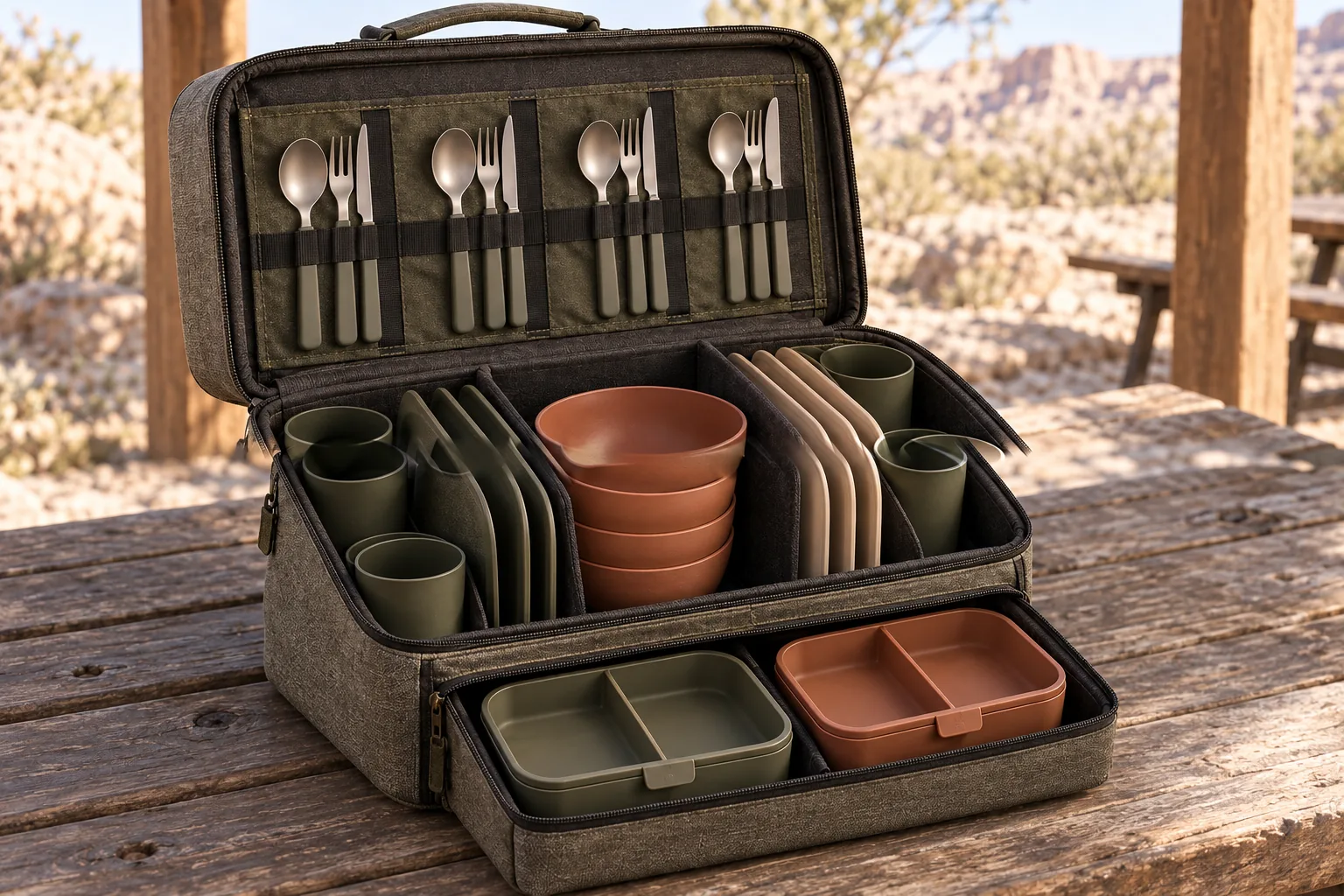
Build the set from the meal matrix
Begin with users and meals, then assign every component a personal or shared role. A four-user statement does not by itself define plates, bowls, cups, lunch boxes or serving pieces. Use the published camping dinnerware component matrix to remove items that add count without a defined task.
The reference concept shows a full family direction, but a buyer can review fewer containers, a different shared piece or a channel-specific utensil group. Every change affects divider layout, packed envelope, artwork, evidence and carton. An approved BOM must replace visual assumptions.
Customization choices for B2B buyers
- Component mix
Define personal, shared and optional meal roles. - Plate lanes
Review profile, divider spacing, contact and removal grip. - Bowl well
Control stack or nest order, clearance and release. - Cup pockets
Set format, orientation, retention and access. - Lower compartment
Allocate lunch boxes or another approved module. - Logo and packaging
Coordinate surfaces, artwork, sales channel and carton.
Customization may include component selection, color direction, artwork placement, soft-case construction, dividers, carry details and packaging, plus technical evaluation of new geometry. This page does not promise universal molding, tooling or production capability. Feasibility, ownership, maintenance, revision rights, timing and commercial terms require written project review before any new tool is commissioned.
Control vertical plate lanes
Vertical plates use case height differently from a horizontal stack. Buyers should define which edge or divider supports each plate, whether food-contact and decorated surfaces are protected, and how the user lifts one piece. Dividers should prevent uncontrolled face-to-face rubbing without creating hard pressure points.
Test the exact saleable quantity. A gap left by a missing plate can allow remaining pieces to migrate unless the lane has a controlled retainer. If alternative plate profiles are considered, review width, rim, foot, corner radius and divider contact rather than assuming compatibility from a nominal size.
The plate and bowl size-system worksheet helps buyers coordinate eating area, base, rim and pack interfaces. To be confirmed for the project applies to every dimension until the drawing and physical sample agree.
Control the bowl well and cup pockets
The center well can accept a repeated bowl stack or a purposeful nesting family. The choice changes unique-part count, release, drainage and replacement planning. Review full-quantity height, intended contacts, damp separation and the lift path before fixing case depth.
Cup pockets should locate each approved cup while leaving a usable grip. Handleless cups can reduce protrusions, but capacity, taper, rim and intended beverage conditions remain project decisions. No heat-resistance or dishwasher claim follows from the pictured shape.
Compare nesting and stacking as separate pack-out options when choosing the center geometry. The drawing, sample and controlled pack instruction remain authoritative for the approved project.
Keep lunch boxes a controlled option
The divided lunch boxes illustrate a possible food-container role. No leakproof, insulated, microwave, freezer or dishwasher claim is made. If a project includes them, specify closure, seals if any, food types, contact conditions, cleaning method and exact retained position.
If containers are removed, the lower compartment should be resized, reassigned or deleted rather than left as uncontrolled void. Product title, piece count, photography, instructions, packaging and evidence must all match the final selection. Props and food in application scenes are not included components.
Material and compliance boundaries
A material name does not establish conformity. For EU-bound programs, scope the final food-contact components against Regulation (EC) No 1935/2004 and, where applicable to plastics, Commission Regulation (EU) No 10/2011. For a United States program, map each final substance and intended condition of use to the FDA's primary food-contact-substance framework.
Those authorities do not certify this concept. Evidence must match each final formulation, color, decoration, food type, contact time and temperature condition. Textile shell, reinforcement, elastic, zipper, dividers, handle and closures need separate specifications and cannot be used to imply dinnerware performance.
Dinnerware is not cookware. No component should be placed on a stove, burner, campfire or direct flame without product-specific verified evidence. Outdoor imagery describes a use setting, not direct-heat suitability.
Development controls before artwork or tooling
Freeze user roles and the component matrix first. Then define plate lanes, bowl order, cup pockets, lunch-box position and utensil retention. A change to one plate rim or bowl taper can alter dividers, access, closure, case balance, carton and imagery.
Request dimensioned drawings and sections through every shared interface. Review the closed pack with all retained components, then run the agreed handling, cleaning, evidence and packaging checks. Scenic images support communication but do not replace technical approval.
New geometry can be evaluated as a project direction, but this page does not assert that every shape can be molded or assembled. The responsible parties must document design responsibility, feasibility, tooling terms and revision control before commitment.
Buyer control checklist
| Check | Buyer question | Required output |
|---|---|---|
| User roles | Which personal and shared function justifies each piece? | Meal-to-component matrix |
| Plate lanes | How are plates located, protected and removed? | Divider section and handling record |
| Bowl well | Are bowls stacked or nested, in what order and quantity? | Interface drawing and complete-height record |
| Cup pockets | Can approved cups be retained and gripped? | Pocket drawing and sample observation |
| Lunch-box option | Are containers included, optional or separately packed? | Controlled BOM and pack instruction |
| Utensil panel | Are complete groups visible and secured? | Lid layout and return count |
| Material evidence | Do records match final food-contact parts and uses? | Destination evidence matrix |
| Artwork | Which surfaces and processes are approved? | Artwork map and decorated sample |
| Change control | Who approves component, case and packaging revisions? | Signed revision register |
Outdoor application and pack access
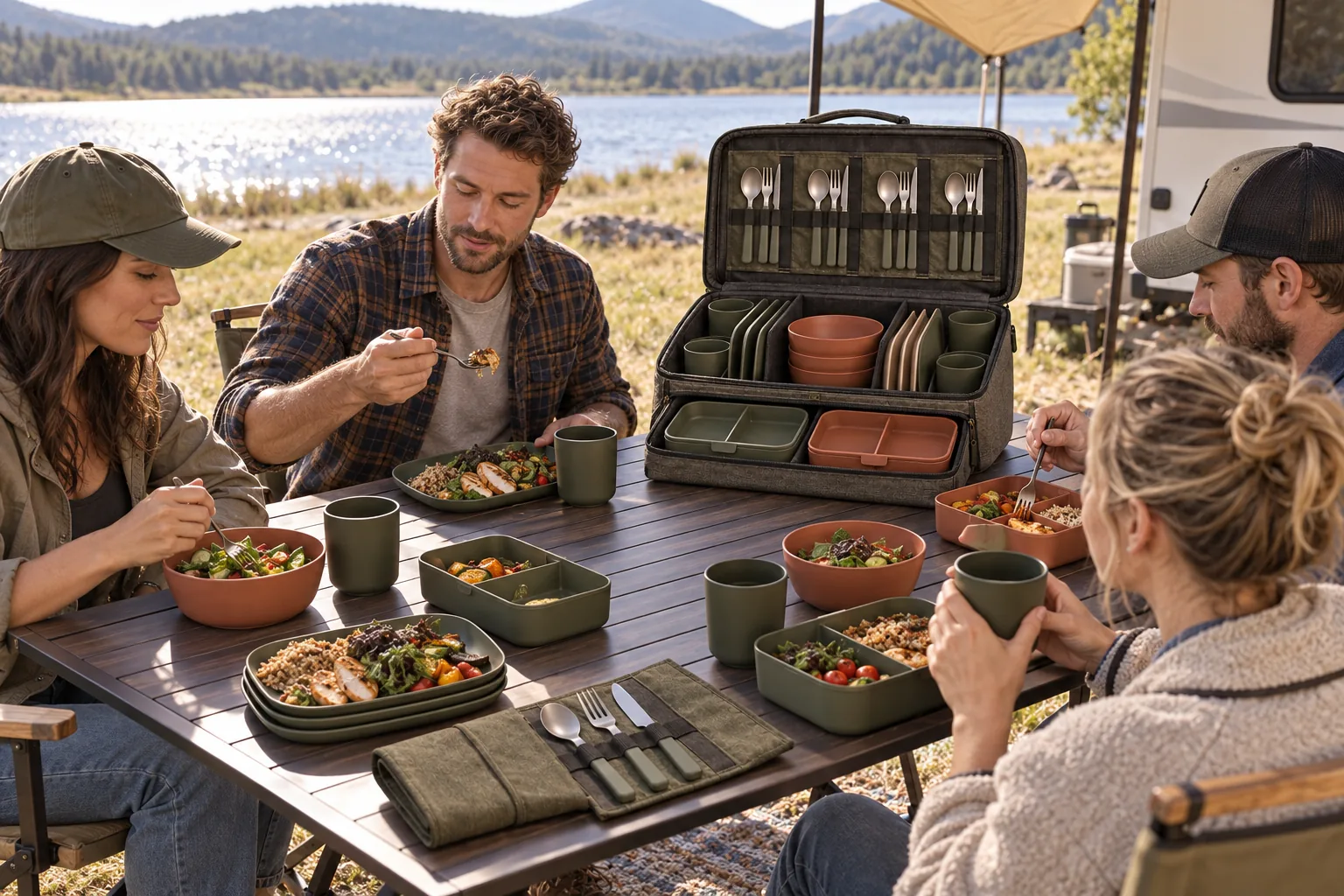
The dryland hero scene shows the complete concept as a buyer discussion aid. The lakeside application view demonstrates four users accessing the same soft case and coordinated components. They are not customer cases or evidence of food-contact compliance, weather resistance, impact strength, leak resistance or quantified performance.
During sample review, place the case on the representative table footprint and ask users to distribute the settings in intended order. Observe whether plate lanes, bowl well, cups, lunch boxes and utensils remain accessible, then repeat the return sequence and confirm that the case closes without force.
Related procurement resources
Define roles with the component-list worksheet, assign quantities through the family camping allocation table, and review stack interfaces using the stackability acceptance criteria. Compare this single-shell vertical-rack architecture with the published Radial-Caddy set, which uses a round center stack and radial cup zones.
Procurement FAQ
Is the Bridge-Rack set a stocked SKU?
No. It is a configurable product-development concept. Availability, dimensions, components, materials, evidence, packaging and commercial terms are to be confirmed for the project.
Can the plate shape or quantity change?
Alternative profiles and counts can be reviewed, but divider spacing, protection, access and closed-pack geometry must be reconfirmed. Compatibility to be confirmed by project sample and drawing.
Are the lunch boxes leakproof?
No leakproof claim is stated. Closures, seals, foods, orientations and an agreed validation method must be defined for the final configuration if that claim is required.
Is the soft case waterproof?
No weather-resistance claim is made. Fabric, reinforcement, zipper, seams and test scope require a project specification before any statement is approved.
Can buyers mix existing components?
Potential combinations can be reviewed, but nominal sizes or images do not establish fit. Compatibility to be confirmed by project sample and drawing.
Can logos appear on both the case and dinnerware?
Artwork can be assessed surface by surface after materials, colors, processes and contact boundaries are defined. Controlled artwork and decorated samples should govern approval.
What information starts a project review?
Send users, meals, component matrix, proposed profiles, case constraints, carry method, material direction, markets, colors, artwork, packaging channel and evidence requirements.
Develop your Bridge-Rack camping dinnerware set
Share the user count, meal roles, proposed component list, plate and bowl profiles, cup format, lunch-box requirement, case target, material and color direction, destination markets, logo files, packaging channel and evidence needs. Confirmed inputs can then be separated from unresolved interfaces before drawings, samples or a written quotation.
Request a Bridge-Rack configuration review
Attach existing component references or sketches through the project inquiry form. The project quotation must separately confirm quantities, pricing, schedule, dimensions and any tooling path.
RELATED SOURCING PATHS
Compare Products and Plan Your Project
Review related product formats, then compare material, set configuration, logo, packaging, testing scope and order quantity with our B2B team.