Description
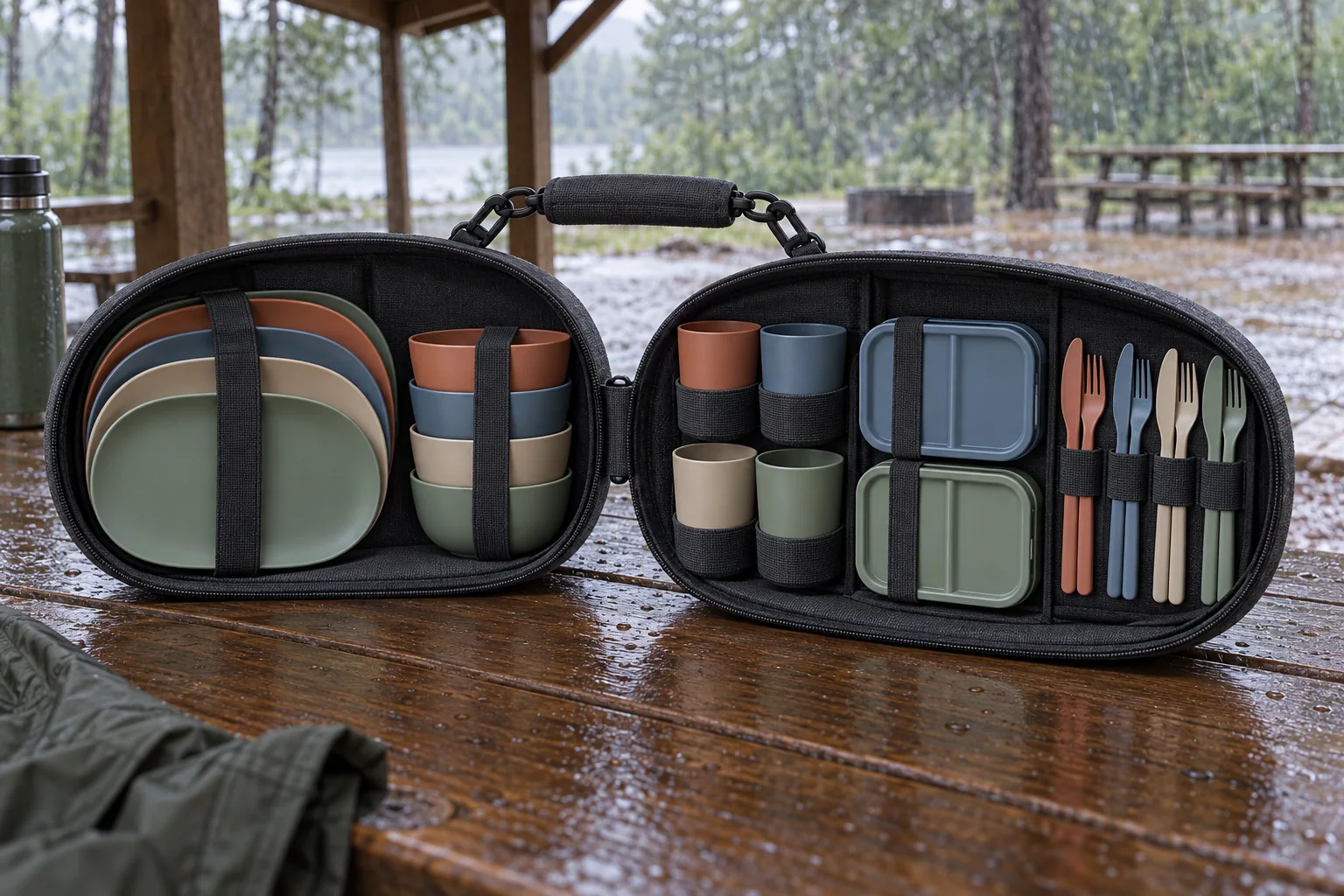
Twin-pod camping dinnerware set: this configurable family concept separates the dining stack from cups, lunch boxes and utensils in two detachable oval zip pods. A padded bridge handle can join both pods for transport or release them for table-side access. Final components, dimensions, materials, interfaces, colors, artwork, packaging and market evidence are to be confirmed for the project.
PRODUCT PARAMETER
| Product concept | Twin-pod family camping dinnerware set for configurable four-user outdoor programs |
|---|---|
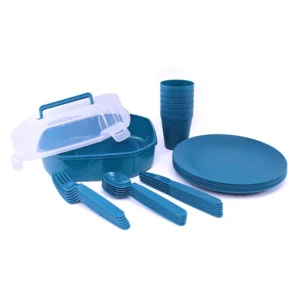
| Reference components | Four oval plates, four low bowls, four handleless cups, two divided lunch boxes, four knife-fork-spoon groups, removable dividers, utensil sleeve, two oval zip pods and padded bridge handle |
| Material direction | PP-oriented dinnerware concept with separately controlled textile shells, reinforcement, zipper, clips, dividers and handle; exact formulations to be confirmed for the project |
| Storage architecture | Two detachable semi-rigid oval pods: one for flatter dinnerware and bowls, one for cups, lunch boxes and utensils |
| Color direction | Charcoal textile with sage, sand, muted terracotta and slate-blue component groups; production references to be confirmed for the project |
| SKU, dimensions, capacity and weight | To be confirmed for the project |
| Logo and decoration | Location and process subject to the final surface, artwork, use and feasibility review |
| Packaging | Retail presentation, pod restraint and transit carton to be confirmed for the project |
| MOQ, price and lead time | To be confirmed for the project; no universal values are stated |
| Intended markets | Europe, North America, Australia and comparable B2B programs, subject to destination requirements |
REFERENCE CONFIGURATIONS
The twin-pod camping dinnerware set is a development framework for buyers who want the complete set to divide into task-based modules. The images communicate one possible design direction and are not a stocked SKU, production record, buyer order or proof of confirmed compatibility.
| Program direction | Pod A | Pod B | Buyer control |
|---|---|---|---|
| Four-user meal set | Four oval plates and four low bowls | Four cups, four utensil groups and two lunch boxes | User allocation, meal matrix and complete BOM |
| Dining-only configuration | Personal plates and bowls | Cups, cutlery and shared serving parts selected by project | Role definition, pack drawing and sample fit |
| Rental or guided-use set | Countable color-grouped settings | Separated utensils and replaceable container group | Return count, component codes and service plan |
| Retail bundle variation | Channel-selected dinnerware mix | Case finish, lunch-box option, artwork and packaging | Exact sales-unit list and evidence index |
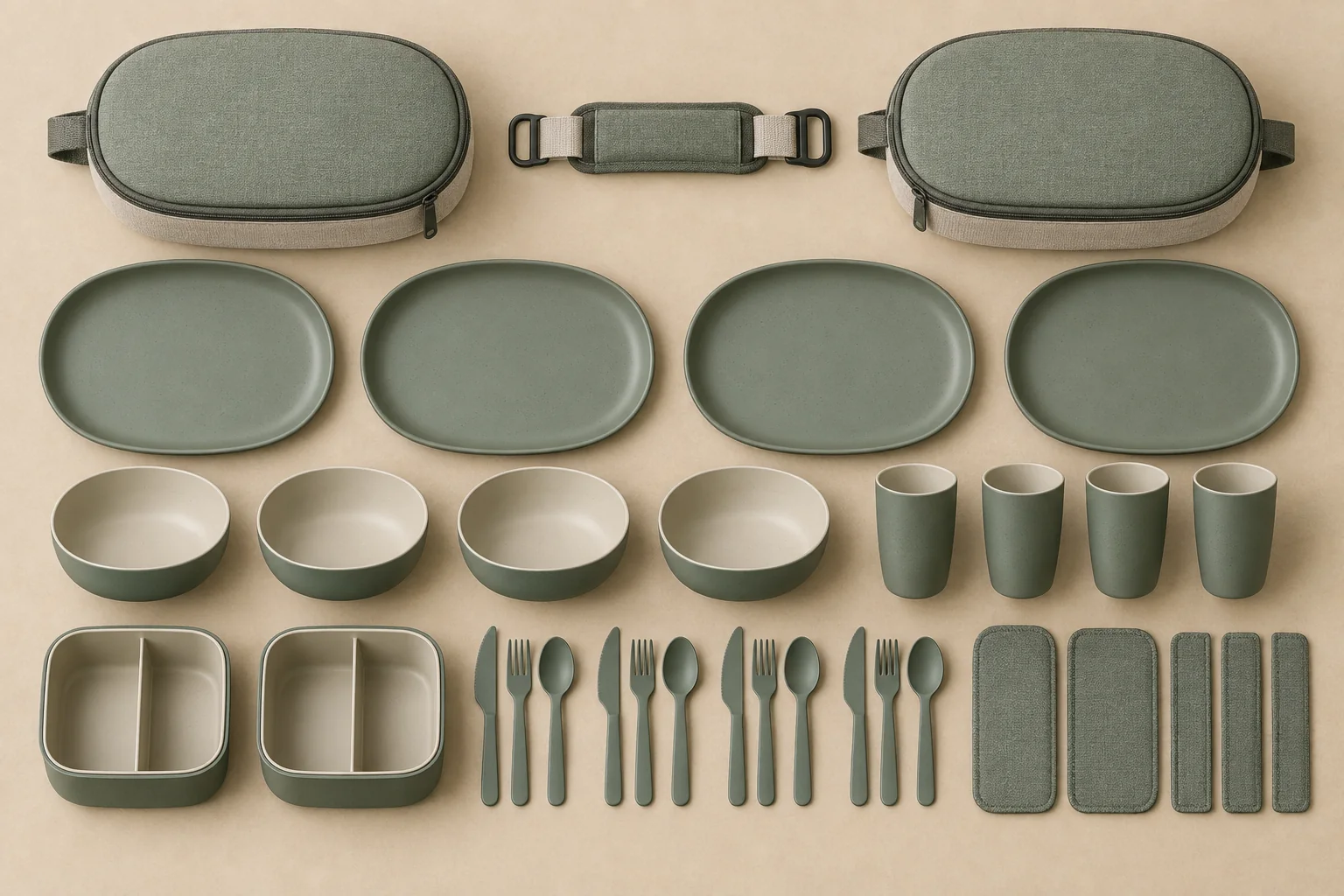
Twin-pod camping dinnerware set architecture
The two-pod arrangement creates a horizontal modular system instead of a single deep case. Pod A can retain flatter oval plates and nested low bowls. Pod B can organize handleless cups, divided lunch boxes and a slim sleeve containing four complete utensil groups.
A padded bridge connector links the pods for carrying. Each pod also needs its own handling boundary when detached. Clip orientation, load balance, zipper path and handle attachment must be assessed around the approved component masses and pack order; the concept image does not establish carrying performance.
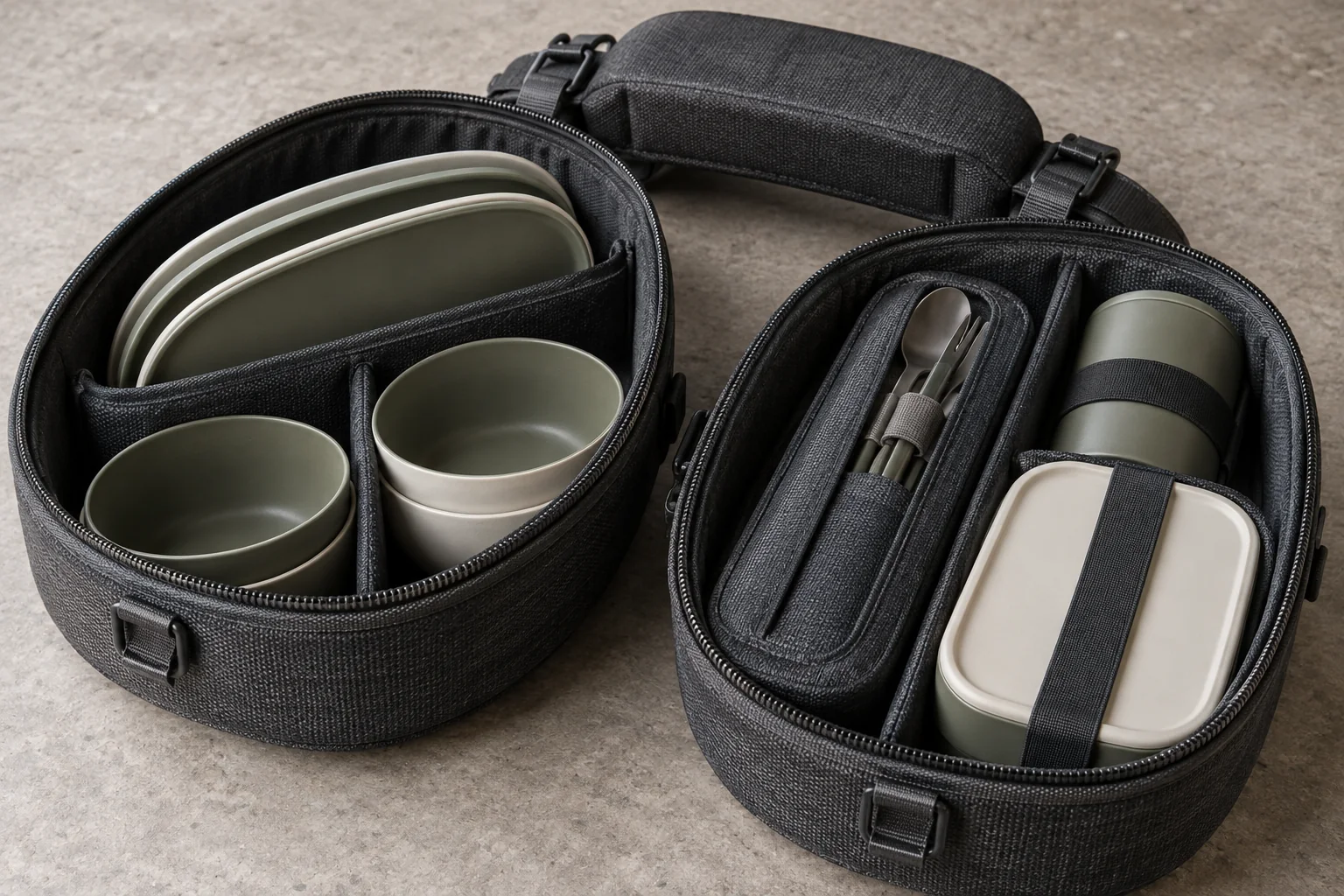
Detachable storage and divider detail
Removable textile dividers allow a buyer to adjust zones after the component matrix is selected. The dinnerware pod needs edge restraint without blocking removal, while the accessory pod needs separate cup, lunch-box and utensil responsibilities. Loose filler should not be used to hide unresolved geometry.
Inspect both pods open, closed, joined and detached. Confirm whether one pod can stand or lie flat without tipping, whether zipper pulls remain accessible and whether utensils are protected from contacting unrelated pieces. Compatibility to be confirmed by project sample and drawing.
Assemble the set around users and tasks
Define the users, meals and serving method before assigning either pod. One plate, bowl, cup and utensil group per user may form the personal allocation, while lunch boxes or shared pieces should appear only when they solve a declared task. Do not raise the headline count with pieces that lack a role.
The split can be adjusted. A meal-prep program may place both lunch boxes in one pod, while a dining-only program may use that space for shared serving components. Every configuration needs its own BOM, packed drawing, color schedule, packaging list and written quotation.
Customization choices for B2B buyers
- Component matrix
Select oval plate, low bowl, cup, container and utensil roles. - Pod allocation
Assign components by dining, storage or service task. - Divider plan
Control removable zones around the approved pack order. - Color family
Approve coordinated, user-coded or channel-specific references. - Logo program
Review decoration on relevant component and textile surfaces. - New geometry review
Evaluate drawings, interfaces, samples and project feasibility.
Customization can cover components, case arrangement, color direction, artwork and packaging, plus technical evaluation of new geometry. This page does not promise universal tooling or molding capability. New-mold feasibility, ownership, commercial terms and timing require a separate written review.
Material and compliance boundaries
Material descriptions do not establish food-contact compliance. European Union buyers can scope final food-contact components against Regulation (EC) No 1935/2004 and, where applicable to plastics, Commission Regulation (EU) No 10/2011. United States projects should reconcile substances and intended uses with the FDA framework for food-contact substances.
These authorities do not certify this concept. Evidence must match final material, color, decoration, food type, time and temperature conditions. Textile shells, reinforcement, zippers, clips and dividers require separate specifications and must not be used to imply unsupported dinnerware performance.
Development controls before tooling and artwork
Freeze the user-to-component matrix before setting pod dimensions. A change to a plate length, bowl foot, cup rim or lunch-box closure can alter divider positions, zipper clearance, balance and carton size. Unknown data must remain “To be confirmed for the project.”
Request dimensioned drawings for every component and each pod, plus interface sections for clips, handle connections and packed contacts. Approve decoration only after relevant surfaces and pack clearances are stable. Scenic images are references; controlled drawings and samples determine the project.
Sample approval sequence
- Approve users, meals, component roles and sales-unit count.
- Review reference dinnerware profiles and lunch-box functions.
- Confirm pod allocation, nesting order, dividers and utensil sleeve.
- Evaluate joined carry balance and detached table access.
- Approve colors and artwork on relevant physical surfaces.
- Reconcile BOM, drawings, golden sample, packaging and evidence index.
Any component or pod change after approval should trigger the affected fit, handling, evidence and packaging reviews. Do not accept an informal substitution as revision control.
Control the bridge handle and pod interfaces
The joining system creates interfaces not present in a single case. Each pod connects to the bridge handle, and the joined pair must remain balanced enough for the declared handling method. The attachment zone must also avoid the zipper and internal components.
Create an interface register naming both parts, intended relationship, drawing revision and sample observation. Do not publish a load, cycle, impact or weather-resistance claim without an agreed method and matching evidence. Compatibility to be confirmed by project sample and drawing.
Pack and label two modules as one sales unit
The product must reach the buyer as one controlled sales unit even though users can detach it into two modules. Packaging artwork should show the exact component list, both pods, connector and approved pack arrangement. Props in application imagery must not be presented as included product.
Retail display and e-commerce transit can require different restraints and cartons. Buyers should provide shelf orientation, handling, delivery and labeling requirements before packaging is quoted. A revision to one pod can change carton dimensions and all related artwork.
Buyer control checklist
| Check | Buyer question | Required output |
|---|---|---|
| Meal logic | Which user or shared task justifies every component? | Meal-to-component matrix |
| Pod split | Why is each component assigned to Pod A or Pod B? | Approved allocation and pack drawing |
| Interface control | How do pods, handle, clips, zippers and dividers interact? | Interface register and sections |
| Carry balance | What complete load and handling condition will be reviewed? | Representative joined-set sample plan |
| Counting rule | Are shared pieces, cases and connector counted consistently? | Sales-unit BOM and artwork list |
| Material evidence | Do records match every final food-contact component and use? | Market-specific evidence matrix |
| Decoration | Which surfaces and processes are approved? | Artwork map and decorated sample |
| Change control | Who approves substitutions or geometry revisions? | Signed revision register |
Outdoor application and table-side access
The covered rainy-campsite view demonstrates a sheltered pack-out scenario, while the rooftop scene shows both modules supporting a four-user meal. They are application illustrations, not customer cases or evidence of waterproofing, food-contact compliance, impact resistance or any quantified performance.
During sample review, position both pods around the actual table footprint. Confirm whether users can reach cups and utensils without moving the dinnerware stack, and whether the pods can be repacked in a clear sequence. Record observations against the exact sample revision.

Related procurement resources
Build the sales-unit BOM with the camping dinnerware component matrix, assign quantities using the family set allocation guide, and coordinate oval plate and bowl dimensions with the plate-and-bowl size-system worksheet. Compare the storage concept with the published flip-tray camping dinnerware set, which uses one rigid case and removable lid panels rather than two detachable pods.
Procurement FAQ
Is this Twin-Pod set a stocked product?
No. It is a configurable product-development concept. Availability, final components, materials, dimensions, evidence, packaging and commercial terms are to be confirmed for the project.
Can buyers order only one pod?
A one-pod program can be evaluated as a different sales unit. It requires its own BOM, handle solution, artwork, packaging, evidence scope and quotation.
Are the two pods proven waterproof?
No weather-resistance claim is made. Shell, zipper, seams and intended exposure need a project specification and matching verification before any claim.
Can the dinnerware component shapes change?
Alternative shapes can be reviewed, but they affect dividers, nesting, pod dimensions and packaging. Compatibility to be confirmed by project sample and drawing.
Can a logo appear on both pods and dinnerware?
Artwork can be assessed surface by surface after materials, colors and processes are defined. Approval should use relevant decorated samples and controlled artwork files.
Are the divided lunch boxes leakproof?
No leakproof claim is stated. Closures, seals, foods, orientations and test methods must be defined for the final product if that claim is required.
What information is needed for review?
Send users, meals, component matrix, preferred pod split, material direction, markets, carry method, colors, artwork, packaging channel and evidence requests.
Develop your Twin-Pod camping dinnerware set
Share the user count, meal map, component list, proposed pod allocation, carry method, material and color direction, destination markets, logo files, packaging channel and evidence needs. We will identify confirmed inputs and unresolved interfaces before a drawing, sample or written quotation review.
Request a Twin-Pod configuration review
Attach existing components or sketches through the project inquiry form. MOQ, price, lead time and tooling feasibility remain to be confirmed for the project.
RELATED SOURCING PATHS
Compare Products and Plan Your Project
Review related product formats, then compare material, set configuration, logo, packaging, testing scope and order quantity with our B2B team.