Camping dinnerware can go in a dishwasher only when the exact finished item is supported for that cycle, temperature, detergent and rack position. Material names alone do not prove dishwasher suitability. Buyers should verify the supplier’s written use instructions, finished-item evidence and decorated-sample performance, then define loading, cycle and inspection conditions before making a reusable-product claim.
What “camping dinnerware dishwasher safe” should mean
A dishwasher claim should tell a buyer more than whether a plate survives one wash. A useful specification identifies the finished product revision, machine type, rack location, program, detergent, water conditions, drying stage, number of cycles and acceptance criteria. Those details make the claim reproducible and prevent a general material reputation from replacing product evidence.
Outdoor dinnerware includes very different articles: stainless-steel bowls, enamel plates, polypropylene cups, silicone vessels, plant-fiber composites, decorated utensils and multi-part storage systems. Even within one material family, wall thickness, pigments, surface finishes, bonding methods and geometry can change the result. A supplier statement should therefore match the exact article that will be sold.
Dishwasher suitability is also separate from food-contact compliance. Food-contact rules address chemical safety for intended use, while dishwashing evaluation asks whether repeated machine cleaning changes function, appearance or the conditions on which the food-contact assessment depends. Buyers need both evidence streams when both claims are made.
Dishwasher suitability decision table
| Decision point | What to verify | Typical risk if omitted | Buyer evidence |
|---|---|---|---|
| Exact article identity | Material, color, finish, decoration, lid and revision | Evidence applies to a different product | Drawing, bill of materials and approved sample |
| Machine scope | Domestic, compact, commercial or other defined machine | Heat and chemistry differ from intended use | Written protocol and machine settings |
| Rack position | Top rack, lower rack or specified basket | Local heat or spray damages the article | Use instructions and loading photographs |
| Cycle conditions | Program, temperature, detergent and drying | A vague pass cannot be repeated | Test record for the finished item |
| Repeat use | Agreed cycle count and inspections | Gradual distortion, fading or corrosion is missed | Before/after records and acceptance limits |
| Functional checks | Fit, stack, seal, base stability and rim condition | The item looks acceptable but no longer works | Dimensional and functional comparison |
| Claim language | Instructions, limitations and destination languages | Marketing overstates the verified scope | Approved artwork and technical file |
This table is a procurement framework, not a universal test method. The correct conditions depend on the product, destination market and intended claim. Buyers should agree the protocol with a qualified laboratory or technical team when formal substantiation is required.
Start with the finished article, not the material label
Stainless steel is often associated with robust cleaning, yet grade, forming condition, surface finish, welds, colored coatings and mixed-metal attachments still matter. An undecorated bowl and a coated hammered bowl should not share a claim automatically. Repeated alkaline detergent exposure may reveal finish or interface issues that a short rinse will not show.
Polypropylene is widely used for reusable food-contact articles, but a resin name does not define a final plate. Additives, fillers, colorants, recycled content where applicable, wall distribution and molding history affect the finished construction. A thin part may distort even when the base polymer is commonly used in dishwashers.
Plant-fiber composite tableware must be treated as a formulation rather than as loose straw or bamboo fiber. The polymer matrix, fiber loading, pigments and processing determine behavior. Buyers should never infer dishwasher performance, biodegradability or food-contact status from the natural-looking surface alone.
Silicone products can differ in cure, formulation, reinforcement and shape. Flexible walls may collect water or invert under spray, and attached rigid components can behave differently. The article’s use instructions should cover the whole assembly instead of discussing silicone in isolation.
Why temperature alone cannot answer the question
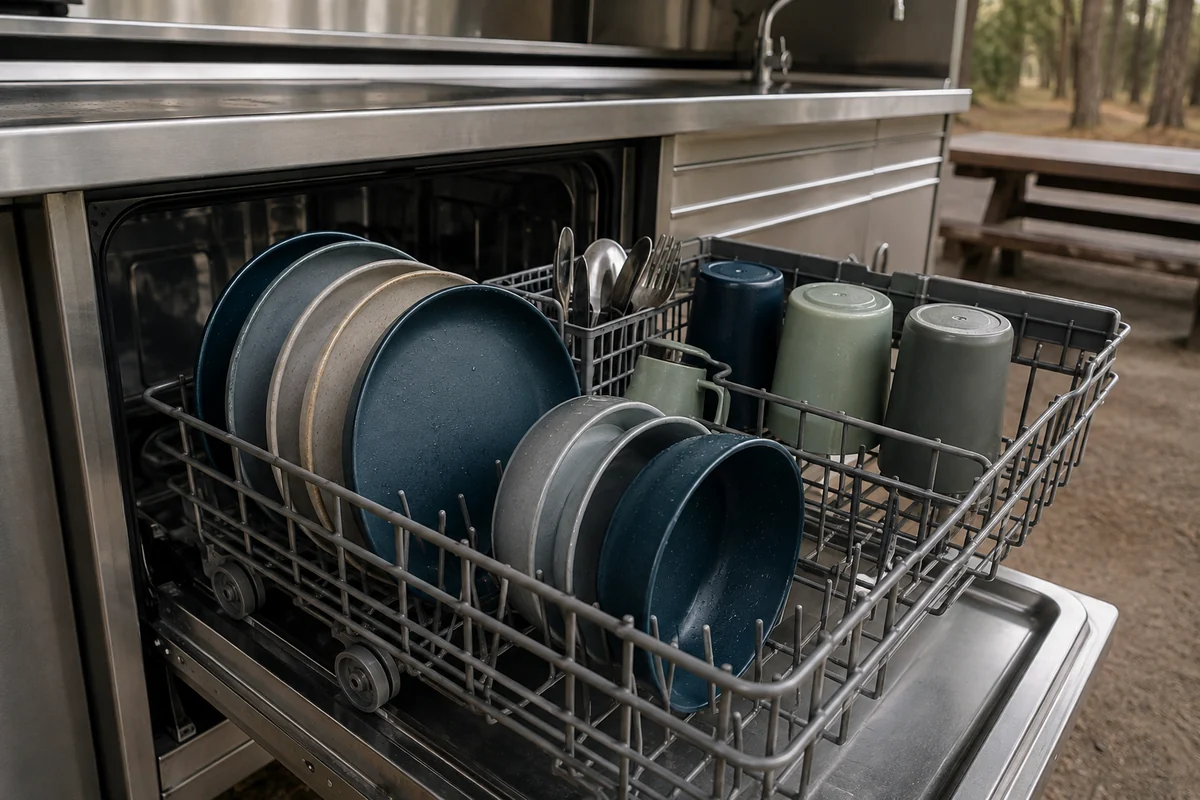
Buyers often ask for one maximum temperature, but a dishwasher exposes products to a sequence of water, chemistry, spray force, contact with racks and drying conditions. Local conditions can differ across the machine, and the hottest or most aggressive stage may not be the wash itself. A single resin heat number is not a finished-product dishwasher claim.
Time matters as well. An item may appear unchanged after one cycle and gradually lose gloss, color, flatness or fit after repeated use. Define when inspections occur and what constitutes failure. Useful checkpoints can include visual appearance, mass where relevant, dimensions, lid fit, stacking, surface condition and odor after cooling.
Detergent chemistry should be recorded because products are not exposed to water alone. Do not assume a pass with one mild detergent proves compatibility with every commercial or consumer formulation. If the target channel uses a known sanitation program, include that program in the buyer brief.
Food-contact rules and dishwasher claims are related but different
The U.S. Food and Drug Administration explains that food-contact substances are considered in relation to their intended conditions of use. Its official food-contact substances guidance is a starting point for understanding authorization and evidence scope. It does not declare every article made from a named material dishwasher safe.
For the European Union, Regulation (EC) No 1935/2004 establishes the general framework for materials and articles intended to contact food. The European Commission’s food-contact materials overview explains the framework and material-specific measures. Buyers still need finished-item documentation relevant to composition and intended use.
Repeated machine washing can matter when it changes a surface, coating, decoration or geometry that was part of the original assessment. The procurement file should connect food-contact evidence, washing instructions and the actual marketed product. If the supplied article changes, reassess whether the evidence and claim remain applicable.
Material-by-material questions buyers should ask
Stainless steel and other metal dinnerware
Confirm the declared alloy or grade, surface condition, colored finish, welded or joined features and contact between dissimilar metals. Inspect for staining, corrosion, sharpness, loosened parts and appearance change after the agreed cycles. A metal bowl without decoration may require a different review from a printed, coated or vacuum-insulated product.
Enamel-coated articles
Inspect the enamel surface, rim, chips, exposed substrate and contact points created by stacking or racks. Machine washing may be allowed for some products, but the claim must come from the exact supplier instructions and evidence. A broad statement about enamel does not cover every coating system or damaged article.
Polypropylene and copolyester products
Verify resin and additive scope, color, wall geometry and stated rack position. Look for warpage, stress whitening, surface change, odor, loss of transparency where relevant and fit changes in lids or nested systems. Do not transfer a claim from a cup to a plate simply because both are described as PP or Tritan.
Silicone bowls and accessories
Check complete formulation evidence, cure, reinforcement, seams, folding zones and attached components. Confirm drainage and stable loading so water does not remain trapped. The live guide Are Silicone Camping Bowls Safe? explains why finished-item evidence matters beyond the material name.
Plant-fiber composite tableware
Confirm the polymer matrix, fiber system, pigments and intended repeated-use conditions. Inspect dimensional stability, surface roughening, staining, odor and decoration. The buyer should distinguish reusable composite products from molded fiber disposables and should not infer compostability or machine-wash performance from appearance.
Build a repeatable dishwasher evaluation protocol
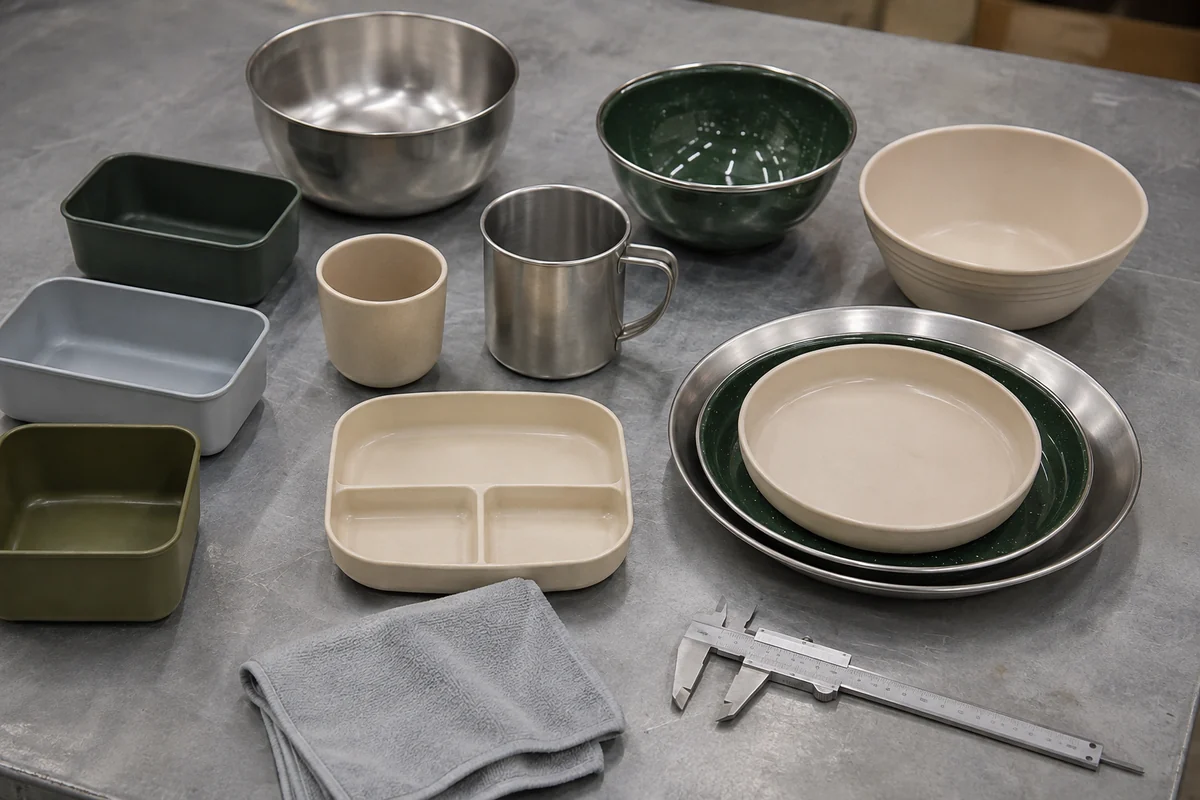
Begin with a controlled sample identity. Record product code, revision, material declaration, color, finish, decoration, component list and manufacturing lot where available. Photograph the sample under consistent lighting and record relevant dimensions and functions before washing.
Define the machine and program. Include rack location, orientation, detergent, rinse aid if used, water conditions, cycle stages and drying. If the intended channel includes compact RV machines and commercial hospitality machines, do not assume one test covers both; define the priority environment or evaluate each separately.
Choose a cycle count that supports the intended claim and service expectation. This article does not prescribe a universal number because the appropriate protocol depends on the claim, product and technical advice. Inspect at planned intervals so the record shows when a change begins rather than only the final condition.
Write acceptance criteria before testing. Examples can include no visible cracking, no unsafe edge, dimensional change within an agreed tolerance, maintained base stability, acceptable decoration retention and continued lid or nesting function. The criteria must be project-specific and measurable; do not copy unverified limits from another product.
After the final cycle, allow the article to cool and dry under a defined condition before inspection. Some distortion or odor observations can change as the item cools. Retain representative tested samples, raw records and photographs with the specification file.
Loading and handling can change the result
A product can move, invert or contact a heating zone when loaded incorrectly. Use racks or baskets that keep small utensils and lids controlled without creating unrealistic protection. Photographs of the approved loading arrangement help factories, laboratories and buyers repeat the same method.
Nested pieces should normally be separated during evaluation so wash water reaches food-contact surfaces. If the consumer instructions allow nested washing, that condition should be assessed deliberately. Trapped water, detergent residue and incomplete drying are practical issues even when the material itself remains intact.
For decorated products, avoid placing the logo against abrasive rack contacts unless that reflects foreseeable use. Then inspect the contact points. A durable claim should not depend on a carefully protected orientation that consumers will not understand.
Domestic, compact and commercial dishwashers are not interchangeable
Household machines, countertop units and commercial equipment can use different cycles, temperatures, detergents and drying approaches. Outdoor hospitality operators may prioritize rapid sanitation and repeated daily washing, while an RV owner may use a compact machine with limited rack space. Define the actual channel before approving instructions.
A retail claim such as “dishwasher safe” may be interpreted broadly unless limitations are visible. If evidence supports only the top rack or a specified cycle, state that clearly on the product and packaging. Do not hide essential conditions in a supplier email that the consumer never sees.
Rental fleets and camps also need an inspection policy. Staff should know when to remove an item with chips, cracks, rough edges, deformation, loose decoration or compromised closures. A cleaning claim does not eliminate routine condition checks.
Common failure modes after repeated machine washing
Dimensional change can make a plate rock, a lid lose fit or a nested set jam. Surface changes can include dulling, roughness, staining, whitening, print loss or coating damage. Metal items may show discoloration or corrosion at vulnerable areas, while multi-part products may loosen at interfaces.
Odor and residue deserve a controlled review. Confirm whether the observation remains after rinsing, drying and cooling, and compare with an unwashed control. Do not label every smell as material migration, but do not dismiss a repeatable change without investigation.
Some failures are packaging or user-information failures rather than material failures. If a detachable seal must be removed or a cup must be top-rack only, the instructions need to make that clear. The safest product is not only technically capable; it is also described in a way the user can follow.
Applicable outdoor and B2B scenarios
RV and caravan collections
Dishwasher compatibility can be attractive where compact machines are installed, but cabinet fit, drainage and rack dimensions matter. Buyers should evaluate the actual appliance type and confirm that plates and bowls remain stable. The related Camping Dinnerware Sets category helps define component combinations before testing.
Glamping and outdoor hospitality
Operators may wash tableware many times per week and care about finish retention, stack abrasion and quick inspection. A decorative metal bowl may require separate review from an undecorated service piece. Define the cleaning system and appearance standard in the procurement brief.
Family camping and home crossover
Consumers may expect the set to move between campsite and home dishwasher. Instructions should cover rack position and excluded components. Color-coded pieces can simplify family allocation, but each color and decoration should be within the evidence scope.
Camps, schools and rental fleets
These programs value repeatable sanitation, counting and replacement. Select shapes that drain well and are easy to inspect. Maintain component codes so damaged pieces can be replaced without discarding a complete set.
Limitations and risks buyers should state clearly
Do not market dinnerware as cookware. A dishwasher claim does not mean the product is suitable for a stove, burner, campfire, grill or direct flame. Direct-heat suitability requires separate product-specific evidence, and many reusable plates, bowls and cups are not designed for it.
Do not assume that all pieces in a set share the same washing instructions. A plate, silicone seal, printed cup, metal utensil and fabric pouch can require different care. The consumer instructions should identify exceptions and removable components.
A passed reference sample does not control production by itself. Lock the material, color, finish, decoration and relevant process conditions, then confirm how changes will be reviewed. Incoming or pre-shipment checks should compare production with the approved article and documentation.
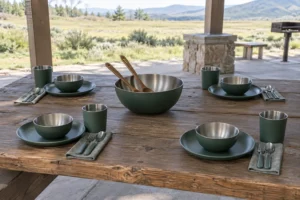
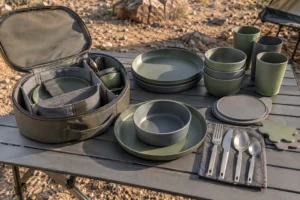
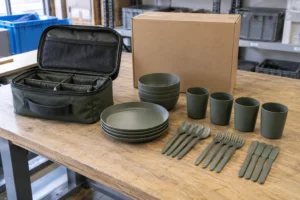
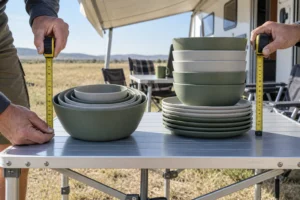
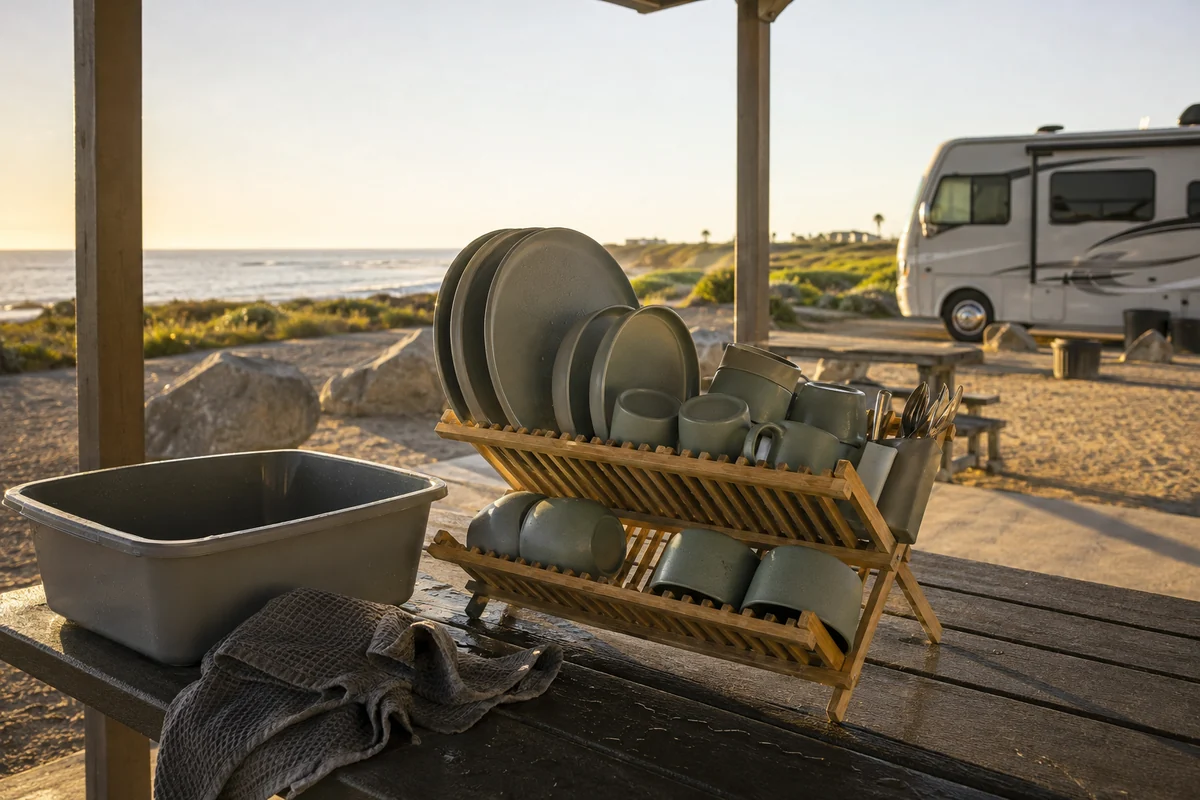
Generated images in this article are scenario illustrations only. They do not prove that any depicted configuration is a current Naike Dinner SKU or has passed a dishwasher test. Product claims must come from verified records and samples.
Procurement workflow for dishwasher-safe camping tableware
First, define the market, user, machine environment and claim wording. Second, identify the exact component list and materials. Third, request declarations, use instructions and any existing finished-item evidence. Fourth, close gaps through an agreed evaluation before artwork approval.
Review the complete decorated sample, not only an undecorated base part. Confirm that the logo, coating, pigment and assembly are represented. Keep the claim conditional until evidence is reviewed and the sample meets agreed criteria.
Include care instructions in packaging approval. If the claim is top-rack only, excludes heated drying or requires separation of components, make that instruction visible. Translation and symbol use should be reviewed for the destination market.
Naike Dinner can review verified molded-tableware projects within its confirmed scope and can help buyers organize a specification request. Neutral discussion of metal, enamel, silicone or copolyester options is educational and does not state that every material or process is supplied. Use the Testing & Certifications page to structure document questions, then request a project review.
B2B Buyer Checklist
| Check | Question | Why It Matters |
|---|---|---|
| Article identity | Does evidence match material, color, finish, decoration and revision? | Prevents transferring a claim from a different item |
| Machine environment | Which machine type, rack and program are intended? | Controls heat, chemistry and mechanical exposure |
| Protocol | Are detergent, cycle stages and inspections documented? | Makes the evaluation repeatable |
| Acceptance criteria | What dimensional, functional and visual changes are allowed? | Avoids subjective pass decisions |
| Food-contact scope | Do declarations and reports cover intended conditions of use? | Dishwashing and food-contact claims require aligned evidence |
| Complete set | Do every component and accessory have correct care instructions? | One incompatible part can undermine the set claim |
| Artwork | Are limitations visible in destination-market language? | Supports accurate consumer use |
| Change control | How will formulation, finish or process changes be reviewed? | Preserves the basis of the approved claim |
Send the checklist with drawings, intended claim and target channel when requesting samples. For a configuration-specific review, contact Naike Dinner with the component matrix rather than asking whether an entire material family is dishwasher safe.
How to write care instructions that buyers can defend
Care language should reflect the narrowest verified condition across the complete consumer set. If the plate is approved for a defined machine cycle but the printed cup, detachable seal or storage accessory is not, list the exception beside the component rather than applying one symbol to the whole pack. Keep the wording consistent across the product, retail box, instruction insert, website and distributor data.
Avoid absolute language such as “safe in every dishwasher” unless the evidence truly supports that scope, which is uncommon because machines and detergents vary. Prefer precise directions such as an identified rack position, separation requirement or excluded drying stage when those conditions are part of the reviewed protocol. Marketing teams should not shorten a qualified statement into an unqualified badge.
Version control matters after launch. Store the approved artwork with the product revision, test record and golden sample, then require review when the material, pigment, coating, logo method, supplier or geometry changes. A small visual update can affect the tested construction or consumer behavior, so the change process should ask whether new evidence or revised care language is necessary.
Customer-service feedback can provide an early warning but does not replace controlled evaluation. Track recurring reports of warpage, finish loss, odor, trapped water or fit problems by product revision and use condition. Investigate patterns with retained samples and production records before changing claims, and communicate any corrective instruction through the same channels used for the original product information.
Buyer FAQs
1. Is all polypropylene camping dinnerware dishwasher safe?
No. Polypropylene describes part of the material system, not the full article and cycle scope. Verify the finished plate, bowl or cup, including color, fillers, geometry and decoration, under the supplier’s documented conditions.
2. Is stainless-steel camping dinnerware always safe for commercial dishwashers?
No universal claim should be made. Grade, finish, coating, joins, detergent and commercial cycle conditions matter. Request instructions and evidence for the exact item and inspect finish and interfaces after the agreed protocol.
3. Does “top-rack dishwasher safe” cover the lower rack?
No. A top-rack limitation is part of the claim. Do not broaden it without evidence covering the lower rack and intended drying conditions.
4. Can printed logos be evaluated separately from the plate?
The decoration should be reviewed on the finished article because adhesion, abrasion, detergent exposure and food-contact position depend on the actual surface and process. Approve the decorated sample and claim together.
5. How many dishwasher cycles are enough?
There is no number supplied by this article. Select a cycle count and protocol appropriate to the product, claim, market and expected service, with qualified technical input and written acceptance criteria.
6. Can a fabric pouch or insulated bag go in the dishwasher with the set?
Do not assume so. Accessories need their own care instructions and may require hand cleaning. The complete consumer pack should identify each exception clearly.
7. Does dishwasher suitability mean microwave or direct-flame suitability?
No. These are separate use conditions. Never place dinnerware on a burner, campfire or stove unless the exact product is verified and instructed for direct heat.
8. What should a buyer send for a documented quotation?
Provide target market, product drawings or reference samples, material direction, component list, decoration, intended dishwasher statement, machine environment, packaging and required evidence. Unknown commercial and performance values should remain subject to project confirmation.
Review Your Dishwasher Claim Before Quotation
Share the exact tableware configuration, target market, material and decoration, intended machine conditions and evidence expectations. Naike Dinner will separate verified scope from open testing and sourcing questions before a quotation or sample plan is documented.