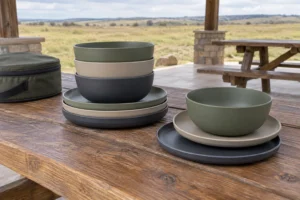
PP is usually the practical choice for lightweight, opaque, value-led camping cups, while Tritan is better when buyers need glass-like clarity, a premium feel, and strong visual merchandising. Neither material is automatically suitable for every drink, cleaning cycle, or market. The correct decision depends on the exact resin grade, finished-cup design, intended temperature, reuse pattern, and product-specific food-contact evidence.
This comparison is written for outdoor brands, importers, distributors, retailers, promotional buyers, campsite operators, and private-label teams selecting reusable camping drinkware. It covers drinking cups and tumblers rather than cookware. Neither material should be placed on a stove, burner, grill, or campfire, and no direct-flame claim is implied.
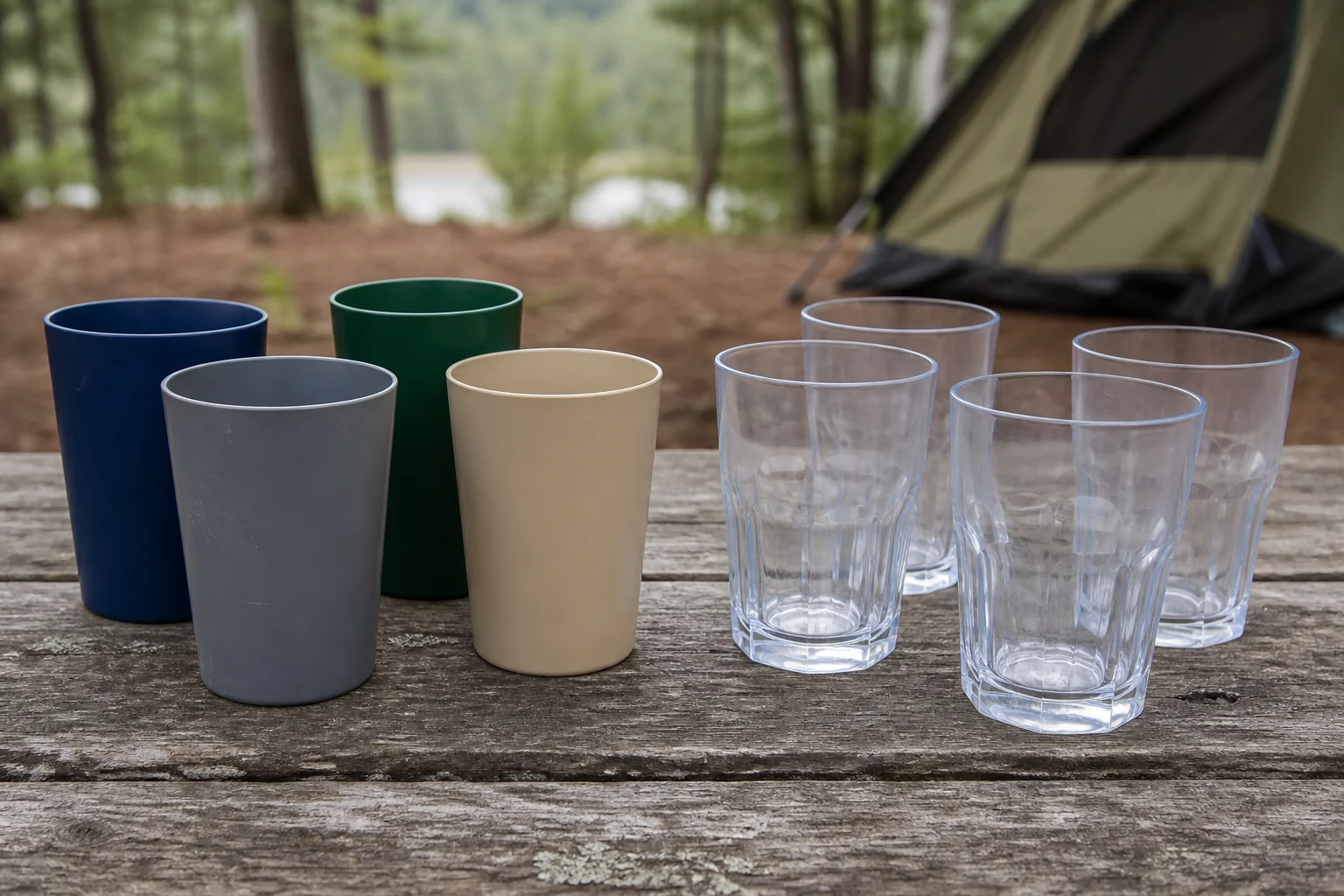
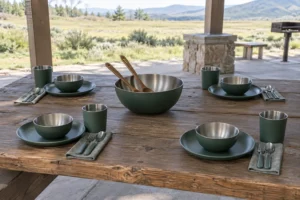
Application illustration: the image supports material-family discussion and does not represent an exact Naike Dinner SKU, production order, test result, or verified commercial configuration.
PP vs Tritan Camping Cups: The Short Procurement Answer
Polypropylene, commonly abbreviated PP, is a semicrystalline thermoplastic widely used for molded food-contact articles when the selected formulation and conditions of use are appropriate. In camping drinkware it is commonly associated with opaque or translucent colors, low part weight, nesting, and cost-sensitive multi-piece programs. The finished feel can range from flexible and utilitarian to relatively rigid depending on wall geometry, grade, fillers, colorants, and molding decisions.
Tritan is an Eastman trademark used for a family of copolyester materials rather than a generic name for every clear plastic. Buyers should therefore identify the exact commercial resin grade instead of accepting “Tritan-like,” “copolyester,” or “clear plastic” as interchangeable descriptions. Clear appearance, gloss, rigidity, and premium presentation are useful sourcing signals, but they are not substitutes for material identification or finished-article evidence.
The choice is not simply cheap versus premium. A lightweight PP cup may be the better product for school camps, rental fleets, family sets, promotional programs, and color-coded group systems. A clear copolyester cup may make more sense for outdoor retail, RV assortments, gift sets, drink visibility, or a design language intended to resemble indoor glassware without using glass.
| Decision factor | PP camping cup | Tritan camping cup | What the buyer must verify |
|---|---|---|---|
| Appearance | Usually opaque or translucent; broad molded-color potential | Often selected for high clarity and gloss | Approved color chip and physical cup under target lighting |
| Weight strategy | Often supports lightweight, multi-piece set planning | May use a more rigid, substantial design language | Finished mass, wall map, dimensions, and nesting count |
| Merchandising | Useful for color-coded families, camps, and value assortments | Useful for clear premium drinkware and gift-led presentation | Channel, shelf story, photography, scratch visibility, and pack protection |
| Impact behavior | Can flex or deform depending on grade and geometry | Can provide high toughness in suitable grades and designs | Product-specific drop method, conditioning, acceptance limit, and sample identity |
| Heat and cleaning | Depends on grade, design, load, exposure time, and cycle | Depends on exact grade, design, chemical exposure, and cycle | Claim-specific testing under intended use; never rely on resin name alone |
| Evidence control | Confirm PP formulation, additives, colorants, and intended conditions | Confirm genuine resin identity, grade, color, and intended conditions | Representative declarations, reports, drawings, and controlled samples |
Start with Regulatory Scope, Not a Marketing Label
Food-contact compliance is tied to substances, formulations, articles, and conditions of use. In the United States, buyers can review the official FDA inventory of food-contact substances listed in 21 CFR and the applicable authorization pathway. For polypropylene, the official Government Publishing Office text of 21 CFR 177.1520 describes specified olefin polymers and limitations, but a citation to that section is not a blanket approval of every colored, decorated, or assembled finished cup.
For European Union programs, the consolidated Commission Regulation (EU) No 10/2011 establishes rules for plastic materials and articles intended to contact food. The buyer still needs to connect the selected formulation and finished article to its intended foods, time, temperature, repeated-use pattern, and other relevant restrictions. A report for a different resin, color, wall thickness, decoration, or manufacturing site may not represent the planned commercial cup.
“BPA-free” is also not a complete procurement specification. A claim about one substance does not identify the polymer, establish every applicable restriction, or demonstrate finished-article performance. Buyers should ask what material is actually supplied, how identity is controlled, what colorants and additives are within scope, which sample was assessed, and which conditions the evidence covers.
For a Tritan proposal, specify the exact branded grade and request traceability that links the commercial resin to the molded article. For PP, specify the grade or controlled material definition and the permitted color system. In both cases, confirm whether regrind, recycled content, change of resin supplier, or formulation substitutions are permitted; those decisions can affect both consistency and evidence representativeness.
How Material Structure Changes the Buyer Experience
PP and copolyester do not create the same visual or tactile product. PP is often used where low weight, color, nesting, and utility matter more than transparency. The surface can conceal some scratches or mineral spotting better than a clear vessel, although dark molded colors may reveal scuffs and dust. A thin PP wall may feel economical or flexible; a more carefully supported wall and rim can feel substantially more controlled.
Clear copolyester makes the beverage visible and can create a more glass-like presentation. That clarity can also reveal fingerprints, water spots, internal molding marks, and abrasion more readily. Retail buyers should evaluate cups under store lighting and after realistic washing, stacking, packing, and handling rather than approving only a pristine first-shot sample.
Rigidity is not an absolute quality ranking. A rigid cup may feel premium but transfer local stress to a rim, base, or decoration interface if geometry is poorly resolved. A more flexible cup may tolerate some handling but feel unstable when filled, especially if the base is narrow or the wall is too thin. Finished geometry, not resin reputation, determines whether the product feels secure in a gloved hand or on an uneven picnic table.
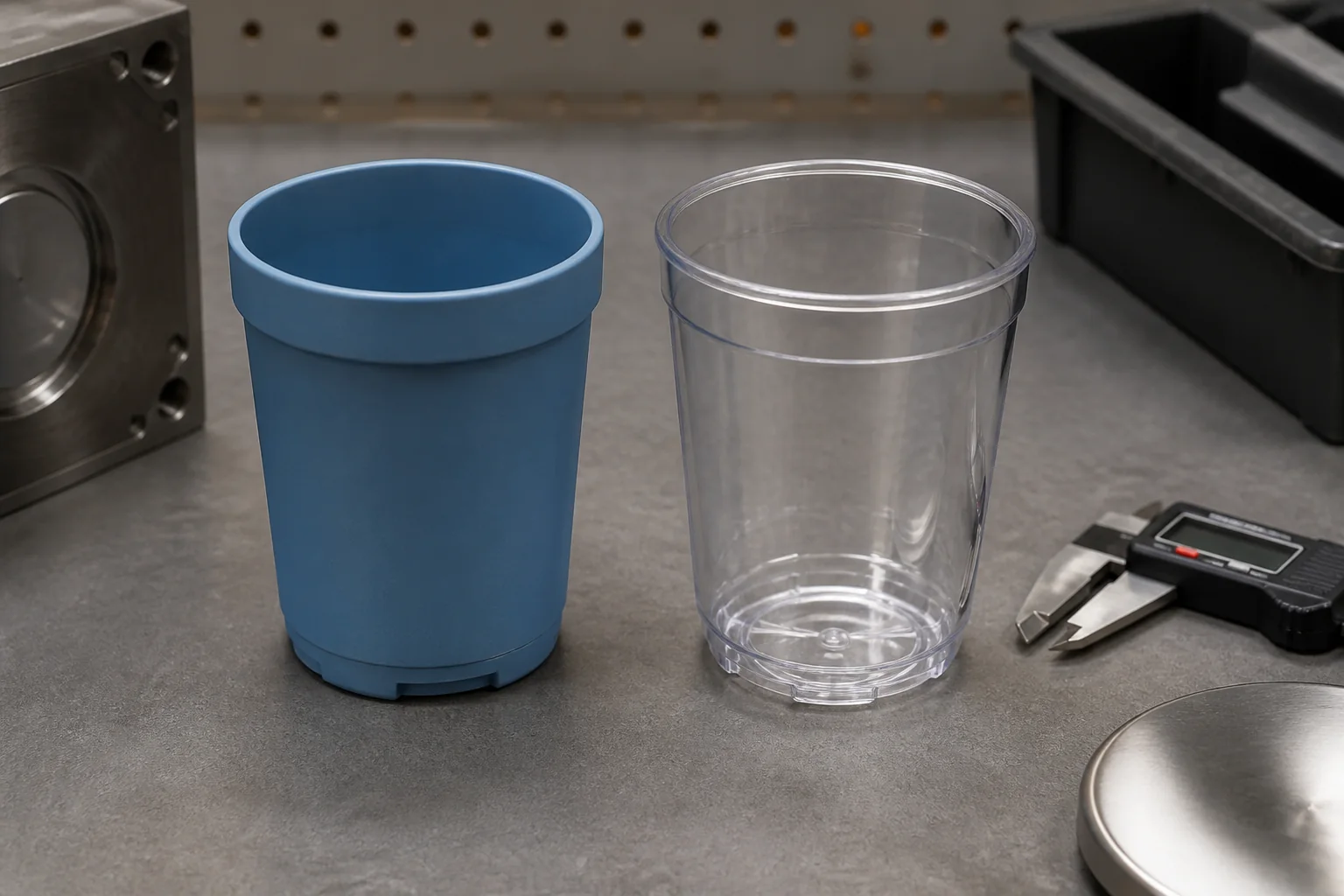
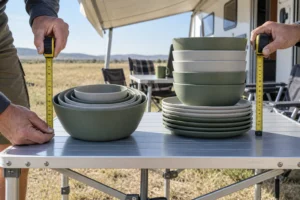
Application illustration: this is a generic sample-review scene. It is not a Naike Dinner factory, laboratory, measurement record, or evidence that a depicted cup passed any test.
Rim, base, and grip deserve separate approval
The rim controls drinking comfort and is one of the first places users notice flash, mismatch, excessive thickness, or sharp transitions. The base controls stability and drainage behavior after washing. Sidewall texture, taper, and diameter affect grip, especially for children, wet hands, gloves, or users drinking in cold weather.
Ask suppliers to define critical dimensions and visual limits on a controlled drawing or specification. A nominal capacity alone cannot describe usable fill level, external size, nesting behavior, cup-holder fit, or the clearance needed for a lid. If the project uses lids, straws, silicone sleeves, or storage racks, control the complete interface rather than approving the cup alone.
Weight, Nesting, and Pack Efficiency
Outdoor programs often compare individual cup weight, but shipping and field convenience depend on the complete system. A very light cup that does not nest efficiently may consume more carton volume than a slightly heavier design. A tall stack may lock, scratch, or become difficult to separate if taper and rim spacing are not managed.
Request a physical nested stack containing the intended retail quantity. Measure packed height, removal force, rim contact, abrasion points, and movement inside the retail package. Repeat the review after washing and after the cups have experienced normal temperature and humidity changes relevant to storage and transport.
PP is often attractive when a six-person or family set requires many cups without excessive mass. Tritan may be justified where the cup is a hero item, the package needs a premium clear presentation, or the assortment uses fewer pieces at a higher perceived value. The correct commercial comparison should include cup mass, pack volume, protective materials, damage risk, replacement policy, and expected selling channel—not resin price alone.
Cleaning, Odor, Stain, and Surface Appearance
Camping cups encounter water, coffee, tea, juice, powdered drinks, dairy residues, detergents, sunscreen transfer, and storage in closed boxes. A buyer should define the target substances, contact time, wash method, drying method, and number of reuse cycles. Generic statements such as “odor-free,” “stain-proof,” or “dishwasher safe” are too broad unless the test method and acceptance criteria are linked to the exact article.
PP’s lower-surface-energy behavior and molded texture may influence how oils, pigments, labels, or printed decorations interact, but results vary by formulation and surface treatment. Clear copolyester can make residual film or spotting visually obvious even when the cup is otherwise functional. A realistic review should include appearance before and after washing, odor after closed storage, and any interaction between nesting surfaces.
Do not infer hot-drink suitability from the fact that a cup survives warm wash water. Service temperature, fill volume, duration, wall deformation, grip comfort, and migration conditions are distinct questions. If the program includes hot beverages, state the maximum intended fill temperature and holding time, then request product-specific evidence and a user-handling assessment.
Which Material Fits Each Outdoor Sales Scenario?
Family car camping
PP can support coordinated colors, larger piece counts, and lightweight packing. Tritan can work for buyers prioritizing clear drink presentation and an indoor-to-outdoor look. Evaluate stack height, vehicle cup holders, washing access, and replacement needs.
RV and caravan retail
Clear tumblers may fit premium RV dining assortments, but rattling, abrasion, cabinet storage, and wash cycles must be reviewed. PP may suit color-led value sets or space-efficient nested programs.
Scout, camp, and rental fleets
Color coding, low weight, simple replacement, and easy inventory can favor PP. Buyers should prioritize controlled piece identity, stable stacking, visible wear criteria, and a repeatable replenishment plan.
Outdoor gifting and branded programs
Tritan may offer a premium clear canvas, while PP may enable coordinated molded color. Decoration feasibility must be confirmed on the selected surface, with adhesion, abrasion, wash, artwork, and claim reviews.
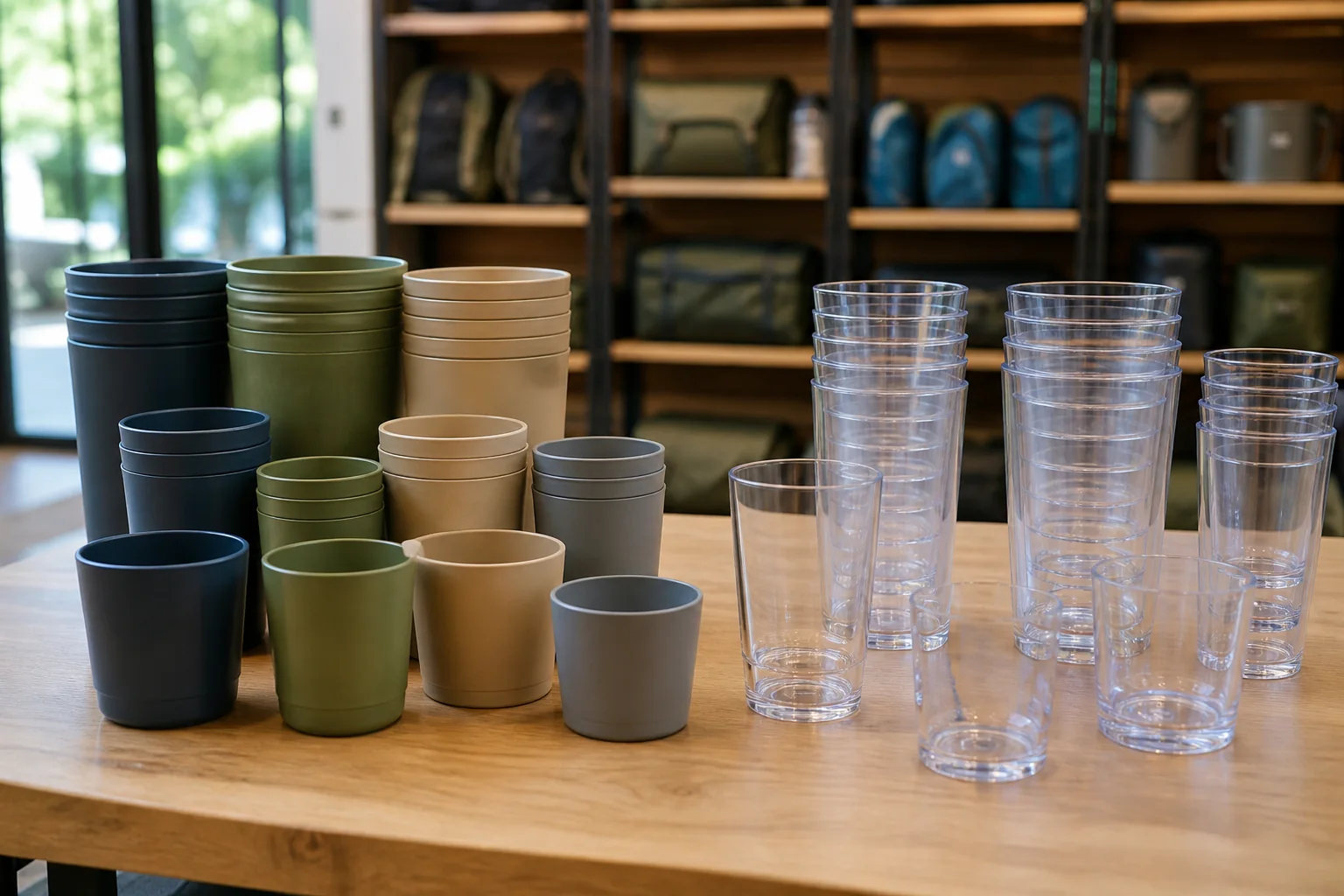
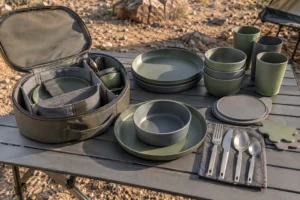
Application illustration: cup colors, sizes, stacking, and assortment are generic planning aids, not confirmed production options or commercial availability.
Limitations and Risks Buyers Should Put in Writing
The first risk is ambiguous material language. “Tritan-style” does not confirm Tritan, and “PP plastic” does not define a controlled formulation. Require purchase documents, specifications, incoming controls, and change-notification rules that match the level of identity the retail claim needs.
The second risk is copying performance claims across cup designs. A result for one wall thickness, capacity, pigment, or geometry may not support another. Dishwasher, impact, hot-fill, freezer, chemical, and stain performance should be evaluated against the planned finished article and the intended claim.
The third risk is approving appearance without use simulation. Clear cups can reveal scratching and spotting; opaque cups can show scuffs, stress whitening, distortion, or color inconsistency. Review packed, washed, nested, and handled samples under realistic lighting, not only a single untouched sample on a white background.
The fourth risk is treating dinnerware as cookware. These cups are not for a burner, open flame, grill, or campfire. If a seller wants microwave, boiling-water, or other elevated-temperature language, that request must be isolated, validated, and written for the specific product rather than assumed from material family.
The fifth risk is uncontrolled decoration. Ink, transfer, label, or coating choices can change appearance, recyclability communications, cleanability, and compliance scope. Place decorations away from food-contact or mouth-contact zones unless the selected system and intended use are properly assessed.
B2B Buyer Checklist for PP vs Tritan Camping Cups
| Check | Question | Why It Matters |
|---|---|---|
| Material identity | Is the exact PP formulation or branded copolyester grade controlled? | Prevents substitution and supports evidence traceability. |
| Market and use | Which foods, temperatures, contact times, wash cycles, and countries apply? | Defines the conditions the article and documents must cover. |
| Finished geometry | Are capacity, usable fill, rim, base, wall, taper, and nesting dimensions controlled? | Connects material choice to real handling and packing performance. |
| Appearance sample | Has color, clarity, gloss, scratch visibility, and decoration been approved physically? | Reduces disputes created by screens and verbal color descriptions. |
| Performance claims | Does every wash, impact, heat, stain, or odor claim identify a method and acceptance limit? | Stops generic resin claims from replacing product evidence. |
| Evidence match | Do reports identify the representative material, color, article, site, and intended conditions? | Keeps compliance files connected to the commercial product. |
| Change control | Must the supplier notify the buyer before changing resin, pigment, additive, site, or process? | Protects consistency after sample approval. |
| Packaging | Does the pack prevent abrasion, nesting lock, deformation, and incomplete piece counts? | Preserves the approved cup through shipment and retail handling. |
A Step-by-Step Sample Approval Plan
1. Write the use brief before requesting samples
State the target buyer, country, drink types, minimum and maximum use temperature, expected contact time, wash method, reuse frequency, storage conditions, and sales channel. Include whether the cups must nest, fit a vehicle holder, accept a lid, or coordinate with an existing dinnerware set.
2. Request identified reference samples
Ask for samples linked to the proposed resin, color, mold, and manufacturing route. Mark any sample that is only a visual proxy. Do not approve a transparent cup as genuine Tritan or an opaque cup as the final PP formulation without documentary and supply-chain confirmation.
3. Compare the complete buyer experience
Fill, grip, drink, empty, wash, dry, nest, pack, carry, and store the cups under representative conditions. Observe rim comfort, base stability, wall deflection, scratching, spotting, odor, decoration, and removal from a nested stack. Record the sample identity and deviations.
4. Lock evidence and claims to the approved article
Review the intended food-contact evidence and any claim-specific performance data. Confirm that the scope represents the selected material, color, geometry, and use. Finalize care instructions and retail language only after this connection is clear.
5. Control production and shipment
Define critical dimensions, component count, appearance limits, packaging sequence, sampling plan, and change-notification requirements. Keep an approved reference sample or equivalent controlled record available to the buyer and supplier.
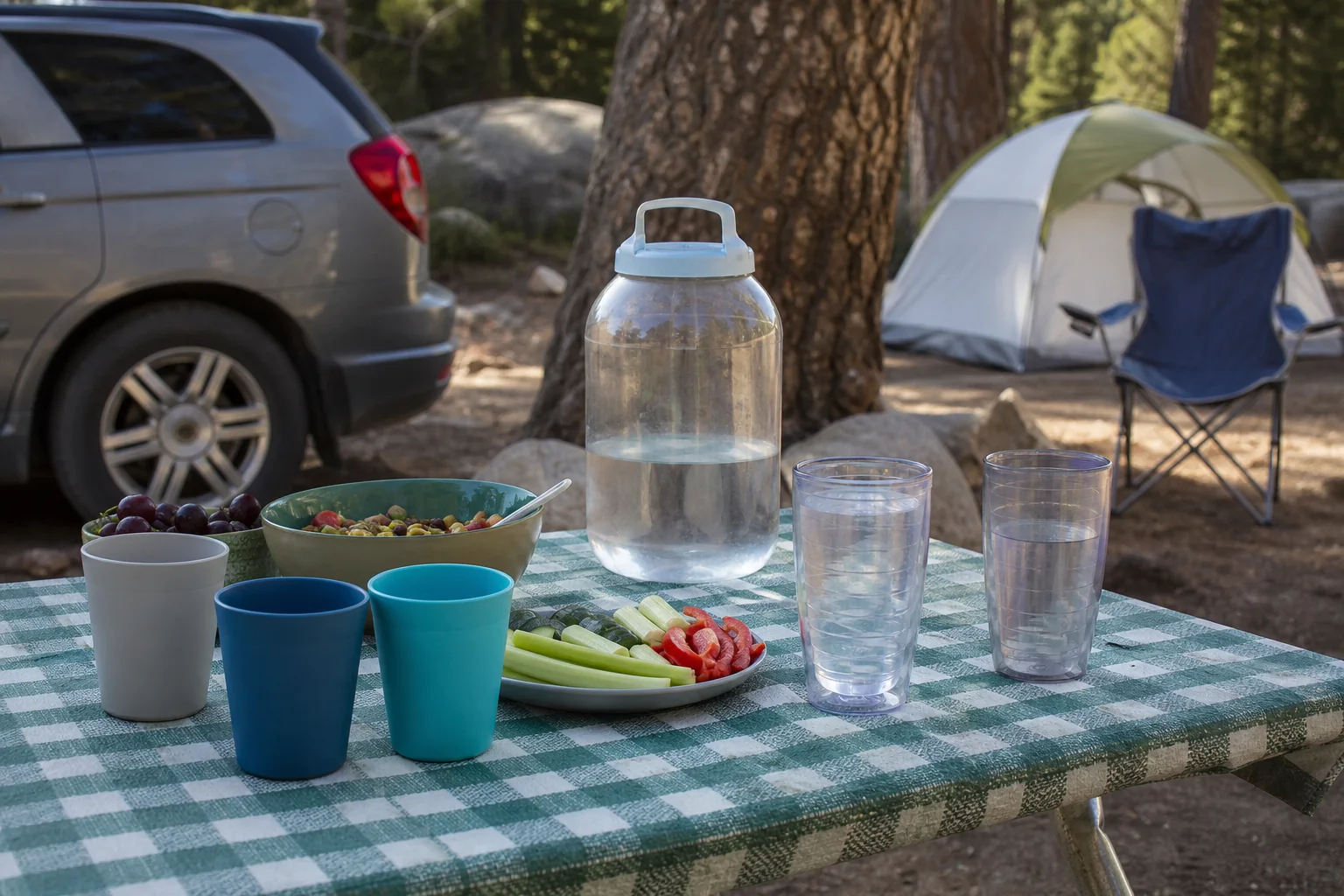
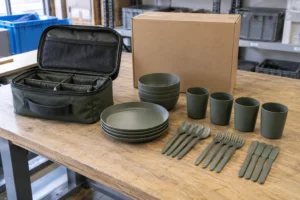
Application illustration: this scene shows a plausible use context only. It does not establish material identity, temperature capability, test performance, or product availability.
Need a material-neutral cup brief?
Send your destination market, user group, cup capacity, appearance target, drinks, cleaning method, nesting requirement, packaging, and claims. Request a specification review
Build the Quotation Around Decisions That Change the Cup
A useful request for quotation separates fixed requirements from preferences. Fixed requirements may include destination market, usable capacity, overall envelope, food-contact conditions, prohibited substitutions, lid interface, required pack count, and the evidence needed before shipment. Preferences may include a color family, surface finish, degree of clarity, decoration position, or retail presentation that can be adjusted after feasibility review.
Ask the supplier to list every assumption in the quotation. If the proposed PP cup uses an existing mold, record its actual dimensions, mass, nesting pitch, and available color process rather than copying a buyer concept drawing into the offer. If the clear cup is proposed in a branded copolyester, identify the grade and whether the quoted article, sample, and supporting evidence all use that grade. Open assumptions should remain marked “to be confirmed” instead of being converted into promises.
Packaging deserves its own line of technical questions. Clear cups may require additional separation or surface protection when shelf appearance is important; PP cups may need controls that prevent distortion, mixed colors, or incomplete set counts. For both materials, test the real retail pack for stack movement, abrasion, carton compression, moisture exposure, barcode placement, multilingual instructions, and efficient repacking by the consumer.
Do not ask for a universal MOQ or price before the specification is stable. Mold status, resin requirement, color count, decoration, packaging, testing, order mix, and shipment plan can all change the commercial structure. A documented quotation should identify inclusions, exclusions, sample stages, evidence responsibilities, artwork responsibility, change points, and the validity of the offered configuration.
Finally, align the approval record with incoming and pre-shipment inspection. The buyer should be able to trace the production lot to the approved material definition, color, drawing, artwork, packaging, and representative evidence. A beautiful sample cannot protect the project if the production order permits uncontrolled resin or pigment changes. Conversely, a strong document set cannot rescue a cup whose rim, stability, nesting, or cleaning experience was never reviewed by real users.
Buyer FAQ: PP vs Tritan Camping Cups
Is Tritan always better than PP for a camping cup?
No. Tritan can support clarity and premium positioning, while PP can support lightweight, colored, value-led, and multi-piece programs. The better choice depends on the intended user, channel, geometry, cleaning, temperature, pack, replacement plan, evidence, and target price architecture.
Are PP camping cups safe for hot drinks?
Do not answer from “PP” alone. Define the exact formulation, cup design, beverage temperature, fill volume, contact time, grip requirement, and destination rules. Request product-specific evidence and user testing before publishing a hot-drink claim.
Does a clear camping cup prove it is Tritan?
No. Many materials can appear clear. Require the exact branded grade or controlled copolyester identity, purchasing traceability, manufacturing controls, and evidence that represents the finished article. Do not use the Tritan trademark for an unidentified clear polymer.
Which material is easier to nest?
Nesting is primarily a geometry and tolerance question. PP is often used for lightweight nesting sets, but both material families require suitable taper, rim spacing, wall control, and surface contact. Approve a full commercial stack rather than two isolated cups.
Which cup is better for outdoor retail photography?
Clear copolyester can communicate beverage visibility and a premium look, while colored PP can support recognizable assortment blocks and family-set coordination. Photograph real approved samples because gloss, transparency, color, scratches, and wall thickness can look different from renderings.
Can buyers request custom colors and logos?
Potential options must be confirmed for the selected material, surface, geometry, artwork, and market. Approve a physical color and decorated sample, check adhesion and wear under intended washing, and review whether decoration changes the compliance or mouth-contact scope.
What should a quotation request include?
Include the cup type, material direction, exact grade requirement if any, capacity, dimensions, quantity structure, colors, decoration, packaging, destination, evidence expectations, test claims, sample plan, and launch timing. MOQ and price should be quoted against that controlled project rather than assumed from a generic page.
Choose the cup by project evidence, not by material reputation
A useful sourcing decision connects material identity, finished geometry, use conditions, visual approval, packaging, and market evidence. Explore Naike Dinner’s reusable plastic camping dinnerware guidance, compare the broader camping dinnerware set direction, or review outdoor tableware options. For a documented PP or clear-copolyester cup project, request a sample and specification review.
Request a cup project reviewView a PP set sourcing example